

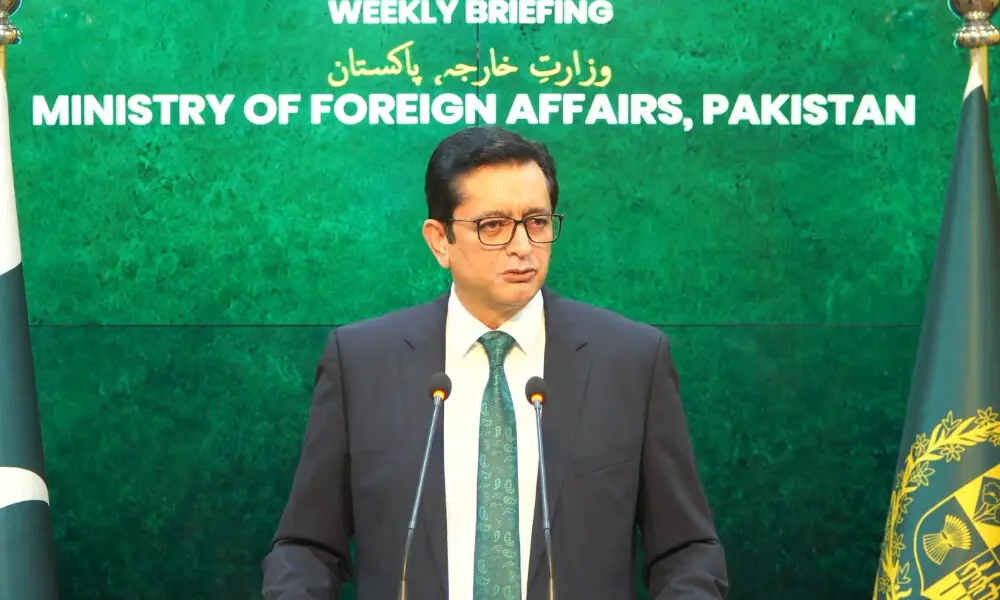
ISLAMABAD: Pakistan has strongly rejected remarks made by India at the United Nations, describing them as baseless and an unacceptable interference in its internal affairs, while renewing allegations that New Delhi supports militant activities in Balochistan and Khyber Pakhtunkhwa.
In a statement issued on Friday, November 20, 2026, Foreign Office spokesperson Sajjad Haider Khan criticised India’s comments and said Pakistan’s representative had responded to the allegations during the same UN meeting.
The spokesperson maintained that the Indian statements were inconsistent with the principles of sovereignty and non-interference enshrined in the United Nations Charter.
Pakistan also accused India of attempting to divert attention from disputes involving shared water resources, regional security and the implementation of international agreements.
The statement reflected continuing diplomatic tensions between the two South Asian neighbours over security, water-sharing arrangements and Jammu and Kashmir.
Pakistan Rejects India’s Statements at United Nations
The Foreign Office said India’s remarks were unfounded and did not warrant further consideration.
According to the spokesperson, Pakistan’s representative had already challenged the accusations during the UN proceedings.
Islamabad argued that comments directed at Pakistan’s institutions and leadership constituted interference in matters falling within its domestic jurisdiction.
The statement further alleged that India was attempting to distract attention from concerns Pakistan has raised regarding the management of shared river waters.
Pakistan characterised India’s actions involving water resources as a form of coercion, using the term hydro-terrorism to describe its concerns.
That characterisation represents Pakistan’s position and is not an independently established legal finding.
The Foreign Office called on India to address the substantive issues raised by Islamabad rather than engage in what it described as unsupported accusations.
Islamabad Repeats Allegations of Cross-Border Terrorism
The statement also renewed Pakistan’s allegations that India has supported terrorist activities in Balochistan and Khyber Pakhtunkhwa.
According to the Foreign Office, such activities are intended to undermine security, disrupt economic development and prevent local communities from benefiting from Pakistan’s natural resources.
Islamabad maintained that it had previously presented evidence supporting its concerns about alleged Indian involvement in militancy.
The statement specifically linked the allegations to instability in areas with significant mineral and natural resource potential.
Pakistan argued that security challenges in these regions could undermine investment and development projects.
However, the statement did not provide new publicly verifiable evidence establishing Indian state involvement in the alleged activities.
India has historically rejected Pakistan’s accusations of sponsoring terrorism.
The allegations therefore remain disputed and should be distinguished from independently established findings.
Pakistan Raises Concerns Over Mineral Resource Development
The Foreign Office also accused India of opposing Pakistan’s efforts to develop its mineral resources.
Islamabad suggested that regional instability and security threats could interfere with projects intended to attract investment and generate economic opportunities.
The statement presented mineral development as an important component of Pakistan’s economic strategy.
Balochistan, in particular, contains substantial mineral resources and has attracted interest in mining and infrastructure investment.
Pakistan has sought to expand resource exploration and encourage participation by domestic and international companies.
The Foreign Office argued that stability in resource-rich areas was necessary to ensure local populations benefited from development.
Its allegations regarding Indian interference were not accompanied by specific new evidence in the supplied statement.
Indus Waters Treaty Becomes Central to Dispute
The Foreign Office devoted significant attention to the Indus Waters Treaty, which governs water-sharing arrangements between Pakistan and India.
Islamabad criticised India’s unilateral decision to place the treaty in abeyance, arguing that such action was inconsistent with international legal obligations.
Pakistan maintained that the treaty remained binding and could not be suspended or terminated unilaterally.
The statement referred to an August 31, 2026, ruling by a Court of Arbitration constituted under the treaty.
According to the Foreign Office, the court unanimously determined that the agreement remained in force and that there was no legal basis for its unilateral suspension or termination.
Pakistan said India’s refusal to accept the ruling raised concerns about compliance with international agreements.
The dispute has become an important issue in bilateral relations because the Indus river system is essential to agriculture, water supplies and economic activity in Pakistan.
The treaty, signed in 1960 with World Bank involvement, established arrangements for allocating the use of rivers within the Indus basin.
Disagreements over treaty interpretation and water infrastructure have periodically generated diplomatic and legal disputes.
Pakistan’s latest statement reaffirmed its position that the treaty’s obligations continue to apply despite India’s unilateral announcement.
India’s legal position and its response to the specific ruling were not included in the supplied Foreign Office statement.
Kashmir Dispute Raised at UN
The Foreign Office also called on India to implement relevant United Nations Security Council resolutions concerning Jammu and Kashmir.
Pakistan reiterated its longstanding position that the people of Jammu and Kashmir should be allowed to exercise their right to self-determination.
Islamabad accused Indian security forces of committing human rights violations in the territory.
India rejects Pakistan’s characterisation of Jammu and Kashmir as occupied territory and maintains that the region is an integral part of India.
The two countries have disputed the territory since their independence in 1947.
The Kashmir issue remains one of the most persistent sources of tension between Islamabad and New Delhi.
Pakistan has repeatedly raised the dispute at international forums, while India has generally maintained that outstanding bilateral matters should be addressed through direct engagement.
The latest exchange at the United Nations demonstrated that the two governments continue to hold sharply different positions on the issue.
Foreign Office Criticises India’s Domestic Policies
The statement also criticised India’s domestic political environment and alleged discrimination against religious and social minorities.
The Foreign Office raised concerns about the treatment of Muslims, Sikhs, Christians and Dalits, presenting these issues as part of its broader criticism of Indian government policies.
It also accused India of spreading disinformation and using hostile rhetoric against Pakistan.
These were allegations and political assessments made by the Pakistani government, rather than findings independently established in the statement.
India has previously rejected accusations that its government systematically discriminates against minority communities.
The Foreign Office argued that New Delhi should focus on its own international obligations and domestic challenges rather than criticise Pakistan at multilateral forums.
Diplomatic Tensions Remain Unresolved
The latest statement underscores continuing tensions between Pakistan and India across several areas of bilateral relations.
The countries remain divided over the Kashmir dispute, allegations of cross-border militancy and the legal status of India’s actions concerning the Indus Waters Treaty.
These disagreements also affect the broader regional security environment.
Pakistan has called for respect for international agreements and United Nations principles, while continuing to challenge Indian positions at international forums.
The specific remarks made by India’s representative at the UN were not reproduced in the supplied account, limiting an independent assessment of the exchange.
No new diplomatic agreement or bilateral engagement mechanism was announced in the Foreign Office statement.
For now, Islamabad has reaffirmed its objections to India’s UN remarks and repeated its positions on terrorism allegations, water-sharing obligations and Jammu and Kashmir.
The exchange highlights the continuing difficulty of resolving longstanding disputes between the two nuclear-armed neighbours through diplomatic channels.
You may also like
-
Maryam Nawaz Reaffirms Commitment to Child Welfare on World Children’s Day
-
Infrastructure Cess Unconstitutional: Federal Constitutional Court Strikes Down Sindh, KP Levies
-
Pakistan Qatar Security Cooperation: Countries Sign MoU and Anti-Drug Action Plan
-
NationalGrid-Pakistan Plans Rs100 Billion Sukuk Programme to Strengthen Electricity Transmission Network
-
Pakistan LNG Imports: Government Plans 16 Cargoes to Meet Winter Gas Demand