

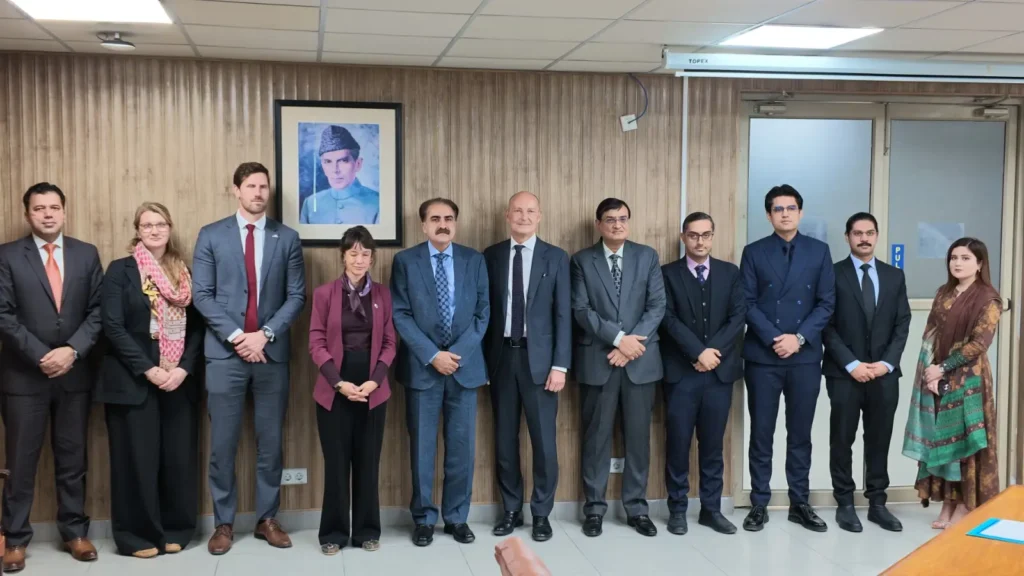
ISLAMABAD: Pakistan and Sweden have initiated negotiations to modernise their 1981 Bilateral Investment Treaty (BIT), seeking to update the decades-old agreement and establish a more contemporary framework for investment cooperation between the two countries.
The Special Investment Facilitation Council (SIFC) announced on Saturday, November 21, 2026, that negotiations had taken place in Islamabad, bringing together senior government officials and technical representatives from both sides.
According to the council, the discussions represent an important step towards updating the legal and institutional arrangements governing bilateral investment relations.
The proposed modernisation is intended to encourage greater private-sector participation, strengthen economic cooperation and create new opportunities for investment.
Officials from Pakistan and Sweden expressed a shared commitment to developing an investment framework aligned with changing economic priorities and international business conditions.
The negotiations remain ongoing, and neither government has announced the signing or implementation of a revised treaty.
Pakistan and Sweden Review 1981 Investment Agreement
The existing Bilateral Investment Treaty between Pakistan and Sweden dates back to 1981, making it one of the older agreements governing investment relations between the two countries.
Bilateral investment treaties generally establish legal protections and obligations relating to investments made by investors from one contracting country in the territory of the other.
Such agreements can address matters including investment treatment, protection against unlawful expropriation, compensation and mechanisms for resolving disputes.
However, the precise scope of protections depends on the wording of each treaty.
Since the original Pakistan-Sweden agreement was concluded, international investment practices, regulatory priorities and approaches to investment governance have evolved significantly.
The current negotiations are intended to examine how the existing framework can be updated to reflect contemporary economic requirements.
According to SIFC, the proposed changes are expected to support a more enabling environment for investment and strengthen economic relations between Islamabad and Stockholm.
Specific amendments to the treaty have not yet been publicly detailed in the supplied statement.
SIFC Secretary Highlights Investment Cooperation
Secretary of the Special Investment Facilitation Council Jamil Ahmed Qureshi welcomed the Swedish delegation during the opening session of negotiations.
He emphasised the importance of the discussions in advancing mutually beneficial economic relations between Pakistan and Sweden.
Qureshi highlighted the need for a modern investment framework capable of responding to evolving economic priorities.
He also stressed the importance of establishing conditions that encourage investment and facilitate stronger commercial engagement.
According to the SIFC statement, Pakistan views the treaty modernisation process as an opportunity to improve the environment for bilateral investment.
The initiative is consistent with the country’s broader efforts to strengthen international economic partnerships and encourage investment in productive sectors.
A contemporary investment agreement could provide greater clarity regarding the rules governing cross-border investments, depending on the final provisions agreed by both governments.
However, the economic effects of the revised framework will depend on its eventual terms and implementation.
Swedish Ambassador Welcomes Constructive Engagement
The Swedish ambassador to Pakistan, who led the visiting delegation, welcomed Pakistan’s engagement in the negotiations.
The ambassador reaffirmed Sweden’s interest in expanding economic cooperation with Pakistan, particularly in sustainable investment, innovation and employment generation.
These areas were identified as important opportunities for strengthening bilateral economic relations.
Sustainable investment can involve projects designed to support long-term economic development while taking environmental and social considerations into account.
Innovation-focused cooperation may also encourage collaboration involving technology, research and business development.
The Swedish delegation’s emphasis on job creation reflects the potential role of investment in supporting employment and economic activity.
However, the statement did not identify specific new investment commitments, project agreements or financial packages resulting from the negotiations.
The discussions were focused on modernising the broader investment framework rather than announcing individual commercial transactions.
Technical Teams Make Progress on Draft Treaty
SIFC reported that technical teams from Pakistan and Sweden had made significant progress on key provisions of the draft agreement.
The council described the discussions as constructive and said both sides remained committed to continued cooperation.
Technical negotiations are an important part of treaty modernisation because they allow governments to examine legal language, investment protections and regulatory provisions.
The process can involve reviewing existing obligations and determining how a revised agreement should address the priorities of both countries.
Although progress has been reported, the statement did not disclose which provisions had been agreed or which issues remained under discussion.
No timetable was announced for concluding the negotiations or signing a final agreement.
The proposed treaty will require further discussions before its provisions can be finalised.
Any subsequent approval or ratification procedures would depend on the applicable legal requirements of the two countries.
Modern Investment Framework Could Encourage Private-Sector Participation
One of the principal objectives of the negotiations is to create an updated framework capable of supporting greater private-sector engagement.
Investment treaties can contribute to investor confidence by clarifying the legal treatment of qualifying foreign investments.
Predictable investment rules may help businesses assess regulatory and legal risks when considering projects in overseas markets.
For Pakistan, improving the investment environment remains an important component of efforts to attract foreign capital and support economic development.
A modernised agreement with Sweden could provide an additional institutional foundation for commercial cooperation.
Swedish businesses operate across a range of industries, including engineering, telecommunications, manufacturing, technology and environmental solutions.
These sectors could offer areas for future engagement, although the SIFC statement did not announce specific projects or sectoral commitments.
Similarly, Pakistani businesses may benefit from a clearer framework for exploring investment opportunities in Sweden.
The extent of any increase in bilateral investment would depend on market conditions, commercial opportunities and the final terms of the agreement.
Sustainable Investment and Innovation in Focus
Sweden’s stated interest in sustainable investment and innovation could provide a basis for expanding cooperation beyond traditional commercial relationships.
Sustainable development has become an increasingly important consideration in international investment policy.
Governments and businesses are placing greater emphasis on long-term project viability, responsible business practices and environmental performance.
Innovation also plays an important role in improving industrial productivity and developing new economic opportunities.
The Pakistan-Sweden negotiations could help establish a framework within which businesses evaluate future partnerships in these areas.
However, the treaty itself would not automatically create new investment projects or guarantee capital inflows.
Investment decisions would remain subject to commercial feasibility, regulatory requirements and the strategies of individual companies.
SIFC Continues Efforts to Strengthen Foreign Investment
The Special Investment Facilitation Council has been involved in coordinating initiatives aimed at improving Pakistan’s investment environment and facilitating engagement with international partners.
The negotiations with Sweden form part of these broader efforts to strengthen economic relationships and encourage foreign investment.
Updating older bilateral agreements can help governments reassess their investment policies and ensure that treaty provisions remain relevant to current economic circumstances.
Modern investment frameworks may also seek to balance investor protections with the ability of governments to regulate in the public interest.
The precise balance in the proposed Pakistan-Sweden treaty will become clearer once its negotiated provisions are disclosed.
For now, the SIFC has characterised the discussions as a positive development in bilateral economic relations.
Pakistan-Sweden Economic Relations Enter New Phase
The decision to modernise the 1981 Bilateral Investment Treaty reflects a shared interest in strengthening the institutional foundations of economic cooperation between Pakistan and Sweden.
Both governments have expressed support for a framework that encourages investment, promotes innovation and facilitates greater private-sector participation.
Progress by the technical negotiating teams suggests that discussions have moved beyond initial diplomatic engagement into consideration of the treaty’s substantive provisions.
Nevertheless, the negotiations have not yet produced a finalised agreement.
Further progress will depend on both sides reaching consensus on the remaining legal and policy issues.
If successfully concluded and implemented, the revised treaty could provide a more contemporary basis for bilateral investment relations.
The negotiations therefore represent a potential opportunity to deepen Pakistan-Sweden economic cooperation, while the scale of future investment will ultimately depend on commercial demand, investor confidence and practical implementation.
You may also like
-
NBP Inaugurates AI and Robotics Lab at Abbottabad Public School
-
IFC Plans $1.3 Billion Smart Meters Project Across Five Power Companies in Pakistan
-
FBR Makes Electronic Production Monitoring Mandatory for Leather and Paper Manufacturers
-
NEPRA Allows DESCO to Buy Electricity Directly From Lucky Cement
-
Ufone Telenor Xiaomi Partnership Aims to Accelerate 5G Smartphone Adoption in Pakistan