Education

Establishment of New Universities Halted as HEC Enforces Nationwide Ban
Education

Establishment of New Universities Halted as HEC Enforces Nationwide Ban

The establishment of new universities in Pakistan has come to a sudden halt after the Higher Education Commission (HEC) imposed a nationwide ban on setting up new institutions and sub-campuses at the tehsil level. The move marks a major policy shift aimed at improving the quality of higher education across the country. HEC Issues Immediate Directives The decision followed formal instructions from the HEC chairman to vice chancellors and university heads. Authorities ordered them to stop all ongoing and planned initiatives related to the establishment of new universities. The directive took immediate effect and left no room for exceptions. Officials stressed that institutions must not proceed with any expansion plans without prior approval. They also made it clear that strict monitoring will follow. Universities must now comply fully with the new regulatory framework. Strict Approval Process Introduced The HEC introduced a stricter approval system to control the establishment of new universities. Authorities stated that no new institution can operate without a comprehensive review process. This process includes the issuance of a No Objection Certificate (NOC). Officials warned that any institution operating without approval will face serious consequences. Degrees issued by such institutions will not receive recognition. Students enrolling in unapproved campuses risk invalid qualifications, which could affect their academic and professional future. Concerns Over Declining Academic Standards The HEC based its decision on growing concerns about declining academic standards. Officials observed that rapid expansion at the tehsil level has weakened the quality of education. Many campuses failed to meet basic academic requirements. Authorities identified several critical issues. These include a shortage of qualified faculty, poor infrastructure, and low student enrolment. Many institutions struggled to maintain proper teaching standards. The lack of PhD-qualified faculty emerged as a major concern. Experts believe that without highly trained educators, universities cannot deliver quality education. The HEC emphasized that improving faculty standards remains essential before allowing further expansion. Tehsil-Level Campuses Under Scrutiny Tehsil-level campuses faced particular scrutiny under the new policy. The HEC noted that many of these campuses operate with limited resources. They often lack proper classrooms, laboratories, and research facilities. Officials argued that unchecked growth in smaller regions has created more problems than solutions. Instead of improving access to education, it has led to compromised quality. The decision to halt the establishment of new universities aims to address these structural weaknesses. All Ongoing Projects Suspended The directive also ordered a complete suspension of all ongoing projects linked to new campuses. Authorities halted admissions, faculty recruitment, construction work, and land acquisition activities. This decision affects both public and private sector institutions. Universities that had already started development work must now pause their operations. The HEC stated that it will review each case individually before allowing any future progress. Officials emphasized that compliance is mandatory. Any institution found violating the directive may face penalties. These include the suspension of academic programme approvals and other regulatory actions. Impact on Students and Education Sector The sudden halt in the establishment of new universities could have mixed implications for students. On one hand, it may limit access to higher education in remote areas. On the other hand, it aims to ensure that existing institutions improve their standards. Education experts believe the move could strengthen Pakistan’s higher education system in the long run. By focusing on quality over quantity, authorities hope to produce better academic outcomes. However, some stakeholders have raised concerns. They argue that restricting expansion may reduce opportunities for students in underserved regions. The HEC has not yet announced alternative measures to address access issues. A Shift Toward Quality Assurance The HEC’s decision signals a clear shift in policy direction. Authorities now prioritize quality assurance over rapid expansion. The focus remains on strengthening existing institutions rather than creating new ones. Officials plan to enhance monitoring mechanisms and enforce stricter standards across universities. They aim to ensure that institutions meet academic, infrastructural, and faculty requirements before receiving approval. The coming months will prove critical for Pakistan’s education sector. Universities must adapt to the new rules and improve their performance. The success of this policy will depend on effective implementation and consistent oversight.

OxfordAQA Enhances International Assessments with Earlier Results and More Choice for Schools and Students
Education

Oxford AQA Enhances International Assessments with Earlier Results and More Choice for Schools and Students

Pakistan: OxfordAQA – a partnership between Oxford University Press; a department of Oxford University; and AQA, the largest provider of GCSEs and A-levels in the United Kingdom (UK); have announced a groundbreaking series of ‘significant improvements;’ including earlier results, three series of yearly examinations, and two windows to submit International EPQ submission points. All advantages available to its international assessment offer now. Shaped by insights for greater advantage to the students globally, the enhancements will be introduced between 2026 and 2029, delivering greater choice and increased flexibility to plan university admissions and academic progression. They comprise: Earlier May/June Exam Results from July 2027; In 2027, International AS/A-level results day will be on 28 July, with International GCSE results on 4 August. Additional Exam Series: an October/November series for all International AS/A-level subjects from 2028, and a January International AS/A-level series for key subjects from 2029 (Biology, Chemistry, Physics, Maths, Further Maths, Economics). Twice‑yearly International EPQ submission points, beginning in May 2026, giving students more control to develop, refine, and complete their projects.Andrew Coombe, Managing Director of OxfordAQA said: “At OxfordAQA, our commitment is to make international exams work better for everyone. These enhancements are a direct response to what schools have told us they need. By releasing results earlier, expanding exam series, and providing greater flexibility for the International EPQ, we are helping schools tailor assessment to their teaching programmes and giving students more opportunities to succeed.” The earlier release of May/June results will give International AS and A-Level students more time/options when navigating global university admissions. It will also support International GCSE learners in planning their next steps, whether progressing to further study or new programmes. Expanding the number of exam series will provide schools operating on varied academic calendars with three opportunities each year to enter students at the right time, ensuring assessment aligns more closely with teaching cycles. From 2027, OxfordAQA will also extend the entries deadline for the May/June series to early March, providing schools with the January International AS/A-level unit results before finalising entries and allowing teachers and students to make more informed decisions. All exam timings for the May/June series will remain the same, with no changes.About OxfordAQA OxfordAQA is a provider of international GCSEs, AS and A-levels, and the International EPQ. Built on a partnership between AQA—the UK’s largest provider of academic qualifications—and Oxford University Press, a department of the University of Oxford, OxfordAQA brings together unparalleled assessment expertise and educational excellence. Its qualifications are designed specifically for international learners, supporting schools around the world.www.oxfordaqa.com/examdelivery For more information, please contact: Grace Carruthers | Senior News & PR Manager | Oxford University Press | grace.carruthers@oup.com

Google and Pakistan Government Launch “AI Seekho 2026” to Train Youth in Vibe Coding and AI Skills
Education

Google and Pakistan Government Launch “AI Seekho 2026” to Train Youth in Vibe Coding and AI Skills

KARACHI: To accelerate Pakistan’s transition into a global digital economy, Google for Developers, in strategic collaboration with the Ministry of Information Technology & Telecom (MoITT), Telenor, and Innovista, announced the launch of AI Seekho 2026. Read More: https://theboardroompk.com/pso-announces-appointment-of-jawwad-ahmed-cheema-as-ceo/ This nationwide initiative aims to equip developers and young professionals with cutting-edge artificial intelligence capabilities, entirely free of financial barriers. The program pioneers the introduction of vibe coding to Pakistani youth, a modern, intuitive, and agent-driven approach to application development. Utilizing next-generation platforms like Google AI Studio and Google Antigravity, participants will learn to build software through natural language and problem-solving, rather than traditional complex syntax. Participants can register here: goo.gle/aiseekho2026. Shaza Fatima, Federal Minister for IT and Telecom, stated: “Our vision is to shift from a legacy service economy to an AI-powered, product-based economy. With 65% of our population under the age of 35, we are declaring AI a core priority to ensure that every young person from tech professionals to doctors, lawyers, and artists is empowered with the digital skills necessary to compete in the global market.” Farhan Qureshi, Cluster Director (Pakistan and Frontier Markets), Google, said: “Google believes very strongly in the future of Pakistan. Through initiatives like AI Seekho, we are helping build the necessary capacity and speed for the local ecosystem. If we want to secure Pakistan’s digital future, we must commit to scaling AI skills, ensuring that our talent can continue to lead in the global freelance and gaming industries.” A Structured “Learn, Build, Win” Journey AI Seekho 2026 moves beyond conventional lectures, offering a hands-on, two-phased competitive journey focusing on tangible deployment: ● Phase 1: Online Challenge (April 11 – May 3): Participants will master the fundamentals of Generative AI and prototyping using Google AI Studio. Participants must submit fully functional solutions in one of two tracks: Build an App (App Banao) or Build a Game (Game Uthao). ● Phase 2: Physical Hackathon (Opening Soon): Developers who will participate in this phase will be required to build solutions usingGoogle Antigravity in Karachi, Lahore & Islamabad. This will be a competition theme-based where the participants will be required to build a mobile app for a chance to win exclusive Swag and a PKR 2.5 Million prize pool! An Unprecedented Industry Collaboration AI Seekho 2026 is powered by a robust multi-partner ecosystem. Google for Developers leads the end-to-end execution, providing free cloud credits and platform access, supported by the Google Developer Groups (GDG) and Google Developer Experts (GDE) communities. Watch the full kick-off event here: https://goo.gle/aiseekho-ytlive AI Seekho 2026 invites Pakistan’s youth to learn, build, and innovate with AI. Through hands-on experiences and global collaborations, it’s creating a future-ready generation poised to lead the AI revolution.

Visa HBL She’s Next Pakistan Is Fueling a New Era of Women-Led Businesses
Education

Visa HBL She’s Next Pakistan Is Fueling a New Era of Women-Led Businesses

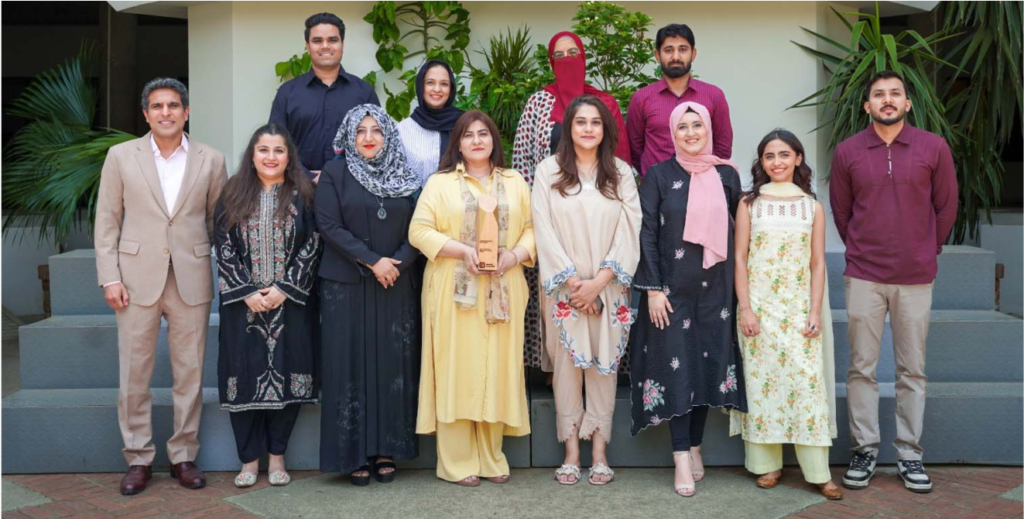
What happens when ambition meets opportunity? Visa HBL She’s Next Pakistan has the answer. At a time when women entrepreneurs are quietly reshaping Pakistan’s economic landscape, Visa global digital payments leader and HBL Pakistan’s premier private bank have once again stepped forward to amplify their impact. The 2026 edition of Visa HBL She’s Next Pakistan culminated in a high-energy final pitch event in Karachi, spotlighting five exceptional women-owned businesses that are not just building companies, but redefining industries. Held at the Pearl Continental Hotel, the awards ceremony marked the finale of a rigorous three-month journey that began in November 2025 and attracted nearly 3,500 applicants from across the country a powerful signal of Pakistan’s growing women-led entrepreneurial momentum. Meet the Five Winners of Visa HBL She’s Next Pakistan 2026 After an intensive evaluation process, an independent jury selected five standout founders whose ideas demonstrated innovation, scalability, and social impact: • Aiman Shafique – EV Square• Anusha Fatima – TrashIt (Winner of the Sustainability Award)• Fizza Hussain – Khaas Foodz Kitchen• Maira Siddiqui – Chiragh Education Technologies• Meesha Baig – Goud These ventures span high-growth sectors such as education, waste management, gaming, food, beauty, and healthcare, reflecting the diversity and depth of women-led innovation in Pakistan today. Why Visa HBL She’s Next Pakistan Stands Out Each winning entrepreneur received USD 10,000 in grant funding, but the program goes far beyond financial support. Participants also gain: • Tailored business training programs• One-on-one mentorship from leading Pakistani and global experts• Access to the She’s Next Club, featuring a rich workshop library and a thriving peer community This holistic approach ensures founders are equipped not just to survive but to scale confidently. Sustainability Takes Center Stage at Visa HBL She’s Next Pakistan A major highlight of the 2026 edition was the introduction of a Sustainability Award, won by Anusha Fatima’s TrashIt, a venture tackling Pakistan’s waste management challenges head-on. By recognizing sustainability as a competitive advantage, Visa HBL She’s Next Pakistan signals a shift toward impact-driven entrepreneurship where profitability and purpose go hand in hand. How Winners Were Selected The jury assessed applicants on: • Strength and progression of their entrepreneurial journey• Business performance metrics and scalability• Digital presence and use of technology• Confidence in problem-solving and leadership The panel included senior leaders from HBL, Visa, IFC, Carbon Law, and Abhi Microfinance Bank, ensuring a transparent and high-caliber selection process. Digital, AI-Driven, and Ready to Scale Insights from the She’s Next Women SMB Digitization Index revealed that women entrepreneurs in Pakistan are leading the digital shift. Instead of listing numbers, the story is clear:Women-led businesses are rapidly adopting digital payments, AI tools, data analytics, chatbots, and NLP platforms like ChatGPT to market smarter, operate efficiently, and retain customers. Many founders also rely on mentors and business coaches, highlighting the value they place on guidance and continuous learning. Their motivations go beyond profit financial independence and building supportive, women-friendly workplaces remain powerful drivers behind these ventures. Why Visa HBL She’s Next Pakistan Matters for the Economy Programs like Visa HBL She’s Next Pakistan are no longer optional—they are essential. As women entrepreneurs formalize, digitize, and scale their businesses, they contribute directly to job creation, financial inclusion, and Pakistan’s digital economic transformation. By combining capital, mentorship, and technology enablement, Visa and HBL are helping ensure that the next generation of Pakistani businesses is inclusive, resilient, and globally competitive.

AI platform Qureos Raises $5 Million Seed Round to Fix Hiring’s Problems
Education

AI platform Qureos Raises $5 Million Seed Round to Fix Hiring’s Problems

Dubai, UAE: Qureos, an AI driven hiring platform founded in the Middle East, has closed a $5 million Seed round led by Prosus Ventures and Salica Oryx Fund, with participation from Oraseya Capital, PlusVC, F6 Ventures, BDev Ventures, Sunny Side Venture Partners and Daniel Tyre, an early HubSpot executive who helped scale the company from inception to its IPO, and follow-on investment from COTU Ventures and Globivest. Read More: https://theboardroompk.com/safety-isnt-a-burden-its-survival-why-gul-plaza-baldia-remind-us-of-the-real-cost-of-cutting-corners/ Founded by Alexander Epure and Usama Nini, Qureos was built around a simple insight. Hiring is not slow because of volume alone. It is slow because it is fragmented. Recruiters juggle disconnected tools across sourcing, screening, and interviewing, while candidates move through the process with little clarity or feedback. Qureos treats hiring as a single system rather than a sequence of manual steps, designed to continuously improve outcomes for both sides. Hiring has become one of the biggest bottlenecks for growing organizations, particularly in high volume environments where speed often determines who secures the best talent. Demand for Qureos has surged as enterprises increasingly use the platform to run high volume and time sensitive hiring, compressing hiring timelines from months to as little as six days and redefining recruitment as a competitive lever rather than a constraint for businesses. “Hiring at scale is one of the most operationally complex challenges facing modern organizations,” said Robin Voogd, Head of Middle East Investments at Prosus Ventures. “Qureos has built a practical, end-to-end system that replaces fragmented recruitment workflows with a single, intelligent platform. By unifying sourcing, screening, and interviewing, the company enables employers to hire faster without sacrificing quality, a critical advantage in high-growth, time-sensitive markets.” At the center of that system is Iris, Qureos’ AI assistant that acts as the interface between companies and candidates throughout the hiring process. For employers and recruitment agencies, Iris functions as an AI recruiter assistant, automating sourcing, screening, and interviewing while continuously optimizing for speed and quality. On the candidate side, Iris matches individuals to relevant roles across the broader job market, clearly signaling where they are the right fit and why. Candidates gain early visibility into aligned opportunities and receive role-specific feedback that helps them engage with the right opportunities from the outset. On the employer side, Qureos automates the full recruitment workflow. Roles are distributed across more than 2,000 job boards globally, as well as social and direct channels, using a multi-channel approach that increases visibility while lowering acquisition costs. Candidate profiles are enriched using publicly available information and AI-based prediction models, then screened against role requirements in under 15 seconds. Shortlisted candidates are assessed through AI-led interviews, delivered via audio or video, and tailored to each role. Hasan Haider, Founder and Managing Partner at Plus VC, said: “Qureos is solving a deeply operational problem with real, measurable impact. By dramatically reducing time-to-hire while improving recruiter productivity and candidate experience, the company is redefining how modern organizations approach talent acquisition. We are excited to support Alex Epure, Usama Nini and the team as they continue to establish Qureos as a category leader in this space. This is exactly the kind of infrastructure-level innovation we look to back.” For organizations hiring at scale, the manual effort required for application review and initial interviews often reaches 15 hours per role, translating into roughly 2,160 hours of work per year. By automating these steps, Qureos eliminates a full year of recruiter workload that would otherwise slow hiring and limit capacity. Today, Qureos has been adopted by teams within more than 1,000 enterprise and public sector organizations, including Qatar Airways, Dubai Economy and Tourism and BAAN Holdings, Union Properties. The platform is built with regional requirements in mind, including localization and nationalization policies across GCC markets, while remaining flexible enough to integrate with existing ATS and HRIS systems or operate as a standalone solution. Hiring speed is becoming one of the most decisive competitive advantages for modern companies, said Alexander Epure, Co Founder and CEO of Qureos. The organizations that win are the ones that can identify the right candidates and move decisively. We built Qureos to help employers and candidates meet in the middle, with a system that improves with every hire.The new funding will be used to further develop Qureos’ AI capabilities, expand its go to market team, and accelerate geographic expansion through enterprise and agency partnerships. About Qureos Qureos is an AI-driven hiring platform that helps enterprises and recruitment teams run faster, more efficient hiring at scale. Built in the Middle East and operating across MENA, Qureos also supports customers and candidates globally, including in the United States. The platform automates sourcing, screening, and interviewing while matching candidates to roles across the broader market based on fit and potential.

Education

Canada Eases Study Permit Rules for International MS and PhD Students

Faster Visa Processing for PhD Students Alongside the cap exemption, PhD applicants from outside Canada will benefit from a 14-day fast-track study permit process, which also applies to accompanying family members. The Immigration, Refugees and Citizenship Canada (IRCC) has launched a dedicated webpage for graduate students, providing details on study programs, scholarships, and post-graduation work opportunities. “Graduate students play a crucial role in Canada’s research and innovation ecosystem and are more likely to contribute long-term to the country’s economy,” said a government official. Why the Change Matters While Canada is reducing the number of international undergraduate and college-level permits, graduate students are largely exempt from these caps. This ensures that the country continues to attract high-skilled researchers and innovators who can contribute to economic growth, scientific advancement, and innovation. The new policy reflects a strategic approach to balancing international student growth with sustainability. By 2027, Canada aims to reduce the overall temporary resident population — including students, temporary workers, and short-term visitors — to under 5% of the total population, addressing pressures on housing, healthcare, and infrastructure. What This Means for Future Students While Canada tightens rules for most international students, master’s and PhD candidates remain prioritized, ensuring continued access to one of the world’s most research-friendly study destinations. The policy underscores Canada’s commitment to attracting highly skilled international talent and reinforces its position as a leading country for advanced education and innovation.   

Scroll to Top