

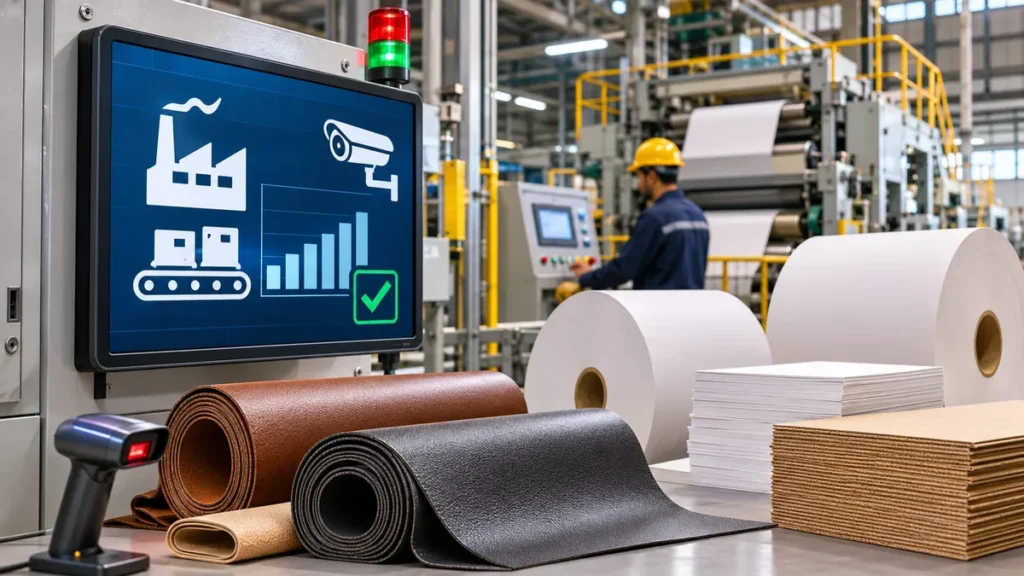
ISLAMABAD: The Federal Board of Revenue (FBR) has made electronic production monitoring mandatory for manufacturers of synthetic leather, paper and paperboard to strengthen tax compliance and prevent the removal of unrecorded goods from factories.
Through Sales Tax General Orders No. 38 and 39 of 2026, the FBR directed synthetic and artificial leather manufacturers to install monitoring systems by November 30, while paper and paperboard manufacturers must comply by December 15, 2026.
The directives were issued under Section 40C of the Sales Tax Act, 1990, and relevant provisions of the Sales Tax Rules, 2006.
FBR Introduces AI-Based Monitoring for Synthetic Leather
Under the new requirements, synthetic leather manufacturers must install sensor-based measurement equipment and AI-enabled cameras on every active roll-producing line.
The systems will electronically record production quantities, roll lengths, cutting times and video evidence.
According to the FBR, measurements must have a resolution of 0.1 metre, while discrepancies exceeding 0.5 percent will trigger automated alerts.
Industrial cameras must provide at least four-megapixel resolution and record at 25 frames per second. Each roll-cutting event must include footage covering at least 10 seconds before and after cutting.
Manufacturers must retain video recordings for 30 days and production records for at least 90 days.
The equipment must maintain 99 percent measurement accuracy, with a minimum acceptable level of 95 percent, and transmit production information to the FBR’s Central Control Unit.
The National Radio and Telecommunication Corporation (NRTC) has been designated as the authorised vendor for the synthetic leather sector.
Paper Manufacturers Given December 15 Deadline
Separately, paper and paperboard manufacturers must install electronic systems capable of detecting, weighing and counting production units according to their grades and grammage.
The requirement applies to registered manufacturers, including composite production facilities, but excludes businesses engaged solely in cutting and printing.
Factories using their own paper production to manufacture other products must also monitor the point where material is diverted for internal consumption.
The FBR has listed 45 registered businesses, including Century Paper and Board Mills, Bulleh Shah Packaging, Security Papers, Nishat Packaging, Tetra Pak Pakistan and Cherat Packaging.
NEPRA Allows DESCO to Buy Electricity Directly From Lucky Cement
However, the authority clarified that eligible manufacturers not included in the list must also comply.
ISSM Labelling Solutions (Pvt) Ltd has been authorised to provide monitoring equipment for the paper and paperboard sector.
FBR Warns Manufacturers Against Non-Compliance
Under both orders, manufacturers cannot remove or supply finished goods unless production has been electronically monitored and the required records generated.
Businesses must provide electricity, connectivity, infrastructure and installation access while paying prescribed vendor charges.
Synthetic leather manufacturers must also report equipment failures, damage or suspected tampering within one hour.
Chief Commissioners Inland Revenue have been instructed to identify covered factories, coordinate with authorised vendors and ensure timely implementation.
The FBR will be able to compare electronically recorded production with sales tax returns, invoices, inventory records and raw material purchases to identify potential discrepancies.
The authority clarified that existing video surveillance requirements for paper manufacturers will remain in force.
Both orders took immediate effect, with violations involving equipment tampering, concealed production lines or removal of unmonitored goods subject to action under applicable tax laws.
You may also like
-
NBP Inaugurates AI and Robotics Lab at Abbottabad Public School
-
IFC Plans $1.3 Billion Smart Meters Project Across Five Power Companies in Pakistan
-
NEPRA Allows DESCO to Buy Electricity Directly From Lucky Cement
-
Ufone Telenor Xiaomi Partnership Aims to Accelerate 5G Smartphone Adoption in Pakistan
-
Pakistan Sweden Investment Treaty: Talks Begin to Modernise 1981 Bilateral Agreement