

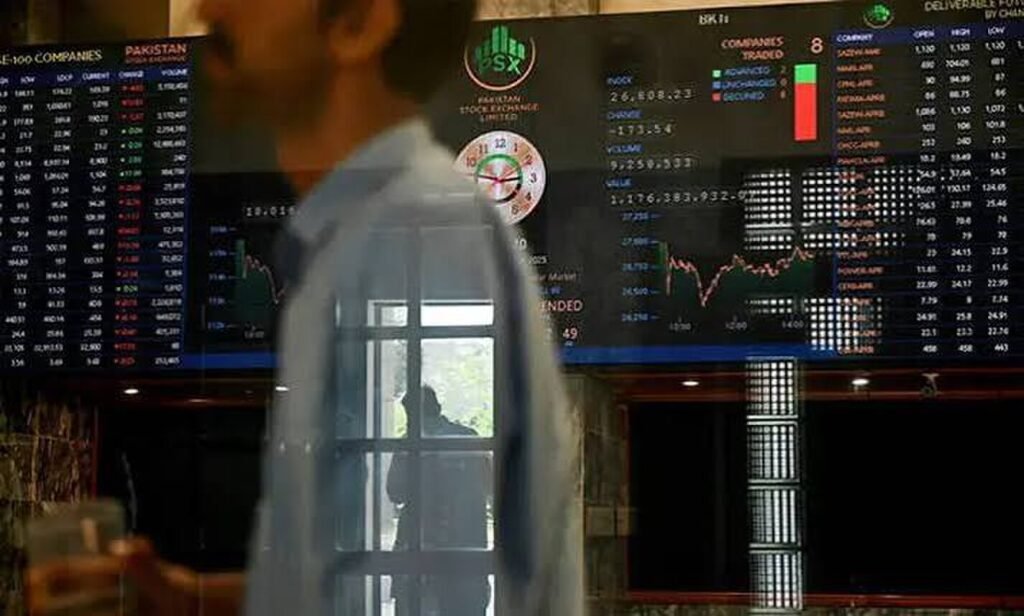
KARACHI: The PSX KSE-100 Index declined by more than 500 points during early trading on Friday as selling pressure returned to the Pakistan Stock Exchange (PSX), with investors reducing exposure to several major sectors amid cautious market sentiment.
At approximately 9:40am, the benchmark KSE-100 Index stood at 176,212.76 points, reflecting a decline of 559.42 points, or 0.32%, from the previous session’s closing level.
The early losses indicated renewed selling activity following Thursday’s modest recovery, when investors had taken advantage of lower share prices after the market touched a weekly low.
Selling pressure was visible across several important sectors, including automobile assemblers, cement manufacturers, oil and gas exploration companies, oil marketing companies and power generation firms.
A number of heavyweight stocks traded in negative territory, contributing to the benchmark index’s decline.
Among the companies recording losses were Attock Refinery Limited (ARL), Pakistan Petroleum Limited (PPL), Pakistan State Oil (PSO), Habib Bank Limited (HBL), MCB Bank Limited (MCB) and National Bank of Pakistan (NBP).
Weakness in these stocks placed additional pressure on the broader market because of their influence on the index.
The decline came after the Pakistan Stock Exchange ended Thursday’s session with modest gains, supported by value buying following earlier losses.
On Thursday, the KSE-100 Index advanced by 477.86 points, or 0.27%, to close at 176,772.19 points.
The recovery followed a period of weakness that had pushed the benchmark to its lowest level of the week during the preceding session.
Investors initially responded to attractive valuations by purchasing selected shares, helping the market regain some of its earlier losses.
However, profit-taking during the second half of Thursday’s trading session limited the recovery.
Market participants also remained cautious because of domestic political developments and uncertainty surrounding the international geopolitical environment.
The renewed decline on Friday suggested that selling pressure continued to influence trading decisions despite the previous session’s rebound.
Meanwhile, international equity markets experienced significant losses, adding to concerns about global investor confidence.
Asian shares declined sharply on Friday, with regional benchmarks heading towards their worst weekly performance since the market turmoil of March 2020.
MSCI’s broadest index of Asia-Pacific shares outside Japan fell 2.5%, putting it on course for a sixth consecutive session of losses.
The index had declined approximately 7% during the week, marking its weakest weekly performance in more than six years.
Japan’s Nikkei index dropped 4.1% and was heading for a weekly decline of 6.8%.
South Korea’s KOSPI also suffered heavy losses, falling 4.7% during the session and moving towards a weekly decrease of approximately 7.5%.
The regional sell-off followed substantial declines on Wall Street, where both the S&P 500 and Nasdaq Composite had lost more than 2%.
Technology stocks remained under pressure as investors reassessed valuations and financial risks associated with artificial intelligence-related businesses.
According to the supplied international market report, artificial intelligence company Anthropic experienced a strong stock market debut, with its shares rising more than 30%.
However, the reported listing failed to restore confidence across the broader AI sector, which continued to face selling pressure.
Investor concerns included rising debt levels among technology companies, the substantial costs associated with AI infrastructure and uncertainty over the industry’s longer-term financial outlook.
The report also cited developments involving Nvidia and increased opposition to data centre expansion as factors affecting sentiment.
Weakness in US equity futures suggested that the international market downturn could continue.
During Asian trading hours, S&P 500 futures declined 0.4%, while Nasdaq futures fell 0.7%.
The US dollar also strengthened as investors sought assets perceived as relatively safer during periods of market uncertainty.
Expectations surrounding US monetary policy added to pressure on global financial markets.
According to the report, federal funds futures indicated that investors were pricing in a quarter-percentage-point increase in US interest rates at the Federal Reserve’s next policy meeting.
Higher US interest rates can tighten global financial conditions and influence capital flows towards dollar-denominated assets, potentially affecting emerging equity markets.
For Pakistan, the combination of domestic uncertainty and weaker international investor sentiment created a challenging environment for equity trading.
The KSE-100 Index’s early decline reflected losses across multiple sectors rather than weakness concentrated in a single industry.
Investors are expected to monitor developments in domestic politics, corporate earnings, international equity markets and global monetary policy for indications of the market’s near-term direction.
The benchmark’s performance during the remainder of Friday’s session will determine whether selling pressure persists or investors return to selected stocks following the early decline.
At 176,212.76 points in early trading, the KSE-100 remained below Thursday’s closing level, highlighting continued volatility at the Pakistan Stock Exchange.
You may also like
-
Asian Stock Markets: South Korea’s Kospi Plunges 4.31% as Global Tech Sell-Off Deepens
-
LSE Financial Services Launches AI Order Management System for Pakistan’s Brokerage Industry
-
Pakistan Startup Investment: SIFC, Endeavor Pakistan Discuss Global Venture Capital Opportunities
-
Gold Prices in Pakistan: Local Rates Fluctuate Amid Global Market Trends
-
US Dollar Index: Currency Holds Near 19-Month High as AI Sell-Off Boosts Safe-Haven Demand