

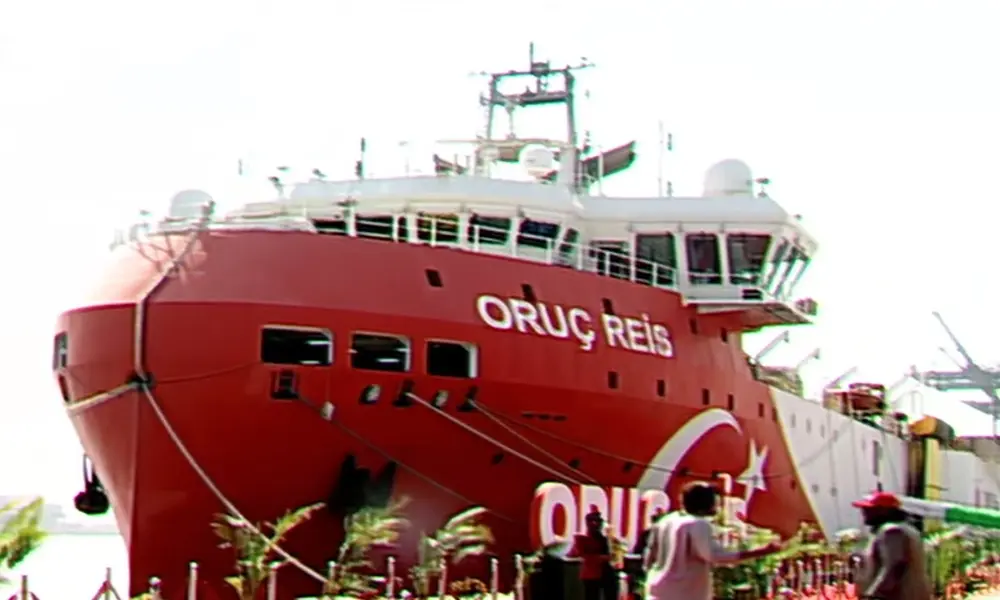
KARACHI: Pakistan has taken a significant step towards reviving offshore oil and gas exploration following the arrival of Turkish seismic research vessel Oruç Reis at Karachi Port on Friday, November 20, 2026, marking a new phase of energy cooperation between Pakistan and Turkiye.
The vessel’s arrival was welcomed by Deputy Prime Minister Ishaq Dar, Turkish Energy Minister Alparslan Bayraktar, Federal Minister for Petroleum Ali Pervaiz Malik and other senior officials during a ceremony in Karachi.
The development forms part of Pakistan’s efforts to explore its offshore hydrocarbon potential, strengthen domestic energy production and reduce dependence on imported fuels.
Speaking at the ceremony, Dar described the arrival of Oruç Reis as an important milestone in scientific exploration and bilateral energy cooperation.
He said the initiative would combine Turkish technical expertise with the experience and capabilities of Pakistan’s national energy companies to advance exploration in the country’s offshore territory.
The deputy prime minister emphasised that seismic exploration was an essential first step towards identifying potential oil and gas reserves.
However, he cautioned that conducting seismic surveys did not guarantee commercially viable discoveries.
Dar also highlighted the economic and strategic importance of Pakistan’s coastline, noting that the country’s maritime territory offers opportunities in energy exploration, shipping, fisheries and international trade.
He said Pakistan’s natural resources were estimated to be worth between $8 trillion and $10 trillion, although the figure was presented as an estimate rather than a verified valuation of commercially recoverable reserves.
The deputy prime minister expressed confidence that closer cooperation with Turkiye could help Pakistan develop its natural resources and strengthen its energy sector.
Turkish Energy Minister Alparslan Bayraktar provided details of the planned exploration programme.
He said Turkish Petroleum would undertake a three-dimensional seismic data acquisition survey covering approximately 670 square kilometres in the Indus Sea block.
The operation is expected to continue for around two months.
The survey will collect geological information to help identify potential hydrocarbon-bearing formations beneath the seabed.
According to Bayraktar, the information gathered during the survey will guide future exploration decisions, with operations in identified areas targeted for 2027.
He expressed hope that the initiative would lead to discoveries capable of contributing to the economic development and energy security of both countries.
The Turkish minister described the project as the beginning of a broader partnership that could create opportunities for additional energy projects, bilateral trade and investment.
Petroleum Minister Ali Pervaiz Malik also welcomed the vessel’s arrival, describing it as a landmark development for Pakistan’s energy industry.
He said the initiative represented a major revival of seismic exploration in the country’s offshore Indus Basin.
Malik acknowledged that offshore exploration involves substantial financial investment, technical complexity and geological uncertainty.
Nevertheless, he argued that Pakistan needed to investigate its domestic resource potential to strengthen long-term energy security.
The minister explained that seismic surveys would provide a clearer understanding of underground geological formations and help reduce uncertainty before drilling activities begin.
The acquired data will be analysed to identify areas that may warrant further exploration.
According to Malik, the overall data acquisition and interpretation process is expected to be completed within approximately six months.
This could allow drilling operations to begin in early 2027, depending on the results of the survey and subsequent technical assessments.
The petroleum minister also highlighted the expanding cooperation between Pakistani energy companies and Turkish Petroleum.
He identified Eastern Offshore Indus Block C as a key project within the partnership.
Turkish Petroleum is the operator of the block with a 25% participating interest, alongside Pakistan Petroleum Limited (PPL), Oil and Gas Development Company Limited (OGDCL) and Mari Energies.
FBR Tax Administration: FPCCI Warns Sales and Income Tax Split Could Expand Informal Economy
The partnership brings together Turkish offshore exploration expertise and the capabilities of established Pakistani energy companies.
The arrival of Oruç Reis follows Pakistan’s decision to offer offshore exploration blocks for oil and gas development after a gap of approximately two decades.
The initiative is intended to attract investment, strengthen technical capabilities and revive exploration activity in offshore areas that have remained largely underexplored.
Earlier, Pakistan Petroleum Limited signed Production Sharing Agreements (PSAs) and exploration licences for eight offshore blocks awarded under the Pakistan Offshore Bid Round 2025.
Those agreements represented an important step towards restarting offshore hydrocarbon exploration and encouraging participation by domestic and international energy companies.
Pakistan has previously faced challenges in developing offshore resources because of limited investment, technical constraints and the financial risks associated with deepwater exploration.
The latest partnership with Turkiye is expected to support efforts to address some of these challenges through specialised equipment, geological research and international technical cooperation.
During the ceremony, Malik also discussed Pakistan’s energy security challenges amid disruptions to international oil and gas markets.
He said the country had entered the Middle East energy crisis on February 28 with limited supply buffers and considerable exposure to the Strait of Hormuz.
The strategic waterway is a major route for international energy shipments, making disruptions particularly important for countries dependent on imported petroleum products.
According to the minister, Pakistan had managed to avoid fuel supply dry-outs during the six months following the outbreak of the conflict involving Iran.
He said the crisis had reinforced the government’s determination to reassess the country’s energy security framework and reduce exposure to external supply disruptions.
Malik stressed that energy security was closely linked to economic stability.
He argued that developing indigenous energy resources could reduce Pakistan’s vulnerability to international market volatility and strengthen its broader economic position.
The government’s offshore exploration strategy is therefore aimed at improving knowledge of potential domestic hydrocarbon resources while creating opportunities for future production.
However, officials acknowledged that seismic exploration is only an initial stage in the process of developing offshore oil and gas fields.
The results must be evaluated before companies can determine whether exploratory drilling is commercially justified.
Even if hydrocarbons are discovered, further appraisal, investment and infrastructure development would be required before commercial production could begin.
The Oruç Reis survey will therefore be an important source of geological information rather than confirmation of commercially recoverable reserves.
The project also reflects growing energy cooperation between Pakistan and Turkiye, with both governments seeking to expand partnerships in exploration and related industries.
For Pakistan, the arrival of the Turkish vessel marks a renewed attempt to assess offshore hydrocarbon potential after years of limited activity.
The planned seismic survey, covering 670 square kilometres, will provide data that could influence future exploration decisions and investment in the Indus offshore region.
While the outcome remains uncertain, the initiative represents a significant step in Pakistan’s efforts to diversify energy sources, encourage exploration investment and strengthen long-term energy security.
You may also like
-
Pakistan Cotton Arrivals: Crop Receipts Rise 5.66% to 5.13 Million Bales Amid Quality Concerns
-
Inflation Doubled in Four Months as Energy Shock Hit Households
-
Fiscal Agreement: Centre and KP Sign Deal for Rs157 Billion Annual Contribution
-
Nishat Group Shows Interest in Pakistan’s Proposed New Port
-
PSX Gains Over 1,000 Points in Early Friday Trading