

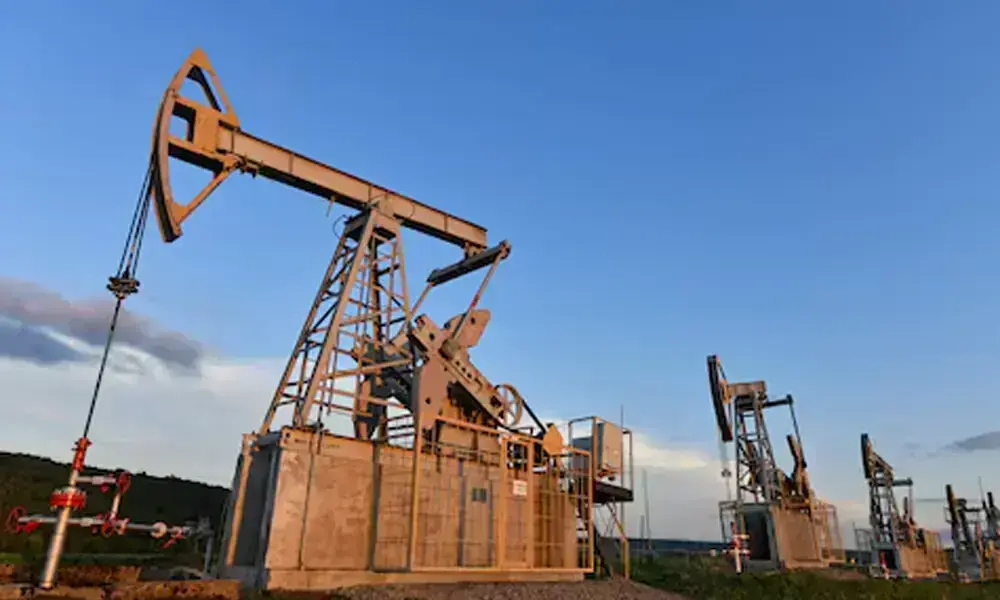
Oil Prices declined on Monday as weakness across global financial markets spread to commodity trading. Concerns about whether artificial intelligence investment can deliver stronger economic growth weighed on investor sentiment, although continuing attacks on shipping in the Gulf limited the decline.
Brent crude futures fell 28 cents, or 0.30%, to $92.29 per barrel by 0216 GMT. US West Texas Intermediate (WTI) crude dropped 15 cents, or 0.18%, to $83.26 per barrel.
Both benchmarks extended their losses after declining for three consecutive weeks. Brent fell 4% last week, while WTI recorded a 5% decline.
Global Market Sell-Off Pressures Crude
The latest decline in oil prices followed a broad sell-off across international financial markets.
Asian equities opened lower on Monday, with South Korea’s technology-heavy stock market falling around 4%. Markets in China, Hong Kong and Australia also declined.
US stocks faced heavy selling last week, with the Nasdaq dropping 10%. Concerns over high valuations and the ability of AI-related investments to generate sufficient returns have weakened risk appetite.
The negative sentiment has also affected commodities, including crude oil.
Gulf Shipping Attacks Limit Oil Price Decline
Despite the downward pressure, escalating tensions in the Middle East continue to threaten oil supplies and shipping routes.
The Houthi movement claimed on Sunday that it had attacked a Saudi Arabian oil refinery. Multiple attacks on commercial shipping were also reported over the weekend in the Gulf and near the Strait of Hormuz.
The shipping disruptions have raised concerns about the movement of crude oil through one of the world’s most important energy transit routes.
US Dollar Greenback Eases From 18-Month High as Market Confidence Recovers
Mukesh Sahdev, chief oil analyst at Sydney-based XAnalysts, said market momentum was driving prices lower. However, he warned that shipping disruptions could eventually push oil prices higher.
He noted that the number of empty vessels waiting to load crude was increasing, while the number of loaded vessels was declining. Such a shift could signal growing pressure on oil supply flows.
COP31 Talks Collapse Over Fossil Fuel Language
Meanwhile, negotiations at the COP31 climate summit in Türkiye collapsed on Sunday after participating countries failed to agree on language addressing the phase-out of fossil fuels.
The disagreement centred on whether the final text should include a commitment to move away from fossil fuel use.
Saudi Arabia and other major oil-producing countries opposed including such language, arguing that fossil fuels would remain part of the global economy for the foreseeable future.
OPEC also defended the continued role of fossil fuels during the summit.
OPEC+ to Decide 2027 Oil Output Policy
Oil markets are also watching upcoming discussions among OPEC+ producers.
Ministers from the group, which includes the Organization of the Petroleum Exporting Countries and allies such as Russia, are scheduled to hold a series of meetings on November 29.
The discussions will focus on the group’s oil production policy for 2027.
The outcome could influence global crude supply expectations as traders balance potential production decisions against geopolitical risks and concerns about the global economic outlook.
You may also like
-
US Dollar Greenback Eases From 18-Month High as Market Confidence Recovers
-
Tata Steel Acquisition Indian Giant to Buy 26.38% Stake in APL Apollo for $1.67 Billion
-
KSE-100 Index PSX Gains Nearly 600 Points in Early Monday Trading
-
THK Accounting Firm Former KPMG Partner Firm Sets Sights on Global Expansion
-
Pakistan Inflation Standard Chartered Warns of 10% Average Rate in FY27