

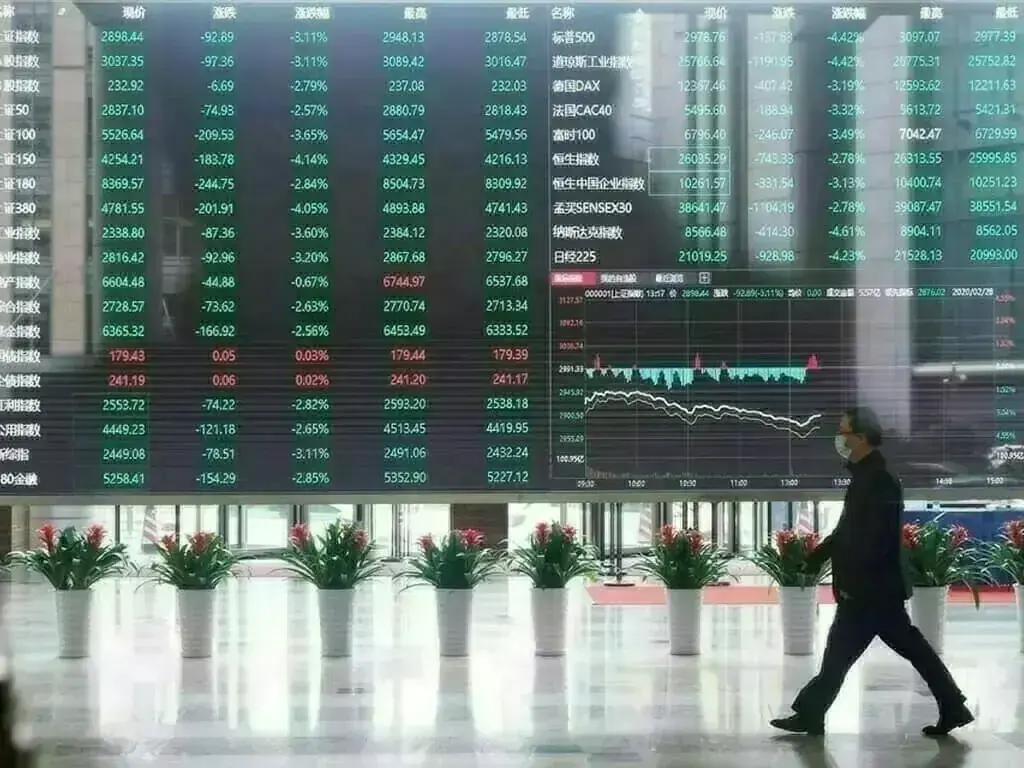
China Stocks fell sharply on Monday, with the Shanghai Composite Index hitting a 16-month low as investors remained concerned about the global sell-off in artificial intelligence and semiconductor shares.
Measures announced over the weekend to support the market, including relaxed margin financing requirements, failed to restore confidence. Investors also faced pressure from fresh US restrictions on advanced chip technology, concerns about China’s domestic economy and the possibility of further US interest rate increases.
Shanghai and Hong Kong Markets Extend Losses
The Shanghai Composite Index dropped 1% in morning trading, falling below the key 3,500-point level and reaching its lowest level since early July 2025.
The blue-chip CSI300 Index declined 0.6%, while Hong Kong’s Hang Seng Index fell as much as 1.8%, touching a 19-month low.
China’s semiconductor industry index lost 5% as global selling pressure intensified following Friday’s decline on Wall Street.
Wang Yapei, a fund manager at Zijie Private Fund, described the latest support measures as inadequate amid the broader global market downturn.
He warned that falling share prices were eroding household wealth and weakening consumer spending.
US Chip Restrictions Add to Technology Sector Pressure
Fresh US restrictions on advanced semiconductor technology have added to concerns among Chinese technology investors.
US President Donald Trump said on Friday that Washington would penalise American companies that build data centres overseas. The announcement marked another move by the administration to restrict China’s access to advanced US chips.
Yuan Yuwei, a hedge fund manager at Trinity Synergy Investments, said the threat had further weakened confidence in the global expansion of computing infrastructure as investors reassessed spending on artificial intelligence.
Trump Meme Coin Interest Fades Ahead of President’s Third Crypto Gala
Washington has also tightened restrictions aimed at closing loopholes that allow China to access powerful US chips. These measures include limits on advanced AI chip exports to several Southeast Asian countries.
The restrictions have increased pressure on Chinese AI companies that depend on access to advanced computing hardware.
Hong Kong Technology Stocks Hit Multi-Month Lows
Hong Kong’s Hang Seng Tech Index, which includes major technology companies such as Alibaba and Tencent, fell to a 26-month low on Monday.
The index was also heading towards its ninth consecutive session of losses.
Higher US Treasury yields have added to the pressure on Chinese and Hong Kong technology stocks by making US assets more attractive to international investors.
Wu Qidi, director of the Yuanda Information Securities Research Institute, said the recent decline partly reflected capital moving back towards the United States.
Yuan Holds Steady as Dollar Remains Strong
China’s onshore yuan remained broadly stable on Monday, trading at around 6.6743 per dollar at midday.
The currency has gained nearly 5% against the US dollar this year. However, expectations of further US interest rate increases have strengthened the greenback, with the dollar index trading near a 20-month high.
Guotai Junan Futures said the weakness in Chinese equities had reduced upward momentum in the yuan.
The firm warned that prolonged losses in Chinese stocks could weaken the appeal of yuan-denominated assets and encourage capital outflows.
Corporate Bond Market Remains Under Pressure
China’s corporate bond market also continued to face uncertainty following weeks of volatility.
Concerns about financial stress at state-owned property developer Huafa Group have kept investors cautious since the company’s difficulties triggered market turbulence in late October.
China’s bond exchange-traded funds remained under selling pressure on Monday, extending a period of weakness in the fixed-income market.
The developments highlight the broader challenges facing Chinese financial markets as investors assess domestic economic conditions, global monetary policy and growing technology-sector restrictions.
You may also like
-
Australian Shares ASX 200 Set to Open Lower as Weak Jobs Data Weighs on Sentiment
-
KSE-100 Index Could Reach 220,000 Points by December 2027, Says Topline Securities
-
KSE-100 Index Gains 610 Points as Pakistan Stock Market Closes Higher
-
Gold Prices in Pakistan Remain Sensitive to Global Market Trends
-
Bitcoin Price Crash: Cryptocurrency Falls 5.1% to $55,830 Amid Global Market Sell-Off