
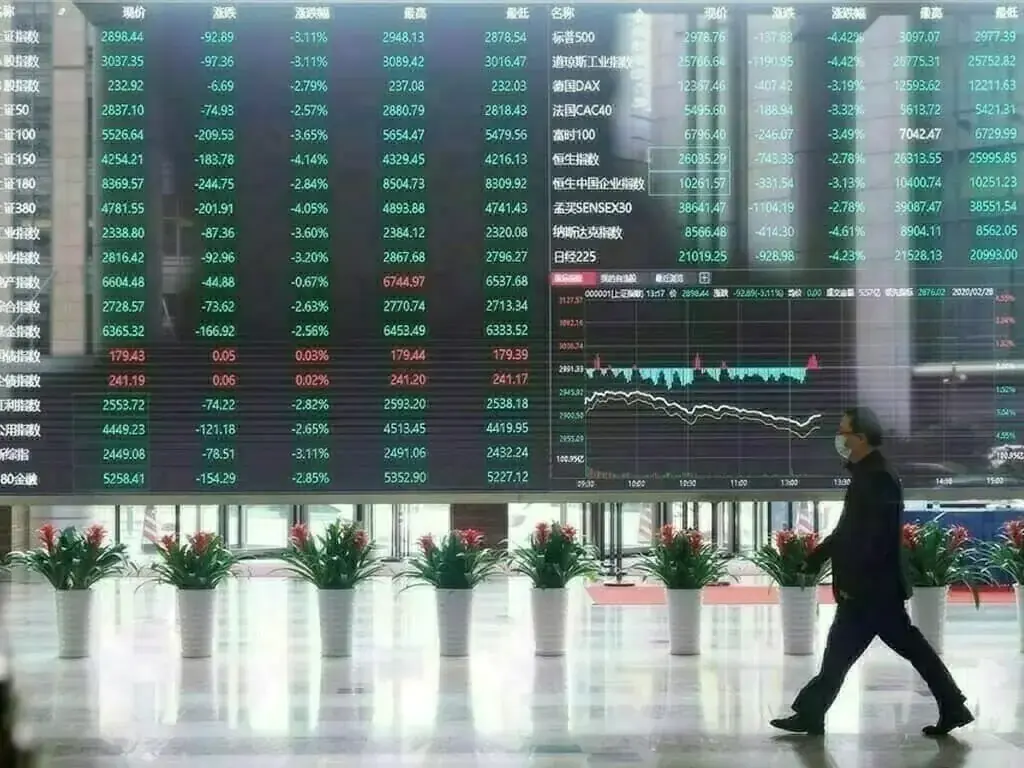
SHANGHAI: The Hong Kong stock market fell sharply on Thursday, with the benchmark Hang Seng Index dropping nearly 2% to its lowest level in four months as renewed tensions between the United States and China weighed on investor confidence.
Mainland Chinese shares also declined, reflecting growing concerns over additional US restrictions on advanced semiconductor exports and the potential impact on China’s artificial intelligence and technology industries.
The sell-off came despite reported diplomatic engagement between Chinese President Xi Jinping and US President Donald Trump in Shenzhen, as investors remained concerned about the possibility of another escalation in trade disputes between the world’s two largest economies.
By the midday trading break, Hong Kong’s Hang Seng Index had fallen 1.9%, reaching its lowest level since late June.
The Hang Seng Tech Index experienced even greater pressure, declining to its weakest level in 26 months as technology companies faced renewed selling.
On mainland exchanges, China’s blue-chip CSI300 Index and the Shanghai Composite Index each dropped approximately 0.4%, touching their lowest levels in more than a year.
Market sentiment deteriorated as investors assessed the potential consequences of increasingly restrictive US trade and technology policies.
Concerns have intensified that Washington and Beijing could enter another cycle of retaliatory trade measures, creating uncertainty for companies operating across international supply chains.
According to the supplied Reuters report, the Trump administration has adopted a tougher position towards China following the Republican Party’s defeat in the US midterm elections.
The changing political environment has added to concerns that trade restrictions could become more extensive, particularly in sectors considered strategically important.
Advanced semiconductors and artificial intelligence technologies have emerged as major areas of tension between the two countries.
Recent developments involving US chipmaker Nvidia have reportedly contributed to tighter export controls on advanced computing equipment.
Such restrictions are intended to limit China’s access to technologies used in developing and training sophisticated artificial intelligence models.
The measures have raised concerns among Chinese technology companies that depend on high-performance computing infrastructure to remain competitive.
Sources cited by Reuters said the Trump administration was considering a requirement for American companies to publicly disclose their use of Chinese artificial intelligence models.
The proposed measure could discourage US businesses from adopting Chinese-developed AI systems and potentially affect the international expansion of Chinese technology providers.
Separately, a US House of Representatives panel requested a briefing from Microsoft on Wednesday following a report concerning the possible use of OpenAI models by Chinese technology company ByteDance through Microsoft’s Azure cloud platform.
The development added to scrutiny of cross-border access to advanced artificial intelligence technologies.
Hong Kong-listed AI developers and major cloud computing companies were among the hardest hit during Thursday’s trading session.
Investors expressed concern that additional restrictions on advanced chips could increase operating costs and slow the development of competitive AI models.
Chinese artificial intelligence company MiniMax declined 8%, reaching a record low.
Other technology companies also experienced substantial losses as investors reduced exposure to businesses considered vulnerable to semiconductor restrictions.
Tencent shares dropped nearly 7%, falling to their lowest level in more than two years.
The decline followed the company’s third-quarter revenue performance, which reportedly fell short of market expectations.
Tencent also warned that new US restrictions on advanced semiconductor exports could slow the training of its artificial intelligence models.
The comments reinforced concerns about the broader impact of technology restrictions on China’s digital economy.
On mainland Chinese exchanges, companies involved in cloud computing, artificial intelligence and big data were among the weakest performers.
These sectors rely heavily on advanced computing chips, making them particularly sensitive to changes in international technology trade policies.
Investors also faced uncertainty surrounding the outlook for US monetary policy.
Expectations of further interest rate increases by the Federal Reserve added pressure to global equity markets, particularly technology stocks.
Higher US borrowing costs can tighten global financial conditions and reduce investor appetite for riskier assets.
They may also increase financing costs and encourage international investors to shift funds towards dollar-denominated investments.
The combination of trade policy uncertainty and tighter monetary conditions contributed to a cautious trading environment across Asian markets.
For Chinese technology companies, the prospect of additional semiconductor restrictions presents challenges extending beyond short-term share price movements.
Limited access to advanced chips could affect investment plans, computing capacity and the pace of artificial intelligence development.
Meanwhile, concerns about further trade retaliation could weigh on broader business confidence and international investment.
The latest market declines highlight the sensitivity of Hong Kong and mainland Chinese equities to developments in US-China relations.
Investors are expected to monitor upcoming trade policy announcements, semiconductor export regulations and Federal Reserve communications for indications of the direction of global financial markets.
With Hong Kong’s benchmark index at a four-month low and technology shares under significant pressure, uncertainty over international trade and monetary policy remains a key concern for regional investors.
You may also like
-
Australian Dollar: Currency Falls as Weak Jobs Data Fuels RBA Rate Cut Expectations
-
US Dollar: Currency Holds Near 19-Month High as Fed Signals Further Rate Hikes
-
Gold Prices: Bullion Holds Near 14-Month Low as Strong Dollar and Fed Rate Outlook Weigh
-
PSX KSE-100 Index: Pakistan Stocks Rebound Nearly 1,200 Points in Early Trading
-
PSX Decline: KSE-100 Index Drops Over 900 Points in Early Wednesday Trading