
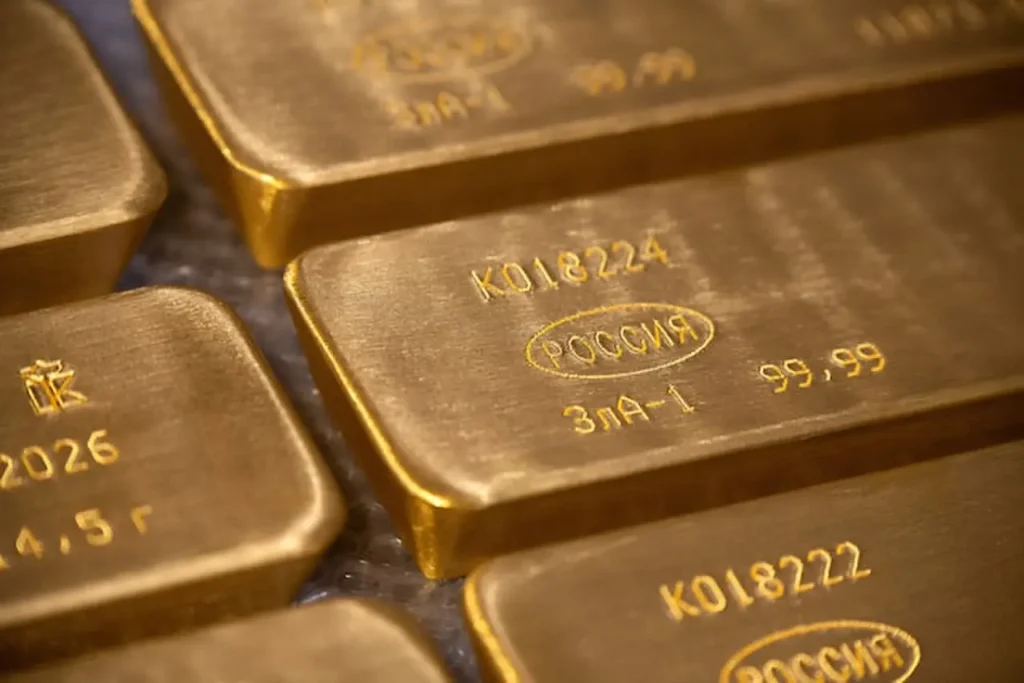
Gold prices remained largely unchanged on Thursday, hovering near their lowest level in 14 months as a stronger US dollar and expectations of another Federal Reserve interest rate increase continued to pressure the precious metals market.
Spot gold was trading at $3,722.84 per ounce as of 0452 GMT, showing little movement after earlier falling to $3,693.13, its lowest level since September 2025.
Meanwhile, US gold futures for December delivery declined by 0.5% to $3,723.90 per ounce.
The subdued performance followed a sharp sell-off in the previous trading session, with investors remaining cautious about the outlook for US monetary policy.
Ilya Spivak, head of global macro at Tastylive, said gold had experienced a brief recovery earlier in the session following the previous day’s substantial losses.
However, he observed that selling pressure had subsequently returned, limiting the precious metal’s ability to sustain gains.
One of the main factors weighing on gold was the strength of the US dollar, which remained near a 19-month high.
A stronger dollar generally makes gold more expensive for buyers holding other currencies, potentially reducing international demand for the dollar-denominated metal.
Investor sentiment was also influenced by expectations that the Federal Reserve could increase interest rates at its December policy meeting.
Minutes from the US central bank’s October 27–28 meeting, released on Wednesday, indicated that policymakers were increasingly concerned about persistent inflationary pressures.
Although officials had agreed to maintain interest rates at their existing level during the meeting, the discussions suggested that additional monetary tightening could become necessary if inflation remained elevated.
Federal Reserve Governor Michael Barr indicated that he was inclined to support tighter monetary policy as inflation continued to present challenges for the US economy.
Similarly, Fed Governor Christopher Waller called for a stronger policy response to persistent price pressures.
The comments reinforced expectations that the central bank could take further action to bring inflation under control.
According to CME Group’s FedWatch tool, financial markets were pricing in a 90% probability of a 25-basis-point interest rate increase in December.
The probability of a larger 50-basis-point increase was estimated at 10%.
Higher interest rates typically reduce the attractiveness of gold because the metal does not generate interest or dividend income.
As borrowing costs and yields on interest-bearing assets rise, investors may prefer alternatives such as government bonds and other fixed-income instruments.
This relationship has contributed to downward pressure on bullion amid expectations of tighter US monetary conditions.
Analysts at OCBC warned that gold’s decline below the $3,800-per-ounce level could reinforce negative market sentiment.
They observed that buying interest remained weak and that continued price declines could increase the risk of further selling by investors.
The break below this level has become an important development for traders assessing the possibility of additional downward movement in gold prices.
Market participants are now awaiting further comments from Federal Reserve officials for indications of the likely direction of US interest rates.
Any changes in inflation expectations, monetary policy signals or movements in the dollar could influence gold’s near-term performance.
Meanwhile, other precious metals recorded mixed movements during Thursday’s trading session.
Spot silver increased by 0.3% to $45.14 per ounce, while platinum remained broadly stable at $1,370.60 per ounce.
Palladium advanced by 0.4% to $952.15 per ounce.
Separately, the World Platinum Investment Council said on Wednesday that the global platinum market was expected to return to a supply deficit next year.
The council attributed the anticipated shortfall to stronger demand for platinum bars and coins, alongside smaller outflows from platinum-backed exchange-traded funds.
The forecast highlighted differences in the supply-and-demand outlook for individual precious metals, even as broader financial market conditions continued to influence prices.
For gold, the immediate market direction remains closely tied to developments in US monetary policy and the strength of the dollar.
With bullion trading near a 14-month low, investors are expected to monitor upcoming Federal Reserve statements and economic indicators for signs of whether the current selling pressure could ease or intensify.
You may also like
-
Hong Kong Stock Market: Hang Seng Falls Nearly 2% as US-China Trade Tensions Hit Tech Shares
-
Australian Dollar: Currency Falls as Weak Jobs Data Fuels RBA Rate Cut Expectations
-
US Dollar: Currency Holds Near 19-Month High as Fed Signals Further Rate Hikes
-
PSX KSE-100 Index: Pakistan Stocks Rebound Nearly 1,200 Points in Early Trading
-
PSX Decline: KSE-100 Index Drops Over 900 Points in Early Wednesday Trading