

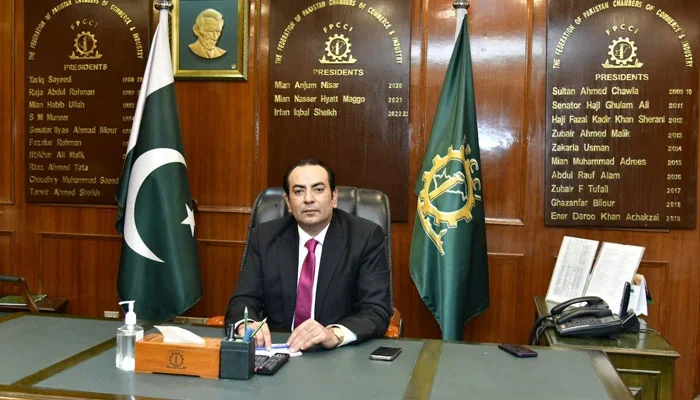
KARACHI: The Federation of Pakistan Chambers of Commerce and Industry (FPCCI) has expressed serious concerns over the Federal Board of Revenue’s (FBR) decision to separate sales tax and income tax administration, warning that the move could weaken efforts to combat tax evasion, increase compliance costs and encourage the expansion of Pakistan’s undocumented economy.
FPCCI President Atif Ikram Sheikh said reversing the unified Inland Revenue administration would undermine an important mechanism for identifying discrepancies in business transactions and detecting potential tax evasion.
He argued that the integrated tax administration system allows authorities to cross-check sales declarations against income records, helping identify businesses that underreport their financial activity.
According to Sheikh, businesses concealing turnover to evade sales tax may also be understating their taxable income.
A unified administrative structure enables tax authorities to compare these records and identify inconsistencies that might otherwise remain undetected.
Separating the two tax functions, he warned, could weaken this cross-verification process and create additional opportunities for businesses operating outside the documented economy.
The FPCCI president also questioned the decision to dismantle the administrative integration framework introduced in 2009.
He noted that Pakistan had invested years of institutional reforms and external financing into developing an integrated tax administration system.
Reversing that structure, he argued, could undermine previous reform efforts without necessarily improving revenue collection.
Sheikh highlighted Pakistan’s domestic tax-to-GDP ratio of approximately 10.3%, describing it as insufficient to meet the country’s fiscal requirements.
He warned that administrative fragmentation could make it more difficult to achieve the government’s target of increasing the tax-to-GDP ratio to 15%.
The FPCCI maintained that improving tax collection should focus on expanding the taxpayer base, strengthening enforcement and addressing weaknesses in revenue administration rather than creating separate bureaucratic structures.
FPCCI Senior Vice President Saquib Fayyaz Magoon also raised concerns about the potential consequences for businesses already operating within the formal tax system.
He said the proposed separation could subject compliant manufacturers, importers and distributors to additional administrative requirements.
Under a divided system, businesses could face separate oversight mechanisms, multiple tax notices and potentially conflicting interpretations of the same commercial transactions.
Magoon warned that two different commissioners examining related business activities could increase uncertainty and create difficulties for taxpayers attempting to comply with existing regulations.
Pakistan Sri Lanka Trade: Exporters Urged to Explore $19 Billion Import Market Under FTA
He argued that the government should prioritise bringing unregistered businesses and undocumented sectors into the tax system rather than placing additional administrative pressure on companies already meeting their obligations.
The FPCCI’s concerns reflect longstanding complaints from the business community regarding the complexity of Pakistan’s taxation framework.
Businesses operating in the documented economy are required to maintain financial records, submit tax returns and comply with multiple regulatory requirements.
Industry representatives argue that additional administrative layers can increase operating costs and divert resources away from productive business activities.
Abdul Mohamin Khan, FPCCI Vice President and Regional Chairman for Sindh, urged the Ministry of Finance and the FBR to reconsider the proposed administrative division.
He called for strengthening institutional capacity, maintaining common transaction records and expanding the use of integrated data analytics.
According to Khan, modern technology and improved coordination between tax authorities could provide more effective tools for identifying evasion and improving revenue collection.
He said the government should focus on improving the existing system rather than introducing structural changes that could complicate compliance procedures.
Khan also warned that duplicating administrative functions could increase costs for documented businesses across the provinces.
He expressed concern that companies could face greater administrative pressure while businesses operating outside the formal economy remained insufficiently monitored.
The FPCCI representative called for meaningful consultation with the business community before implementing changes affecting tax administration.
He stressed that reforms should support ease of doing business, reduce unnecessary regulatory burdens and strengthen Pakistan’s industrial competitiveness.
The business body also raised questions about the performance of domestic sales tax collection compared with taxes collected at the import stage.
FPCCI Vice President Asif Sakhi pointed to a 1.7% decline in domestic sales tax collection alongside a 17% increase in import-stage collections.
He argued that the contrasting trends demonstrated weaknesses in efforts to broaden the domestic tax base.
According to Sakhi, the increase in import-stage collections indicated that documented trade at ports and border entry points was carrying a growing share of the collection burden.
Meanwhile, the decline in domestic sales tax receipts suggested that revenue authorities were struggling to expand effective taxation within the local economy.
The FPCCI maintained that the government should address these structural challenges by improving compliance among unregistered businesses and strengthening domestic revenue enforcement.
The federation argued that placing additional administrative requirements on existing taxpayers would not necessarily resolve the underlying problem of widespread economic informality.
Its representatives emphasised the importance of maintaining coordinated tax records and improving the ability of revenue authorities to monitor commercial transactions across different tax categories.
The concerns come as Pakistan continues efforts to strengthen domestic revenue mobilisation and improve its tax-to-GDP ratio.
Broadening the tax base remains an important policy objective, particularly as the government seeks to increase revenue without placing excessive pressure on existing taxpayers.
However, the FPCCI believes that separating sales tax and income tax administration could work against these objectives if it weakens information sharing and increases compliance complexity.
The federation has therefore urged policymakers to review the proposed changes and consider alternative approaches focused on administrative efficiency, technology and institutional coordination.
The business body called for a tax system that improves revenue collection while providing consistent rules and predictable compliance procedures for manufacturers, importers, distributors and other taxpayers.
The FPCCI’s position represents concerns expressed by business representatives rather than an independent assessment of the proposed restructuring’s likely effects.
The FBR’s detailed rationale for the administrative separation and its response to the federation’s objections were not included in the statement.
The federation reiterated that meaningful consultation and coordinated tax administration would be essential to improving Pakistan’s revenue performance while protecting the competitiveness of documented businesses.
You may also like
-
PSX UNICEF Children’s Rights: Only 3% of Listed Firms Disclose Explicit Commitments, Report Finds
-
Pakistan Sri Lanka Trade: Exporters Urged to Explore $19 Billion Import Market Under FTA
-
AlphaX Brings Zero-Fee Crypto Trading to Pakistan
-
Emirates Tops TIME’s Inaugural World’s Best Airlines 2027 Rankings
-
Commerce Minister Jam Kamal Khan Calls for Stronger Trade and Investment Ties with South Africa