

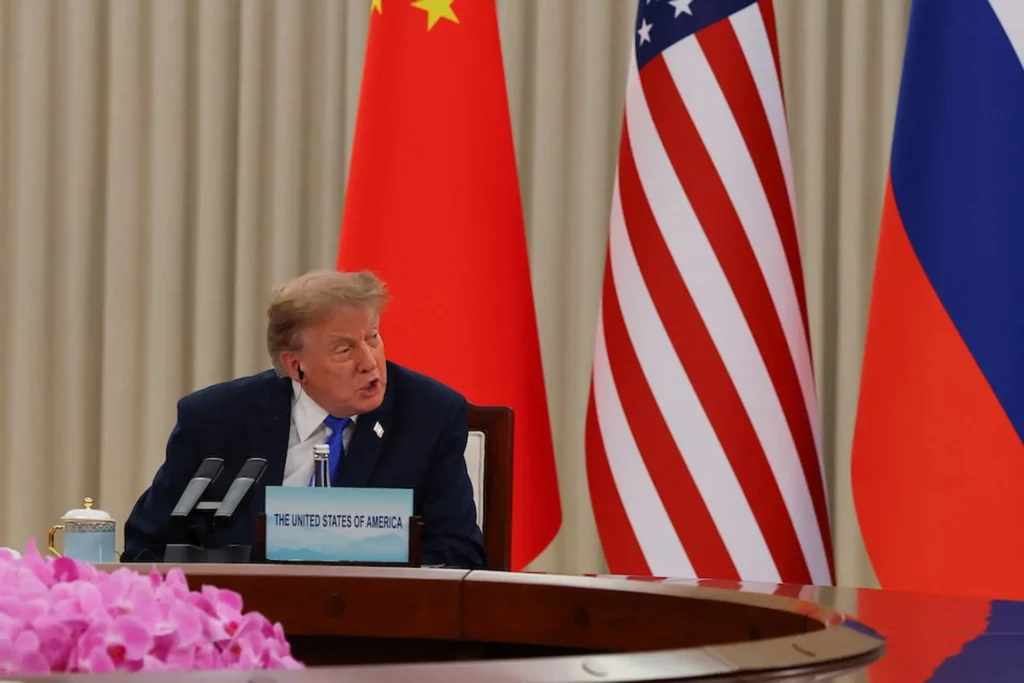
WASHINGTON: US President Donald Trump has acknowledged that reaching a nuclear arms control agreement with China and Russia will be difficult, despite expressing support for efforts to limit nuclear weapons following reported talks with Chinese President Xi Jinping and Russian President Vladimir Putin.
Speaking to Reuters by telephone on Thursday while returning to Washington from a reported trilateral summit in China, Trump said he remained committed to pursuing an agreement but recognised the significant diplomatic and political challenges involved.
The US president described nuclear weapons limitations as an important objective while acknowledging that persuading countries to reduce their arsenals would require difficult negotiations.
Trump said he supported the concept of limiting nuclear weapons but considered the practical process of negotiating reductions particularly challenging for national leaders.
The reported discussions formed part of Trump’s broader diplomatic engagement with China and Russia, with nuclear arms control identified as one of the major priorities of his visit.
Washington has sought to encourage a three-way dialogue involving the world’s leading nuclear powers, although differences in their existing arsenals remain a major obstacle.
China has historically been reluctant to participate in negotiations that would place its nuclear capabilities under restrictions comparable to those affecting the United States and Russia.
Beijing maintains a significantly smaller nuclear arsenal than either Washington or Moscow, although its stockpile has expanded in recent years.
According to estimates cited in the report, China possessed approximately 410 nuclear warheads in 2023.
A separate assessment placed the US nuclear stockpile at around 3,708 warheads, illustrating the substantial difference between the two countries’ nuclear capabilities.
Russia was estimated to possess approximately 5,420 nuclear warheads as of March 2026, making it the world’s largest nuclear power by the measure used in the cited assessment.
US Dollar Index: Currency Holds Near 19-Month High as AI Sell-Off Boosts Safe-Haven Demand
These figures highlight the imbalance that negotiators would need to address when developing any framework for limiting nuclear weapons.
China’s ongoing nuclear expansion has also become an important consideration for US defence and foreign policy officials.
The Pentagon has projected that China’s nuclear arsenal could exceed 1,000 operational warheads by 2030.
The anticipated expansion has raised questions about how future arms control agreements could accommodate countries with substantially different nuclear capabilities and strategic priorities.
For the United States and Russia, negotiations would potentially involve reducing existing stockpiles that are already much larger than China’s.
For Beijing, participation in a broader agreement could involve accepting limitations while its nuclear forces remain considerably smaller than those of the other two powers.
Trump said Xi appeared to share his support for the general concept of nuclear weapons limitations, although he acknowledged that agreement on specific reductions would be difficult.
He illustrated the challenge by referring to the reluctance of nuclear-armed countries to surrender a substantial proportion of their existing weapons.
According to Trump, asking a country with thousands of nuclear warheads to eliminate half its arsenal would present significant political and psychological obstacles.
Despite those concerns, the US president said he intended to continue raising the issue in future discussions.
His comments suggested that the administration views nuclear arms control as a long-term diplomatic objective rather than an agreement likely to be concluded immediately.
The reported talks also addressed the broader importance of reducing nuclear risks and preventing the spread of nuclear weapons.
A joint statement issued following the discussions reaffirmed the leaders’ position that nuclear war must never occur and that no country could emerge victorious from such a conflict.
The statement also expressed support for continued dialogue on nuclear risk reduction and non-proliferation.
However, the announcement did not establish specific limits on nuclear warheads or provide a timetable for negotiating a binding arms control agreement.
The absence of concrete commitments indicates that substantial differences remain over the structure and scope of any future arrangement.
Nuclear arms control agreements typically require extensive negotiations covering verification procedures, transparency measures, weapons limitations and compliance mechanisms.
These issues become more complex when multiple nuclear powers with different military capabilities and security concerns are involved.
Any agreement between Washington, Moscow and Beijing would need to address not only the number of nuclear weapons held by each country but also how restrictions would be monitored and enforced.
The reported discussions nevertheless represent an attempt to establish common ground on a sensitive international security issue.
The United States and Russia possess the overwhelming majority of the world’s nuclear weapons, while China’s expanding capabilities have increased calls for its inclusion in future arms control frameworks.
Trump’s remarks indicate that significant progress may depend on whether the three governments can reconcile their competing strategic interests.
Although the leaders reportedly expressed support for reducing nuclear risks, no formal disarmament commitments were announced.
Further diplomatic engagement will be necessary to determine whether the discussions can develop into a structured negotiation process.
For now, Trump’s commitment to continue pursuing nuclear weapons limitations highlights the importance of arms control in relations between the three major powers, even as the prospects for a comprehensive agreement remain uncertain.
You may also like
-
Trump Executive Order Restricts Federal Contractors From Sharing Information With Congress
-
Autonomous Weapons Regulation: UN Talks End Without Binding Agreement on ‘Killer Robots’
-
Saudi Arabia Houthi Conflict: Coalition Strikes Yemen’s Hodeidah Port as Retaliation Threats Escalate
-
Nikhil Gupta Sentenced to 19 Years in US Prison Over Sikh Separatist Murder Plot
-
Global Energy Crisis: IEA Warns Middle East Conflict Poses Historic Threat to Energy Security