
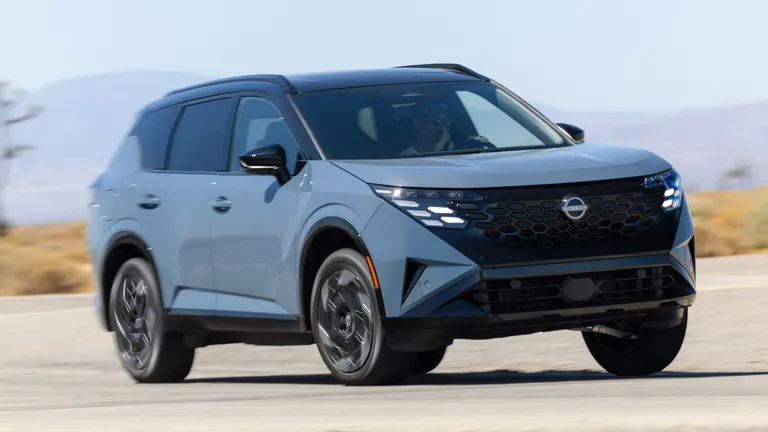
The 2027 Nissan Rogue Hybrid is the quickest version of the compact SUV tested so far, delivering stronger acceleration, improved refinement and competitive performance against rivals such as the Toyota RAV4 Hybrid and Honda CR-V Hybrid.
Powered by Nissan’s latest e-Power system, the new Rogue Hybrid produces a combined 225 horsepower through its front and rear electric motors. The front motor generates 243 lb-ft of torque, while the rear motor produces 144 lb-ft. This represents a significant improvement over the current petrol-powered Rogue, which delivers 201 horsepower, and the previous Rogue Pure Drive Hybrid, rated at 170 horsepower.
In testing, the 2027 Rogue Hybrid SR AWD accelerated from 0 to 60 miles per hour in just 6.2 seconds. That makes it considerably quicker than previous Rogue models, including the 2008 Rogue SL with front-wheel drive, which recorded 8.0 seconds, and a more recent AWD Rogue Rock Creek that completed the same run in 8.8 seconds.
The new model also outperformed its main competitors. The hybrid-only Toyota RAV4 completed the 0–60 mph sprint in 7.0 seconds, while the Honda CR-V Hybrid recorded 7.6 seconds.
Much of the Rogue Hybrid’s performance comes from its distinctive e-Power technology. Its front and rear electric motors draw power from a 1.67-kWh battery, which is charged by a 1.5-litre three-cylinder petrol engine producing 148 horsepower and 171 lb-ft of torque. Unlike conventional hybrids, the engine does not directly drive the wheels or connect to them through a transmission. Instead, it operates as a generator when additional electricity is needed and shuts down when the battery has sufficient charge.
This arrangement gives the Rogue Hybrid an electric-vehicle-like driving experience, with smooth and immediate power delivery. Nissan has also improved cabin quietness through sound insulation and engine isolation, addressing a weakness identified in previous Rogue models.
The SUV features an e-Pedal mode that enables one-pedal driving, allowing the vehicle to slow down and stop through regenerative braking. The transition between regenerative and conventional friction braking is also smooth, with a naturally weighted brake pedal.
Google Malaysia: Tech Giant Announces $15 Billion Investment in Data Centres and Clean Energy
Braking performance is another strong point. The Rogue Hybrid stops from 60 mph in 119 feet, outperforming the Toyota RAV4 at 124 feet and the Honda CR-V Hybrid at 123 feet. It also improves on previous Rogue models, which required between 125 and 129 feet to stop from the same speed.
The vehicle’s handling further strengthens its position in the segment. Its steering offers good feedback and stability, while the chassis remains composed through corners, although some body roll is noticeable during more aggressive driving.
On the test track, the Rogue Hybrid completed the figure-eight course in 26.7 seconds. The Toyota RAV4 Limited recorded 27.6 seconds, while the Honda CR-V Hybrid Sport Touring took 27.9 seconds. The result also improves on the previous Rogue Hybrid, which recorded 28.7 seconds, and recent petrol-powered models that completed the course in just under 28 seconds.
Around town, the Rogue Hybrid delivers a quiet and comfortable ride, with effective insulation against road noise and the ability to absorb most small and medium-sized bumps. However, rougher road surfaces can still produce noticeable vibrations inside the cabin.
Fuel efficiency remains an area where Nissan trails its most efficient competitor. The Rogue Hybrid is rated at 40 miles per gallon in city driving, 36 mpg on the highway and 38 mpg combined. By comparison, the 2026 Toyota RAV4 AWD achieves up to 46 mpg in the city, 39 mpg on the highway and 42 mpg combined. The Rogue, however, edges out the Honda CR-V AWD Hybrid, which is rated at 40/34/37 mpg.
The Rogue Hybrid offers an estimated driving range of 532 miles per tank, placing it between the Toyota RAV4’s 609 miles and the Honda CR-V Hybrid’s 518 miles. Despite its lower fuel economy than the Toyota, its performance and overall refinement help offset the difference.
Beyond its powertrain, the 2027 Rogue Hybrid features distinctive exterior styling that separates it from the petrol-powered version and other compact SUVs. Its interior is also well equipped, with an available 12.3-inch digital instrument cluster and a 14.3-inch central display, along with a conventional dashboard layout and physical controls for the heating and air-conditioning system.
Other features include dual magnetic wireless phone chargers, comfortable seating in both rows and a flexible cargo area with a movable floor. However, the centre console’s textured finish may be prone to scuffing.
Nissan’s available ProPilot Assist system adds further convenience, offering lane-centering assistance and visual information from the vehicle’s cameras and sensors. The system has also evolved to provide greater support during long journeys, although activating it changes the instrument cluster display.
The 2027 Rogue Hybrid starts at $37,065 for the SV trim, which includes the all-wheel-drive e-Power system. The SR trim starts at $39,065 and adds further comfort features and sportier styling. The tested SR model, equipped with the Technology package, costs $43,065 and includes larger displays, front and rear parking sensors, a 360-degree camera system and the full ProPilot Assist suite.
The top Platinum trim costs an additional $2,000, making the Technology-equipped SR a more attractive option for buyers seeking advanced features without paying for the highest trim level.
Compared with its competitors, the Rogue Hybrid remains competitively priced. The all-wheel-drive Toyota RAV4 XSE starts at $42,895, while the Honda CR-V Sport-L Hybrid with all-wheel drive costs $42,175.
Although the Toyota offers better fuel economy and the Honda comes in at a slightly lower price, the Rogue Hybrid stands out with its electric-like driving experience, quicker acceleration and refined performance. Nissan’s latest hybrid SUV therefore makes a strong case for buyers looking for a balance of performance, comfort and technology.
You may also like
-
Pakistan Auto Policy Ghandhara Delays T9 Hunter PHEV Launch, Plans D-Max ADAS Upgrade
-
GM Settlement: $220 Million Deal Raises Questions Over Drivers’ Personal Data
-
Tesla FSD: South Korea Consumer Group Seeks Ban Over Unusable Software Sales
-
Hydrogen Technology: Hyundai Unveils Autonomous Refuelling Robot for Commercial Vehicles
-
Islamabad’s Kashmir Chowk Underpass Completed in Record 27 Days