
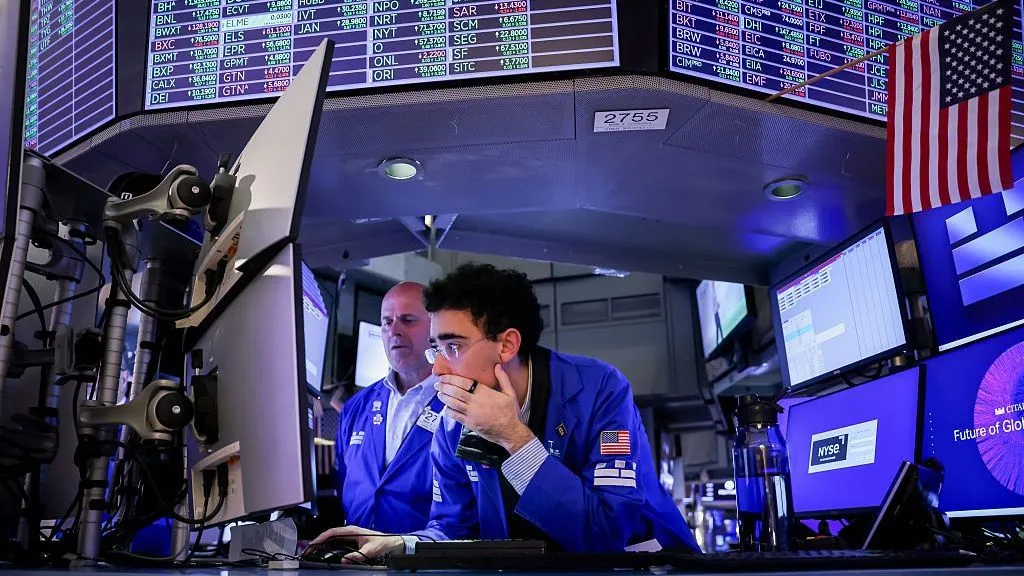
Trillions of dollars have been wiped off the market value of major technology companies across the United States, Europe and Asia following a global stock sell-off triggered by concerns that the US midterm election results could slow the expansion of artificial intelligence (AI).
In the United States, the technology-heavy Nasdaq Composite fell 5.5% on Thursday, erasing an estimated $2.5 trillion (£1.9 trillion) in market value. Other major US stock indexes also recorded substantial losses.
Investors are increasingly concerned that Democratic lawmakers could push for tougher regulation of artificial intelligence and restrictions on the construction of data centres needed to power the technology. The sell-off has also intensified existing doubts about whether the enormous sums being invested in AI infrastructure will generate sufficient returns.
The so-called Magnificent Seven technology companies, including Apple, Nvidia and Tesla, collectively lost around $1 trillion in market value during Thursday’s trading session.
Nvidia shares plunged more than 9%, while other chipmakers suffered even steeper losses. Advanced Micro Devices (AMD) and Micron Technology both fell more than 17%.
Shares in Elon Musk’s companies also came under pressure. SpaceX shares fell 8%, while Tesla declined nearly 11%, wiping more than $300 billion off their combined market value.
Musk had spent nearly $450 million supporting Republican campaigns, including at least $45 million backing Ken Paxton’s campaign for a Texas Senate seat. However, Texas turned Democratic during Tuesday’s election results.
The technology sell-off extended into Europe, where semiconductor manufacturer Infineon lost more than 8.5% and chipmaking equipment supplier ASML declined 6.5%.
Asian markets suffered further losses on Friday. Japan’s Nikkei index closed 6% lower as memory chipmaker Kioxia and technology equipment manufacturer Tokyo Electron recorded significant declines.
In South Korea, SK Hynix shares fell more than 10%, while Samsung Electronics declined 6.4%. The benchmark KOSPI index ended the session down 6%.
MarketWatch chips analyst Britney Nguyen described the losses as a continuation of concerns surrounding the scale of investment in AI infrastructure.
Data centre expansion faces political pressure
Democratic candidates across the United States campaigned on slowing the expansion of data centres and artificial intelligence. Dozens of ballot measures across the country also sought to restrict the development of facilities considered essential to powering AI systems.
The Democrats secured control of both the Senate and the House of Representatives in Tuesday’s midterm elections, giving them control of Congress for the remainder of President Donald Trump’s term.
Paraguay Crisis: President Pena Faces Impeachment After Bank Takeover Triggers Protests
Texas Democratic governor-elect Gina Hinojosa also campaigned against data centre expansion, pledging a moratorium on new construction in the sector.
Trump blamed his political opponents for Thursday’s stock market decline. In a post on social media, he described it as one of the worst trading days in history based on the election results and insisted that the US economy would emerge stronger.
Later on Thursday, he again criticised Democratic voters in a post on Truth Social, attributing the market decline to the party’s election gains.
Democratic lawmakers have argued that the AI industry has expanded without adequate safeguards and oversight. They have pledged to use their new congressional influence to push for stronger protections.
Democratic Senator Bernie Sanders called for a national moratorium on data centre construction, arguing that major technology companies should not be allowed to damage the environment, threaten jobs or put the future at risk.
Susannah Streeter, chief investment strategist at Wealth Club, said the sharp decline on Wall Street had sent shockwaves through international markets.
“Fresh panic over the AI trade has hit Wall Street hard,” she said, adding that concerns over whether massive AI infrastructure investments would deliver expected returns were now colliding with the possibility of a significant slowdown in data centre construction.
Technology leaders acknowledge growing backlash
Some technology executives have admitted that the industry underestimated public opposition to data centre expansion.
OpenAI president and co-founder Greg Brockman said the reaction to data centres had surprised many industry participants and highlighted the need for technology companies to engage more closely with local communities.
Speaking at the Wall Street Journal’s Tech conference in Napa, California, on Wednesday evening, Brockman said companies could not simply announce that infrastructure projects would benefit communities. Instead, they needed to build relationships with residents in areas where they planned to develop facilities.
Meta President Dina Powell McCormick also acknowledged that the industry needed to make a stronger case for artificial intelligence and explain its potential benefits to the public.
“I think we need to double and triple down on telling the story,” she told the conference.
Beyond the immediate political consequences of the US midterm elections, investors are also questioning whether technology shares have become overvalued amid the AI investment boom. Growing concerns that the sector may be in a bubble have added to expectations of a market correction.
You may also like
-
Paraguay Crisis: President Pena Faces Impeachment After Bank Takeover Triggers Protests
-
Ukraine Attack: Russian Drone Strike Injures Three in Dnipro
-
South Korea: Government to Monitor US AI Policies and Tariff Changes After Midterms
-
US Democrats: Can They Deliver Lower Costs After Sweeping Midterm Victory?
-
JD Vance: Vice-President Blames Iran War for Republican Midterm Defeat
1 thought on “AI Stocks: Trillions Wiped Off Tech Giants as US Election Sparks Sell-Off”
Comments are closed.