
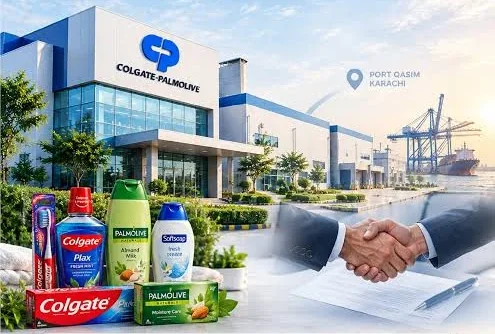
Colgate-Palmolive (Pakistan) Limited has agreed to buy Procter & Gamble Pakistan’s manufacturing facility at Port Qasim, Karachi, marking a major shift in Pakistan’s consumer goods industry.
The company disclosed the agreement to the Pakistan Stock Exchange on October 28. The asset purchase agreement covers the land, manufacturing facility and related assets at the 58-acre site.
The companies have not disclosed the transaction value. Completion remains subject to approval from the Competition Commission of Pakistan (CCP).
Colgate’s board approved negotiations on May 14. However, its annual report for the year ended June 30 stated that the company had not signed an agreement when it approved the financial statements. The deal was finalised five months later.
P&G’s Long Investment in Pakistan Manufacturing
Procter & Gamble entered Pakistan on August 5, 1991, initially importing cleaning products. For much of its early presence, the company operated mainly as a marketing office, distributing imported goods through local partners.
Over its first 25 years, P&G invested around $150 million in local manufacturing. Ariel became its first product manufactured in Pakistan.
South African Rand: Currency Gains as Lower Oil Prices Ease Inflation Concerns
The company later established a plant in Hub, Balochistan, which produced Safeguard soap. By 2019, the facility was exporting products to 20 European countries.
P&G expanded its local manufacturing footprint further in 2019. It announced a $50 million investment to produce Pantene and Head & Shoulders shampoos at its Port Qasim facility.
By 2024, more than 98% of P&G Pakistan’s revenue came from locally manufactured products, compared with less than 25% in 2010. Imported raw materials accounted for less than 5% of its production costs.
Why Colgate-Palmolive Is Expanding Capacity
Colgate-Palmolive has the financial resources and existing manufacturing capacity to support the acquisition.
The company holds Rs31.6 billion in cash and investments, while its own manufacturing plants operate at approximately 85% capacity. This leaves room for additional production without requiring immediate construction of new facilities.
The Port Qasim acquisition would give Colgate access to an established manufacturing site as P&G winds down its direct operations in Pakistan.
P&G is shifting towards a third-party distributor model as part of a wider global restructuring. The sale therefore offers Colgate an opportunity to expand its manufacturing footprint while its rival changes its local business model.
CCP Approval Remains the Final Hurdle
The transaction would consolidate manufacturing capacity within Pakistan’s consumer goods sector following P&G’s decision to scale back its local presence.
However, the assets cannot change hands until the Competition Commission of Pakistan completes its review and grants the required approval.
The outcome will determine when Colgate-Palmolive can take control of the Port Qasim facility and incorporate it into its manufacturing operations.
You may also like
-
Saudi and Pakistani Investors Sign MoU to Launch Saudi–Pak Private Equity Fund
-
South African Rand: Currency Gains as Lower Oil Prices Ease Inflation Concerns
-
Petrol Prices: Government Cuts Fuel Rates by Rs7.06 Per Litre
-
Pakistan Inflation: Tomato Prices Push Weekly SPI Higher Despite Cheaper Fuel
-
Crypto Prices: Bitcoin and Ether Hit Lowest Levels Since August Amid US Regulatory Fears
1 thought on “Colgate-Palmolive Buys P&G Port Qasim Factory After Exit”
Comments are closed.