
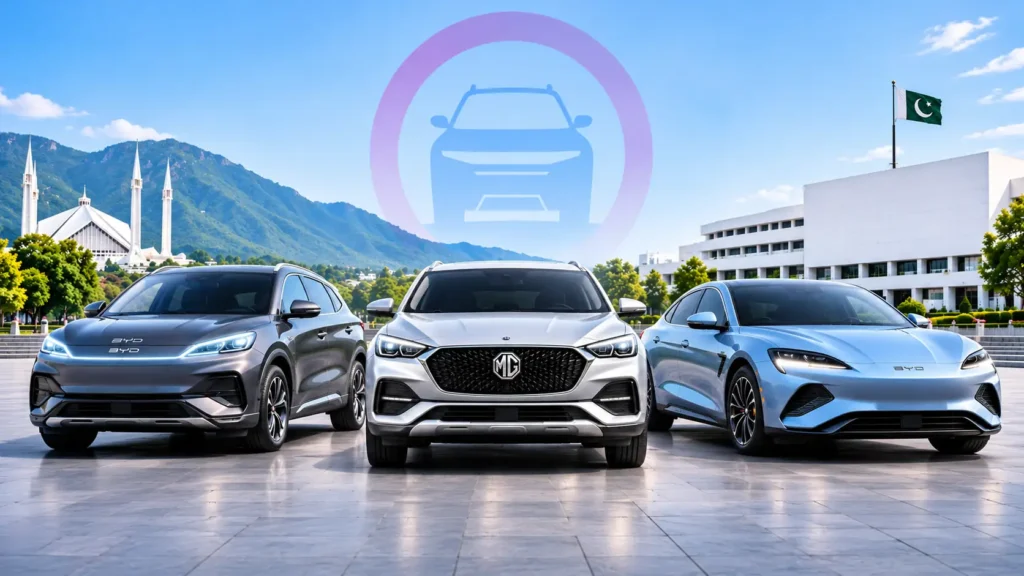
KARACHI: Pakistan’s new Auto Policy 2026-31 promises lower vehicle prices, improved safety standards and incentives for electric vehicles (EVs), but its biggest benefits are likely to reach a relatively small segment of car-owning households, while the majority of the population may see limited gains.
The assessment was presented by Bilawal Suhag, Head of Research at the Federation of Pakistan Chambers of Commerce and Industry (FPCCI), during a virtual workshop organised by LENS (Learning, Ethics, Networking and Support for Media) on Saturday.
Addressing journalists, Suhag said public policy should be evaluated on whether it enables people to travel to work, educational institutions and healthcare facilities affordably and safely.
According to his analysis, Pakistan has a population of 241.5 million, living in approximately 40 million households with an average monthly income of Rs82,000. Only 6.6% of households own a car, while around 57% own a motorcycle. An estimated 41% of the population, or between 99 million and 125 million people, do not own any vehicle.
“The people who gain most are the fewest; the largest group gains least,” his presentation concluded.
The policy was unveiled on November 7 by Information Minister Attaullah Tarar and Haroon Akhtar Khan after Prime Minister Shehbaz Sharif approved a revised draft in October. However, it still requires Federal Cabinet approval and formal notification. Suhag cautioned that the final provisions could differ from the figures reported so far.
Under the proposed framework, tariffs on completely built-up vehicles and completely knocked-down (CKD) kits will gradually decline to 15% by FY2030-31 under a simplified four-tier customs structure of 0%, 5%, 10% and 15%. Regulatory and additional customs duties are also scheduled to be abolished by FY31.
Electric vehicles will receive reduced sales tax rates ranging from 1% for battery-electric vehicles to 9% for plug-in hybrids. The financing limit for EV purchases will also increase from Rs3 million to Rs10 million.
The policy includes measures intended to strengthen consumer protection. Advance payments at the time of vehicle booking will be capped at 20% of the purchase price to discourage the practice of charging premiums, commonly known as “on-money”.
Additionally, 45 new safety standards based on the United Nations WP.29 framework will apply to locally manufactured and imported used vehicles.
However, the government plans to introduce an Automotive Development Levy (ADL) to finance the policy’s initiatives. The proposed levy will stand at 2% for vehicles with engine capacities between 1,001cc and 2,000cc, rising to 10% for vehicles above 2,000cc.
The levy is expected to generate Rs232 billion over five years, with most of the funds directed towards export incentives. The government’s central objective is to increase automotive exports from $200 million to $6 billion.
Suhag argued that the policy offers limited direct support to the groups most dependent on affordable transport. Duties on locally manufactured components for electric motorcycles and rickshaws will decline from 30% to 15%, but the proposed framework does not include a specific comparable measure for petrol-powered motorcycles.
Buses and trucks will also face a 2% levy, while no corresponding incentive for electric buses has been reported. He highlighted Karachi’s public transport shortage, noting that the city has 1,029 buses against an estimated requirement of 15,000.
He also questioned whether ordinary consumers would experience substantial reductions in vehicle prices, saying that lower tariffs alone would not guarantee affordability.
“I do not expect a major drop for ordinary buyers,” Suhag said, adding that actual price reductions would depend on market competition and exchange-rate stability.
Concluding his presentation, he said Pakistan’s transport policy should focus on moving more people rather than simply increasing the number of cars on the road.
You may also like
-
Indus Motor Sales: Toyota Assembler Records 10% Decline in October
-
Pakistan Auto Policy Ghandhara Delays T9 Hunter PHEV Launch, Plans D-Max ADAS Upgrade
-
GM Settlement: $220 Million Deal Raises Questions Over Drivers’ Personal Data
-
Tesla FSD: South Korea Consumer Group Seeks Ban Over Unusable Software Sales
-
Hydrogen Technology: Hyundai Unveils Autonomous Refuelling Robot for Commercial Vehicles