

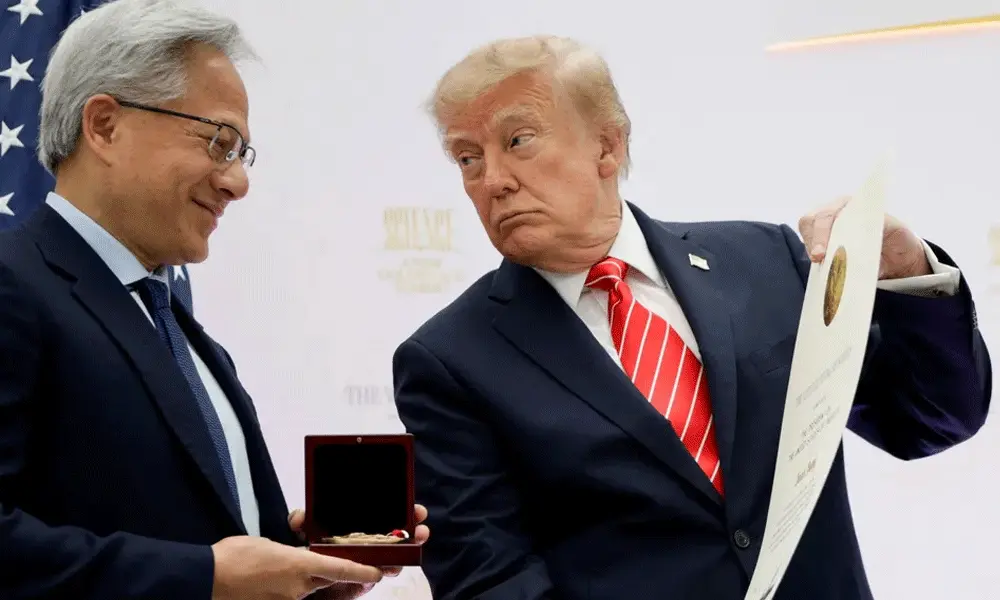
Nvidia has reinstated Jensen Huang as its president and chief executive officer (CEO), less than two weeks after his resignation amid revelations about extramarital affairs and concerns over possible foreign intelligence links.
The company announced the decision on November 23, 2026, following pressure from US President Donald Trump, industry leaders and investors. Nvidia’s board voted unanimously to bring Huang back after discussions with him and input from senior US government officials. The board said it was confident his return posed no national security risk. <Cite refs={[“turn573533search0″,”turn573533news34”]}/>
Huang’s return marks a dramatic reversal. On November 17, board chair Harvey Jones had said Nvidia did not intend to reinstate him. The board had initially appointed Chief Financial Officer Colette Kress as interim CEO following Huang’s departure.
Nvidia Shares Surge After Huang’s Return
The announcement lifted investor sentiment and sent Nvidia shares sharply higher. The stock closed up 31.5%, adding nearly $1 trillion to the company’s market value.
The rally restored Nvidia’s position as the world’s second-largest company by market capitalisation, behind Apple. However, the gains did not fully offset the losses recorded since Huang’s resignation on November 12.
Huang said he was honoured to return and looked forward to resuming his work. Employees welcomed him back at the company’s headquarters.
Governance experts, however, questioned the board’s independence after its sudden reversal.
James St. Aubin, chief investment officer at Ocean Park Asset Management, said the decision raised concerns about corporate governance in the United States. He argued that highly influential executives could face different standards because of their perceived importance to a company.
Trump Backs Huang as Lawmakers Raise Concerns
Trump publicly supported Huang’s return and told CNBC that his intervention played an important role in securing the decision.
The president also confirmed that he had spoken to the Nvidia chief and urged the company to maintain compliance with US export controls.
Trump owns Nvidia shares valued between $11 million and $55 million, according to his financial disclosures. The rise in the company’s stock price could have increased the value of his holdings by as much as $17 million.
A White House spokesperson said independent financial institutions manage Trump’s investment portfolio. The spokesperson added that neither the president nor his family could direct investment decisions.
Lawmakers from both parties criticised the reinstatement and called for stronger safeguards over advanced chip exports to China.
Senate Minority Leader Chuck Schumer accused Trump of putting personal financial interests ahead of national security. Republican Senator Pete Ricketts also said Huang’s return did not remove the need for Nvidia to answer questions about national security and unaccounted-for chips.
Some lawmakers urged Congress to pass the proposed Chip Security Act. The bill aims to prevent legally exported advanced chips from reaching China through unauthorised channels.
Nvidia Faces Scrutiny Over China Chip Exports
Huang’s return comes as Nvidia faces growing scrutiny in Washington over its business with China.
US authorities have tightened licensing requirements for certain advanced chip shipments and overseas data centres serving Chinese companies. Lawmakers are also preparing to question Nvidia’s leadership over export controls.
Huang has agreed to testify at a public US Senate hearing on December 3, according to the Senate Banking Committee.
NBP Exchange Rates for November 24, 2026
Trump said he had discussed Huang with Chinese President Xi Jinping during a recent visit to Shenzhen. He also said he had urged Nvidia to strengthen its export-control compliance.
Huang’s departure had reportedly unsettled Nvidia’s Chinese customers. Some buyers cancelled orders or delayed purchases, putting billions of dollars in potential revenue at risk.
The US government also added Megaspeed, Alice Huang’s former employer, and Alibaba’s Singapore subsidiary to its trade blacklist. Both entities have faced scrutiny over alleged links to the movement of restricted Nvidia chips.
Alibaba rejected allegations that its subsidiary diverted chips in violation of US export restrictions. Megaspeed has also maintained that its business activities were legitimate and complied with US rules.
Singapore Prime Minister Lawrence Wong said the country would continue investigating Megaspeed. US and Singaporean law enforcement agencies conducted an on-site visit in 2025 and interviewed Alice Huang.
Investigations Into Nvidia Will Continue
Nvidia’s board has established an independent committee to investigate whether foreign intelligence operations targeted Huang.
A separate committee will oversee national security and export-control matters. The company has also said it will continue cooperating with government investigations and inquiries.
The investigations come as Nvidia faces several other challenges. These include probes into potential accounting irregularities and suspected chip smuggling.
The company and Huang also face a shareholder lawsuit. It accuses them of misleading investors by concealing Huang’s alleged relationship with Alice Huang.
Nvidia’s board has not publicly detailed the personal allegations surrounding Huang. He has acknowledged being unfaithful to his wife and apologised to his family, but has not addressed the alleged individual relationships in detail.
The board’s reinstatement decision does not end the investigations. Instead, Huang returns to lead Nvidia while questions over corporate governance, export controls and national security remain unresolved.
You may also like
-
FPCCI Challenges Gas Tariff Claims by SNGPL and SSGC, Seeks OGRA Review
-
Saudi Arabia Attack: Houthis Strike Riyadh Financial District as PM Shehbaz Condemns Assault
-
Bitcoin Hits Two-Year Low, at $55,830, Amid Global Market Turmoil
-
Petrol Prices: Government Cuts Petrol by Rs1, Raises Diesel by Rs2 Per Litre
-
Pakistan Offshore Oil Exploration: Turkish Seismic Vessel Oruç Reis Arrives in Karachi