
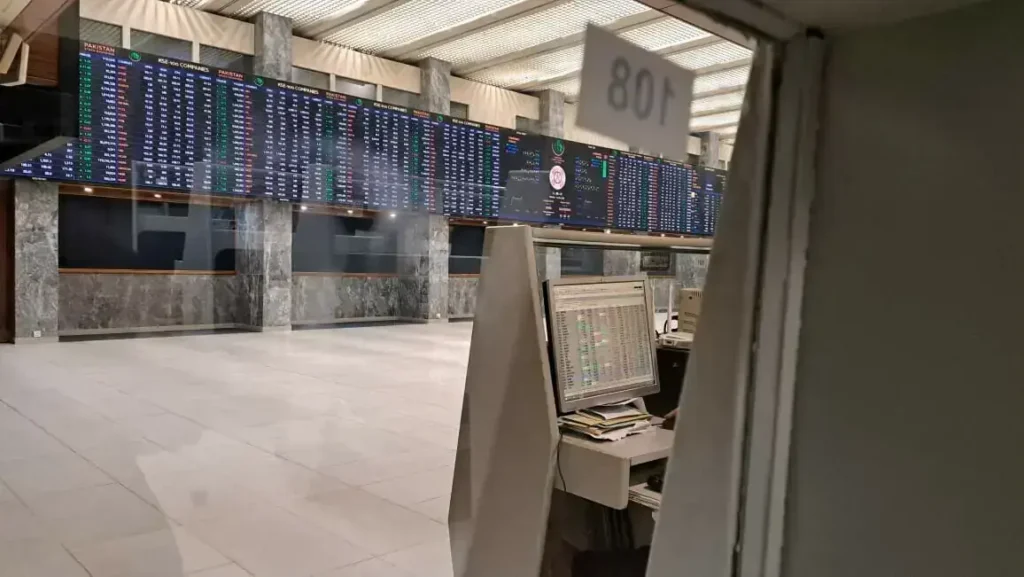
KARACHI: The Pakistan Stock Exchange (PSX) came under selling pressure on Wednesday as concerns over continued attacks on shipping in the Strait of Hormuz weighed on investor sentiment, pushing the benchmark KSE-100 Index down more than 500 points during the opening minutes.
At 9:45am, the benchmark index stood at 178,812.16 points, down 523.08 points, or 0.29%.
Selling emerged across major sectors, including automobile assemblers, cement, commercial banks, oil and gas exploration companies and oil marketing companies (OMCs).
Index-heavy stocks, including Hub Power Company (HUBCO), Sui Southern Gas Company (SSGC), Mari Petroleum, Pakistan Petroleum Limited (PPL), MCB Bank, Meezan Bank, National Bank of Pakistan (NBP) and United Bank Limited (UBL), traded in negative territory.
The decline followed a strong rally on Tuesday, when broad-based buying lifted investor confidence amid improving geopolitical sentiment after US President Donald Trump made remarks about prospects for peace.
The KSE-100 Index had surged 5,448.56 points, or 3.13%, to close at 179,335.24 points.
In international markets, bonds came under pressure and the US dollar remained firm after stronger-than-expected inflation data and hawkish comments from Federal Reserve officials increased concerns about further interest rate increases.
Data showed that US core inflation rose 0.3% month-on-month in October, exceeding the market forecast of 0.2%.
Before the release, Federal Reserve Governor Christopher Waller said a 0.3% core inflation reading would prompt him to consider a 50-basis-point rate increase at the central bank’s December meeting.
Oil Prices: Brent Rises to $92 as Hormuz Shipping Attacks Fuel Supply Concerns
Dallas Fed President Lorie Logan said two further rate increases were necessary and could come rapidly. Chicago Fed President Austan Goolsbee warned of a significant inflation challenge, while Philadelphia Fed President Anna Paulson supported a gradual approach to rate increases.
Fed funds futures indicated that a quarter-point increase was almost fully priced in, with a 10% probability of a larger 50-basis-point move. Markets also priced in three quarter-point increases by the middle of next year.
Asian equity markets showed mixed performance despite the pressure on Wall Street. MSCI’s broadest index of Asia-Pacific shares outside Japan rose 0.2%, while Japan’s Nikkei gained 0.6%.
South Korea’s KOSPI advanced 0.4%, whereas China’s blue-chip index declined 0.2%.
SoftBank Group shares fell 3.3% after the company reported a net loss of $7 billion in the second quarter, partly reflecting substantial investment in US data centre infrastructure.
US and European equity futures also recovered, with Nasdaq futures rising 0.5%, S&P 500 futures gaining 0.2% and European stock futures advancing 0.6%.
Meanwhile, Nvidia remained under scrutiny amid reports that the company was investigating whether its chief executive, Jensen Huang, had been targeted by a foreign intelligence operation. Its shares dropped 5.5% overnight, extending losses from their recent peak to 30%.
You may also like
-
SBP Policy Rate: Central Bank Highlights Inflation Risks and Economic Resilience in FY26
-
SIFC Investment: Pakistan Reports $20 Billion China Portfolio and $2.3 Billion Saudi Inflows
-
Pakistan IT Exports: Monthly Earnings Hit Record $453 Million in October 2026
-
Pakistan REER: Rupee’s Real Effective Exchange Rate Hits Nearly Nine-Year High
-
Electricity Prices: CPPA-G Seeks Rs2.88 Per Unit Increase for October 2026