

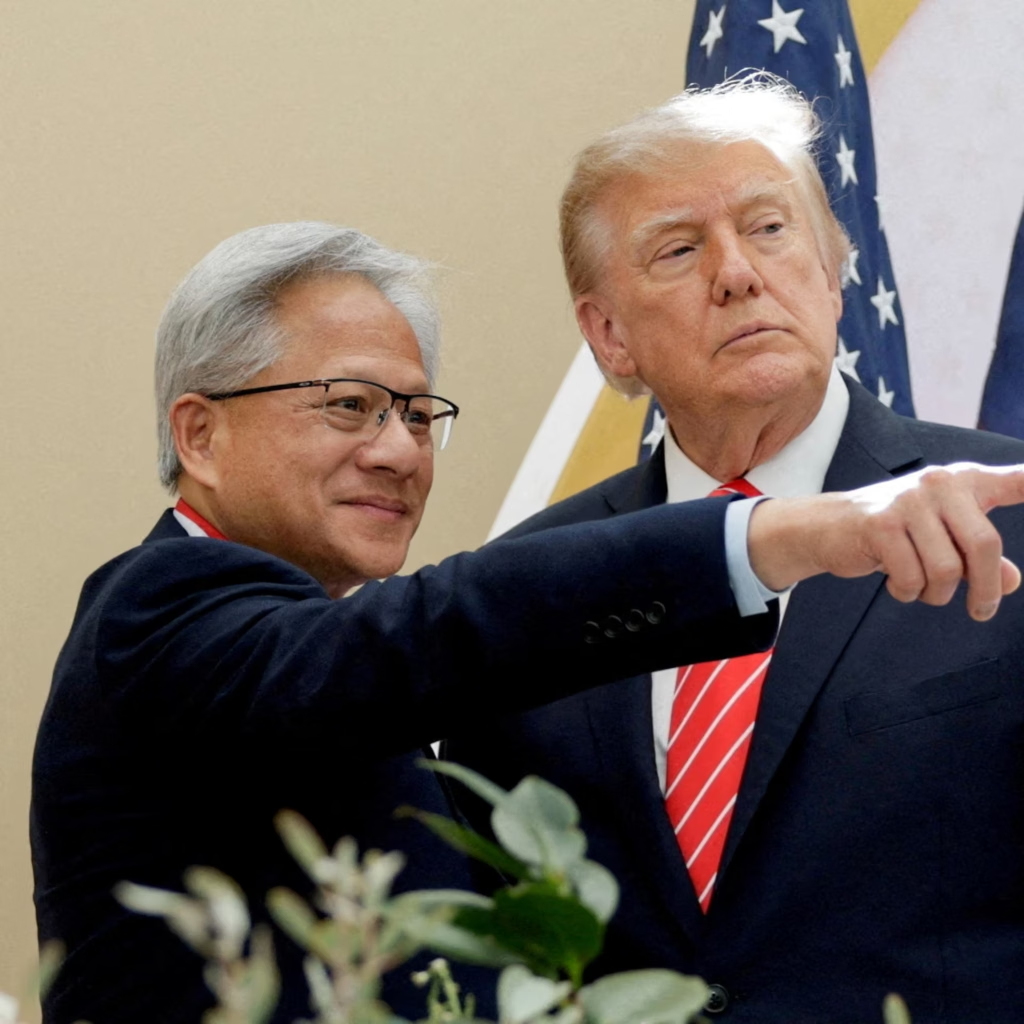
WASHINGTON: US President Donald Trump’s public intervention in support of Nvidia chief executive Jensen Huang has raised fresh political and regulatory questions, highlighting the growing connection between the administration’s economic agenda and the artificial intelligence industry.
After Nvidia announced Huang’s return, following a period of controversy surrounding allegations involving a suspected Chinese spy, the company’s shares surged. Trump told CNBC that he had personally helped secure the outcome and defended Huang, saying he did not believe the allegations against him.
Trump also posted an AI-generated image depicting Huang in a scene resembling the famous photograph taken after the 2024 assassination attempt on the president. The post drew attention to the close association between Trump and the Nvidia chief.
Congressional scrutiny and national security concerns
The president’s position has not ended concerns among lawmakers. Democrats and some Republicans have called for congressional oversight of Nvidia, including possible subpoenas and witness testimony, to examine whether the company violated laws governing access to advanced semiconductor technology by China.
Republican Senator Tom Cotton reiterated concerns about China obtaining advanced US chips through smuggling or remote access, saying Congress had more to investigate.
The controversy has also exposed differences within Trump’s administration over semiconductor export controls. Treasury Secretary Scott Bessent has supported a tougher approach towards China, while Commerce Secretary Howard Lutnick has advocated policies favouring the AI industry.
Political risks tied to the AI boom
Trump’s support for Huang reflects the importance he places on AI investment as a driver of US economic growth and technological leadership. The administration has backed data centre development and sought to strengthen America’s position in the global AI race.
However, opposition to rapid AI expansion has grown across political lines, particularly over data centre construction, pressure on local resources and concerns about the technology’s wider economic and social effects.
The intervention has also raised questions about government involvement in private corporate affairs, particularly given reports that Trump holds millions of dollars in Nvidia stock.
Nvidia’s shares had fallen more than 32% during the weeks preceding the announcement, including a 14% decline on the Friday before Huang’s return was announced. The rebound proved short-lived, however, as the stock surrendered much of its gains on Tuesday.
The episode highlights the risks of tying US economic and political fortunes so closely to the AI industry. While Trump’s intervention temporarily eased market pressure, continuing regulatory scrutiny and uncertainty over AI investment returns could keep Nvidia and the wider technology sector under pressure.
You may also like
-
US to Announce New Tariffs on China, EU and Japan
-
Pakistan Digital Banking Users Reach 140 Million as Transactions Double
-
Pakistan, China Agree to Fast-Track LPG and Gasoline Projects
-
PSX Takes Regulatory Action Against Six Listed Companies
-
FBR Introduces Faceless Income Tax Appeals Through Automated System