
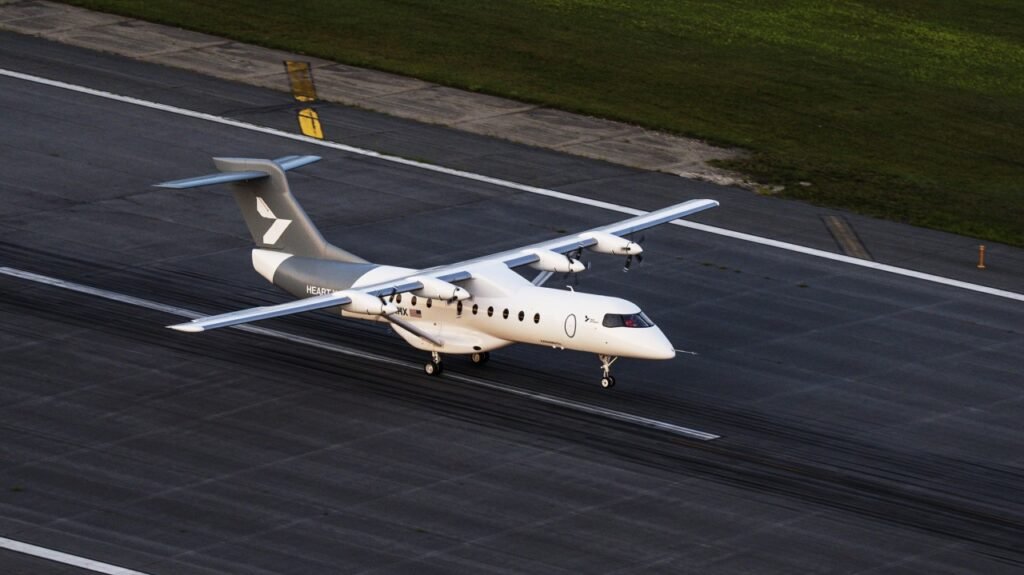
World’s Largest Battery-Powered Aircraft X1 Completes First Flight
The world’s largest fully battery-powered aircraft has taken its first flight, marking a significant step in the development of electric aviation and the effort to reduce the industry’s dependence on conventional jet fuel. Known as the X1, the aircraft was developed by Los Angeles-based Heart Aerospace. The 30-seat aircraft completed a 27-minute test flight using battery power alone, demonstrating electric propulsion technology at a scale closer to commercial regional aviation. The X1 took off from Plattsburgh International Airport in New York on August 12. It reached an altitude of approximately 1,100 feet during the flight and carried only a pilot as part of the early-stage test programme. Heart Aerospace said the aircraft used roughly $5 worth of electricity during the test flight. However, the figure represents only the electricity consumed and should not be interpreted as the aircraft’s total operating cost. X1 Aircraft Completes 27-Minute Flight The X1 has a wingspan of approximately 106 feet and measures 76 feet from nose to tail. The aircraft weighs more than 25,000 pounds and has a 30-seat configuration. During its maiden flight, the aircraft relied entirely on battery power for propulsion. The 27-minute flight was designed to demonstrate the performance of the electric propulsion system and gather important technical data for the company’s future aircraft programme. Heart Aerospace founder and CEO Anders Forslund described the test flight as an important demonstration of electric aviation technology. “With the first flight of X1, Heart Aerospace has demonstrated electric flight at the scale of a commercial airliner,” Forslund said in a statement. The achievement is significant because battery-powered aviation faces major challenges related to weight, energy density, range and charging infrastructure. Larger aircraft require substantial amounts of energy, while batteries remain considerably heavier than the equivalent energy stored in conventional aviation fuel. $5 Electricity Cost Does Not Mean $5 Flight The reported $5 electricity cost attracted attention because of its extremely low figure compared with conventional aircraft operating expenses. However, Heart Aerospace’s figure covers only the electricity consumed during the 27-minute test flight. It does not include the cost of the pilot, maintenance, airport charges, financing, insurance or other operating expenses. It also excludes battery depreciation and potential battery replacement costs. The figure should therefore be understood as the electricity bill for the experimental flight, rather than the overall cost of operating an aircraft. The distinction is important when comparing electric aircraft with conventional commercial planes. Although electricity could eventually reduce energy costs, airlines would still have to account for maintenance, crew, infrastructure, financing and other expenses. X1 Supports Heart Aerospace’s ES-30 Programme The X1 is primarily a technology demonstrator and is not intended to enter commercial passenger service in its current form. Instead, the aircraft is being used to test technology for Heart Aerospace’s larger commercial project, the ES-30. The ES-30 is a 30-seat hybrid-electric regional aircraft that Heart Aerospace hopes to introduce into service by 2031. Unlike the fully battery-powered X1 test aircraft, the ES-30 will use a hybrid-electric propulsion system. The hybrid configuration is designed to provide greater range and overcome some of the limitations associated with using batteries alone. The company believes hybrid-electric aircraft could be particularly suitable for short regional routes where lower fuel consumption and reduced emissions could provide economic and environmental advantages. Airlines Show Interest In Hybrid-Electric Aircraft Heart Aerospace’s ES-30 has already attracted interest from major airlines, including United Airlines, Air Canada and JSX. Airlines are examining the potential of hybrid-electric aircraft as they look for ways to lower operating and maintenance costs while reducing their exposure to fluctuations in jet fuel prices. For regional aviation, where aircraft often operate relatively short routes, electric and hybrid-electric propulsion could eventually become more practical than on long-haul flights. However, commercial deployment will depend on technological improvements, regulatory approval, charging infrastructure and the ability to operate aircraft safely and reliably under real-world conditions. Electric Aviation Faces Major Challenges The first flight of the X1 represents an important technological milestone, but it does not mean fully electric passenger aviation is ready for widespread commercial use. Battery technology remains one of the biggest challenges facing the sector. Aircraft require high energy density because every additional kilogram of battery affects performance, range and payload capacity. As a result, fully battery-powered aircraft are currently more suited to smaller aircraft and shorter routes. Hybrid-electric systems could provide a transitional solution by combining battery propulsion with conventional energy sources. Heart Aerospace’s ES-30 reflects this approach, with the company targeting regional routes where hybrid-electric technology could offer greater commercial viability. Aviation Industry Targets Lower Emissions The development of electric aircraft comes amid growing pressure on the aviation industry to reduce greenhouse gas emissions. Aviation accounts for an estimated 2.5% of global carbon dioxide emissions and also produces other heat-trapping pollutants, including nitrogen oxides. The global aviation industry has set a target of reaching net-zero carbon emissions by 2050. Achieving that goal will require advances across aircraft design, propulsion systems, sustainable aviation fuels, air traffic management and airport infrastructure. Battery-powered aircraft could contribute to those efforts, particularly when their electricity comes from renewable energy sources. Electric propulsion can eliminate direct combustion emissions during flight, although the overall environmental impact depends partly on how the electricity used to charge the batteries is generated. X1 Flight Marks Early Step Toward Electric Aviation Heart Aerospace’s X1 maiden flight demonstrates that battery-powered propulsion can be tested at a scale significantly larger than small experimental aircraft. The flight nevertheless remains an early step rather than proof that fully electric commercial flights are imminent. The company’s main commercial objective remains the ES-30, whose hybrid-electric design is intended to balance environmental benefits with the range and performance requirements of regional aviation. If battery technology, electric propulsion systems and supporting infrastructure continue to improve, aircraft such as the ES-30 could eventually become part of the regional aviation market.