
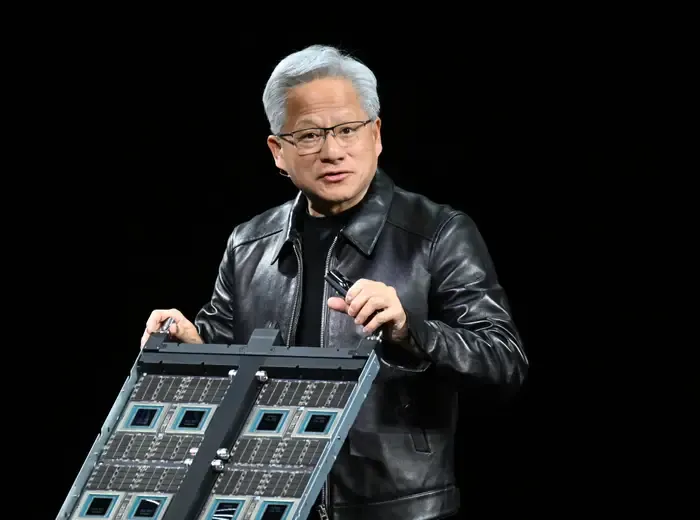
WASHINGTON: Nvidia lost nearly $493 billion in market value this week after chief executive Jensen Huang reportedly resigned on Thursday following revelations of alleged extramarital relationships, including one involving a woman suspected of links to Chinese intelligence.
The developments triggered a sharp sell-off in the world’s leading artificial intelligence chipmaker, raising concerns about its leadership, relationship with Washington and future growth prospects.
Nvidia shares fell as much as 14.3% during Thursday’s session before recovering to close 4.3% lower, leaving the company’s market capitalisation at approximately $4.01 trillion.
The stock has declined around 12% this week and more than 30% from its record high reached on October 6, as the leadership controversy adds to existing concerns about the sustainability of investment in artificial intelligence infrastructure.
Huang, who holds a 3.61% stake in Nvidia and is the company’s fourth-largest shareholder, also reportedly resigned from its board.
Chief Financial Officer Colette Kress has taken over as interim chief executive while Nvidia searches for a permanent successor. The company is considering both internal and external candidates.
Nvidia has also appointed former Synopsys chief executive and longtime director Harvey Jones as its first board chairman.
The controversy follows reports of two alleged extramarital relationships, one involving a woman suspected of acting on behalf of Chinese intelligence and another involving a company executive. Reuters subsequently reported that Huang had also maintained an intimate relationship with a second Nvidia employee, citing two people familiar with the matter.
The controversy dates back more than a year, beginning with an October 2025 New York Times report linking Huang to Alice Huang, a former executive at Singapore-based Megaspeed, an Nvidia cloud partner that reportedly received priority access to the company’s advanced chips.
Subsequent reports indicated that US intelligence officials suspected Alice Huang of acting on behalf of Chinese intelligence. Beijing has denied that she was a spy.
Earlier in November, Nvidia’s board reportedly launched an investigation into whether Huang had been targeted by a foreign intelligence operation. The inquiry was led by independent directors and supported by external legal counsel.
The developments have raised broader questions about Nvidia’s relationship with Washington and the future of US restrictions on advanced semiconductor exports to China.
Huang had been a prominent advocate of maintaining access to the Chinese market and had developed close ties with US President Donald Trump. His reported departure could therefore have implications for discussions surrounding chip export policy and the wider artificial intelligence industry, where Nvidia’s graphics processing units remain central to advanced computing.
The controversy has also increased scrutiny of the Trump administration’s approach to semiconductor sales to China, with Commerce Secretary Howard Lutnick among officials facing questions over the handling of chip exports.
Meanwhile, Nvidia’s falling share price has pushed its valuation to its lowest level in 14 years, according to a Reuters analysis. The stock is trading at approximately 12 times expected earnings, its lowest forward price-to-earnings ratio since 2012.
At that time, Nvidia was primarily competing with Advanced Micro Devices in the video game graphics card market while attempting to establish a presence in tablets and other mobile devices.
The decline has prompted questions about whether Nvidia shares have become attractive to investors. However, the lower valuation also reflects concerns about the company’s future profitability and growth.
Leadership uncertainty is not the only factor weighing on the stock. Investors have increasingly questioned whether the rapid expansion of artificial intelligence data centres can continue at its current pace, particularly as technology companies face mounting pressure to demonstrate returns on substantial infrastructure investments.
The prospect of slower data centre construction has affected Nvidia, whose processors have powered much of the global artificial intelligence boom.
Some market analysts have described Huang’s reported departure as a significant leadership development rather than an immediate threat to demand for Nvidia’s products. Customers are unlikely to cancel chip orders solely because of a change in chief executive, although uncertainty surrounding the investigations and succession process could continue to influence investor sentiment.
Despite the decline in shares, Wall Street analysts have largely maintained expectations for strong earnings growth.
Demand for Nvidia’s advanced processors is still expected to exceed supply, although those projections could change following the company’s upcoming financial results.
According to LSEG data, analysts expect Nvidia to report a 92% year-on-year increase in revenue for its October quarter, alongside net profit exceeding $60 billion, representing growth of 89%.
Nvidia is scheduled to announce its quarterly earnings on Tuesday, with investors closely watching whether the company can sustain its rapid expansion during the leadership transition.
Attention will also focus on interim chief executive Colette Kress’s assessment of demand for artificial intelligence chips, the outlook for data centre investment and Nvidia’s ability to maintain its market position.
Analysts expect the company’s forward guidance to carry particular significance, potentially outweighing its quarterly results as investors reassess its long-term growth prospects.
You may also like
-
Trump Iran Policy: President Says US Does Not Need Deal, Redirects Vance to Domestic Issues
-
Ukraine Energy Crisis: Russian Strikes Leave Millions Facing Winter Blackouts
-
Singapore Gold Vault: City-State Plans 500-Tonne Storage Service for Foreign Central Banks
-
Ukraine Power Crisis: Russian Strikes Leave Kyiv Families Facing Prolonged Blackouts
-
North Korea Tensions: Seoul Sees Little Chance of US-Kim Meeting at APEC Summit
1 thought on “Nvidia Stock: Shares Lose Nearly $493 Billion in Market Value Amid Leadership Crisis”
Comments are closed.