
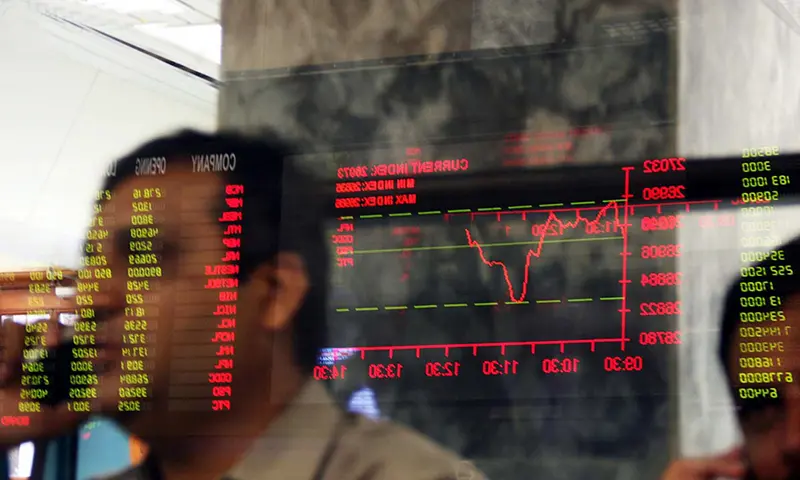
KARACHI: The Pakistan Stock Exchange (PSX) extended its downward trend on Wednesday, with the benchmark KSE-100 Index falling more than 900 points during the opening minutes of trading amid widespread selling pressure across major sectors.
At 9:50am, the KSE-100 Index stood at 176,604.59 points, reflecting a decline of 913.14 points, or 0.51%, from the previous session’s close.
Selling pressure was observed across several key sectors, including cement, commercial banking, oil and gas exploration, oil marketing companies, power generation and refineries.
Major index-weighted stocks traded in negative territory, including Attock Refinery Limited (ARL), Hub Power Company (HUBCO), Mari Energies (MARI), Oil and Gas Development Company (OGDC), Pakistan Petroleum Limited (PPL), Pakistan Oilfields Limited (POL) and Pakistan State Oil (PSO).
Banking stocks, including MCB Bank, Meezan Bank (MEBL) and United Bank Limited (UBL), also recorded declines during early trading.
The market weakness came as investors assessed warnings from the State Bank of Pakistan (SBP) regarding risks to the country’s economic outlook.
In its annual report for fiscal year 2025–26, the central bank cautioned that evolving domestic and external challenges could affect Pakistan’s projected economic performance.
The SBP identified a prolonged conflict in the Middle East and extreme weather events associated with El Niño among the potential threats to macroeconomic stability.
The central bank’s assessment highlighted the importance of monitoring external developments and domestic vulnerabilities that could influence inflation, economic growth and overall financial conditions.
The latest decline followed a negative trading session on Tuesday, when the KSE-100 Index fell by 665.21 points, or 0.37%, to close at 177,517.74 points.
Tuesday’s session was characterised by broad-based selling and reduced trading activity as investors booked profits at higher levels.
An early market recovery, supported by declining international oil prices, failed to sustain momentum as selling pressure returned.
Meanwhile, Asian equity markets moved higher on Wednesday, supported by gains in technology-related stocks following stronger-than-expected financial projections from US semiconductor company Nvidia.
MSCI’s broadest index of Asia-Pacific shares outside Japan advanced 0.9%, recovering after four consecutive sessions of losses.
South Korea’s KOSPI Index gained as much as 3.3%, while Japan’s Nikkei 225 rose 0.6%.
Electricity Tariff: CPPA-G Seeks Rs2.88 Per Unit Increase for October 2026
US S&P 500 e-mini futures also increased by approximately 0.5%, indicating improved sentiment ahead of the US trading session.
Nvidia shares reportedly climbed 4.7% in after-hours trading after the company released quarterly financial results and a revenue forecast that exceeded market expectations.
The supplied international market report also referred to an alleged leadership change at Nvidia and reported regulatory scrutiny. Those claims require independent verification.
The gains in Asian technology stocks followed another negative session on Wall Street, where the S&P 500 declined 1% overnight, marking its fourth consecutive session of losses.
Despite the recovery in regional equity markets, Pakistan’s benchmark index remained under pressure during early Wednesday trading.
Investors are expected to continue monitoring domestic economic developments, corporate performance and international market conditions for signals about the direction of the PSX in upcoming sessions.