
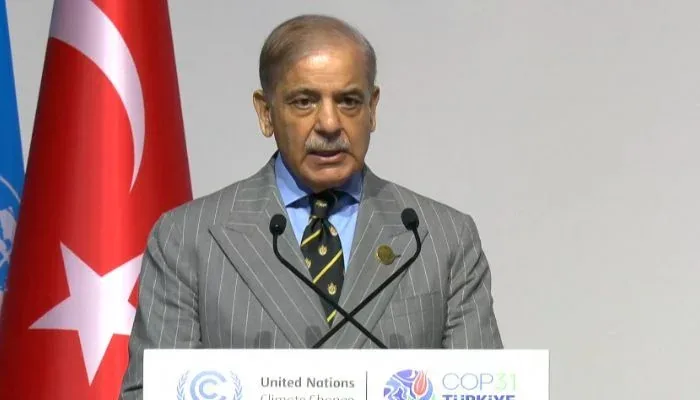
ANTALYA, TÜRKİYE: Prime Minister Shehbaz Sharif has urged world leaders to move beyond declarations of solidarity and take practical action against climate change, warning that vulnerable countries such as Pakistan cannot continue bearing the devastating consequences of environmental disasters without adequate international financial assistance.
Addressing the COP31 Leaders’ Summit in Antalya on Thursday, the prime minister called for grant-based climate financing, increased adaptation resources and stronger international cooperation to protect countries facing severe environmental challenges despite contributing relatively little to global greenhouse gas emissions.
He stressed that financial assistance for climate-vulnerable nations must be timely, accessible and structured in a way that does not further increase their debt burdens. He also called for greater public-private partnerships and a substantial expansion of international resilience and adaptation funds.
Shehbaz said expressions of international solidarity would remain insufficient unless accompanied by practical commitments, sustainable financing arrangements and effective implementation mechanisms.
Referring to his earlier warnings about climate change, the prime minister recalled that Pakistan had alerted the international community four years ago that the consequences of climate disasters would eventually extend far beyond its borders. He said subsequent environmental developments had demonstrated that climate change was a global challenge requiring a coordinated response.
Highlighting Pakistan’s experience, he recalled the catastrophic floods of 2022, when approximately one-third of the country was submerged, affecting nearly 33 million people. The disaster claimed more than 1,700 lives and caused economic losses exceeding $30 billion, damaging homes, infrastructure, agriculture and economic activity.
The prime minister said the disaster illustrated the unequal burden of climate change, with developing nations frequently suffering the most severe consequences despite making relatively limited contributions to global emissions.
Pakistan accounts for less than one per cent of global carbon emissions but continues to face devastating floods, extreme temperatures, unpredictable weather patterns and other climate-related emergencies.
Shehbaz emphasised that the growing frequency and intensity of natural disasters had made climate resilience and adaptation urgent development priorities for Pakistan.
He also expressed appreciation for Türkiye’s assistance during Pakistan’s devastating floods, acknowledging the support extended by the Turkish government and people during one of the country’s worst humanitarian emergencies.
The prime minister reaffirmed Pakistan’s commitment to environmentally sustainable development and cleaner energy solutions, saying the country remained determined to pursue climate-friendly policies despite financial and structural challenges.
His remarks came as world leaders gathered in Antalya for the 31st United Nations Climate Change Conference, amid growing concerns over whether existing climate policies and financial commitments are sufficient to address the accelerating environmental crisis.
The two-week conference is scheduled to continue until November 20. Discussions are expected to focus on climate finance, energy transition, adaptation measures and the implementation of commitments made at previous international climate conferences.
United Nations Secretary-General Antonio Guterres, addressing world leaders on Wednesday, warned that global efforts to tackle climate change were failing to keep pace with the worsening crisis.
He criticised the continued expansion of fossil fuel production and called for a decisive transition away from coal, oil and gas. Guterres also expressed concern over governments approving new fossil fuel projects while pledging to reduce greenhouse gas emissions.
The negotiations are taking place amid geopolitical tensions, military conflicts and uncertainty in global energy markets, which have complicated efforts to secure stronger commitments from major economies.
Significant differences remain between developed and developing countries over financial responsibility, emissions reduction obligations and the pace of the transition towards cleaner energy sources.
For Pakistan and other climate-vulnerable nations, the availability of adequate financing remains a central concern. Developing countries need resources to strengthen infrastructure, protect agriculture, improve disaster preparedness and support communities exposed to extreme weather events.
They have consistently argued that loans alone cannot provide a sustainable response to climate emergencies, particularly when repeated disasters increase reconstruction costs and deepen existing debt pressures.
Grant-based assistance and affordable climate financing are therefore considered essential to help vulnerable countries implement adaptation programmes without sacrificing other development priorities.
Pakistan has also emphasised the importance of expanding renewable energy, improving environmental governance and strengthening institutional capacity to address future climate challenges.
As negotiations continue in Antalya, attention will remain focused on whether participating governments can translate political declarations into accessible financing and measurable action.
For Pakistan, where recurring climate disasters continue to threaten economic stability and public welfare, the outcome of COP31 could have significant implications for future adaptation funding, international cooperation and long-term environmental security.
You may also like
-
PBA, KPC Join Hands to Strengthen Industry–Media Relations
-
Nishat Group Expresses Interest in Investing in Pakistan’s Proposed New Port
-
Toyota Assembler Indus Motor Company Sales Fall 10% in October Across All Lineups
-
Export Pullback Drags Gul Ahmed Revenue Down 17%
-
Digital Payments: SBP Asked to Prepare Raast QR Merchant Discount Rate Framework