
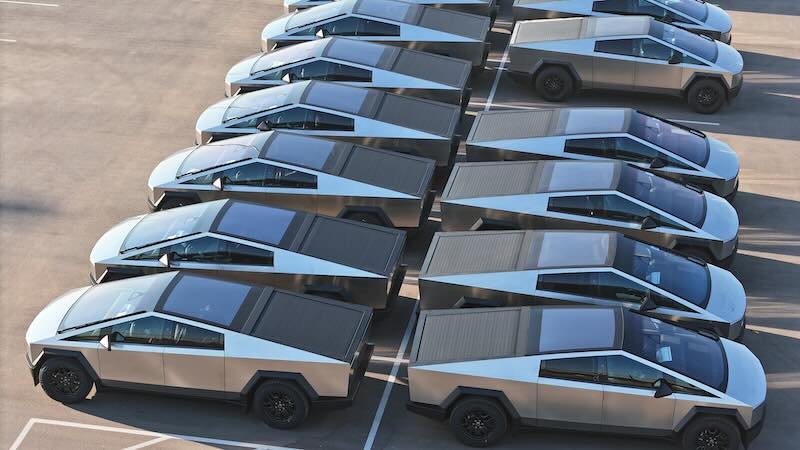
Chief Executive Elon Musk announced the decision in a post on X on Friday, saying the company would reduce Cybertruck production around the middle of next year to make room for increased Cybercab manufacturing.
Musk did not clarify whether Tesla intends to end Cybertruck production entirely. The Texas Gigafactory remains the company’s only manufacturing facility for the electric pickup.
The move marks a shift in Tesla’s manufacturing priorities after the Cybertruck fell short of the sales volumes Musk initially projected. At the company’s annual shareholder meeting in May 2023, he estimated that annual sales could eventually reach between 250,000 and 500,000 vehicles once production reached full capacity.
However, US sales fell from an estimated 38,965 Cybertrucks in 2024 to 20,237 in 2025, according to Cox Automotive’s Kelley Blue Book. The decline continued in 2026, with 11,586 units sold during the first nine months, down 28% from the same period a year earlier.
Tesla does not report Cybertruck deliveries separately in its quarterly results. Instead, it groups the pickup with other vehicles outside its Model 3 and Model Y line-up.
Deliveries across this broader category fell 48% to 8,295 vehicles in the third quarter, although the figure includes models other than the Cybertruck.
Tesla’s latest production update showed that its Texas factory had installed annual manufacturing capacity of more than 125,000 Cybertrucks, considerably higher than current sales levels.
The company unveiled the Cybertruck in 2019 and initially planned to launch it in 2021 with a starting price of $39,900. After several delays, deliveries began in November 2023, by which time the starting price had increased to $60,990.
The pickup has also faced multiple recalls and quality concerns. In 2024, Tesla recalled vehicles over accelerator pedals that could become trapped and cause unintended acceleration. In 2025, the company recalled more than 46,000 Cybertrucks over concerns that stainless-steel exterior panels could detach while driving.
Another recall in April 2026 affected 173 vehicles because of brake rotor defects that could cause wheel studs to separate.
Krakow Shooting: Gunman Dies in Hospital After Killing Six in Poland
Tesla is now directing greater attention towards the Cybercab, a two-seat autonomous vehicle unveiled in 2024 without conventional steering wheels or pedals.
The company began offering paid robotaxi rides in parts of Austin, Texas, in September 2026 as it works to expand the service. During Tesla’s October earnings call, Vice President of Vehicle Engineering Lars Moravy said the company was targeting customer availability of the Cybercab by the end of 2026.
Musk has indicated, however, that most Cybercabs would remain under Tesla’s ownership and operate through its robotaxi network rather than being sold directly to individual customers.
Following the production announcement, Cybertruck lead engineer Wes Morrill described the electric pickup as an important platform for developing technologies that Tesla would carry forward into the Cybercab programme.
Tesla shares rose 2.74% to $353.12 in premarket trading on Friday, following a 10.77% decline in the previous session amid a broader stock market sell-off.
You may also like
-
Krakow Shooting: Gunman Dies in Hospital After Killing Six in Poland
-
Aramco Tower: Debris From Missile Attack Damages Saudi Arabia’s Riyadh Office
-
Egypt Train Collision: At Least 7 Killed and 112 Injured Near Cairo
-
Saudi Loan Rollover: Riyadh Extends Pakistan’s $3 Billion Repayment Deadline
-
Quaid-e-Azam Bust Unveiled in Cuba to Mark 150th Birth Anniversary
1 thought on “Tesla Cybertruck: Musk Plans to Scale Back Production by Mid-2027”
Comments are closed.