
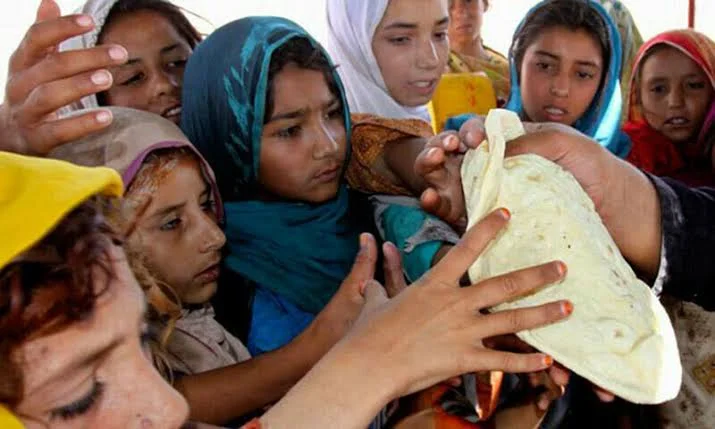
At least 11 million people in Pakistan are facing acute food insecurity, placing the country among the world’s ten largest food crises, according to a recent global report.
Of those affected, approximately 9.3 million people face crisis-level conditions, while another 1.7 million are experiencing emergency levels of food insecurity.
The Numbers Behind Pakistan’s Food Crisis
The figures mainly cover rural districts in Balochistan, Sindh and Khyber Pakhtunkhwa. These areas represent around one-fifth of Pakistan’s population.
Pakistan ranks 106th out of 123 countries on the Global Hunger Index, placing it in the serious hunger category.
Child malnutrition remains a major concern. Around one in three children under five suffers from stunted growth.
As food prices rise, many households are reducing their consumption and stretching meals to manage limited budgets.
Climate and Economic Pressures Deepen Food Insecurity
Heavy monsoon rains and floods in 2025 affected more than six million people. The disasters destroyed crops and damaged infrastructure, adding pressure to agricultural production and food supplies.
Wheat production has also declined. Meanwhile, Pakistan meets more than three-quarters of its edible oil demand through imports, leaving the country exposed to currency fluctuations and international price shocks.
Punjab Plans Industrial Estate Along Rawalpindi Ring Road
Inflation has further weakened household purchasing power. National consumer prices more than doubled between 2019 and 2025, making essential food items increasingly difficult for many families to afford.
Agricultural Production and Food Distribution Remain Disconnected
Pakistan continues to produce substantial agricultural harvests and has the land, water resources and farming expertise to support domestic food needs.
However, production, markets, imports and household incomes often fail to move in line with one another.
Surplus production can leave farmers struggling to sell their crops, while shortages increase costs for consumers. Weak seed systems, inadequate storage and limited agricultural extension services also constrain farm productivity.
The challenge therefore extends beyond grain availability. Structural weaknesses in the agricultural and food distribution systems leave both farmers and urban households vulnerable.
Reducing Import Dependence and Supporting Farmers
Reducing reliance on imported edible oils and improving wheat production resilience could help ease pressure on food supplies.
Stronger market connections, climate-smart farming practices and targeted support for small-scale farmers could also improve agricultural stability.
These measures would help address supply challenges without relying exclusively on emergency imports.
Pakistan’s food insecurity requires sustained action across agriculture, trade, infrastructure and household support. Addressing these weaknesses will be essential to improving food access and protecting vulnerable communities.
You may also like
-
Rock Collapse at Tarbela T5 Allows Water to Enter Tunnel and Powerhouse Area
-
PIA Cleanliness Drive: Airline Conducts Deep Cleaning of Aircraft Fleet
-
Gaza Humanitarian Crisis: Shehbaz Sharif Condemns Israeli Restrictions on Aid
-
Rawalpindi Shooting: Female News Anchor Found Dead, Husband Detained
-
Youth Loan Scheme: Pakistan Raises Maximum Financing Limit to Rs25 Million