

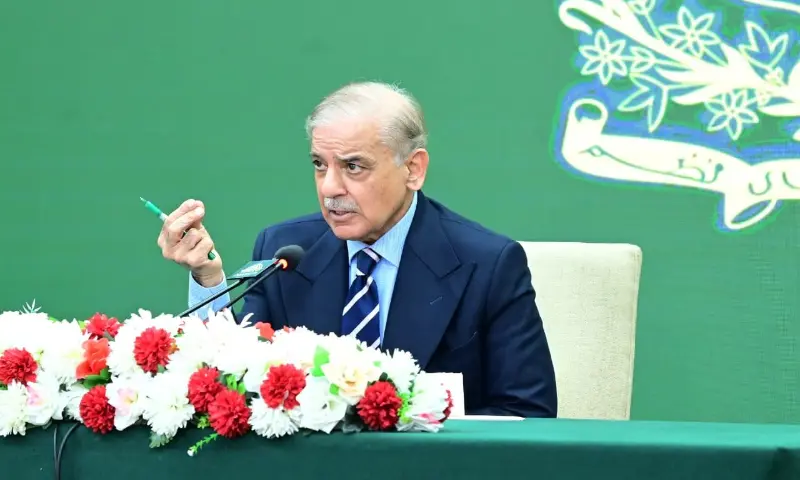
Pakistan Debt: Prime Minister Shehbaz Sharif has called for political unity and difficult economic decisions to free Pakistan from its dependence on external loans. He said the government, political parties and all sections of society must work together to address the country’s growing debt burden.
Speaking at the National Security Workshop in Islamabad on Sunday, the prime minister said Pakistan could overcome its debt challenges through collective action and a willingness to make difficult choices.
“There are solutions to this, but we will have to take bitter decisions,” he said. He added that national cooperation could help the country escape what he described as a mountain of loans.
PM Criticises Subsidies and Loss-Making State-Owned Enterprises
Shehbaz said Pakistan’s debt had continued to rise over the past 80 years. He argued that subsidies had weakened the economy because the government financed them through taxpayers’ money.
He said the country could have developed without relying on repeated subsidies and financial support. Instead, public funds had supported an economic structure that left the nation increasingly burdened.
India Faces Inflation Risks From Extreme Weather and Geopolitical Tensions
The prime minister also criticised the billions of rupees spent on loss-making state-owned enterprises and highlighted widespread tax evasion.
He said his objective was not to blame individuals or institutions but to identify the problems and find solutions.
Shehbaz acknowledged that the government had worked with parliamentary political parties over the past two-and-a-half years to resolve major issues. However, he said several important reforms remained incomplete.
Government Cites Savings From Institutional Closures
The prime minister defended the closure of the Pakistan Public Works Department (PWD), saying the decision had faced criticism but eliminated around Rs100 billion in corruption.
He also referred to the closure of the Utility Stores Corporation, which had faced allegations of corruption and poor-quality food supplies.
“Every year, people lined up to receive substandard rice and flour, and there was massive corruption,” he said, adding that the government had saved the country from corruption worth hundreds of billions of rupees.
The government has instead used digital wallets to transfer payments directly to beneficiaries.
FBR Reforms and Tax Enforcement Recover Rs900 Billion
Shehbaz said the federal government had introduced long-overdue structural reforms in the Federal Board of Revenue (FBR), particularly to remove corrupt elements.
He identified indirect taxes, especially sales tax, as a major source of tax evasion.
The prime minister claimed that enforcement measures had recovered Rs900 billion for the first time in Pakistan’s history. He questioned why previous governments had struggled to recover even Rs9 billion lost through tax evasion.
He also recalled a meeting with the International Monetary Fund (IMF) in the United States, where the institution’s managing director reportedly described Pakistan as a changed country.
Shehbaz attributed the progress to commitment, hard work and sustained efforts.
PM Wants Economic Gains From Diplomatic and Defence Achievements
The prime minister also highlighted Pakistan’s diplomatic and security developments, including its mediatory role during the US-Iran conflict, defence agreements with Saudi Arabia and Turkiye, and the four-day conflict with India in May 2025.
He said Pakistan should now convert these achievements into economic benefits.
“I think it is time to convert these achievements into economic gains because time and tide wait for none,” he said.
Government Targets 6% Economic Growth
Shehbaz said Pakistan’s foreign exchange reserves had reached their highest level in history. However, he stressed that the country needed to move away from dependence on external financial assistance.
He said Pakistan must choose between relying on financial support and building an economy based on dignity, hard work and honesty.
The prime minister noted that exports had increased by 8%, but said the country needed to achieve much stronger growth.
He also referred to an economic growth projection of 3.5% and set a target of reaching at least 6% as soon as possible.
Agriculture Sector Needs Urgent Reforms
The prime minister expressed concern over the government’s limited progress in improving the agriculture sector.
He said Pakistan had failed to deliver the reforms needed to strengthen agriculture, despite the sector’s importance to the national economy.
Shehbaz argued that the sector could undergo significant improvements within six months if the government and relevant stakeholders showed the required commitment.
He concluded that hard work remained the key requirement for achieving stronger economic growth and reducing Pakistan’s dependence on foreign loans.
You may also like
-
Pakistan, Saudi Arabia and Türkiye Reaffirm Collective Defence Commitment
-
Petrol Price Reduced by Re1 to Rs312 Per Litre, Diesel Unchanged
-
Pakistan Hosts Trilateral Defence Meeting with Saudi Arabia and Türkiye
-
China-Pakistan Youth Dialogue Calls for Stronger Academic and Technological Cooperation
-
Petrol Price: Government Cuts Rate by Rs4 and Diesel by Rs5 Per Litre for November 26