
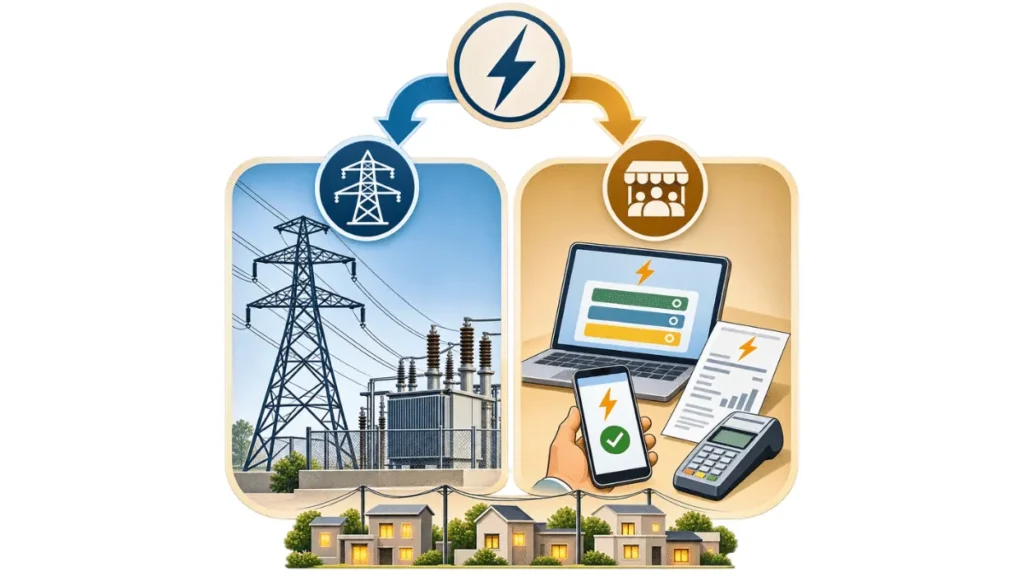
The federal government has proposed a two-tier business model for privatised power distribution companies (DISCOs), under which new owners would retain electricity networks while other private operators could take over power sales, billing and collections. The arrangement would also involve legacy capacity payment obligations estimated at Rs1.7 trillion annually, The Express Tribune reported.
The proposal, which requires approval from the power sector reform steering committee and the federal cabinet, aims to separate regulated electricity distribution from power supply. It would allow private companies to compete for customers and offer different tariffs.
Under the proposed model, buyers of distribution companies would retain infrastructure, including electricity poles and wires, and operate as regulated suppliers of last resort. Other private operators, known as competitive suppliers, would be permitted to sell electricity at deregulated rates after acquiring contracted power capacity and corresponding customer portfolios.
The model is being considered for the Faisalabad, Gujranwala and Islamabad electricity distribution companies. Faisalabad Electric Supply Company (FESCO) could become the first to adopt the arrangement, as the Privatisation Commission aims to sell the utility by early next year.
A Privatisation Commission official said the proposed model would not immediately reduce electricity costs, as consumers would continue to bear an idle capacity payment charge of Rs17 per unit. However, competition among suppliers could result in modest tariff reductions over the medium to long term.
Under the proposed mechanism, the Central Power Purchasing Agency-Guaranteed (CPPA-G) would auction electricity capacity contracted on FESCO’s behalf, along with its corresponding customer base, to private suppliers following privatisation.
Successful bidders would assume CPPA-G’s position as buyers of the allocated electricity from the national power pool and take over commercial relationships with the relevant customers. They would also become responsible for electricity procurement, customer management, billing, collections and related commercial obligations.
Existing CPPA-G contracts with independent power producers would remain unchanged. Instead, the agency would enter into separate agreements with competitive suppliers to allocate electricity capacity and corresponding customer portfolios.
The official said private investors would be reluctant to assume legacy capacity payment obligations without receiving a matching customer base. The proposal therefore envisages transferring contracted electricity supply and corresponding demand together, either in a single transaction or through a limited number of stages.
The existing uniform tariff regime would remain applicable to the regulated supplier of last resort, while competitive suppliers could offer lower, deregulated rates to customers other than protected consumers.
Protected consumers would retain regulated tariff safeguards and remain part of the customer portfolios transferred to private suppliers. Existing cross-subsidy arrangements would also continue during the transition to prevent additional fiscal pressure and discourage suppliers from selecting only commercially attractive customers.
If a competitive supplier failed to provide electricity, the distribution company owner would be responsible for serving the affected customers as the supplier of last resort.
Electricity Tariff: NEPRA Approves Revised Incremental Package at Rs25.30 per Unit
The proposed arrangement would allow competitive suppliers to charge lower rates than the supplier of last resort. It is also intended to compensate distribution company buyers for maintaining a minimum customer load base.
According to the Privatisation Commission official, prospective investors showed considerable interest in acquiring idle electricity capacity during the government’s investor sounding exercise.
The government expects the proposed reforms to improve bill recoveries, reduce distribution losses, strengthen accountability and attract private investment while lowering reliance on government financial support.
However, the growing shift towards alternative energy sources, particularly solar power, remains a challenge. The number of consumers switching to alternative energy sources is reportedly increasing faster than the national grid’s customer base.
The proposal also includes battery storage services as a potential additional business opportunity, which could help offset network losses during peak demand hours.
You may also like
-
Mining Investment: Jam Kamal Khan Seeks Global Partnerships to Unlock Pakistan’s Mineral Wealth
-
PTA flags peak-hour slowdown risk as several ISPs, including Gerry’s IT, breach utilisation cap
-
Electricity Tariff: NEPRA Approves Revised Incremental Package at Rs25.30 per Unit
-
Gatron Restructuring: Balochistan High Court Approves Corporate Scheme
-
China Stocks: Mainland Shares Edge Higher as Semiconductor Sector Gains