
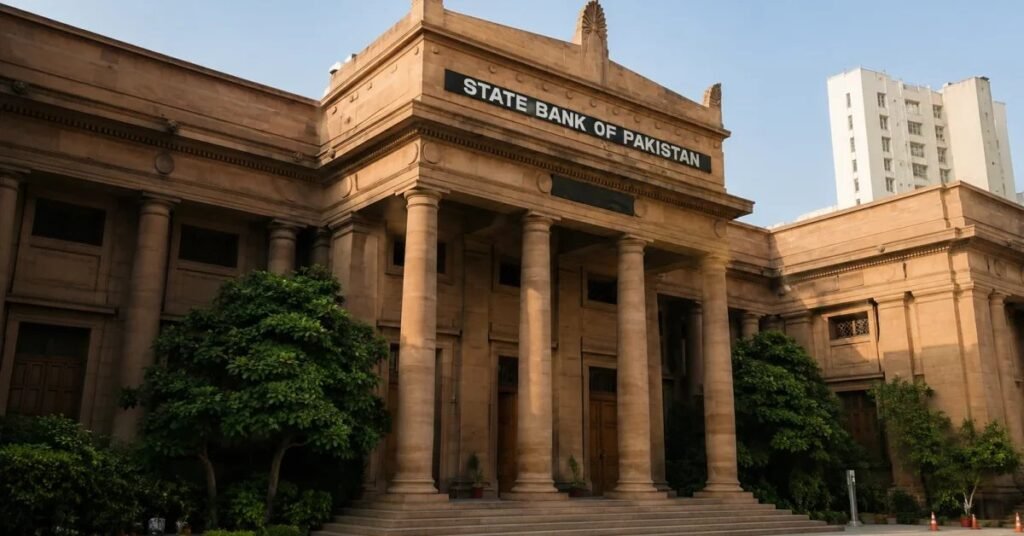
Pakistan’s banking sector continued to direct most of its resources towards government securities in fiscal year 2025-26, highlighting the government’s reliance on banks for financing and raising concerns about credit availability for businesses.
Government securities accounted for 63.3% of banks’ total assets in FY26, up from 62.9% a year earlier, according to the State Bank of Pakistan’s (SBP) Governor’s Annual Report 2025-26.
The report said highly liquid government securities made up 60.8% of banks’ asset mix, supporting the sector’s strong liquidity position.
Banks’ asset expansion was largely driven by investments, particularly government securities, reflecting the government’s continued reliance on the banking system for budgetary financing.
Banks Remain Major Source of Government Financing
The banking sector financed 67.3% of the fiscal deficit in FY26, down from 74% in the preceding year.
External sources accounted for 35.5% of deficit financing, while non-bank financing recorded net retirements.
Industrial Growth Slows to 3.3% in FY26 Amid Q4 Contraction
Despite the lower share of deficit financing, government securities remained the largest component of banks’ assets. The trend highlights the sector’s significant exposure to sovereign borrowing.
Private-Sector Credit Grows 14.7%
Private-sector credit expanded by 14.7% in FY26, compared with 13% in FY25, according to the report.
The private-sector credit-to-GDP ratio also increased to 9% from 8.7%.
The growth reflected improved economic activity, relatively easier financial conditions and stronger demand for working-capital financing.
Both working-capital and fixed-investment loans increased during the year, with fixed-investment financing recording a more pronounced rise.
However, lending to export-oriented industries, particularly textiles and wearing apparel, remained relatively weak amid slower export activity.
Most of the increase in private-sector credit went to manufacturing, led by sugar producers and fertiliser companies.
Banking Assets Reach Rs43.6 Trillion in Investments
The SBP reported that banks’ total assets grew by 15.8% during FY26, with investments remaining their largest asset component.
Net investments increased to Rs43.6 trillion by the end of June 2026, compared with Rs37.5 trillion a year earlier.
Net advances also rose to Rs15.4 trillion from Rs13.2 trillion over the same period.
The figures show that banks expanded both government investments and private-sector lending, although government securities continued to dominate their portfolios.
Limited Credit-to-GDP Ratio Highlights Financing Gap
The continued concentration of bank assets in government securities raises questions about the allocation of financial resources between sovereign financing and businesses.
Companies seeking funds for expansion, modernisation and job creation depend on access to affordable credit. However, the private-sector credit-to-GDP ratio of just 9% indicates that bank financing remains limited relative to the size of Pakistan’s economy.
Although private-sector lending improved during FY26, the figures highlight the challenge of deepening financial intermediation and directing a larger share of domestic savings towards productive investment.
You may also like
-
Industrial Growth Slows to 3.3% in FY26 Amid Q4 Contraction
-
Fauji Foods: Company Appoints Acting CEO and CFO Amid Profit Decline
-
Pakistan Turkmenistan Trade: Ministers Discuss Regional Corridors and Bilateral Commerce
-
Aluminium Smelter: Hubco Subsidiary Plans Feasibility Study for 300,000-Tonne Project
-
RLNG Shortage: Pakistan Faces Winter Load Shedding Risk as Power Plants Struggle With Fuel Supplies