
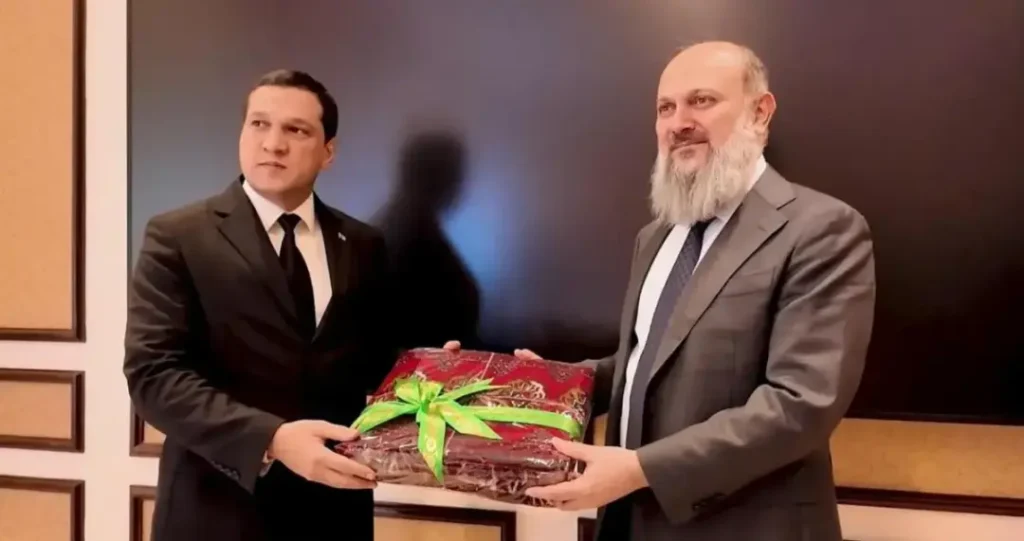
ISLAMABAD: Pakistan and Turkmenistan have discussed expanding bilateral trade, strengthening regional connectivity and improving market access as both countries seek to enhance economic cooperation and reverse a decline in commercial exchanges.
Federal Minister for Commerce Jam Kamal Khan held a bilateral meeting with Turkmenistan’s Minister of Trade and Foreign Economic Relations, Dortguly Suleymanov, in Islamabad on Monday, ahead of the sixth session of the Pakistan–Turkmenistan Joint Intergovernmental Commission scheduled for November 17, 2026.
During the meeting, Jam Kamal Khan emphasised the importance of transforming longstanding diplomatic relations into practical commercial partnerships, particularly in textiles, agriculture, food processing, manufacturing and logistics.
He welcomed exchanges of business delegations between the two countries and called for sustained engagement to identify investment opportunities and develop commercially viable trade arrangements.
The commerce minister noted that rising international freight costs and disruptions to traditional trade routes had increased the importance of regional economic integration.
He said Pakistan and Turkmenistan were well positioned to benefit from emerging trade opportunities connecting South Asia, Central Asia and the Middle East.
To improve connectivity, Jam Kamal Khan proposed exploring direct flights between Islamabad and Ashgabat, along with chartered cargo services for perishable agricultural and food products.
He highlighted the relatively short flying distance between the two capitals as a potential advantage for time-sensitive exports.
Suleymanov acknowledged the importance of improved air connectivity and indicated that the proposal could be discussed with relevant aviation authorities during the upcoming Intergovernmental Commission meeting.
The discussions also focused on strengthening overland transportation links and exploring alternative trade corridors to facilitate cross-border commerce.
Jam Kamal Khan highlighted the expanding operations of Pakistan’s National Logistics Corporation (NLC) in Central Asian markets, including its growing fleet of vehicles suitable for regional transportation.
He stressed the need to address logistical challenges, improve cross-border movement and explore alternative routes for Pakistani marble and other exports destined for Central Asian markets.
The minister also emphasised business visa facilitation, noting that easier travel arrangements for traders and investors could encourage stronger economic cooperation.
During the meeting, Suleymanov expressed concern over the recent decline in bilateral trade between Pakistan and Turkmenistan.
According to figures shared by the Turkmen minister, bilateral trade exceeded $36 million in 2025, representing a decline of nearly 23% compared with 2024.
Trade between the two countries reached approximately $15 million during the first nine months of 2026, reflecting a decrease of 56% compared with the corresponding period last year.
Suleymanov attributed the decline primarily to reduced textile exports and expressed Turkmenistan’s interest in restoring previous trade volumes while diversifying its exports to Pakistan.
He proposed exchanging updated lists of exportable products, sharing information on import requirements and strengthening coordination between relevant institutions.
Both ministers agreed to nominate focal persons to ensure regular communication and follow-up on trade-related matters.
Joint Secretary Maria was designated as Pakistan’s focal person, while Turkmenistan also nominated a counterpart to coordinate between the two commerce ministries.
Jam Kamal Khan briefed the visiting minister on Pakistan’s ongoing five-year tariff rationalisation programme, explaining that gradual reductions in customs duties could create additional opportunities for international businesses.
He also highlighted the Ministry of Commerce’s newly developed online trade information portal, which provides details about preferential trade agreements and tariff schedules to assist foreign exporters and investors.
The two sides discussed increasing direct engagement between chambers of commerce, industrial associations and business communities.
They also explored opportunities for greater Turkmen participation in international exhibitions held in Pakistan, particularly those focusing on food, agriculture and textiles.
Jam Kamal Khan expressed optimism that the sixth Joint Intergovernmental Commission meeting would help advance cooperation in trade facilitation, transportation, market access and private-sector engagement.
Both ministers reaffirmed their commitment to strengthening Pakistan–Turkmenistan economic relations through improved regional connectivity, closer institutional coordination and sustainable growth in bilateral commerce.
You may also like
-
Pakistan’s Banking Sector Channels 63.3% of Assets to Government, Raising Concerns Over Business Financing
-
Industrial Growth Slows to 3.3% in FY26 Amid Q4 Contraction
-
Fauji Foods: Company Appoints Acting CEO and CFO Amid Profit Decline
-
Aluminium Smelter: Hubco Subsidiary Plans Feasibility Study for 300,000-Tonne Project
-
RLNG Shortage: Pakistan Faces Winter Load Shedding Risk as Power Plants Struggle With Fuel Supplies