
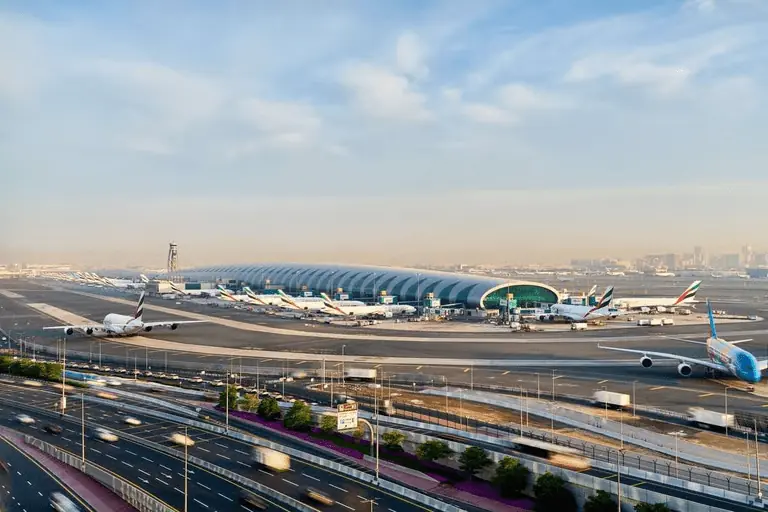
DUBAI: Dubai International Airport (DXB) handled 50.4 million passengers during the first nine months of 2026, marking a 28.1% decline compared with the same period last year, as disruptions linked to the Middle East conflict continued to affect regional aviation.
Dubai Airports, the operator of one of the world’s busiest international travel hubs, disclosed the figures on Tuesday, highlighting the impact of regional instability on passenger movements and airline operations.
The conflict has significantly disrupted air travel across the Middle East this year, with several countries intermittently closing their airspace during the early stages of hostilities.
Major Gulf airlines, which operate some of the world’s largest international flight networks, have gradually restored services. However, recent attacks on Saudi Arabia by Yemen’s Iran-aligned Houthi movement have raised concerns about the pace of a full recovery.
During the third quarter of 2026, Dubai International Airport welcomed 18.8 million passengers, representing a 22.1% decrease from the corresponding period a year earlier.
Despite the decline, Dubai Airports expects total passenger traffic at DXB to reach approximately 70 million by the end of 2026.
Dubai Airports Chief Executive Officer Paul Griffiths confirmed the annual passenger forecast in a statement, reflecting expectations of continued recovery in international travel demand.
The airport operator said several international airlines that had suspended flights to the region because of the conflict had resumed services to Dubai in recent months.
British Airways was among the carriers identified as having returned to the airport.
Dubai Airports also noted that direct and connecting passenger traffic remained broadly balanced during the year, highlighting DXB’s continued importance as both an international gateway to Dubai and a major global aviation hub.
The airport’s performance reflects the challenges facing the Middle East aviation sector as airlines work to restore flight networks while navigating ongoing geopolitical uncertainty and regional security risks.
Although passenger volumes remain below last year’s levels, the projected annual traffic of 70 million indicates expectations of further recovery during the final quarter of 2026.
You may also like
-
SBP Policy Rate: Central Bank Highlights Inflation Risks and Economic Resilience in FY26
-
SIFC Investment: Pakistan Reports $20 Billion China Portfolio and $2.3 Billion Saudi Inflows
-
Pakistan IT Exports: Monthly Earnings Hit Record $453 Million in October 2026
-
Pakistan REER: Rupee’s Real Effective Exchange Rate Hits Nearly Nine-Year High
-
Electricity Prices: CPPA-G Seeks Rs2.88 Per Unit Increase for October 2026