
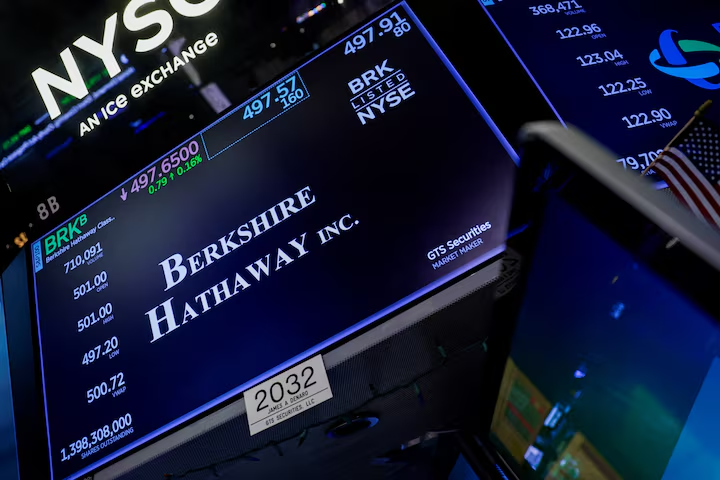
Berkshire Hathaway has accelerated its share buybacks under new Chief Executive Greg Abel, signalling a greater willingness to deploy the conglomerate’s substantial cash reserves.
The Omaha-based company repurchased $9.6 billion of its own shares between July and September. It bought another $2 billion in October, following $4.8 billion in buybacks earlier in 2026.
The move marks a shift from the approach of former chief executive Warren Buffett, who struggled to find attractive investment opportunities during the final years of his six-decade leadership.
Berkshire reported lower third-quarter profits on Saturday. Operating earnings fell 6% to $12.71 billion, while net earnings declined 28% to $22.11 billion.
Berkshire Cash Reserves Decline After Buybacks
Berkshire ended September with $356.9 billion in cash and cash equivalents, down from $380.2 billion six months earlier.
Abel, 64, has led the company since Buffett stepped down as chief executive. The quarter marked his third since taking charge. Buffett, 96, remains chairman emeritus, while his son Howard Buffett replaced him as chairman in September.
Berkshire’s largest annual share repurchase programme took place in 2021, when the company bought back $27 billion of its stock.
The conglomerate owns businesses across insurance, railroads, utilities, manufacturing, industrial operations and retail. Its holdings include Geico, BNSF Railway, Brooks running shoes, Fruit of the Loom and See’s Candies.
It also held $335.5 billion in publicly traded stocks as of September 30, including investments in Alphabet, Apple and American Express.
Economic Uncertainty Weighs on Consumer Demand
Berkshire said considerable uncertainty remained around economic and geopolitical developments, including tariffs and conflicts.
Several of its retail businesses have faced sluggish demand as uncertainty affects consumer confidence.
The US economy grew at an Annualised rate of 3.4% in the third quarter, according to the advance estimate from the Commerce Department’s Bureau of Economic Analysis. However, elevated inflation and gasoline prices continued to pressure household spending.
President Zardari and PM Shehbaz Reaffirm Commitment to Minority Rights in Pakistan
Despite broader market weakness linked to concerns about artificial intelligence and technology companies’ debt-funded spending, Berkshire shares reached record highs during the week.
Since the end of September, Berkshire’s stock has outperformed the S&P 500 by more than 18 percentage points. The company has also beaten the index by more than five percentage points in 2026.
CFRA Research analyst Cathy Seifert said Berkshire’s strong balance sheet, diversified businesses and share repurchases supported its performance.
She noted that investors appeared to be moving towards less volatile, high-quality companies. However, she said the key question was how much short-term underperformance investors would accept following the company’s transition beyond Buffett’s leadership.
Insurance Earnings Fall as Geico Faces Pressure
Berkshire’s third-quarter operating profit reached $12.71 billion, equivalent to approximately $8,954 per Class A share. This compared with $13.49 billion in the same period last year.
Insurance profits fell 26%, while underwriting earnings declined 43%.
Geico recorded a 45% drop in pretax profit. The decline reflected its decision to lower premiums to attract customers after a multiyear effort to improve underwriting standards and reduce overhead costs.
Its loss ratio, which measures claims costs against premiums, increased to 76.6% from 71.5% a year earlier.
Other insurance and reinsurance businesses also faced higher claims.
Seifert described Geico’s performance as weak compared with competitors Allstate and Progressive. She also raised concerns about Berkshire’s limited financial disclosures, saying they made it harder for analysts to identify operational problems.
Revenue Growth Supported by Acquisitions
Berkshire’s revenue increased 11% to $105.65 billion, marking its second consecutive quarter of double-digit growth.
The results included contributions from recent acquisitions. These included Occidental Petroleum’s chemicals business, acquired for $9.4 billion, and homebuilder Taylor Morrison, purchased for $6.8 billion.
Berkshire also invested billions of dollars in Alphabet shares, supporting the parent company of Google as it expands its artificial intelligence business. It acquired a 4% stake in Italian technology company Bending Spoons.
However, consumer businesses including Fruit of the Loom and Forest River recreational vehicles recorded declines.
BNSF, Energy and Industrial Businesses Deliver Stronger Results
Several of Berkshire’s non-insurance businesses reported stronger earnings.
BNSF Railway increased profit by 19%, supported by fuel surcharges and higher volumes of consumer, agricultural and energy products.
Berkshire Hathaway Energy recorded an 8% profit increase. The business owns utilities, natural gas pipelines and a real estate brokerage.
Industrial operations also performed well. Aerospace and industrial gas turbine sales helped Precision Castparts increase pretax profit by 30%.
Consumer products earnings declined, mainly because Duracell received lower tax credits. Higher gasoline prices, however, supported the performance of the Pilot truck stop chain.
The results highlight differences across Berkshire’s businesses as Abel takes a more active approach to capital allocation while retaining a substantial cash reserve.
You may also like
-
President Zardari and PM Shehbaz Reaffirm Commitment to Minority Rights in Pakistan
-
Pakistan Exports: Shipments to Europe Fall 1.84% to $2.35 Billion in Q1 FY27
-
Oil Prices: Brent Crude Rebounds as Markets Assess Iran War Outlook After US Midterms
-
ECC Approvals: Pakistan Clears Rs380bn in Supplementary Grants for Water Projects and Armed Forces
-
US Midterm Elections: Trump-Backed Candidates Lose Key Senate Races