Business

Gold Price in Pakistan Slides Sharply: Is This a Golden Buying Opportunity or a Warning Signal?
Business

Gold Price in Pakistan Slides Sharply: Is This a Golden Buying Opportunity or a Warning Signal?

The gold price in Pakistan witnessed a dramatic fall on Friday, triggering intense debate among investors, jewelers, and everyday buyers alike. After weeks of bullish momentum, the sudden drop has left many asking a critical question: Is this a temporary correction or the start of a deeper shift in the precious metals market? According to the All-Pakistan Gems and Jewelers Sarafa Association (APGJSA), 24-karat gold plunged by Rs21,400 per tola, settling at Rs507,762. This sharp correction has disrupted market sentiment and reopened conversations about timing, inflation hedging, and global price volatility. Gold price in Pakistan today: What changed overnight? The fall wasn’t limited to one category. Across purity levels, gold prices softened significantly: • 24-karat gold per 10 grams dropped by Rs18,347, reaching Rs435,324• 22-karat gold per 10 grams declined to Rs399,061 In simple terms, buyers who were priced out just days ago suddenly find gold more accessible while those who bought near recent highs are feeling the pinch. When looking at recent performance, the gold price in Pakistan had surged strongly over the past month. Despite today’s drop, gold remains Rs41,000 higher month-on-month, showing that long-term momentum hasn’t fully disappeared. Since the start of the fiscal year, gold has still gained over Rs157,000 per tola, underlining its role as a preferred hedge against economic uncertainty. Silver prices follow gold’s lead in Pakistan The precious metals sell-off wasn’t limited to gold. Silver prices in Pakistan also saw a sharp correction: • 24-karat silver per tola fell by Rs1,430 to Rs7,825• Silver per 10 grams declined by Rs1,226, now priced at Rs6,708 Although silver’s month-on-month performance remains mixed, the metal has still posted a positive trend on a fiscal year basis suggesting speculative interest remains intact. Gold price in Pakistan vs global markets: A surprising divergence Interestingly, while domestic prices fell, global gold markets moved in the opposite direction. International spot gold traded near $4,870 per ounce, gaining $168.7 (3.59%) in a single session. This divergence highlights a key factor influencing the gold price in Pakistan: currency dynamics and local market adjustments. A stronger dollar globally and shifts in international investor positioning can often cause short-term disconnects between local and global prices creating both risks and opportunities. Why the gold price in Pakistan matters more than ever Gold in Pakistan isn’t just a luxury it’s a financial instrument, a store of value, and a cultural asset. From weddings to wealth preservation, price movements directly affect household decisions and business strategies. This sudden drop could: • Encourage retail buying ahead of wedding season• Trigger profit-taking by short-term investors• Push jewelers to adjust pricing strategies rapidly• Renew interest among investors waiting for a correction Yet, volatility remains the key theme. With global economic uncertainty, fluctuating interest rate expectations, and geopolitical risks still in play, the gold price in Pakistan is likely to remain highly sensitive in the coming weeks. Is this the right time to buy gold in Pakistan? That depends on perspective. • Short-term traders may remain cautious due to volatility• Long-term investors could see this dip as a strategic entry point• Consumers may find temporary relief in jewelry prices What’s clear is that gold continues to dominate financial conversations both locally and globally. Final Thoughts The latest drop in the gold price in Pakistan has injected fresh uncertainty into the market, but it has also reignited opportunity. Whether this move turns into a deeper correction or a brief pause before another rally will depend on global cues, currency movements, and investor sentiment. One thing is certain: gold is once again commanding attention and Pakistan is right at the center of the story.
Dun & Bradstreet Teams Up with Midas Safety to Boost Data-Driven Finance in Pakistan
Business

Dun & Bradstreet Teams Up with Midas Safety to Boost Data-Driven Finance in Pakistan

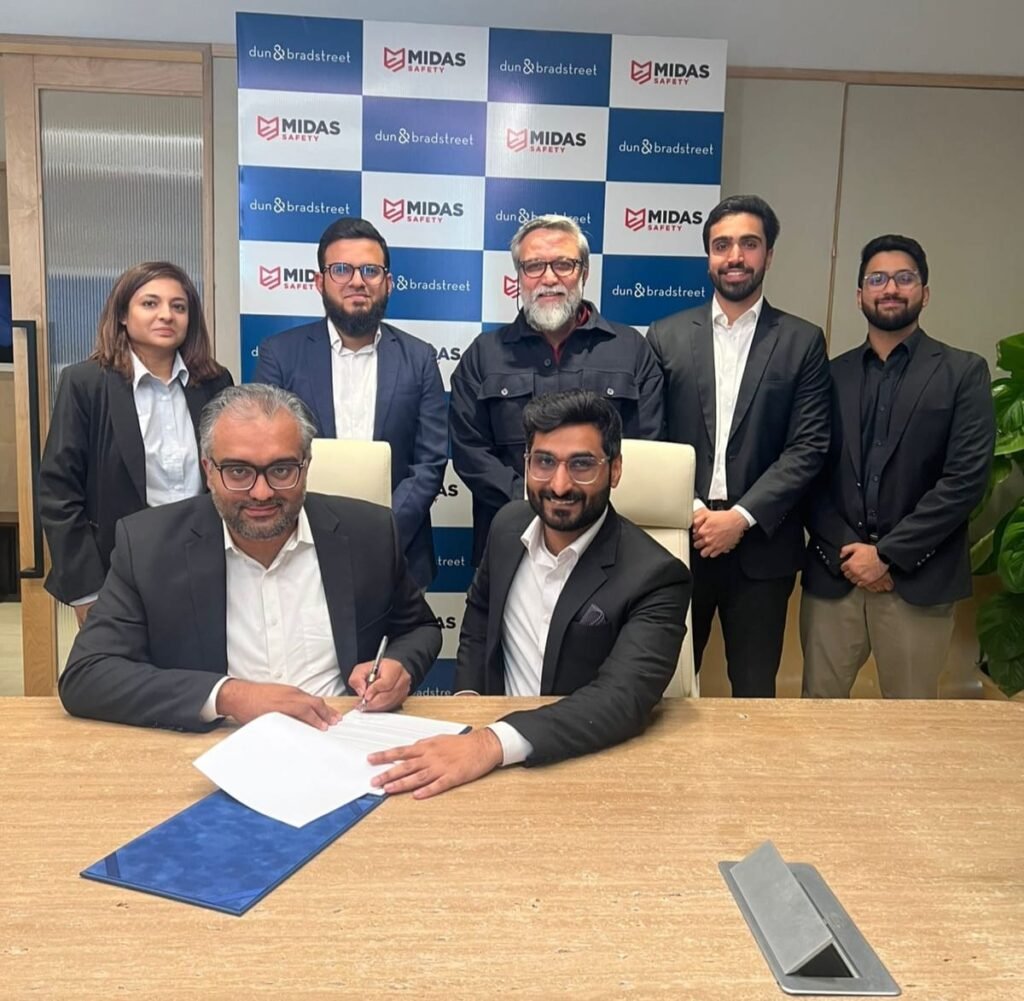
KARACHI: Dun & Bradstreet has partnered with Midas Safety through the deployment of D&B Finance Analytics. The partnership will enable Midas Safety to strengthen its financial decision-making capabilities through enhanced data-driven insights. The signing ceremony was held recently at the Dun and Bradstreet Pakistan Office, where representatives from both organizations came together to formalize the collaboration. The ceremony was attended by Khawaja Khurram, General Manager IT, Hasan Vohra, Group Commercial Finance Manager, and Kashan Mansoori CFO – from Midas Safety Pakistan. The collaboration reflects the growing demand among enterprises for strong analytics that give better visibility into finances and help teams make better decisions. D&B Finance Analytics solution helps corporate finance teams manage credit risk, streamline financial analysis, and access holistic company insights powered by Dun & Bradstreet’s global commercial database. With strong data intelligence at its core, the solution will equip Midas Safety to strengthen its finance initiatives and support its ongoing focus on operational efficiency and sustainable business growth. While talking about the collaboration, Zubair Qureshi, CBO Dun and Bradstreet Pakistan said, “We’re pleased to collaborate with Midas Safety as they adopt D&B Financial Analytics platform to strengthen its partner evaluation framework. This reflects how leading Pakistani enterprises are adopting global best practices to make smarter and sustainable partnership decisions”. Dun & Bradstreet is a global provider of business data and analytics. The company maintains one of the world’s largest commercial databases and provides data intelligence tools to support operations, compliance, and growth activities. More than 90% of the Fortune 600+ and millions of companies worldwide rely on Dun & Bradstreet data in support of their business decisions.

Standard Chartered Connects Pakistani SMEs to Global Markets Through Tailored Foreign Exchange Solutions
Business

Standard Chartered Connects Pakistani SMEs to Global Markets Through Tailored Foreign Exchange Solutions

Standard Chartered Bank Pakistan organized a dedicated client event in Islamabad on February 4, 2026, to showcase foreign exchange (FX) solutions designed specifically for the SME sector. The gathering highlighted ways to facilitate smoother international trade and expansion for local businesses. Read More: https://theboardroompk.com/wb-president-ajay-banga-pakistan-must-generate-30-million-jobs-to-secure-future/ SMEs as Economic Backbone Representing over 70% of non-agri jobs and a major export driver, SMEs are central to Pakistan’s growth story. Discussions centered on overcoming challenges in global dealings, with FX tools positioned as key enablers for efficient and confident market entry. Global Network and Specialized Services Leveraging presence in more than 53 countries, the bank delivers comprehensive support including in-depth market intelligence, seamless end-to-end FX processing, attractive pricing, and dedicated global trade guidance. This infrastructure helps reduce costs and complexities associated with cross-border payments and operations. Building Confidence and Partnerships Saadya Riaz, Head of Wealth and Retail Banking, remarked: “SMEs are a vital engine of Pakistan’s economy, driving growth and employment. At Standard Chartered, we are committed to supporting their ambitions by building long-term partnerships and by delivering tailored solutions, insights, and global expertise that will enable them to scale their businesses with confidence.” The event underscores Standard Chartered’s ongoing efforts to drive innovation and resilience in priority sectors. Through such engagements, the bank aims to equip SMEs with the tools needed to thrive internationally, contributing to broader economic development and export enhancement in Pakistan.

Gold Price in Pakistan Soars Past Rs514,000: What’s Driving This Historic Surge?
Business

Gold Price in Pakistan Soars Past Rs514,000: What’s Driving This Historic Surge?

Gold Price in Pakistan made headlines on Tuesday after recording one of its sharpest single-day jumps in recent memory, reigniting debate across financial markets, jewellery circles, and investment communities. Read More: https://theboardroompk.com/pia-forges-major-cargo-alliance-with-air-france-klm-to-boost-global-exports/ According to rates issued by the All-Pakistan Gems and Jewelers Sarafa Association (APGJSA), the price of 24-karat gold per tola climbed to Rs514,362, reflecting a staggering day-on-day increase of Rs24,000. For many Pakistanis, this surge feels less like a routine fluctuation and more like a loud warning bell for the economy. This sudden leap has pushed gold deeper into the spotlight not just as a luxury item, but as a financial shield against uncertainty. Gold Price in Pakistan: Breaking Down the Latest Rates The rally wasn’t limited to one category. Across weights and purity levels, gold prices moved sharply upward: • 24-karat gold (per tola) reached Rs514,362, compared to Rs490,362 just a day earlier.• 24-karat gold (per 10 grams) surged to Rs440,982 after gaining Rs20,576.• 22-karat gold (per 10 grams) also climbed significantly, now quoted at Rs404,248. In practical terms, this means buyers planning jewellery purchases, weddings, or long-term investments now face substantially higher entry costs, while existing holders are seeing instant paper gains. Over a broader timeline, the Gold Price in Pakistan has risen by nearly Rs58,800 in one month, an eye-opening figure that underscores how fast the market is moving. Silver Prices Follow Gold’s Lead The precious metals rally wasn’t confined to gold alone. Silver also posted strong gains in the domestic market: • 24-karat silver per tola increased to Rs9,146, up Rs741 in a single day.• Silver per 10 grams rose to Rs7,841 after gaining Rs636. Since the start of the fiscal year, silver prices have climbed by more than Rs5,300 per tola, reinforcing the broader trend of investors shifting toward tangible assets. Why Is the Gold Price in Pakistan Rising So Fast? Internationally, spot gold traded near $4,925 per ounce, rising $152.9 (3.20%) in one session. This global rebound, following a brief correction, has had a direct impact on local pricing. Persistent pressure on the Pakistani rupee continues to inflate import-linked commodities. Since gold is priced globally in dollars, any rupee weakness immediately pushes the Gold Price in Pakistan higher. With global geopolitical tensions, inflation fears, and volatile equity markets, investors are once again turning to gold as a safe haven, amplifying demand both locally and internationally. What This Means for Investors and Consumers For investors, the latest surge reinforces gold’s reputation as a store of value during uncertainty. Those who entered the market earlier are enjoying strong gains, while new investors must weigh the risks of buying at elevated levels. For consumers, especially those planning weddings or festive purchases, the spike may trigger delays, reduced buying volumes, or a shift toward lighter jewellery designs. The bigger question now is whether the Gold Price in Pakistan has reached a temporary peak or if this rally is just getting started. Outlook: Is More Upside Ahead? Market watchers believe that if global gold prices remain firm and currency pressures persist, domestic prices could stay elevated in the near term. However, short-term corrections remain possible, especially if international markets cool or the rupee stabilizes. One thing is clear: gold has reclaimed its throne as Pakistan’s most closely watched asset.

Pakistan SADC Chamber Announces Central and Provincial Office-Bearers
Business

Pakistan SADC Chamber Announces Central and Provincial Office-Bearers

The Pakistan SADC Chamber Trade Federation has taken a decisive step toward reshaping Pakistan’s trade and investment relationship with Southern Africa by announcing its central and provincial office-bearers for the 2026–2027 term. The newly unveiled Pakistan Chapter leadership signals renewed ambition, sharper focus, and a clear intent to deepen economic cooperation between Pakistan and the Southern African Development Community (SADC) region. Announced from Johannesburg on February 3, the development has drawn attention across business and diplomatic circles, as the federation positions itself to play a more strategic role in regional trade facilitation, joint ventures, and cross-border investment flows. A Strategic Vision Backed by Leadership Founder Chairman of the Pakistan SADC Chamber Trade Federation, Mr. Muhammad Rafiq Memon, underscored the importance of the Pakistan Chapter in delivering the federation’s core mission. Congratulating the newly nominated team, he expressed confidence that the central and provincial leadership would actively contribute to expanding Pakistan’s trade footprint across African markets. According to Mr. Memon, the federation’s renewed structure is aligned with its long-term manifesto transforming Pakistan into a competitive and trusted trading partner for Southern Africa while unlocking opportunities for exporters, investors, and entrepreneurs on both sides. The Pakistan SADC Chamber Trade Federation has taken a decisive step toward reshaping Pakistan’s trade and investment relationship with Southern Africa by announcing its central and provincial office-bearers for the 2026–2027 term. The newly unveiled Pakistan Chapter leadership signals renewed ambition, sharper focus, and a clear intent to deepen economic cooperation between Pakistan and the Southern African Development Community (SADC) region. Read more: Pakistan SADC Trade Relations Gain Momentum at Elite Karachi Diplomatic Gathering Announced from Johannesburg on February 3, the development has drawn attention across business and diplomatic circles, as the federation positions itself to play a more strategic role in regional trade facilitation, joint ventures, and cross-border investment flows. A Strategic Vision Backed by Leadership Founder Chairman of the Pakistan SADC Chamber Trade Federation, Mr. Muhammad Rafiq Memon, underscored the importance of the Pakistan Chapter in delivering the federation’s core mission. Congratulating the newly nominated team, he expressed confidence that the central and provincial leadership would actively contribute to expanding Pakistan’s trade footprint across African markets. According to Mr. Memon, the federation’s renewed structure is aligned with its long-term manifesto transforming Pakistan into a competitive and trusted trading partner for Southern Africa while unlocking opportunities for exporters, investors, and entrepreneurs on both sides. Pakistan SADC Chamber Trade Federation Central Cabinet 2026–27 At the heart of the Pakistan Chapter is a central cabinet composed of seasoned professionals with diverse trade and organizational experience. Mumtaz Khan Yousafzai will lead the chapter as President, supported by Syed Moizuddin as Senior Vice President. The operational backbone will be handled by Ikramullah Jan as General Secretary, while Sheikh Muhammad Ejaz takes on the role of Vice President. Together, this leadership team is expected to steer policy advocacy, trade missions, and institutional partnerships aimed at accelerating bilateral and multilateral trade. Provincial Leadership: Strengthening Grassroots Trade Engagement The Pakistan SADC Chamber Trade Federation has also strengthened its provincial footprint to ensure nationwide participation in Pakistan–Africa trade initiatives. In Islamabad, Shehzada Khurram assumes the presidency, supported by General Secretary Asghar Khan. Punjab’s chapter will be led by Khawaja Faiq Kaleem, with Aleena Ejaz playing a dual role as General Secretary and Senior Vice President of the Women Wing. In Sindh, Muhammad Shoaib Qadri heads the chapter, supported by Sheikh Aqeel Ahmed, Muhammad Shafiq, and Sadiq Karim. Khyber Pakhtunkhwa sees Engineer Khalifa Khan as President, backed by a strong team including Muhammad Arshad Afridi and Muhammad Shakeel Afridi. Balochistan and Kashmir are represented by Noor Afshan Baloch and Raja Sher Afghan respectively, ensuring inclusivity across regions. This decentralized structure is designed to convert local business potential into international trade opportunities. Women Wing and Inclusive Economic Growth A notable highlight is the federation’s strong emphasis on women-led trade initiatives. The Women Wing of the Pakistan SADC Chamber Trade Federation will be led by Noor Afshan Baloch, with Aleena Ejaz, Neelum Gul, and Maria Raza in key leadership roles. This reflects the federation’s commitment to inclusive growth and empowering women entrepreneurs in cross-border commerce. Digital Trade Takes Center Stage In a move aligned with global trade trends, Syed Salman Shah has been appointed as Director of Technology and Digital Trade. His role will focus on leveraging e-commerce platforms, online business networks, and modern digital tools to strengthen trade linkages between Pakistan and Southern Africa. This appointment signals the federation’s intent to modernize trade facilitation and tap into the rapidly growing digital economy. Why This Matters for Pakistan’s Economy With prominent figures from trade, industry, and social sectors, the Pakistan SADC Chamber Trade Federation is positioning itself as a catalyst for export growth, foreign investment, and economic diplomacy. The 2026–27 leadership is expected to play a pivotal role in opening new markets, reducing trade barriers, and supporting national economic growth through Africa-focused engagement. At the heart of the Pakistan Chapter is a central cabinet composed of seasoned professionals with diverse trade and organizational experience. Mumtaz Khan Yousafzai will lead the chapter as President, supported by Syed Moizuddin as Senior Vice President. The operational backbone will be handled by Ikramullah Jan as General Secretary, while Sheikh Muhammad Ejaz takes on the role of Vice President. Together, this leadership team is expected to steer policy advocacy, trade missions, and institutional partnerships aimed at accelerating bilateral and multilateral trade. Provincial Leadership: Strengthening Grassroots Trade Engagement The Pakistan SADC Chamber Trade Federation has also strengthened its provincial footprint to ensure nationwide participation in Pakistan–Africa trade initiatives. In Islamabad, Shehzada Khurram assumes the presidency, supported by General Secretary Asghar Khan. Punjab’s chapter will be led by Khawaja Faiq Kaleem, with Aleena Ejaz playing a dual role as General Secretary and Senior Vice President of the Women Wing. In Sindh, Muhammad Shoaib Qadri heads the chapter, supported by Sheikh Aqeel Ahmed, Muhammad Shafiq, and Sadiq Karim. Khyber Pakhtunkhwa sees Engineer Khalifa Khan as President, backed by a strong team including Muhammad Arshad Afridi

Pakistan OMC Sales January 2026 Signal a Strong Comeback for Fuel Demand
Business

Pakistan OMC Sales January 2026 Signal a Strong Comeback for Fuel Demand

Pakistan OMC sales January 2026 have delivered a powerful message to the market: fuel demand is back, and momentum is building across the energy and industrial landscape. After months of cautious recovery, Pakistan’s Oil Marketing Companies (OMCs) recorded a robust upswing in January, driven by higher diesel consumption, industrial revival, and seasonal demand pressures. Read More: https://theboardroompk.com/jf-17-export-boom-puts-pakistans-production-lines-under-pressure/ According to data compiled by AHL Research, total OMC offtake reached 1.52 million tons in January 2026. This represents a 12% month-on-month increase and a 10% year-on-year rise, underscoring renewed confidence in economic activity and transportation demand across the country. OMC Sales Performance Shows Sustained Growth in FY26 The encouraging January numbers build on a steady trend seen during the ongoing fiscal year. Cumulative Pakistan OMC sales for the first seven months of FY26 (7MFY26) stood at 9.67 million tons, marking a 3% year-on-year increase. While the overall growth may appear moderate, analysts note that this improvement is significant given last year’s subdued demand environment. Rising infrastructure activity, improved supply chains, and stable fuel availability have all contributed to strengthening domestic consumption. High-Speed Diesel Leads Pakistan OMC Sales January 2026 Rally HSD Demand Reflects Industrial and Transport Recovery A key driver behind Pakistan OMC sales January 2026 was High-Speed Diesel (HSD), which recorded one of the strongest performances among petroleum products. HSD sales climbed to 0.66 million tons, reflecting a 20% MoM jump and an 11% YoY increase. This sharp rise highlights growing activity in freight movement, agriculture, construction, and power generation. Analysts view diesel demand as a reliable proxy for economic health, making this surge a particularly bullish indicator. Motor Spirit Sales Remain Stable but Positive Motor Spirit (MS), commonly known as petrol, showed steady improvement. Sales reached 0.64 million tons, up 2% MoM and 3% YoY. While growth was modest compared to diesel, the consistency suggests stable private transport usage amid controlled inflationary pressures. Fuel Oil Records a Surprise Comeback Fuel Oil (FO) emerged as the surprise contributor to January’s growth. FO sales surged 76% MoM, reaching 0.10 million tons. This rebound is largely attributed to power generation requirements and strategic inventory drawdowns by key players. Company-Wise Breakdown Highlights Market Leaders Pakistan State Oil (PSO) Strengthens Its Dominance Pakistan State Oil (PSO) led the market with total sales of 0.63 million tons, posting a 17% MoM increase and 6% YoY growth. The company’s performance was largely driven by a 28% MoM rise in HSD sales, reinforcing PSO’s dominant position in the diesel segment. Attock Petroleum (APL) Posts Exceptional Growth Attock Petroleum Limited (APL) recorded sales of 0.13 million tons, up 31% MoM. The standout factor was a remarkable 1,237% jump in Fuel Oil offtake, reflecting aggressive trading and demand recovery in niche segments. Wah Petroleum (WAFI) Gains Momentum Wah Petroleum (WAFI) achieved sales of 0.12 million tons, rising 17% MoM and 20% YoY. Diesel sales surged 37% MoM, highlighting strong regional demand and efficient supply management. Hascol Petroleum Holds Steady Hascol Petroleum maintained relatively stable volumes at 0.05 million tons, registering a 5% MoM increase. While growth remains cautious, stability itself is viewed as a positive sign amid ongoing restructuring efforts. What Pakistan OMC Sales January 2026 Mean for the Economy The January surge points toward a gradual but sustained recovery in domestic fuel consumption. Rising diesel usage suggests expanding industrial output, improved logistics movement, and seasonal agricultural demand. Market experts expect Pakistan OMC sales momentum to continue in the coming months, supported by steady economic activity, controlled fuel supply, and improved inventory planning by major distributors. Outlook: Can the Momentum Last? With HSD demand acting as the primary growth engine and fuel oil staging an unexpected comeback, Pakistan’s oil marketing sector appears well-positioned for near-term stability. If industrial output and infrastructure development remain on track, Pakistan OMC sales January 2026 may mark the beginning of a stronger growth cycle for FY26.

UAE $2 Billion Loan to Pakistan: A Temporary Breathing Space
Business

UAE $2 Billion Loan to Pakistan: A Temporary Breathing Space

UAE $2 billion loan to Pakistan has once again taken center stage in regional financial headlines, as the United Arab Emirates agreed to roll over the loan for an additional month. While the extension may appear modest in duration, its economic and symbolic significance is far greater especially at a time when Pakistan is carefully balancing foreign exchange reserves, debt obligations, and ongoing reform commitments. Read More: https://theboardroompk.com/india-commits-to-massive-us-purchases-in-landmark-trade-deal-halts-russian-oil-imports/ This short-term rollover offers immediate liquidity relief, buying Islamabad precious time as it navigates a complex economic landscape shaped by global uncertainty, domestic fiscal pressures, and ongoing engagement with international lenders. Why the UAE $2 Billion Loan to Pakistan Matters Right Now Pakistan’s economy has been operating under tight financial conditions, with external debt repayments and import financing placing pressure on foreign reserves. In this context, the UAE $2 billion loan to Pakistan serves as a financial buffer that helps stabilize reserves and strengthens confidence in the country’s short-term repayment capacity. While the rollover does not inject fresh capital, it prevents an immediate outflow an equally critical factor when liquidity management is the top priority. Understanding the One-Month Rollover in Simple Terms Instead of repaying the $2 billion immediately, Pakistan has been granted a one-month extension. This effectively keeps the funds parked within the country’s reserves, allowing policymakers to manage cash flows more strategically. In practical terms, this means: • Reduced immediate pressure on foreign exchange reserves• Greater flexibility in managing imports and debt servicing• Enhanced confidence among global investors and lenders Rather than being just a financial transaction, the rollover reflects diplomatic trust and continued economic cooperation between Pakistan and the UAE. UAE–Pakistan Economic Ties: More Than Just a Loan The UAE $2 billion loan to Pakistan is part of a broader pattern of financial and strategic collaboration. Over the years, the UAE has remained one of Pakistan’s most reliable partners, supporting the economy through deposits, investments, energy projects, and employment opportunities for millions of Pakistani expatriates. This extension reinforces the message that Pakistan continues to enjoy backing from key regional allies an important signal for markets closely watching the country’s economic trajectory. What This Means for Pakistan’s Economic Outlook Although the one-month rollover is temporary, its timing is crucial. Pakistan is currently focused on: • Maintaining macroeconomic stability• Advancing fiscal and structural reforms• Strengthening engagement with multilateral institutions• Improving investor confidence The UAE $2 billion loan to Pakistan rollover provides a narrow but vital window for policymakers to align financial strategies without the immediate stress of a large repayment. However, economists caution that short-term relief must be accompanied by long-term solutions. Structural reforms, export growth, and revenue enhancement remain essential for sustainable recovery. Market Reaction and Investor Sentiment Financial markets tend to view such rollovers positively, as they reduce near-term default risk and improve liquidity metrics. For investors, the move suggests that Pakistan retains diplomatic and financial goodwill an important consideration in emerging markets. Still, analysts emphasize that repeated short-term rollovers underline the need for durable economic reforms rather than reliance on stopgap measures. What Comes Next After the One-Month Extension? The key question now is whether the UAE $2 billion loan to Pakistan will see further extension, conversion into a longer-term facility, or eventual repayment through improved reserve inflows. Much will depend on: • Progress in economic reforms• External financing arrangements• Global financial conditions• Pakistan’s trade and remittance performance The coming weeks will be closely watched by markets, policymakers, and international partners alike. Final Thoughts: A Small Window with Big Implications The rollover of the UAE $2 billion loan to Pakistan may last only one month, but its impact extends far beyond the calendar. It offers stability, confidence, and breathing room at a moment when every dollar counts. For Pakistan, the challenge now is to turn this short-term lifeline into a stepping stone toward long-term economic resilience.

Gold Surges around $170 as Investors "Buy the Dip" Amid US Government Shutdown
Business

Gold Surges around $170 as Investors “Buy the Dip” Amid US Government Shutdown

Gold prices staged a powerful recovery on Tuesday, climbing more than 3% as investors rushed back into the market following a period of intense selling. Read More: https://theboardroompk.com/india-commits-to-massive-us-purchases-in-landmark-trade-deal-halts-russian-oil-imports/ After touching a near one-month low in the previous session, spot gold rose 3.7% to approximately $4,837 per ounce. The rebound suggests that the “safe-haven” appeal of bullion remains intact despite recent volatility that saw prices drop from record highs of $5,594 seen just last week. Impact of the US Shutdown The rally was largely fueled by a partial U.S. government shutdown, which has halted the release of key economic data, including the highly anticipated January employment report. This lack of transparency has created a vacuum of information, prompting traders to seek safety in precious metals. With the Bureau of Labor Statistics unable to provide updates, market participants are bracing for a week of high uncertainty until a funding deal is reached in Washington. Interest Rate Outlook Bullion’s upward momentum is further supported by shifting expectations for the Federal Reserve. Despite a firm U.S. dollar, investors are still pricing in at least two interest rate cuts for 2026. Because gold is a non-yielding asset, it tends to perform better when rates are lower. Market analysts suggest that once the temporary leverage “flushing” ends, the long-term investment case for gold remains strong, with some institutions projecting a return to the $6,000 level.

Gold Price Forecast 2026: Why JPMorgan Is Betting Big on Gold’s Next Historic Rally
Business

Gold Price Forecast 2026: Why JPMorgan Is Betting Big on Gold’s Next Historic Rally

The Gold Price Forecast 2026 has taken a dramatic turn upward, and the world’s biggest investors are paying close attention. JPMorgan, one of the most influential financial institutions globally, has raised its year-end 2026 gold price forecast to a staggering $6,300 per ounce, despite recent price volatility that rattled global markets. This bullish call is not driven by speculation or short-term momentum. Instead, JPMorgan points to something far more powerful and structural: a sustained surge in central bank buying and accelerating investor demand, signaling that gold’s role in the global financial system is rapidly evolving. Gold Price Forecast 2026 Driven by Central Bank Buying At the heart of JPMorgan’s Gold Price Forecast 2026 is an aggressive wave of official-sector demand. Central banks purchased approximately 230 tonnes of gold in the fourth quarter alone, pushing total gold buying in 2025 to around 863 tonnes even as prices climbed beyond the psychologically significant $4,000 per ounce mark. Rather than slowing down, JPMorgan expects this trend to continue. For 2026, central bank demand is projected at roughly 800 tonnes, reflecting a long-term strategy of reserve diversification away from traditional fiat currencies. According to analysts, this diversification trend is far from complete and remains one of the strongest structural pillars supporting higher gold prices. In simple terms, when institutions that think in decades not quarters are consistently buying gold at record prices, it sends a powerful message to the market. Investor Demand Strengthens the Gold Price Forecast 2026 Beyond central banks, investor appetite for gold is also heating up. JPMorgan highlights growing inflows into gold exchange-traded funds (ETFs), resilient physical bar and coin demand, and broader portfolio allocations into gold as a hedge against uncertainty. From inflation risks and monetary policy shifts to geopolitical instability, gold is increasingly viewed as a multi-dimensional portfolio insurance asset. Analysts describe gold as a “dynamic hedge” capable of protecting wealth across a wide range of macroeconomic scenarios. This dual engine central banks on one side and investors on the other is what JPMorgan believes will ultimately propel gold prices to $6,300 per ounce by the end of 2026. Is Gold Overheated? JPMorgan Pushes Back Recent weeks saw sharp pullbacks in both gold and silver prices after rapid rallies pushed markets into overextended territory. A rebound in the US dollar briefly added pressure, triggering concerns that gold may be nearing unsustainable levels. JPMorgan disagrees. Their analysis suggests that even at elevated price levels, demand remains well above the historical threshold required to keep the gold market tight. While acknowledging that higher prices naturally thin liquidity, the bank argues that the structural rally is not close to collapsing under its own weight. In other words, this is not a speculative bubble it’s a demand-driven repricing of gold’s role in the global financial system. Silver Outlook: Caution Alongside Opportunity While gold headlines dominate the Gold Price Forecast 2026, JPMorgan strikes a more cautious tone on silver. After silver’s explosive rally and subsequent pullback, analysts warn of potential near-term volatility. Unlike gold, silver lacks consistent central bank support as a structural dip-buying force. This makes it more vulnerable to sharp corrections, particularly relative to gold. That said, JPMorgan still sees silver holding a higher long-term floor, estimating average prices in the $75 to $80 per ounce range. Over time, elevated prices are expected to reshape silver’s supply-demand dynamics, gradually easing the deficit that fueled its recent surge. What the Gold Price Forecast 2026 Really Signals JPMorgan’s upgraded outlook is more than just a price target it’s a signal of shifting financial priorities worldwide. Persistent central bank accumulation, resilient investor demand, and structural diversification away from traditional assets are reshaping the precious metals landscape. If the forecast proves accurate, gold’s move toward $6,300 per ounce may be remembered not as an anomaly, but as a defining moment in a broader monetary transition. For investors, policymakers, and market watchers alike, the Gold Price Forecast 2026 is no longer just about gold it’s about the future architecture of global finance.

Pakistan SADC Trade Relations Gain Momentum at Elite Karachi Diplomatic Gathering
Business

Pakistan SADC Trade Relations Gain Momentum at Elite Karachi Diplomatic Gathering

Pakistan SADC Trade Relations entered a decisive new phase as Karachi hosted one of the most high-profile diplomatic and business networking evenings of the year. Against the elegant backdrop of the Karachi Gymkhana’s swimming pool area, an exclusive sea-food dinner brought together global diplomats, senior government officials, industry leaders, and influential entrepreneurs signaling a unified push toward expanding Pakistan’s trade footprint across Southern Africa. Hosted by Mr. Shoaib Qadri, President of the Southern African Development Community (SADC) Sindh Chapter, the evening was held in honor of Mr. Akbar Iqbal Puri, President of Karachi Gymkhana. More than a social engagement, the event emerged as a strategic platform to advance Pakistan SADC Trade Relations through dialogue, commitment, and collaboration. A Strategic Evening for Pakistan SADC Trade Relations The guest list reflected the seriousness of intent. Diplomats representing many countries, senior trade policymakers, heads of regulatory bodies, and leaders of Pakistan’s most influential business associations gathered under one roof demonstrating a rare convergence of public and private sector alignment. Trade associations such as KATI, SITE, Super Highway Association, and NKATI, along with representatives from FPCCI and KCCI, were present, reinforcing the institutional backing behind Pakistan’s growing Africa-focused trade ambitions. Event Promo: Click Here Who Was Attending, and Why It Mattered The strength of the evening lay not just in numbers, but in influence. Senior figures from government, banking, industry, academia, and diplomacy engaged in meaningful exchanges focused on long-term trade expansion. Among the distinguished attendees were senior officials from TDAP, honorary consulates, commercial attachés, NAB, provincial and federal secretariats, leading universities, major banks, real estate developers, and manufacturing giants. Their presence underscored a shared realization: Africa represents Pakistan’s next major export and investment frontier. Rather than listing attendees, the discussions reflected a powerful mix of: • Policy authority to remove trade barriers• Financial leadership to enable cross-border investment• Academic insight to support research and skills development• Private-sector agility to execute trade opportunities Pakistan SADC Trade Relations and Africa’s Untapped Potential Why Africa Matters Now Despite Africa being one of the fastest-growing regions globally, Pakistan’s trade volume with African economies remains disproportionately low. Structural gaps, limited market intelligence, and weak institutional linkages have long constrained growth. During the evening, fruitful and result-oriented discussions addressed: • Market access challenges for Pakistani exporters• Logistics and regulatory bottlenecks• Financing mechanisms for Africa-bound trade• Diplomatic facilitation through SADC member states A strong emphasis was placed on transitioning from opportunity awareness to execution-driven trade frameworks. Government and Private Sector Alignment A pivotal moment came with the reaffirmation of support from TDAP, as its leadership expressed firm commitment to: • Increasing Pakistan’s trade volume with African nations• Identifying new and emerging African markets for Pakistani products• Supporting exporters through structured market-entry strategies Private-sector leaders echoed these commitments, offering technical expertise, financial facilitation, and operational support to ensure sustainability rather than one-off engagements. Leadership Driving Pakistan SADC Trade Relations Forward The initiative received unanimous praise for the leadership of: • Mr. Muhammad Rafiq Memon, Chairman, Pakistan SADC Chamber Trade Federation• Mr. Shoaib Qadri, President SADC Sindh Chapter• Mr. Syed Moiz, Vice President, Pakistan SADC Their vision of a private-sector-led, diplomatically supported trade corridor between Pakistan and Southern Africa was fully endorsed. Participants directed their respective teams to provide continuous institutional backing for timely and measurable outcomes. From Dialogue to Direction Thought leaders highlighted that Africa’s trade potential can only be realized through: • Structured engagement with diplomatic missions• Stronger B2B matchmaking mechanisms• Policy consistency and long-term commitment• Sector-focused export strategies in textiles, food processing, pharmaceuticals, construction, and engineering The consensus was clear: Pakistan SADC Trade Relations must now move from intent to implementation. A Defining Moment for Pakistan–Africa Economic Engagement As the evening concluded, it was evident that the dinner had achieved far more than ceremonial significance. It fostered ownership, accountability, and shared purpose, key ingredients for sustainable trade growth. With renewed confidence, cross-sector commitment, and diplomatic goodwill, Pakistan now stands better positioned than ever to deepen its economic ties with the SADC region and unlock Africa’s vast, untapped potential.

Scroll to Top