Author name: Web Desk

Over 2,000 Flights Grounded as Devin Dumps Snow on Major US Airports
World

Over 2,000 Flights Grounded as Devin Dumps Snow on Major US Airports

As of December 27, 2025, more than 1,600 flights were canceled on Friday alone, with an additional 650 scrubbed for Saturday, totaling over 2,250 disruptionsa1abe8. Delays exceeded 7,800 on Friday, primarily affecting New York’s major hubs: John F. Kennedy, Newark Liberty, and LaGuardia airports, which handled the bulk of cancellations6ba62d622da6. JetBlue led with around 225 cancellations, followed by Delta (212), Republic (157), American (146), and United (97)71bb79. Carriers like American, United, and JetBlue waived rebooking fees to assist stranded passengers, but many faced overnight stays or rerouting amid packed schedules. The storm’s timing exacerbated issues, as holiday demand had already pushed load factors above 85%. Read More: https://theboardroompk.com/san-francisco-electricity-blackout-waymo-pledges-software-upgrades-and-emergency-overhaul-after-robotaxis-stall/ Winter Storm Devin, named by the National Weather Service, emerged as a potent weather system originating from the Great Lakes region, fueled by cold Arctic air clashing with moist Atlantic flows. This storm, typical of late December patterns influenced by La Niña conditions, has historical parallels to events like the 2022 Buffalo blizzard that caused widespread power outages and fatalities. In 2025, Devin intensified during the peak post-Christmas travel period, when millions of Americans return home or embark on New Year’s getaways. The American Automobile Association estimated over 119 million travelers this holiday season, amplifying the chaos from weather disruptions. Airlines, already strained by staffing shortages and supply chain issues post-pandemic, faced compounded challenges as Devin brought heavy snow, ice, and winds to the densely populated Northeast corridor. Ground transportation fared no better, with states declaring emergencies to mobilize resources. New York Governor Kathy Hochul warned of “treacherous road conditions,” forecasting up to a foot of snow in Long Island and the Hudson Valley, with New York City potentially seeing its heaviest accumulation since 2022 at rates of 2 inches per houreff1c1. New Jersey and Pennsylvania imposed commercial vehicle bans on interstates, urging residents to avoid travel143b887aa30e. Ice storm warnings extended across Connecticut, Massachusetts, and Pennsylvania, mixing snow with sleet and freezing rain, heightening risks of power outages and accidents. Officials emphasized safety, with Hochul stating, “The safety of New Yorkers is my top priority.” As Devin continues into Saturday, forecasters predict lingering hazards, potentially delaying recovery into the new week and costing the economy millions in lost productivity and tourism revenue.

Pakistan’s digital payments lag peers despite rapid growth; Rs11.5 Trillion is outside banks and only 15% of bank accounts are digitally active
Pakistan

Pakistan’s digital payments lag peers despite rapid growth; Rs11.5 Trillion is outside banks and only 15% of bank accounts are digitally active

KARACHI – Pakistan’s drive toward a cashless economy is gaining momentum, but deep-seated structural challenges continue to slow the adoption of digital payments, according to industry leaders and a new banking sector report. “Despite progress, Pakistan’s digital payments ecosystem still trails regional and global benchmarks, with merchant economics and usage habits limiting adoption,” said Aamir Ibrahim, Chairman JazzCash International, in comments published in PwC Pakistan’s Banking Publication 2025. Pakistan remains one of the most cash-dependent economies in the region. Cash in circulation stood at about 34% of GDP as of June 2025, more than double levels seen in countries such as India and Bangladesh, underscoring the scale of the undocumented economy, the report said. Read More: https://theboardroompk.com/pakistans-5g-push-hits-pricing-roadblock-govt-caught-in-revenue-vs-rollout-dilemma/ Government and regulatory initiatives are beginning to show results. The State Bank of Pakistan’s instant payment system, Raast, recorded 45 million registered IDs by June 2025, facilitating 1.3 billion transactions valued at 29.6 trillion rupees, more than doubling in volume and value from a year earlier. The number of QR-enabled merchants also doubled to over one million during the same period. Still, analysts say adoption remains uneven. Only around 159,000 merchants are equipped with point-of-sale terminals, compared with millions across regional peers, while mobile banking penetration stands at roughly 15% of total bank accounts, far below levels seen in other emerging markets. Ibrahim said widespread adoption would depend on making digital payments cheaper, simpler and safer than cash. “A user-friendly, widely accessible digital ecosystem that offers transaction costs lower than cash is crucial for driving adoption,” he said, adding that the industry must also rethink monetisation models to ensure affordability for merchants without undermining the economics for banks and payment providers. Security concerns remain a key risk as transaction volumes rise. “The industry carries a collective responsibility to strengthen security, reduce scams, and invest in customer education,” Ibrahim said, warning that trust must keep pace with growth if digital payments are to replace cash at scale. The central bank has echoed those concerns, highlighting the economic cost of cash-heavy transactions. “Rs. 11.5 trillion remains outside the formal banking system. Redirecting even 20–30% of this cash into banks would boost liquidity, enabling greater lending to priority sectors,” said Saleem Ullah, deputy governor at the State Bank of Pakistan, according to the report. He added that digitising cash transactions would require sustained merchant onboarding, supply-chain digitisation and incentives to make digital payments as convenient and cost-effective as cash. According to PwC, digitising even a modest share of Pakistan’s cash-based transactions could save about 164 billion rupees annually and help shrink the undocumented economy, estimated at roughly 40% of GDP. While momentum is building, industry executives caution that technology alone will not be enough. Coordinated action by banks, telecom operators, fintechs and regulators will be needed to shift behaviour, deepen merchant acceptance and convert digital payments growth into lasting economic gains.

Pakistan Foreign Exchange Reserves Reach $21 Billion in December 2025
Editor pick, Pakistan

Pakistan Foreign Exchange Reserves Reach $21 Billion in December 2025

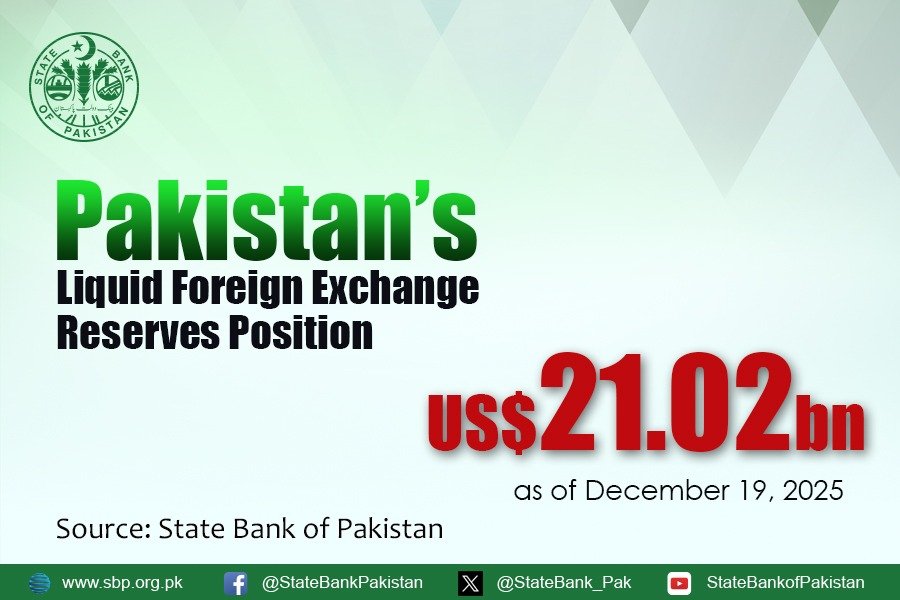
Pakistan foreign exchange reserves showed a modest but positive improvement in the third week of December 2025, reinforcing signs of growing external sector stability. According to the latest data released on December 26, 2025, the country’s total liquid foreign reserves stood at US$21.02 billion as of December 19, 2025, supported by a weekly increase in reserves held by the State Bank of Pakistan (SBP). This development comes at a time when Pakistan’s economy continues to navigate fiscal consolidation, external financing requirements, and exchange rate management, making foreign reserves a critical indicator for investors, policymakers, and international lenders. Pakistan Foreign Exchange Reserves: Latest Breakdown The Pakistan foreign exchange reserves are composed of holdings by the central bank and commercial banks, offering a comprehensive snapshot of the country’s external liquidity position. As of December 19, 2025, SBP-held foreign exchange reserves stood at US$15.9 billion, accounting for the majority share of the national reserve stockpile. These reserves play a vital role in meeting external debt obligations, stabilizing the Pakistani rupee, and supporting imports such as energy, food, and industrial raw materials. Meanwhile, net foreign reserves held by commercial banks amounted to US$5.12 billion. These funds primarily support trade financing, private sector imports, and routine banking operations linked to international transactions. Combined, the SBP and commercial bank holdings brought Pakistan’s total liquid foreign exchange reserves to US$21.02 billion, reflecting a cautiously improving external balance. Weekly Increase in Pakistan Foreign Exchange Reserves During the week ended December 19, 2025, Pakistan foreign exchange reserves held by the State Bank of Pakistan increased by US$16 million, rising from the previous week’s level to US$15.9 billion. Although the weekly increase was relatively modest, it signals continued inflows and disciplined external account management. Such gains often stem from a mix of multilateral financing, bilateral inflows, export receipts, and remittances from overseas Pakistanis. Why Pakistan Foreign Exchange Reserves Matter Strong Pakistan foreign exchange reserves are essential for maintaining macroeconomic stability. Adequate reserve levels help: • Strengthen investor confidence and improve sovereign credit outlook• Cushion the economy against external shocks• Support exchange rate stability• Ensure uninterrupted imports of essential commodities• Enhance Pakistan’s negotiating position with international lenders With reserves above the psychologically important $20 billion mark, Pakistan remains better positioned to manage short-term external pressures compared to earlier periods of acute balance-of-payments stress. Outlook for Pakistan Foreign Exchange Reserves in 2026 Looking ahead, the trajectory of Pakistan foreign exchange reserves will depend on several key factors, including IMF program continuity, export growth, remittance inflows, oil prices, and external debt repayments. Sustained reforms, prudent monetary policy, and improved current account discipline will be critical in ensuring reserves remain on an upward path in 2026. Any significant rise in exports or foreign investment could further strengthen Pakistan’s external buffers. Key Takeaway The latest data confirms that Pakistan foreign exchange reserves reached US$21.02 billion in December 2025, with a weekly increase driven by higher SBP holdings. While challenges remain, the improving reserve position reflects cautious optimism for Pakistan’s external economic outlook as the year draws to a close.

Following PIA privatisation, PSX's KSE-100 Smashes New Record at 172,401
Editor pick, Pakistan

Following PIA privatisation, PSX’s KSE-100 Smashes New Record at 172,401

Karachi, December 26, 2025 — The Pakistan Stock Exchange (PSX) capped a bullish year-end session with strong momentum, as the benchmark KSE-100 Index surged 1,571 points (+0.92%) to close at a historic new all-time high of 172,401. The upbeat sentiment mirrored classic year-end trends, with trading volumes rising to 345 million shares (up from 320 million the previous day). Commercial Banks, Oil & Gas Exploration Companies, and Cement sectors were the dominant drivers, collectively contributing 905 points to the index gain. Top point contributors included ENGROH (+342 points), PPL (+145 points), SYS (+110 points), NBP (+103 points), and MLCF (+75 points). Price-wise, standout gainers were JVD C (+9.72%), KOHC (+6.85%), ENGROH (+4.64%), MLCF (+3.89%), and THALL (+3.63%). On the flip side, RMP L (-5.99%), UNITY (-3.92%), DHPL (-3.35%), YOUV (-2.77%), and BNWM (-1.75%) were among the notable losers. The rally reflects sustained investor confidence amid improving macroeconomic indicators and year-end positioning.

Customs intercepts smuggled mobile phones worth Rs. 62 million
Uncategorized

Customs intercepts smuggled mobile phones worth Rs. 62 million

ISLAMABAD: The Anti-Smuggling Organization (ASO) of Collectorate of Customs Enforcement, Karachi successfully intercepted a consignment of smuggled mobile phones worth approximately Rs.62 million during an intelligence-based operation conducted on Thursday morning.Acting on credible information regarding the movement of a Mazda truck transporting smuggled mobile phones from Balochistan to Karachi, ASO teams swiftly deployed plainclothes squads at strategic locations, said a news release. Read More: https://theboardroompk.com/foreign-branded-phones-surge-in-china-shipments-more-than-double-in-november/ Mazda truck bearing registration number NAF-859, approaching from Sakran Road, was intercepted at the Hamdard Checkpost which was subsequently shifted to the CPF Warehouse for detailed examination.During inspection, 803 assorted-brand mobile phones, including iPhone, Vivo, Google Pixel, Infinix, and Spark, were recovered from a specially concealed cavity inside the vehicle.The seized mobile phones are valued at approximately Rs. 62 million, while the Mazda vehicle is estimated to be worth Rs. 25 million, bringing the total value of the case to around Rs. 87 million.The driver and helper have been taken into custody, and further legal proceedings are underway. An FIR is being lodged in accordance with the relevant provisions of law.This successful operation reflects FBR’s sustained commitment to combat smuggling and illicit trade.

Pakistan Refinery Capacity Crisis Exposes Growing Energy Security Risks
Pakistan

Pakistan Refinery Capacity Crisis Exposes Growing Energy Security Risks

Pakistan refinery capacity crisis has emerged as a serious challenge for the country’s energy sector, as rising fuel imports continue to overshadow domestic refining capabilities. Despite importing nearly 70% of petrol and 30% of diesel, Pakistan’s largest oil refineries are operating at only around 65–70% capacity, highlighting deep-rooted structural and policy failures. This imbalance between imports and local production is raising alarms about Pakistan’s long-term energy security, foreign exchange stability, and industrial competitiveness. Pakistan Refinery Capacity Crisis: Underutilized Assets Amid Rising Demand Pakistan has several major oil refineries with the technical ability to meet a significant portion of domestic fuel demand. However, the Pakistan refinery capacity crisis is driven by outdated infrastructure, lack of investment incentives, and policy uncertainty. In simple terms, while fuel demand continues to rise due to population growth and economic activity, refineries are unable to operate at full capacity because their decades-old technology is not designed to process modern fuel specifications efficiently. This has forced Pakistan to rely heavily on imported refined petroleum products instead of upgrading local capacity. How Fuel Imports Are Worsening the Pakistan Refinery Capacity Crisis The scale of fuel imports paints a worrying picture. Pakistan currently imports: • Approximately 70% of its petrol consumption• Around 30% of its diesel needs This heavy dependence on imports puts constant pressure on the country’s foreign exchange reserves, especially during periods of high global oil prices. Each shipment of imported fuel adds to Pakistan’s trade deficit and increases vulnerability to external supply disruptions. The Pakistan refinery capacity crisis also undermines local refineries’ financial viability. When cheaper imported fuel floods the market, domestic refineries struggle to compete, leading to further underutilization of existing capacity. Outdated Technology at the Core of the Pakistan Refinery Capacity Crisis One of the most critical contributors to the Pakistan refinery capacity crisis is obsolete refining technology. Most local refineries were built decades ago and lack the ability to produce Euro-V compliant fuels, which are now the global standard for cleaner emissions. Without major upgrades, refineries cannot efficiently convert crude oil into high-demand products like petrol and diesel. As a result, they either operate below capacity or produce lower-value fuel oil, which has limited domestic demand. Policy Uncertainty and Investment Gaps Deepen the Crisis Policy inconsistency remains another major obstacle. Frequent changes in energy policies, unclear pricing mechanisms, and delayed incentives have discouraged long-term investment in refinery modernization. Although refinery upgrade policies have been announced in the past, implementation delays have stalled progress. This uncertainty has worsened the Pakistan refinery capacity crisis, leaving investors hesitant to commit billions of dollars required for technological upgrades. Economic and Strategic Risks of the Pakistan Refinery Capacity Crisis The implications of the Pakistan refinery capacity crisis extend far beyond the energy sector. Economically, it increases reliance on imports, weakens the rupee, and exposes the country to global price shocks. Strategically, underutilized refineries mean Pakistan lacks adequate buffer capacity during supply disruptions or geopolitical tensions. In emergencies, dependence on imported fuel could severely impact transportation, agriculture, and industrial output. The Way Forward: Resolving the Pakistan Refinery Capacity Crisis Addressing the Pakistan refinery capacity crisis requires a coordinated approach: • Clear and consistent refinery upgrade policies• Attractive fiscal incentives for modernization• Long-term pricing certainty• Support for cleaner fuel production By enabling refineries to operate closer to full capacity, Pakistan can reduce import dependence, strengthen energy security, and create a more resilient fuel supply chain. The Pakistan refinery capacity crisis is a structural issue that can no longer be ignored. While fuel imports temporarily bridge supply gaps, they are not a sustainable solution. Revitalizing domestic refining capacity is critical for safeguarding Pakistan’s economy, reducing external vulnerabilities, and ensuring long-term energy security

Pakistan SPI Inflation Shows Weekly Decline Amid Mixed Price Movements
Pakistan

Pakistan SPI Inflation Shows Weekly Decline Amid Mixed Price Movements

Pakistan SPI inflation recorded a marginal weekly decline, offering short-term relief to consumers, even as year-on-year price pressures remain elevated. According to the latest data released by the Pakistan Bureau of Statistics (PBS), the Sensitive Price Indicator (SPI) fell by 0.09% compared to the previous week, while showing a 2.83% increase on an annual basis. The SPI is a key measure of short-term inflation in Pakistan, reflecting price movements of essential commodities that directly impact household budgets. Read More: https://theboardroompk.com/pakistani-rupee-performance-today-signals-stability-in-currency/ Pakistan SPI Inflation: Weekly Price Movement Snapshot During the reviewed week, PBS monitored price changes across 51 essential commodities collected from 50 markets in 17 cities nationwide. Instead of tabulated data, the weekly breakdown can be explained as follows: • Roughly one-quarter of essential items experienced price increases, indicating pressure in select food and energy categories.• Slightly over one-fifth of items saw price reductions, mainly due to seasonal supply improvements in vegetables.• More than half of the basket remained price-stable, reflecting relative short-term market balance. This mixed trend highlights that while headline Pakistan SPI inflation eased slightly on a weekly basis, volatility persists in individual commodity prices. Items Driving Weekly Increase in Pakistan SPI Inflation The largest weekly increases were observed in food and utility-related items. Chilies powder led the upward movement with a sharp rise of over 6%, followed by chicken prices, which increased by more than 5%. Other notable weekly increases included: • Bananas, supported by supply constraints• Electricity charges for Q1, reflecting energy cost adjustments• Garlic, eggs, vegetable ghee, pulses, and mutton, all posting moderate gains These increases partially offset the relief provided by falling vegetable prices and contributed to uneven inflation dynamics. Weekly Declines Ease Pakistan SPI Inflation Pressure On the downside, sharp declines in perishable food items helped contain weekly inflation. The most significant drops were seen in: • Potatoes, tomatoes, and onions, each posting strong double-digit weekly declines• Sugar, which fell by over 4%, easing pressure on household staples• Pulses, LPG, gur, and basmati broken rice, showing modest reductions These declines are largely attributed to improved supply conditions and seasonal harvest effects. Pakistan SPI Inflation: Year-on-Year Trend Remains Elevated Despite the weekly dip, Pakistan SPI inflation increased by 2.83% on a year-on-year basis, signaling persistent structural inflation pressures. Annual price increases were particularly sharp in: • Gas charges for Q1, surging nearly 30%• Wheat flour and sugar, reflecting food security and procurement challenges• Beef, gur, bananas, firewood, eggs, and powdered milk, all showing strong double-digit growth Non-food items such as lawn printed fabric and shirting also recorded notable annual increases, indicating broader inflationary transmission beyond food. Items Recording Annual Price Declines In contrast, several food staples showed significant year-on-year price corrections: • Tomatoes and potatoes, benefiting from bumper supply• Garlic, onions, and pulses, easing affordability pressures• Electricity charges for Q1 and LPG, providing limited relief in the energy basket These declines helped soften the overall annual Pakistan SPI inflation figure. Fertilizer and Cement Price Trends Outside the SPI basket, PBS data shows: • Sona urea prices edged slightly lower on a weekly basis and declined significantly compared to last year, supporting agricultural input affordability.• Cement prices remained broadly stable week-on-week, with a marginal annual increase, indicating steady construction sector demand. Why Pakistan SPI Inflation Matters for the Economy Pakistan SPI inflation serves as a critical early-warning indicator for policymakers, businesses, and investors. Weekly monitoring allows authorities to assess price shocks quickly, particularly for food and energy, and respond through administrative or monetary measures when necessary. As inflation management remains central to Pakistan’s economic stability, SPI trends provide valuable insights ahead of broader CPI readings and monetary policy decisions.

Pak Suzuki K-Electric 20 MW Grid Station Strengthens Industrial Power Infrastructure
Pakistan

Pak Suzuki K-Electric 20 MW Grid Station Strengthens Industrial Power Infrastructure

Pak Suzuki K-Electric 20 MW Grid Station collaboration marks a significant step forward for Pakistan’s industrial and automotive sectors, as both companies partner to ensure reliable and uninterrupted electricity for expanding manufacturing operations in Karachi. On December 26, 2025, K-Electric (KE) and Pak Suzuki Motor Company Ltd. signed an agreement to develop a dedicated 132 kV grid station at Pak Suzuki’s manufacturing facility. The project will supply up to 20 megawatts (MW) of electricity, tailored specifically to meet the automaker’s increasing power requirements as production scales up. This initiative not only strengthens Pak Suzuki’s operational resilience but also reinforces K-Electric’s commitment to supporting industrial growth through dependable and cost-efficient energy solutions. Read More: https://theboardroompk.com/ford-recalls-over-272000-electric-and-hybrid-vehicles-over-park-failure-risk/ Pak Suzuki K-Electric 20 MW Grid Station: Powering Automotive Growth The Pak Suzuki K-Electric 20 MW Grid Station is designed to provide a stable, high-quality power supply that minimizes disruptions and enhances production efficiency. As one of Pakistan’s largest automobile manufacturers, Pak Suzuki relies heavily on consistent electricity to maintain output, meet market demand, and support future expansion plans. With automotive manufacturing being energy-intensive, even minor power fluctuations can impact productivity. The dedicated grid station ensures that Pak Suzuki’s facility receives priority power directly from KE’s network, reducing dependency on alternative or backup sources. This development aligns with broader industrial modernization efforts aimed at improving competitiveness and attracting further investment into Pakistan’s manufacturing sector. K-Electric’s Expanding Role in Industrial Power Solutions The agreement with Pak Suzuki adds to a growing list of industrial partnerships secured by K-Electric in recent years. Similar collaborations with DP World and Pakistan Steel Re-Rolling Mills (PSRM) reflect rising confidence in KE’s system reliability, grid stability, and pricing competitiveness. According to Moonis Alvi, CEO of K-Electric, the project goes beyond supplying electricity. It represents a strategic partnership that anticipates the evolving needs of Pakistan’s industrial and automotive sectors while contributing to long-term economic sustainability. By increasing demand on the national grid through dedicated industrial connections, KE continues to strengthen Karachi’s position as a manufacturing and logistics hub. Pak Suzuki’s Vision Supported by Reliable Energy Speaking on the occasion, Hiroshi Kawamura, Managing Director of Pak Suzuki, emphasized that reliable energy is fundamental to meeting Pakistan’s mobility needs and sustaining economic growth. The Pak Suzuki K-Electric 20 MW Grid Station will enable the company to operate with greater efficiency while planning for future capacity enhancements. Pak Suzuki remains a key contributor to Pakistan’s industrial output, employment generation, and localization of automotive manufacturing. The availability of uninterrupted power plays a critical role in ensuring timely production, quality assurance, and supply chain stability. Why the Pak Suzuki K-Electric 20 MW Grid Station Matters for Pakistan The significance of this project extends beyond a single industrial facility. It highlights how targeted infrastructure investments can deliver broader economic benefits, including: • Reliable power for large-scale manufacturing operations• Improved industrial productivity and reduced downtime• Strengthened confidence among domestic and foreign investors• Enhanced utilization of the national electricity grid By supporting critical sectors such as automotive manufacturing, K-Electric continues to reinforce Pakistan’s industrial backbone and enable sustainable economic growth. The Pak Suzuki K-Electric 20 MW Grid Station project represents a milestone in industry–energy collaboration in Pakistan. Through a dedicated 132 kV grid station, the partnership ensures uninterrupted power supply, supports production expansion, and contributes to Karachi’s industrial resilience. As Pakistan looks to accelerate industrialization and economic recovery, such strategic energy partnerships will remain central to driving productivity, competitiveness, and long-term growth.

Pakistani Rupee Performance Today Signals Stability in Currency
Pakistan

Pakistani Rupee Performance Today Signals Stability in Currency

Pakistani Rupee performance today reflected cautious optimism on Friday as the local currency posted marginal gains against the US dollar and several major global currencies, while Pakistan’s equity and money markets also remained resilient. The currency movement highlights improving sentiment driven by fiscal discipline, controlled inflation, and steady foreign exchange dynamics. On December 26, 2025, the Pakistani rupee (PKR) appreciated by 2.87 paisa in the interbank market, closing at PKR 280.17 per US dollar, compared to the previous session’s close of 280.20. During the trading session, the rupee fluctuated within a narrow band, touching an intraday high of 280.50 and a low of 280.20 signaling controlled volatility. Read More: https://theboardroompk.com/gold-price-in-pakistan-reaches-historic-high-amid-strong-domestic-demand/ Pakistani Rupee Performance Today Against the US Dollar The slight appreciation against the greenback indicates continued stability in Pakistan’s foreign exchange market. In the open market, exchange companies quoted the dollar at PKR 280.40 for buying and PKR 281.25 for selling, reflecting a manageable spread and steady dollar demand. From a broader perspective, the rupee has strengthened by PKR 3.59 (1.28%) during the current fiscal year, although it remains down PKR 1.62 (0.58%) in the calendar year to date showing gradual recovery after earlier pressures. Pakistani Rupee Performance Today Against Major Global Currencies Beyond the US dollar, Pakistani Rupee performance today was notably positive against several key global currencies: • Euro (EUR): PKR gained 63.62 paisa (0.19%), closing at 329.71.• British Pound (GBP): The rupee strengthened by Rs1.06 (0.28%), settling at 377.60.• Swiss Franc (CHF): PKR appreciated Rs1.07 (0.30%), ending at 354.74.• Japanese Yen (JPY): A gain of 0.72 paisa (0.40%), closing at 1.7913.• Saudi Riyal (SAR): Marginal improvement of 0.76 paisa, closing at 74.70.• UAE Dirham (AED): Strengthened by 1.20 paisa, ending at 76.28. However, the rupee slightly weakened against the Chinese Yuan (CNY), losing 2.78 paisa (0.07%) to close at 39.97, reflecting shifting regional trade and settlement dynamics. Pakistani Rupee Performance Today in the Money Market Money market indicators also supported the stable outlook. The benchmark 6-month Karachi Interbank Offered Rate (KIBOR) edged up by 1 basis point, with bid and offer rates at 10.41% and 10.66%, respectively. This marginal uptick suggests expectations of monetary stability while maintaining liquidity control. Outlook: What Pakistani Rupee Performance Today Means for the Economy The latest data shows that Pakistani Rupee performance today is aligned with improving macroeconomic indicators, disciplined monetary policy, and better external account management. While global currency risks remain, the rupee’s controlled movement against major currencies reflects a more balanced foreign exchange environment. If current trends continue supported by stable interest rates, controlled imports, and consistent inflows, the rupee may maintain its gradual recovery path into the next quarter.

Foreign-branded smartphones have made a strong comeback in China as shipments more than doubled in November, signaling renewed consumer demand despite intense competition from domestic brands. 👉 For full shipment data, market context, and what’s driving the surge, click the link in the first comment. #ChinaTech #Smartphones #Apple #MobileMarket #TechNews #ConsumerTrends
Uncategorized

Foreign-Branded Phones Surge in China: Shipments More Than Double in November

Data released by the China Academy of Information and Communications Technology (CAICT) on December 25, 2025, revealed a dramatic surge in foreign-branded mobile phone shipments to China in November, more than doubling year-on-year to 6.93 million units—a 128.4% increase. This sharp rise contrasts with the overall market’s modest 1.9% growth to 30.16 million units, highlighting renewed consumer interest in international brands, particularly Apple’s iPhones, amid a stabilizing domestic economy. Read More: https://theboardroompk.com/india-considers-mandating-constant-smartphone-location-surveillance-amid-backlash-from-apple-samsung-and-google/ Background on China’s Smartphone Market Dynamics China, the world’s largest smartphone market, has long been dominated by local brands like Huawei, Vivo, Xiaomi, and Oppo, which collectively hold over 70% share in recent years. Foreign brands, led by Apple, faced headwinds from intense competition, U.S.-China trade tensions, and Huawei’s resurgence post-sanctions. Apple’s sales declined for several quarters through early 2025, dipping below 20% market share at times. However, the September 2025 launch of the iPhone 17 series, featuring advanced AI capabilities and localized features, sparked a turnaround. October saw Apple’s sales jump 37% year-on-year, capturing 25% market share—the highest since 2022. Drivers Behind the November Surge and Implications The November spike is largely attributed to sustained demand for the iPhone 17 lineup, including the popular base model and Pro variants, boosted by holiday promotions and year-end inventory builds. Foreign brands’ share rose significantly, signaling a shift in premium segment preferences. Analysts note this recovery reflects Apple’s strategic pricing adjustments, ecosystem loyalty, and innovations countering domestic rivals. While overall market growth remains tepid, this foreign brand momentum could pressure local manufacturers to accelerate AI and foldable innovations. For global players, it underscores China’s enduring importance, potentially adding billions in revenue amid broader economic recovery signals.

Scroll to Top