Author name: Web Desk

PTA Concludes 5G Auction, Nets $507M as Jazz Grabs 190 MHz, Ufone 180 MHz, Zong 110 MHz
Tech

PTA Concludes 5G Auction, Nets $507M as Jazz Grabs 190 MHz, Ufone 180 MHz, Zong 110 MHz

Islamabad (10th March, 2026): Pakistan Telecommunication Authority (PTA) has successfully concluded the allocation stage of the landmark Next Generation Mobile Services (NGMS) / 5G Spectrum Auction, marking a major step toward the rollout of 5G services in Pakistan. Read More: https://theboardroompk.com/psx-find-relief-from-geopolitical-front-jumps-9697-points/ Three qualified operators Jazz, Ufone, and Zong participated in the auction, which offered 597.2 MHz of spectrum across six frequency bands (700, 1800, 2100, 2300, 2600 and 3500 MHz). The auction was conducted through a secure Electronic Auction System (EAS) with PTA’s Control Room established at its Headquarters in Islamabad. The process was managed by PTA in collaboration with international consultant NERA Economic Consulting. Operators participated remotely, while results of each round were publicly announced at the Islamabad Marriott Hotel in the presence of Print and Electronic media, on PTA’s website, and live broadcast on Pakistan Television to ensure transparency. During the allocation stage, a total of 480 MHz spectrum was sold. Jazz secured 190 MHz, Ufone 180 MHz, and Zong 110 MHz across different bands. The allocation stage concluded after three rounds of bidding. The Assignment Stage, to determine specific frequency positions within each band, will be held on 12th March, 2026. The auction conclusion ceremony was attended by Federal Minister for Information and Broadcasting Mr. Attaullah Tarar and Minister for IT & Telecom Ms. Shaza Fatima Khawaja. The ministers appreciated PTA for conducting a fair, transparent, and efficient auction as directed by Honorable Prime Minster of Islamic Republic of Pakistan and describing it a significant step toward Pakistan’s digital transformation. Representatives of participating operators also appreciated the transparent process and PTA’s collaborative approach. The auction is expected to accelerate Pakistan’s digital economy, improve mobile broadband quality, and pave the way for next-generation 5G services nationwide.
PSX Find Relief From Geopolitical Front, Jumps 9,697 points
Business

PSX Find Relief From Geopolitical Front, Jumps 9,697 points

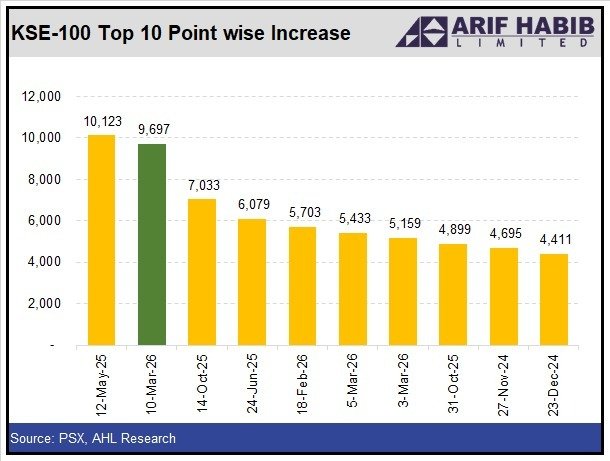
PSX staged a remarkable rebound, with the benchmark KSE-100 Index surging by 9,697 points (+6.62%) to close at 156,177, marking the second-highest point gain in the history of the exchange. Read More: https://theboardroompk.com/saudi-aramco-turns-to-rare-spot-tenders-immediate-sales-bypass-hormuz-blockade/ “Trading commenced on a jubilant note as investor sentiment improved sharply following an early morning statement by Donald Trump indicating that the Middle East conflict may be nearing its end,” said Ali Najib, Deputy Head of Trading at Arif Habib Ltd. The optimistic development triggered aggressive buying at the open, pushing the market up by more than 5% within minutes, which led to a temporary trading halt in accordance with PSX circuit breaker regulations, he added. Once trading resumed after an hour, broad-based buying momentum continued across major sectors, driving the benchmark index to an intraday high of 158,354. However, some profit-taking in the final hour of trading trimmed earlier gains, leading the index to settle at 156,177 by the close. On the sectoral front, progress on Pakistan’s 5G spectrum auction remained in focus. The auction process is being conducted in two stages through electronic bidding, with six spectrum bands on offer. The first phase comprises five bidding rounds, while the second stage will commence following a one-day break. All three telecom operators—local subsidiaries of VEON, e&, and China Mobile—are participating in the auction. FFC, ENGROH, UBL, HUBC, MEBL, HBL, LUCK, PPL, OGDC, and SYS collectively contributed 5,692 points to the day’s rally. Despite the strong market performance, overall participation remained relatively modest, with total traded volume recorded at 484 million shares, while turnover stood at PKR 31.1 billion. K-Electric (KEL) led the volume chart, with 53.2 million shares traded during the session. Outlook: Yesterday’s expectation that markets were approaching a “peak fear” phase appears to have played out, as constructive developments on the Middle East front helped restore investor confidence and triggered a strong relief rally, resulting in the second-largest bull run in PSX history today. Going forward, if geopolitical conditions remain stable, the positive momentum may extend into the next session; however, investors are likely to remain cautious as markets continue to monitor external developments closely.

Saudi Aramco Turns to Rare Spot Tenders: Immediate Sales Bypass Hormuz Blockade
World

Saudi Aramco Turns to Rare Spot Tenders: Immediate Sales Bypass Hormuz Blockade

Saudi Aramco, the world’s largest oil exporter, has resorted to issuing rare spot tenders for crude oil amid escalating geopolitical tensions in the Middle East. Read More: https://theboardroompk.com/bingx-launches-p2p-march-mega-spin-campaign-with-a-400000-prize-pool-copy/ Traders report that the company offered more than 4 million barrels through multiple tenders in recent days. This unusual move comes as the ongoing U.S.-Iran conflict severely disrupts traditional export routes. Geopolitical Tensions and Route Disruptions The conflict has led to the virtual closure of the Strait of Hormuz, a critical chokepoint through which about one-fifth of global oil and liquefied natural gas normally flows. Fears of attacks have halted or slowed tanker traffic, forcing exporters like Saudi Arabia to reroute shipments via the Red Sea ports, such as Yanbu. Producers including Iraq and Kuwait have begun reducing output due to these blockages. Asian refiners, who source around 60% of their oil from the Middle East, face immediate supply shortages, leading to potential production cuts. Aramco’s Tender Details and Market Response In one tender closing on Monday, Aramco offered 2 million barrels of Arab Heavy crude for loading at Egypt’s Ain Sokhna port between March 10-30, destined for Asia on an FOB basis. Another involved 650,000 barrels of Arab Light on a CFR basis from Yanbu. A third tender resulted in the sale of 2 million barrels of Arab Extra Light to Japan’s Idemitsu Kosan, with the cargo already near Taiwan. These sales occurred at premiums to Saudi Arabia’s March official selling prices. This spot market activity highlights supply constraints and efforts to maintain flows despite regional instability. Oil prices have surged, reflecting broader market concerns over prolonged disruptions.

FPCCI Proposes Energy Emergency to Shield Pakistan’s Economy from Middle East Conflict Petroleum Prices and Interest Rate Highest in the Region
Pakistan

FPCCI Proposes Energy Emergency to Shield Pakistan’s Economy from Middle East ConflictPetroleum Prices and Interest Rate Highest in the Region

Karachi: Mr. Atif Ikram Sheikh, President of the Federation of Pakistan Chambers of Commerce and Industry (FPCCI), has strongly called upon the federal government to declare an immediate energy emergency; and, implement reliable contingency measures to insulate Pakistan’s fragile economic recovery and its exports from the severe fallout of the ongoing conflict in the Middle East. Read More: https://theboardroompk.com/bingx-launches-p2p-march-mega-spin-campaign-with-a-400000-prize-pool-copy/ Mr. Atif Ikram Sheikh has highlighted that the compounding burden of regionally-uncompetitive petroleum prices – already raised by an exorbitant PKR. 55 per liter – and punishingly high interest rates – with key policy rate continuing to be at 10.5% – will cause Pakistan’s cost of doing business to soar to unsustainable levels and will effectively result in crippling the industrial growth and exacerbate country’s exports slowdown even further. FPCCI Chief stressed that while regional competitors maintain accommodative, single-digit monetary policies and rationalize their petroleum prices to support their manufacturing bases, Pakistani trade and industry will be stifled by exorbitant borrowing costs that paralyze capital investment and modernization – coupled with relentless upward revisions in petroleum levies, which directly inflate logistical, transportation and captive power generation expenses – manufacturers will be left with severely eroded profit margins. FPCCI Chief reiterated that Pakistan’s industrial sector cannot afford another external shock; given our heavy reliance on Gulf energy imports from Saudi Arabia, the UAE and Qatar – and, interruptions in crude oil and liquefied natural gas (LNG) supplies will fuel inflationary pressures and deepen the cost-of-living crisis. Mr. Atif Ikram Sheikh has highlighted the surging freight and insurance costs as war-risk classifications have driven marine insurance premiums drastically higher. Freight costs on major shipping routes have spiked by up to 300% – with daily LNG freight rates jumping by more than 40%. President FPCCI maintained that supply chain delays on the back of rerouting shipments away from the Gulf is projected to add 15 to 20 days to transit times for Pakistani exports heading to key markets in the European Union, the UK and the United States. Mr. Atif Ikram Sheikh also pointed out the vulnerability of Pakistani ports as both Port Qasim and Karachi Port are directly linked to Gulf shipping routes; leaving domestic supply chains highly exposed to maritime disruptions and massive delays. Mr. Atif Ikram Sheikh stressed that while the current 28-day petroleum reserve offers a brief buffer, it is insufficient for an extended regional conflict. We are exposed to a severe economic shock if tensions persist. Coordinated action between policymakers, regulators and the business community is indispensable right now, he added. Mr. Saquib Fayyaz Magoon, SVP FPCCI, demanded that national strategic oil reserves need initiation of an urgent framework to build up strategic petroleum reserves from the current 28 days of consumption coverage to a more resilient and logical 60-90 day target. SVP FPCCI said that protecting export competitiveness has become imperative and introduction of targeted policy actions to absorb the shock of rising imported raw material costs and probable exchange-rate volatility is warranted. FPCCI stands ready to assist the government in formulating and executing these contingency plans to ensure the survival of Pakistan’s trade and industry during this period of unprecedented global uncertainty.

BingX Launches P2P March Mega Spin Campaign with a $400,000 Prize Pool Copy
Tech

BingX Launches P2P March Mega Spin Campaign with a $400,000 Prize Pool Copy

Pakistan March 9, 2026 – BingX, a leading cryptocurrency exchange and Web3-AI company, announced the launch of its P2P March Mega Spin campaign, a new initiative designed to reward users and compete for a $400,000 prize pool. The campaign offers participants the chance to win a range of prizes, including $777 gold bars, $555 in USDT rewards, and exclusive Mystery Boxes worth up to $300. Read More: https://theboardroompk.com/sbp-stays-cautious-policy-rate-unchanged-at-10-5-as-brent-spike-fuels-inflation-worries/ Built around a task-based participation model, the campaign gives users multiple ways to earn draw entries throughout the event period. Users can participate by completing qualifying actions such as making a first-time P2P deposit, reaching cumulative deposit milestones, executing eligible futures trades, and referring new users through the campaign’s referral link generator. This structure is designed to support both new user activation and continued engagement from more active participants. The launch also highlights BingX’s broader approach to campaign design, where platform exploration and user activity are rewarded. In its recently published Zero-Fee Carnival announcement, BingX introduced zero-fee trading across selected spot crypto and TradFi assets and paired the initiative with a spin-based promotion linked to user milestones such as registration, KYC, first trades, and cumulative trading activity. With P2P March Mega Spin, BingX continues to expand how users interact with the platform by turning everyday actions into new reward opportunities. Users can visit the official campaign page to explore the full event details and begin completing tasks to unlock their draw entries.

SBP Stays Cautious — Policy Rate Unchanged at 10.5% as Brent Spike Fuels Inflation Worries
Pakistan

SBP Stays Cautious — Policy Rate Unchanged at 10.5% as Brent Spike Fuels Inflation Worries

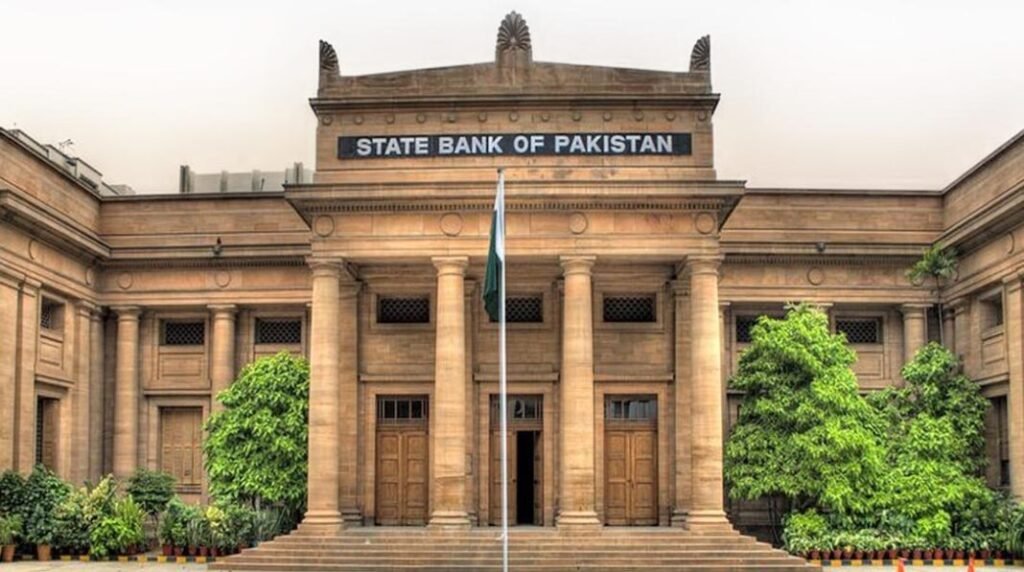
The Monetary Policy Committee of the State Bank of Pakistan (SBP) today (March 9, 2026) opted to leave the policy rate unchanged at 10.5%, signalling continued vigilance in an environment marked by escalating Middle East tensions and sharply higher global energy costs. Read More: https://theboardroompk.com/ccp-report-pakistans-civil-aviation-lacks-vision-risks-over-reliance-on-gulf-carriers/ This is the second consecutive hold of 2026, following January’s unexpected pause at the same level. The stance reflects heightened caution after Brent crude’s rapid 25% climb and corresponding 37–49% jumps in global diesel prices – developments that directly feed into Pakistan’s import bill and domestic inflation pressures. A widely followed pre-MPC poll by Topline Securities (March 6) captured the prevailing view: 92% of participants expected the rate to stay unchanged, citing the sudden reversal in energy price dynamics and regional uncertainty. Notably:62% anticipated the conflict-related turmoil persisting for 2–5 weeks. Money-market indicators had already priced in caution, with 6-month T-bill and KIBOR yields rising 58–85 bps in the lead-up.Looking forward, 60% saw rates holding near current levels through June, while inflation expectations settled around 7% on average and the rupee broadly stable at 280–285 to the dollar. The MPC’s decision buys time to assess whether the oil shock proves transitory or becomes embedded in medium-term inflation and external balances. It follows a cumulative easing cycle (including the December 2025 50 bps reduction to 10.5%) that had supported early signs of growth recovery. While the hold preserves hard-won macroeconomic stability, analysts warn that an extended period of elevated global energy prices – or currency slippage – could shift the balance toward future tightening. For now, SBP appears focused on safeguarding the 5–7% medium-term inflation target while monitoring real-side momentum.

PSX Market Crash: Pakistan Stock Exchange Plunges Nearly 7% Amid Oil Price Shock
Pakistan

PSX Market Crash: Pakistan Stock Exchange Plunges Nearly 7% Amid Oil Price Shock

The PSX market crash dominated headlines on Monday as the Pakistan Stock Exchange (PSX) experienced one of its sharpest single-day sell-offs in recent months. Investors rushed to exit positions amid escalating geopolitical tensions and a sudden surge in global oil prices, triggering panic across trading floors. The benchmark KSE-100 Index closed at 146,480.14, plunging 11,015.96 points or 6.99%, reflecting widespread investor anxiety. The dramatic drop also forced the exchange to temporarily halt trading after the KSE-30 Index fell more than 5%, activating the market-wide circuit breaker under PSX regulations. The sudden halt underscored just how fragile investor sentiment has become in the face of global uncertainty. Extreme Volatility During the PSX Market Crash Monday’s session was marked by intense volatility. The KSE-100 Index swung within a massive 6,054-point range, highlighting the scale of the panic-driven sell-off. The market reached an intraday high of 150,174 points before falling sharply to a low of 144,119 points, as traders rapidly offloaded shares. Despite the steep decline, market participation remained unusually high. Trading activity surged significantly as investors rushed to reposition portfolios. Instead of presenting the statistics in table format, the key trading indicators show the magnitude of the sell-off: • Total trading volume for the KSE-100 Index reached about 378 million shares.• The broader market recorded over 621 million shares traded, up sharply from the previous session’s 363 million shares.• Market turnover rose to Rs37.12 billion, an increase of Rs14 billion from the prior trading day.• A total of 480 companies were traded, with only 33 stocks advancing, while 386 declined and 61 remained unchanged. The overwhelming negative breadth reflects the scale of the PSX market crash. Major Stocks Dragging the Market Lower Several heavyweight companies were responsible for pulling the benchmark index deep into negative territory. Among the biggest contributors to the decline were fertilizer, banking, and energy giants. Fauji Fertilizer, United Bank Limited, Engro Holdings, Hub Power Company, and Lucky Cement collectively erased thousands of index points, intensifying the downward momentum. Meanwhile, only a handful of stocks managed to resist the sell-off. Pakistan General Insurance (PGLC) emerged as one of the few gainers, posting a modest rise while most of the market remained under pressure. Other major losers included Unity Foods, Bank of Punjab, AGP Limited, and Bannu Woollen Mills, each witnessing double-digit percentage declines. Banking and Fertilizer Sectors Lead the PSX Market Crash Sector-wise, the damage was widespread but particularly severe in key economic sectors. The commercial banking sector recorded the steepest decline, wiping out more than 3,300 index points. Fertilizer companies followed closely, contributing to another 1,800-point drop. Other heavily impacted sectors included: • Cement industry• Investment banks and securities companies• Power generation and distribution companies The widespread losses show how the PSX market crash affected nearly every major segment of Pakistan’s economy. Global Oil Shock Behind the Market Panic The primary catalyst behind the market turmoil was a dramatic surge in global crude oil prices. International oil prices jumped past $110 per barrel after Iran moved to close the Strait of Hormuz, one of the world’s most critical energy shipping routes. The development sent shockwaves through global financial markets and immediately impacted energy-importing economies like Pakistan. The ripple effects were felt domestically when the federal government announced a massive increase in fuel prices. Petrol prices surged from Rs266.17 per litre to Rs321.17, while high-speed diesel climbed from Rs280.86 to Rs335.86 per litre, effective March 7, 2026. These sharp increases significantly raised concerns about inflation, industrial costs, and economic growth. Economic Risks Rising After the PSX Market Crash Higher energy costs could create serious challenges for Pakistan’s manufacturing sector. Industries that rely heavily on fuel and electricity may face rising production costs, forcing them to reduce output or temporarily halt operations. For investors, this translates into concerns over declining corporate profitability and slower economic activity. Despite Monday’s plunge, the KSE-100 Index remains up by about 16.6% during the current fiscal year, though it has fallen nearly 15.8% in the calendar year so far. This contrast highlights the volatile nature of Pakistan’s stock market in the current geopolitical environment. What Investors Are Watching Next Market participants are now closely monitoring several key factors: • Global oil price trends• Developments in Middle East geopolitics• Pakistan’s inflation outlook• Potential monetary policy adjustments Any stabilization in global energy markets could help calm investor nerves. However, continued geopolitical uncertainty may keep the PSX market crash narrative dominating financial discussions in the coming weeks. For now, Pakistan’s stock market remains on edge caught between global energy shocks and domestic economic pressures.

MG U9 Pickup Pakistan Deliveries Begin Early, Surprising Auto Buyers and Raising Expectations
Auto

MG U9 Pickup Pakistan Deliveries Begin Early, Surprising Auto Buyers and Raising Expectations

MG U9 Pickup Pakistan has officially hit the roads sooner than many buyers anticipated. In a surprising and welcome move, MG Motor Pakistan has begun delivering the highly anticipated MG U9 weeks ahead of its originally promised schedule. Read More: https://theboardroompk.com/ccp-report-pakistans-civil-aviation-lacks-vision-risks-over-reliance-on-gulf-carriers/ The first batch of the pickup trucks was handed over to customers in mid-February, earlier than the company’s previously announced late-February delivery timeline. The move has quickly caught the attention of Pakistan’s automotive market, where delays in vehicle deliveries are often considered the norm. By delivering the MG U9 earlier than expected, MG Motor Pakistan is sending a clear signal: reliability and customer trust are becoming central to its strategy in the country’s increasingly competitive auto sector. MG U9 Pickup Pakistan Sets a New Benchmark for Timely Deliveries In Pakistan’s automotive industry, supply chain disruptions, import restrictions, and production delays frequently push delivery timelines far beyond initial promises. Against this backdrop, the MG U9 Pickup Pakistan early rollout represents a notable shift. Rather than following industry trends of extended waiting periods, MG managed to accelerate deliveries through coordinated planning between its international supply chain partners and local operations. Company officials say the achievement was made possible through synchronized logistics, efficient inventory management, and proactive planning that ensured vehicles reached customers without delays. For buyers who placed early bookings, the unexpected early delivery has strengthened confidence in the brand, showing that promises made to customers can actually be fulfilled—or even exceeded. What Makes the MG U9 Pickup Stand Out? The MG U9 Pickup Pakistan is positioned as a premium entrant in the country’s growing pickup and off-road vehicle segment. Unlike traditional pickups that focus solely on utility, the U9 blends rugged performance with modern comfort and technology. The vehicle targets a wide spectrum of buyers, including commercial users, off-road enthusiasts, and drivers seeking a powerful yet comfortable lifestyle vehicle. Key highlights of the MG U9 include a strong off-road capability supported by a robust chassis, advanced driving technologies designed for challenging terrain, and a modern interior that prioritizes driver comfort and connectivity. The pickup also features a bold exterior design that reflects its off-road DNA while maintaining the premium styling associated with the MG brand. Together, these features position the vehicle as more than just a workhorse it aims to deliver a versatile driving experience suited for both adventure and everyday practicality. MG’s Customer-First Strategy in Pakistan According to company representatives, the early delivery of the MG U9 Pickup Pakistan reflects a broader strategic vision. The brand aims to differentiate itself by focusing on customer satisfaction, transparency, and reliable service. By ensuring that bookings translate quickly into actual vehicle ownership, MG Motor Pakistan hopes to build long-term relationships with buyers and reinforce its reputation in the market. This approach could prove crucial in Pakistan’s automotive sector, where consumer confidence often fluctuates due to unpredictable delivery timelines and price adjustments. Delivering ahead of schedule sends a powerful message to customers: commitments are not just promises they are targets to be surpassed. Growing Interest in Pakistan’s Pickup and Off-Road Market The launch of the MG U9 Pickup Pakistan also reflects a broader shift in consumer preferences. Demand for pickup trucks and off-road capable vehicles has been steadily rising as buyers increasingly seek vehicles that combine power, practicality, and premium features. Lifestyle pickups, once considered niche products, are now gaining mainstream attention among urban drivers, entrepreneurs, and adventure seekers alike. With its blend of rugged engineering and modern luxury, the MG U9 appears well-positioned to capitalize on this trend and compete in Pakistan’s evolving utility vehicle segment. A Strong Start for the MG U9 Pickup Pakistan The early deliveries of the MG U9 Pickup Pakistan mark an encouraging start for the vehicle’s journey in the local market. By exceeding customer expectations on delivery timelines, MG Motor Pakistan has set a new benchmark for reliability in the industry. As the pickup begins appearing on roads across the country, its real test will be how it performs in Pakistan’s diverse driving conditions from urban highways to rugged off-road terrain. For now, however, the message from MG is clear: when it comes to customer commitments, exceeding expectations might just become the new standard.

CCP Report: Pakistan's Civil Aviation Lacks Vision, Risks Over-Reliance on Gulf Carriers
Pakistan

CCP Report: Pakistan’s Civil Aviation Lacks Vision, Risks Over-Reliance on Gulf Carriers

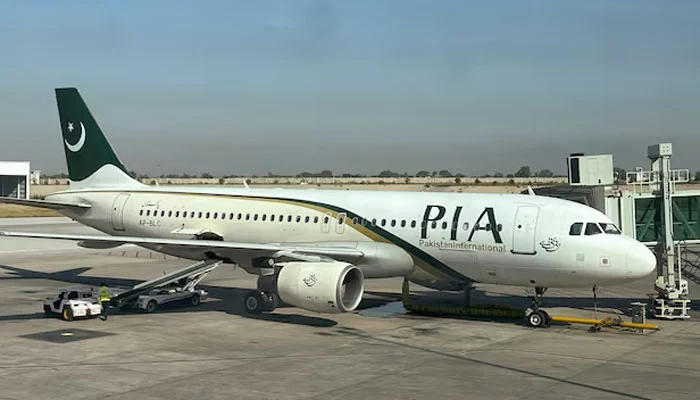
ISLAMABAD: The Competition Commission of Pakistan (CCP) has released the draft of the report titled “Competition in the Skies: Pakistan’s Civil Aviation Market Assessment,” an evidence-based, comprehensive competition assessment study of Pakistan’s civil aviation sector, which evaluates nearly two decades of data (2006–2025) along with stakeholder consultation. Read More: https://theboardroompk.com/global-inflation-oil-prices-imf-warns-middle-east-conflict-could-trigger-new-price-surge/ Over the review period, Pakistan’s civil aviation sector served nearly 340 million passengers, with annual traffic rising from 12.8 million in 2006–07 to 24.3 million in 2024–25—an 89% increase. This translates into a moderate overall CAGR of approximately 3.42% over 19 years. However, this growth was driven almost entirely by the international segment (CAGR ~5.46%), while domestic traffic remained nearly stagnant (CAGR ~0.19%). Overall, while passenger volumes have expanded, the sector’s structural depth and competitive strength have not kept pace—particularly when measured against Pakistan’s population growth and long-term economic potential. The report concludes that Pakistan has lacked a unified national aviation vision, treating civil aviation as a strategic economic sector rather than an administrative function. The CCP states clearly: “Civil aviation cannot be governed in silos.” The study highlights structural gaps, including the absence of an integrated national aviation strategy, fragmented governance and policy inconsistency across regulatory, fiscal, and financial institutions, domestic market stagnation relative to international growth, frequent airline exits and financial fragility among local carriers, weak aviation-specific financing frameworks, underutilization of airports, increasing reliance on Gulf-based carriers, and competitive asymmetry arising from differences in regional macroeconomic factors as well as domestic and foreign state-backed players. The report stresses that civil aviation is critical for economic connectivity, trade, and mobility, yet regional tensions and restricted airspace in the country and nearby hubs highlight Pakistan’s vulnerability. This further underscores the need for a strategically strong and self-reliant domestic civil aviation sector rather than overdependence on foreign carriers. The study calls for a National Civil Aviation Roadmap and a long-term phased Reform & Stabilization Plan to build a resilient, investment-ready ecosystem, integrating air travel, tourism, financing, and commercial services, while ensuring regulatory clarity, competitive neutrality, financial sustainability, and strategic policy coordination. Key priorities include modernization of Karachi and Lahore terminals, secondary airports (Skardu, Gilgit), e-gates, digital slot allocation, a unified aviation data hub, and real-time IBMS reconciliation, guided by demand-based, fiscally prudent planning. The report also recommends aviation- and tourism-specific financing and insurance, predictable FX and fee policies, tax rationalization, self-sustaining airport commercial operations with strategic private participation, evidence-based bilateral engagement, domestic capacity building, low-cost carrier promotion, SME participation, ancillary services, and local MRO development to restore competitive balance and strengthen the domestic aviation ecosystem. The report emphasizes that competitive neutrality is essential, historical privileges should be reassessed, market entry must remain open, and strategic oversight of critical aviation assets must be retained. Collectively, these measures aim to transition Pakistan’s aviation sector from volume growth to structurally resilient, competition-driven development. The draft report is available on the CCP website for stakeholder comments for a limited period, and the final report will be published following the consultation process.

Scroll to Top