
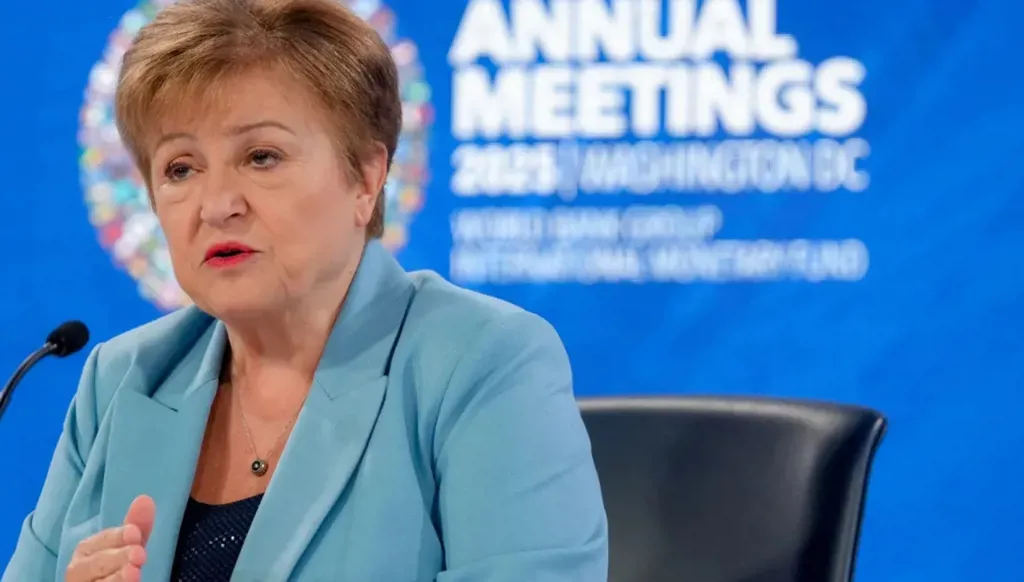
Global inflation oil prices are once again at the center of global economic concerns after the head of the International Monetary Fund (IMF) warned that escalating geopolitical tensions could push inflation higher worldwide.
Speaking on Monday, IMF Managing Director Kristalina Georgieva cautioned that the ongoing conflict in the Middle East may trigger renewed inflationary pressures if energy markets become unstable. Her remarks come at a time when many economies are still recovering from the inflation shocks of recent years.
According to Georgieva, even a moderate increase in oil prices could have widespread consequences for global economic stability.
Global Inflation Oil Prices Could Rise with Energy Shock
The global inflation oil prices dynamic is closely tied to energy markets. Georgieva explained that if oil prices increase by 10% and remain elevated throughout the year, global inflation could rise by roughly 40 basis points.
Oil prices influence transportation costs, manufacturing expenses, and food supply chains. As a result, even small price shocks can ripple through global markets and consumer prices.
Instead of presenting raw statistics, the economic impact can be understood through the following trends:
• A 10% sustained rise in oil prices could add approximately 0.4 percentage points to global inflation.
• Higher energy costs typically translate into increased transportation and logistics costs, which raise consumer prices.
• Emerging economies are often more vulnerable to oil price spikes due to reliance on energy imports.
• Global supply chains can become more volatile during geopolitical conflicts, amplifying inflationary pressure.
Georgieva noted that the global economy is facing another test of resilience.
“We are seeing resilience tested again by the new conflict in the Middle East,” she said, highlighting the economic risks tied to geopolitical tensions.
Policymakers Urged to Prepare for the Unexpected
In response to these risks, Georgieva urged governments and central banks to adopt proactive strategies.
Her advice to policymakers was clear: prepare for unexpected economic shocks in an increasingly uncertain global environment.
“My advice to policymakers in this new global environment is think of the unthinkable and prepare for it.”
This warning underscores the growing uncertainty surrounding inflation, interest rates, and global growth.
Central banks worldwide have spent the past few years aggressively tightening monetary policy to combat inflation. A renewed spike in global inflation oil prices could complicate these efforts and delay potential interest rate cuts.
Pakistan’s IMF Talks Gain Importance Amid Global Inflation Oil Prices
While global inflation concerns rise, Pakistan is currently engaged in crucial economic discussions with the IMF in Islamabad.
A visiting IMF mission, led by mission chief Iva Petrova, is conducting the Third Review under the Extended Fund Facility (EFF) and the Second Review under the Resilience and Sustainability Facility (RSF).
The talks are being attended by Pakistan’s Finance Minister Muhammad Aurangzeb along with senior economic officials.
Key areas under discussion include:
• Fiscal performance and deficit management
• Structural economic reforms
• Revenue mobilization strategies
• Energy sector restructuring
These discussions are critical for Pakistan as they determine the continuation of financial support under the IMF program.
Pakistan’s Economic Progress Strengthens IMF Review Prospects
Despite global uncertainty surrounding global inflation oil prices, Pakistan has recently reported several encouraging economic indicators.
For the first time in 14 years, the country recorded a current account surplus, signaling improved external sector stability.
Additionally, Pakistan achieved a primary fiscal surplus of 1.3% of GDP in fiscal year 2025, reflecting tighter fiscal discipline and improved revenue collection.
Other signs of stabilization include:
• Moderating inflation
• Improved fiscal management
• Stabilizing foreign exchange reserves
If the IMF review concludes successfully, Pakistan could receive the next funding tranche under its economic support program.
This funding would provide a much-needed boost to foreign exchange reserves and strengthen macroeconomic stability.
Global Markets Watching Oil Prices Closely
As geopolitical tensions persist, economists and policymakers are closely monitoring the relationship between global inflation oil prices and economic growth.
Energy price shocks have historically triggered waves of inflation, forcing central banks to maintain tight monetary policies longer than expected.
For countries like Pakistan, which rely on energy imports, fluctuations in oil prices can quickly affect trade balances, currency stability, and inflation levels.
The coming months will determine whether the current geopolitical tensions remain contained or evolve into another major economic challenge for the global economy.