Author name: Web Desk

KCCI raises alarm over targeted attack on industrialist Warns of resurgent extortion mafia, collapsing law & order
Editor pick

KCCI raises alarm over targeted attack on industrialist, warns of resurgent extortion mafia, collapsing law & order

KARACHI: President Karachi Chamber of Commerce & Industry (KCCI) Rehan Hanif, while expressing grave concern over a brazen firing incident in New Karachi in which a prominent industrialist was critically injured, termed the attack a chilling reflection of the rapidly deteriorating law and order situation and the alarming resurgence of organized extortion networks in the city. Read More: https://theboardroompk.com/nbp-dividend-delay-raises-investor-concerns-despite-record-profit/ In a statement issued, Rehan Hanif stated that Farzand Ali, a member of the North Karachi Association of Trade & Industry (NKATI), was targeted by unidentified armed assailants within the jurisdiction of New Karachi Police Station. As a result of the attack, he sustained two bullet injuries and was immediately shifted to a nearby hospital, where his condition is reported to be critical. Rehan Hanif strongly condemned the incident and categorically described it as a direct consequence of rising extortion activities, emphasizing that the business and industrial community is increasingly being pushed into a state of fear and insecurity. He warned that such incidents are no longer isolated but indicative of a broader and more dangerous trend. He further noted that the incident triggered an immediate response from the business community, as a large number of traders and industrialists rushed to the hospital to express solidarity with the injured industrialist, reflecting the deep concern and anxiety prevailing across commercial circles. President KCCI demanded that the government and law enforcement agencies take immediate, transparent, and decisive action to address the situation. He called for the swift arrest of those involved and the strengthening of police presence and intelligence-based operations in industrial zones. He warned that any continued inaction would inflict serious and long-term damage on investor confidence, disrupt industrial operations, and further erode the already fragile economic environment of Karachi, ultimately discouraging both local and foreign investment. Emphasizing that the safety and security of businessmen and industrialists is non-negotiable, Rehan Hanif stated, “We demand a comprehensive and immediate security framework to protect industrialists, traders, and the broader business community. Every instance of an extortion call must be treated as a high-priority threat, with prompt response, effective follow-up, and strict accountability of law enforcement agencies.” He further stressed that isolated measures would not suffice, and a technology-driven, city-wide security mechanism must be urgently implemented. “The Safe City Project must be made fully operational across Karachi without any further delay, with particular focus on all industrial zones, where economic activity remains highly vulnerable to criminal elements. Integrated surveillance, real-time monitoring, and rapid response systems are essential to deter extortion networks and restore confidence among stakeholders,” he added. Rehan Hanif cautioned that if urgent corrective measures are not taken, the business community may be compelled to adopt a strong and united course of action, including protests, to safeguard their lives, investments, and economic interests.

Pakistan Stock Exchange Rally Gains Momentum as Investors Turn Bullish
Business

Pakistan Stock Exchange Rally Gains Momentum as Investors Turn Bullish

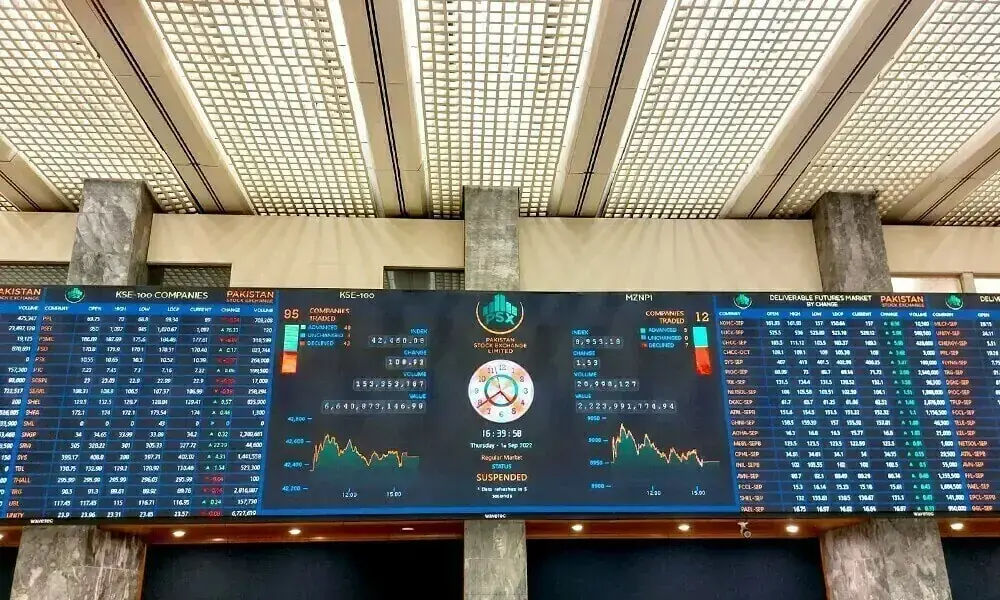
The Pakistan Stock Exchange Rally extended on Tuesday as stocks closed higher, driven by improved external inflows and easing global oil prices. The benchmark index at the Pakistan Stock Exchange reflected strong investor sentiment, with buying interest dominating the session. The KSE-100 Index settled at 173,155.79 points, climbing 959.09 points or 0.56 percent. The market remained upbeat throughout the day, reaching an intraday high of 175,298.11 points and a low of 172,837.79 points, indicating sustained accumulation across major sectors. Trading volumes remained robust at over 524 million shares in the benchmark index. Market breadth also stayed positive, as advancing stocks significantly outnumbered decliners, reflecting a broad-based rally across the bourse. Banking Stocks Lead Pakistan Stock Exchange Rally Commercial banks played a decisive role in driving the Pakistan Stock Exchange Rally. The banking sector contributed the majority of index points, supported by strong buying in major financial institutions. United Bank Limited emerged as the top contributor, followed by Bank Al Habib, Pakistan State Oil, Meezan Bank and Attock Refinery. These heavyweights collectively pushed the index higher, offsetting declines in select energy and cement stocks. Sector-wise performance showed that commercial banks added over 844 points to the index. Oil and gas marketing companies, refineries, pharmaceuticals and textile composites also supported the upward momentum. However, exploration companies and cement stocks limited further gains. Top Gainers and Decliners in Today’s Session Among individual stocks, YOUW led the gainers with a sharp increase of over 21 percent. Other notable performers included GADT, CNERGY, NPL and UBL, all posting solid gains. On the downside, CHCC, KTML, LOTCHEM, PABC and NBP ended the session lower, reflecting selective profit-taking by investors. Despite these declines, the broader trend remained positive. The most actively traded shares included CNERGY, BOP, PRL, WTL, KEL, KOSM, UNITY, NCPL, CSIL and PIBTL. These stocks dominated volumes, highlighting strong retail participation in the market. Saudi Deposit Boosts Confidence in Pakistan Stock Exchange Rally Investor sentiment strengthened after the State Bank of Pakistan confirmed receiving one billion dollars from the Ministry of Finance of Saudi Arabia. This amount represents the second tranche of a three billion dollar deposit facility. The inflow provided crucial support to Pakistan’s foreign exchange reserves and reinforced confidence in macroeconomic stability. Analysts believe such inflows reduce external financing risks and encourage institutional investors to increase exposure to equities. Global Oil Prices Add Support to Market International developments also supported the Pakistan Stock Exchange Rally. Oil prices declined amid expectations of renewed diplomatic engagement between the United States and Iran. Lower oil prices are generally favorable for Pakistan, which relies heavily on energy imports. Market participants remain optimistic that potential diplomatic progress could ease supply constraints and stabilize energy costs. This outlook improved sentiment in oil marketing and refinery sectors, contributing to overall gains. Broader Market Performance Remains Positive The All-Share Index also closed higher at 103,349.02 points, gaining 560.51 points. Total market volume crossed 1.16 billion shares, while traded value reached Rs54.94 billion, indicating strong liquidity. Out of 489 companies traded, 279 advanced, 165 declined and 45 remained unchanged. This performance signals a healthy and broad-based market rally. Fiscal Year Performance of KSE-100 The benchmark index has gained 47,528 points during the current fiscal year, reflecting a rise of nearly 38 percent. However, on a calendar year basis, the index remains slightly down by 899 points, indicating recent volatility despite strong fiscal-year performance. Outlook: Can Pakistan Stock Exchange Rally Continue Analysts believe the Pakistan Stock Exchange Rally may continue if foreign inflows remain stable and global oil prices stay subdued. Banking sector strength, improved reserves and geopolitical easing are key factors supporting the bullish outlook. However, investors remain cautious about inflation trends, monetary policy direction and political developments. Any negative surprise could trigger profit-taking in the near term. Overall, the market tone remains optimistic, with strong participation and improving macroeconomic indicators supporting further upside potential in the Pakistan Stock Exchange.

Matco Foods Restructuring Signals Strategic Shift in Pakistan’s Food Industry
Business

Matco Foods Restructuring Signals Strategic Shift in Pakistan’s Food Industry

Matco Foods restructuring has captured attention across Pakistan’s business community after the listed rice exporter announced a significant internal consolidation move. The company has approved the transfer of key operational assets in Gujranwala to its wholly owned subsidiary, Falak Foods Ltd., signaling a broader effort to streamline operations and strengthen its corporate structure. The decision, disclosed in a regulatory filing to the Pakistan Stock Exchange, reflects a strategic attempt to optimize production control while maintaining ownership within the group. Market analysts view the move as part of a growing trend among Pakistani agribusiness firms seeking operational efficiency through subsidiary based structuring. Matco Foods Restructuring: What the Board Approved The Matco Foods restructuring plan was approved by the company’s board through circulation on April 20, 2026. The decision authorizes two major steps. First, Matco Foods will participate in a rights issue of Falak Foods. Second, the company will transfer a 3.47 acre industrial property along with plant, machinery, and equipment to the subsidiary. This transfer will be executed against cash consideration. Falak Foods will fund the transaction through its upcoming rights issue, allowing capital to remain within the group. Importantly, Matco Foods confirmed it will continue to hold full ownership of Falak Foods even after the restructuring. The restructuring effectively shifts operational control of the Gujranwala unit to the subsidiary while keeping strategic oversight centralized at the parent level. Gujranwala Facility at the Center of the Restructuring The Matco Foods restructuring involves land and an operational business unit located in Tehsil Kamoki, District Gujranwala. This facility plays a key role in production and operational activities within the group’s rice processing network. By transferring the asset, the company appears to be consolidating production under Falak Foods, which may enhance operational efficiency and improve management focus. Such restructuring allows companies to separate operational execution from strategic oversight, a model increasingly used in Pakistan’s food sector. Although the company did not disclose the financial value of the transaction, analysts believe the move is primarily structural rather than driven by immediate capital gains. The absence of a timeline for completion suggests that the process may be executed in phases. Why Matco Foods Restructuring Matters The Matco Foods restructuring highlights a broader shift in corporate strategy among listed food companies. Instead of expanding through new acquisitions, firms are optimizing internal assets and reallocating capital to subsidiaries. This approach can deliver multiple benefits. It simplifies operational management by grouping production activities. It enhances financial transparency by separating business units. It also improves access to funding, as subsidiaries can raise capital independently through rights issues. In the case of Matco Foods, the restructuring also builds on earlier disclosures made in January 2026, indicating a phased and carefully planned consolidation strategy. Growing Trend in Pakistan’s Agribusiness Sector The Matco Foods restructuring reflects a growing trend among Pakistan’s agribusiness companies to streamline operations. Firms are increasingly adopting subsidiary based structures to manage risks, improve efficiency, and allocate capital more effectively. This shift is particularly relevant in a competitive export environment where margins are under pressure. By consolidating production under focused entities, companies can reduce administrative overheads and strengthen operational control. Investors often view such restructuring positively when it signals improved governance and clearer operational focus. However, the absence of financial details in this case may leave some stakeholders waiting for further disclosures. Outlook After the Restructuring The Matco Foods restructuring is expected to strengthen internal coordination while maintaining group ownership. If executed effectively, the move could enhance operational efficiency and position the company for future growth. While the market awaits details on valuation and timeline, the development underscores how Pakistani food exporters are adapting their corporate structures to remain competitive. The restructuring may also encourage other listed agribusiness firms to adopt similar strategies.

Pakistan Petroleum Imports Rise as Transport Demand Drives Energy Trade in March 2026
Pakistan

Pakistan Petroleum Imports Rise as Transport Demand Drives Energy Trade in March 2026

Pakistan Petroleum Imports recorded a moderate increase in March 2026, reflecting steady demand from the transport sector and a shifting energy mix. Latest data indicates that petroleum, oil and lubricants imports climbed to 1.34 million metric tonnes during the month, marking a 4 percent month-on-month increase while remaining broadly unchanged on a year-on-year basis. The numbers signal continued economic activity, particularly in transportation and logistics, despite higher fuel prices. Over the first nine months of fiscal year 2026, cumulative Pakistan Petroleum Imports reached 13.28 million metric tonnes, up 6 percent from the 12.49 million metric tonnes recorded in the same period last year. This trend suggests sustained fuel consumption and stronger refinery operations. Pakistan Petroleum Imports Driven by Motor Gasoline Demand Motor gasoline continued to dominate Pakistan Petroleum Imports in March 2026. It accounted for approximately 82 percent of total petroleum product imports, nearly identical to its share a year earlier. This heavy reliance on motor gasoline highlights persistent demand from commuters, ride-hailing services, and goods transporters across the country. Despite elevated retail fuel prices, consumption remained stable, indicating that transportation remains a necessity for both businesses and households. The consistent demand also reflects gradual economic activity recovery and urban mobility expansion. Crude Oil Imports Fall Monthly but Remain Strong for FY26 Crude oil imports declined by 9 percent compared to February, falling to 765,263 metric tonnes in March. On a yearly comparison, crude imports were also slightly lower by 3 percent. However, the broader fiscal year picture tells a different story. During the first nine months of FY26, crude imports reached 7.84 million metric tonnes, representing a strong 17 percent increase compared to 6.69 million metric tonnes in the same period last year. This indicates higher refinery throughput and suggests that domestic refineries are operating at elevated utilization levels. High-Speed Diesel Sees Sharp Rebound High-speed diesel imports posted a significant recovery in March, surging 153 percent month-on-month. This rebound followed a steep decline in February and reflects renewed demand from agriculture, transport and industrial sectors. The diesel recovery is particularly important for Pakistan’s economy, as the fuel plays a key role in trucking, farming machinery, and power generation in off-grid areas. Domestic Energy Mix Shifts as Gas Supply Increases Pakistan Petroleum Imports trends were also influenced by changes in the natural gas mix. Domestic gas supply increased by 12 percent month-on-month, reaching 3,055 mmcfd. As a result, domestic gas accounted for 94 percent of the total supply.In contrast, RLNG imports fell sharply by 75 percent month-on-month to just 201 mmcfd. The decline indicates reduced reliance on expensive imported LNG cargoes during March. However, over the nine-month fiscal period, RLNG maintained an average share of around 23 percent, similar to last year. This shift suggests short-term optimization of domestic resources while maintaining long-term LNG dependence. Energy Exports Jump on Furnace Oil Shipments On the export side, Pakistan’s energy exports increased by 20 percent month-on-month to 149,057 tonnes in March. The rise was driven entirely by furnace oil shipments, as there were no crude condensate or naphtha exports during the month. Furnace oil exports reached 129,900 tonnes in March. While this figure was lower compared to the same month last year, cumulative exports for FY26 showed growth. During the nine-month period, furnace oil exports totaled 1.26 million tonnes, representing a 12 percent increase year-on-year. Overall energy exports for the fiscal period stood at 1.50 million tonnes, marking a 6 percent annual increase. Refinery Feed Mix Changes with Higher Local Production Imported crude share in refinery feed declined to 74 percent in March from 79 percent in February. The change occurred as domestic crude production increased by 7 percent month-on-month to 64,915 barrels per day. This improvement in local production slightly reduced reliance on imported crude and supported refinery operations. Outlook for Pakistan Petroleum Imports Pakistan Petroleum Imports are expected to remain closely tied to transportation demand, refinery throughput and global energy prices. Continued growth in fuel consumption signals stable economic activity, while fluctuations in LNG imports highlight efforts to manage import costs. With refinery utilization increasing and domestic gas supply improving, Pakistan’s energy mix may continue evolving in the coming months. However, strong reliance on imported fuels suggests that petroleum imports will remain a key component of the country’s trade balance.

NBP Dividend Delay Raises Investor Concerns Despite Record Profit
Business

NBP Dividend Delay Raises Investor Concerns Despite Record Profit

Shareholders of National Bank of Pakistan continue to wait for their long-awaited NBP dividend, even after the bank announced a historic payout nearly two months ago. The delay has triggered concern across the market. However, officials suggest that the issue is administrative rather than financial. Read More: https://theboardroompk.com/strait-of-hormuz-scam-alert-fake-messages-target-ships-as-blockade-disrupts-global-trade/ Record Profit and Historic Dividend Announcement NBP delivered an exceptional financial performance for the year ending December 31, 2025. The bank reported a profit after tax of Rs85.91 billion. This marked a more than threefold increase compared to the previous year. Following this strong result, the bank announced a final cash dividend of Rs35 per share, representing a 350 percent payout. The board approved this dividend on February 24, 2026. Later, shareholders endorsed it during the 77th Annual General Meeting held on March 31, 2026. Investors who held shares as of March 17 became eligible for the payout. Under normal corporate procedures, payments would follow shortly after such approvals. However, that has not happened in this case. State Ownership Slows the Process The delay in the NBP dividend does not stem from weak finances or liquidity constraints. Instead, it reflects the unique structure of state-owned institutions. As a government-controlled bank, NBP must secure federal approval before releasing dividends. This requirement originates from the Banks (Nationalization) Act 1974. Under this law, profit distribution by nationalized banks requires clearance from the federal government. This adds an additional step beyond standard corporate governance processes. Typically, the approval comes through the federal cabinet or the Ministry of Finance. In this case, no cabinet meeting has taken place since April 8. Meanwhile, Shehbaz Sharif has remained engaged in diplomatic commitments. As a result, the approval process has stalled. Legal Position Remains Intact From a legal perspective, the delay does not yet violate corporate laws. The Companies Act 2017 requires companies to pay dividends within 15 working days of declaration. However, in NBP’s case, the declaration is considered incomplete until the government grants approval. This means the statutory timeline has not officially started. Therefore, the bank remains compliant with legal requirements. Still, the situation highlights how regulatory frameworks can affect investor experience in state-owned entities. Market Sentiment Faces Pressure Despite legal clarity, the delay has raised concerns among investors. Shareholders locked in their positions by mid-March. The bank has already realized its earnings. Moreover, shareholders have formally approved the payout. Yet the funds remain undistributed. This gap between financial performance and payout execution has created uncertainty. Investors rely on predictable returns, especially in dividend-heavy stocks. When delays occur, confidence can weaken. The situation also reflects broader governance challenges. State-owned enterprises often face procedural delays due to multiple layers of approval. In contrast, private sector companies usually process dividends more quickly. Impact on Pakistan Stock Exchange The delay in the NBP dividend could influence sentiment at the Pakistan Stock Exchange. Timely payouts play a key role in maintaining investor trust. When large institutions face delays, it can ripple across the market. NBP holds a significant position in the banking sector. Therefore, any uncertainty surrounding its payouts attracts attention. Analysts believe such episodes may discourage short-term investors who prioritize consistent cash flows. However, some experts argue that the issue is temporary. They point out that once the government grants approval, the payout should proceed without further complications. Still, the delay has already highlighted inefficiencies in administrative processes. Administrative Delay Not Financial Weakness Market observers emphasize that the bank remains financially strong. The record profit clearly demonstrates its capacity to pay dividends. Therefore, the delay should not be interpreted as a sign of financial instability. Instead, it reflects how government oversight can slow decision-making. While such oversight aims to ensure transparency and accountability, it can also create bottlenecks. In fast-moving financial markets, these delays can carry reputational costs. What Investors Should Expect Investors now await the next federal cabinet meeting. Once approval is granted, the bank is expected to release the NBP dividend promptly. Until then, the market will likely remain cautious. The episode serves as a reminder of the structural differences between state-owned and private institutions. While both operate under the same market conditions, their internal processes can vary significantly. For now, the focus remains on when the government will finalize its approval. Until that happens, shareholders of NBP must continue to wait for one of the largest payouts in the bank’s history.

Airspace Ban on Indian Airlines Extended by PAA Until May 24
World

Airspace Ban on Indian Airlines Extended by PAA Until May 24

The restrictions on Indian airlines continue as Pakistan officially extended its airspace ban for another month, pushing the deadline to May 24, 2026. The move marks nearly one year since both countries imposed reciprocal aviation restrictions following escalating tensions in 2025. PAA Issues Fresh NOTAM The Pakistan Airport Authority issued a new Notice to Airmen (NOTAM) confirming that Pakistani airspace will remain closed to all Indian-registered aircraft and operators. The directive applies to commercial flights as well as military aircraft. According to the official statement, the ban will remain in force until 4:59am on May 24, 2026. The previous extension was set to expire on April 24, but authorities decided to prolong the restrictions amid ongoing tensions. The notification clearly stated that no aircraft linked to Indian airlines or operators would be allowed to use Pakistani airspace during this period. Ban Covers Major Airspace Regions The restriction applies to both key flight zones managed by Pakistan. These include the Karachi Flight Information Region and the Lahore Flight Information Region. These regions play a critical role in regional and international air traffic. Their closure forces Indian airlines to reroute flights, particularly those traveling to Europe, the Middle East, and North America. As a result, airlines face longer flight durations and higher operational costs due to increased fuel consumption. Background: Crisis Since April 2025 The aviation standoff between Pakistan and India began in late April 2025. The escalation followed a deadly attack in Pahalgam. India accused Pakistan of supporting the attack. However, Islamabad strongly denied the allegations and called for an independent investigation. Despite this, tensions continued to rise, leading both countries to shut their airspace to each other’s carriers. Pakistan responded to India’s actions by immediately closing its airspace to all aircraft operated or owned by Indian airlines. Military Escalation Deepened Impact The situation intensified further in May 2025, when both countries engaged in a major aerial confrontation. Pakistani officials claimed that their forces shot down several Indian fighter jets during the conflict. This military escalation reinforced the continuation of aviation restrictions and hardened positions on both sides. Since then, no significant diplomatic breakthrough has been achieved to restore normal air traffic. Economic and Operational Impact The continued ban has significantly affected Indian airlines. Carriers have been forced to adopt longer routes, increasing fuel costs and operational expenses. Flights to Western destinations now require detours that add hours to travel time. Passengers also face indirect consequences, including higher ticket prices and extended journey durations. Meanwhile, the aviation sector in the region continues to experience disruption due to the prolonged standoff. Pakistan, on the other hand, also faces reduced overflight revenues. However, analysts view the decision as primarily driven by security concerns rather than economic considerations. No Immediate Resolution in Sight Despite the extension, there are no clear signs of de-escalation between the two nuclear-armed neighbors. Diplomatic engagement remains limited, and both sides continue to maintain firm positions. Experts believe that the continuation of restrictions on Indian airlines reflects deeper geopolitical tensions that extend beyond aviation issues. Without meaningful dialogue, the airspace ban may continue in the coming months.

Strait of Hormuz Scam Alert, Fake Messages Target Ships as Blockade Disrupts Global Trade
Editor pick, World

Strait of Hormuz Scam Alert, Fake Messages Target Ships as Blockade Disrupts Global Trade

A serious Strait of Hormuz scam alert has emerged as fraudulent actors exploit rising tensions between the United States and Iran. Greek maritime risk management firm MARISKS has warned shipping companies about fake messages promising safe passage through the strategic waterway in exchange for cryptocurrency payments. Read More: https://theboardroompk.com/two-week-ceasefire-ends-us-and-iran-trade-threats-as-tensions-escalate/ Fake Messages Target Stranded Ships According to MARISKS, several shipping companies received suspicious messages while their vessels remained stranded west of the Strait of Hormuz. These messages claimed to offer secure transit through the blocked route but demanded payment in digital currencies such as Bitcoin and Tether. The firm clarified that these communications are fraudulent and have no connection to Iranian authorities. The scam attempts to take advantage of the ongoing crisis and the desperation of shipping operators facing delays and financial losses. How the Scam Operates The fraudulent messages follow a calculated pattern. They claim to represent Iranian security services and promise to assess a vessel’s eligibility for safe passage. Once approved, the sender demands a fee in cryptocurrency before granting clearance. One such message cited by MARISKS stated that after submitting documents and verification, a payment in Bitcoin or USDT would ensure uninterrupted transit at a pre-arranged time. However, experts have confirmed that this is a classic scam designed to exploit uncertainty in the region. Renewed Blockade Intensifies Crisis The Strait of Hormuz scam alert comes as Iran has once again imposed a blockade on the waterway. This move followed Washington’s decision not to lift restrictions on Iranian ports. The renewed standoff has escalated tensions and disrupted one of the world’s most critical maritime routes. The Strait of Hormuz carries nearly 20 percent of global oil and energy supplies. Any disruption in this narrow passage has immediate consequences for global trade and energy markets. Hundreds of Ships Stranded The ongoing blockade has left hundreds of vessels stranded in the Gulf. Reports suggest that nearly 20,000 seafarers are currently affected by the disruption. Shipping companies are facing mounting operational challenges, including delays, rising costs, and uncertainty over safe navigation routes. This situation has created an environment where fraudsters can easily target vulnerable operators. The promise of guaranteed transit has become a powerful lure, especially for companies under pressure to deliver cargo on time. No Official Response from Iran So far, Iranian authorities have not issued any official statement regarding the scam warning. However, MARISKS has emphasized that these messages are not linked to any legitimate government agency. Security experts advise shipping firms to ignore such communications and verify all transit-related instructions through official maritime channels. They also recommend heightened vigilance as cyber threats and financial scams often increase during geopolitical crises. Talks Expected in Pakistan Amid rising tensions, diplomatic efforts continue to prevent further escalation. Officials from the United States and Iran are expected to resume high-level talks in Pakistan. These discussions aim to find a path toward de-escalation and potentially ease restrictions affecting maritime trade. The outcome of these talks could play a critical role in determining the future of the blockade and the safety of global shipping routes. Global Impact and Growing Concerns The Strait of Hormuz scam alert highlights the broader risks associated with geopolitical instability. As tensions rise, not only do physical threats increase, but digital and financial risks also expand. Experts warn that if the blockade continues, global oil prices could surge further, while supply chains may face prolonged disruptions. At the same time, cybercriminals and rogue actors are likely to intensify their activities, targeting industries already under strain.

Two-Week Ceasefire Ends, US and Iran Trade Threats as Tensions Escalate
Editor pick, Politics

Two-Week Ceasefire Ends, US and Iran Trade Threats as Tensions Escalate

The fragile truce between the United States and Iran is nearing a critical deadline as the two-week ceasefire ends, raising fears of renewed conflict in the Middle East. Both sides have intensified rhetoric, exchanged threats, and signaled readiness for escalation if negotiations fail to produce a breakthrough. Read More: https://theboardroompk.com/zong-paa-redefine-travel-connectivity-with-pakistans-first-5g-facilitation-sales-kiosk-at-islamabad-international-airport/ Rising Tensions Ahead of Deadline The ceasefire, which began earlier this month after weeks of intense conflict, was meant to create space for diplomacy. However, as the two-week ceasefire ends, the situation appears more volatile than ever. Leaders from both countries have issued strong warnings, reflecting deep mistrust and unresolved disputes. Iranian officials have warned that they are prepared to take decisive action if the ceasefire collapses. At the same time, US leadership has threatened severe consequences if Tehran refuses to negotiate on key issues, including its nuclear program and regional influence. Breakdown of Diplomatic Efforts Efforts to extend the truce or initiate meaningful dialogue have faced serious obstacles. Planned talks in Islamabad remain uncertain, with Iran signaling reluctance to participate. Tehran has accused Washington of violating the ceasefire through military actions and naval operations in strategic waterways. One major flashpoint emerged after US forces seized an Iranian-flagged vessel near the Strait of Hormuz. Iran condemned the move as a breach of the truce and international law. This incident has further strained already fragile diplomatic channels and cast doubt on the future of negotiations. Military Posturing and Strategic Signals As the two-week ceasefire ends, both sides have increased military readiness. Iran has hinted at unveiling new strategies on the battlefield, while the US has maintained a strong military presence in the region. The situation reflects a dangerous balance where diplomacy continues alongside preparations for conflict. Analysts note that neither side has shown willingness to compromise on core demands. These include sanctions relief, control over regional waterways, and security guarantees. The lack of progress has reinforced fears that the ceasefire may collapse without a replacement agreement. Global Economic Concerns Grow The rising tensions have already affected global markets. Oil prices have fluctuated sharply as investors react to uncertainty in the Middle East. The Strait of Hormuz remains a critical chokepoint, with disruptions threatening global energy supplies. Recent developments, including restricted shipping routes and increased military activity, have amplified concerns about a potential energy crisis. Analysts warn that prolonged instability could push oil prices significantly higher and disrupt international trade flows. Uncertain Path Forward With only hours left before the two-week ceasefire ends, the path forward remains unclear. Diplomatic efforts continue behind the scenes, but public statements from both sides suggest limited optimism. The possibility of renewed hostilities looms large, especially if negotiations fail to resume. Experts emphasize that the current ceasefire is not a permanent solution but a temporary pause in a deeper conflict. Without a comprehensive agreement, the region risks sliding back into violence, with far-reaching consequences for global stability.

Zong & PAA Redefine Travel Connectivity with Pakistan’s First 5G Facilitation & Sales Kiosk at Islamabad International Airport
Business

Zong & PAA Redefine Travel Connectivity with Pakistan’s First 5G Facilitation & Sales Kiosk at Islamabad International Airport

ISLAMABAD, April 21, 2026 – Zong, Pakistan’s leading technology service enterprise, has set a new industry benchmark by launching the country’s first dedicated 5G Customer Facilitation & Sales Kiosk at Islamabad International Airport. This milestone has been achieved through the collaborative efforts of Zong and the Pakistan Airports Authority (PAA) and forms part of a key initiative to modernize indoor airport facilities and introduce 5G-ready solutions for passengers. Read More: https://theboardroompk.com/same-platform-different-price-what-explains-the-rs1-million-gap-for-suv-buyers-in-pakistan/ As mobility and digital reliance converge, airports have become high-intensity connectivity zones where instant access to digital services is no longer optional; it is essential. This initiative underscores Zong’s leadership in next-generation connectivity and marks a strategic step in embedding 5G into Pakistan’s most critical transit ecosystems. Zong is addressing a critical moment in the travel journey: the transition from arrival to real-world connectivity. By enabling immediate access to high-speed services upon arrival, it ensures passengers can seamlessly connect to essential digital tools, including real-time communication for instant connectivity upon landing, navigation and logistics through high-speed data for ride-hailing and digital maps, digital payments with seamless integration into Pakistan’s digital ecosystem and operational flow support for timely decision-making and smooth passenger movement through the terminal; expectations Zong fulfills through its on-ground facilitation model, delivering speed, reliability, and convenience exactly when it matters most. Commenting on the initiative, Faheem Durrani, Head of Sales and Distribution, Zong, said, “Airports are critical digital touchpoints where immediate and reliable connectivity is essential. This initiative enables travelers to seamlessly integrate into Pakistan’s digital ecosystem from the moment they arrive. By strengthening our presence at key transit hubs, we are delivering connectivity where demand is most immediate and impactful.” The Director General of Pakistan Airports Authority (DGPAA) stated, “This development reflects our broader strategy to modernize airport infrastructure across Pakistan and integrate advanced digital capabilities into the aviation ecosystem. Initiatives like this 5G deployment at Islamabad International Airport are an important step toward building smarter, more connected airports that align with global aviation standards and future demand.” The realization of this 5G-ready ecosystem is a testament to the seamless collaboration between the Zong and the Pakistan Airports Authority, especially Director General PAA, Deputy Director General PAA (Airports) HQPAA, and Director Commercial & Estate HQPAA for their institutional support, along with the Airport Manager – COO and Senior Joint Director Commercial of Islamabad International Airport for their critical on-ground facilitation Zong’s 5G strategy is anchored in delivering ultimate customer experience, a diversified products & services portfolio, and AI Enablement. Building on the successful deployment in Islamabad, Zong, in collaboration with the Pakistan Airports Authority (PAA), plans to scale this initiative to other major aviation hubs, including Lahore and Karachi, further accelerating Pakistan’s digital transformation and reinforcing its position as a connected, future-ready nation.

Scroll to Top