Pakistan

Environmental Alarm: residual fuel oil (RFO) Surge in Pakistan's Power Mix Amid Global Tensions
Pakistan

Environmental Alarm: residual fuel oil (RFO) Surge in Pakistan’s Power Mix Amid Global Tensions

KARACHI: As the escalating conflict in the Middle East disrupts global energy supplies, Pakistan’s power sector is pivoting to dirtier fuels, raising serious environmental red flags. A new report from Optimus Research warns that regasified liquefied natural gas (RLNG) shortages, triggered by Iran’s closure of the Strait of Hormuz and attacks on Qatar’s LNG facilities, could force a surge in residual fuel oil (RFO) generation to 530 GWh in March—jumping its mix to 5.7% from a mere 0.2%. This shift comes as Qatar, supplier of 99% of Pakistan’s LNG imports, halts exports, leaving a 815 GWh RLNG shortfall. RFO, priced at PKR 54.5/KWh amid Brent crude at $90/bbl, is 150% costlier than RLNG and far more polluting. Burning RFO emits high levels of CO2, sulfur dioxide, and particulate matter, exacerbating air quality issues in northern regions where plants are concentrated. Studies show fossil fuels like RFO contribute to toxic waste streams, including arsenic and mercury, threatening water and soil in Punjab and Sindh. In Karachi, Usman, this could worsen smog episodes, already linked to power generation emissions. Environmental groups warn of heightened health risks, with NO2 hotspots intensifying around urban centers. The conflict, involving U.S.-Israeli strikes on Iran, has sent gas prices soaring 52% globally, forcing Pakistan to ration supplies and shut urea plants.

FPCCI Proposes Energy Emergency to Shield Pakistan’s Economy from Middle East Conflict Petroleum Prices and Interest Rate Highest in the Region
Pakistan

FPCCI Proposes Energy Emergency to Shield Pakistan’s Economy from Middle East ConflictPetroleum Prices and Interest Rate Highest in the Region

Karachi: Mr. Atif Ikram Sheikh, President of the Federation of Pakistan Chambers of Commerce and Industry (FPCCI), has strongly called upon the federal government to declare an immediate energy emergency; and, implement reliable contingency measures to insulate Pakistan’s fragile economic recovery and its exports from the severe fallout of the ongoing conflict in the Middle East. Read More: https://theboardroompk.com/bingx-launches-p2p-march-mega-spin-campaign-with-a-400000-prize-pool-copy/ Mr. Atif Ikram Sheikh has highlighted that the compounding burden of regionally-uncompetitive petroleum prices – already raised by an exorbitant PKR. 55 per liter – and punishingly high interest rates – with key policy rate continuing to be at 10.5% – will cause Pakistan’s cost of doing business to soar to unsustainable levels and will effectively result in crippling the industrial growth and exacerbate country’s exports slowdown even further. FPCCI Chief stressed that while regional competitors maintain accommodative, single-digit monetary policies and rationalize their petroleum prices to support their manufacturing bases, Pakistani trade and industry will be stifled by exorbitant borrowing costs that paralyze capital investment and modernization – coupled with relentless upward revisions in petroleum levies, which directly inflate logistical, transportation and captive power generation expenses – manufacturers will be left with severely eroded profit margins. FPCCI Chief reiterated that Pakistan’s industrial sector cannot afford another external shock; given our heavy reliance on Gulf energy imports from Saudi Arabia, the UAE and Qatar – and, interruptions in crude oil and liquefied natural gas (LNG) supplies will fuel inflationary pressures and deepen the cost-of-living crisis. Mr. Atif Ikram Sheikh has highlighted the surging freight and insurance costs as war-risk classifications have driven marine insurance premiums drastically higher. Freight costs on major shipping routes have spiked by up to 300% – with daily LNG freight rates jumping by more than 40%. President FPCCI maintained that supply chain delays on the back of rerouting shipments away from the Gulf is projected to add 15 to 20 days to transit times for Pakistani exports heading to key markets in the European Union, the UK and the United States. Mr. Atif Ikram Sheikh also pointed out the vulnerability of Pakistani ports as both Port Qasim and Karachi Port are directly linked to Gulf shipping routes; leaving domestic supply chains highly exposed to maritime disruptions and massive delays. Mr. Atif Ikram Sheikh stressed that while the current 28-day petroleum reserve offers a brief buffer, it is insufficient for an extended regional conflict. We are exposed to a severe economic shock if tensions persist. Coordinated action between policymakers, regulators and the business community is indispensable right now, he added. Mr. Saquib Fayyaz Magoon, SVP FPCCI, demanded that national strategic oil reserves need initiation of an urgent framework to build up strategic petroleum reserves from the current 28 days of consumption coverage to a more resilient and logical 60-90 day target. SVP FPCCI said that protecting export competitiveness has become imperative and introduction of targeted policy actions to absorb the shock of rising imported raw material costs and probable exchange-rate volatility is warranted. FPCCI stands ready to assist the government in formulating and executing these contingency plans to ensure the survival of Pakistan’s trade and industry during this period of unprecedented global uncertainty.

SBP Stays Cautious — Policy Rate Unchanged at 10.5% as Brent Spike Fuels Inflation Worries
Pakistan

SBP Stays Cautious — Policy Rate Unchanged at 10.5% as Brent Spike Fuels Inflation Worries

The Monetary Policy Committee of the State Bank of Pakistan (SBP) today (March 9, 2026) opted to leave the policy rate unchanged at 10.5%, signalling continued vigilance in an environment marked by escalating Middle East tensions and sharply higher global energy costs. Read More: https://theboardroompk.com/ccp-report-pakistans-civil-aviation-lacks-vision-risks-over-reliance-on-gulf-carriers/ This is the second consecutive hold of 2026, following January’s unexpected pause at the same level. The stance reflects heightened caution after Brent crude’s rapid 25% climb and corresponding 37–49% jumps in global diesel prices – developments that directly feed into Pakistan’s import bill and domestic inflation pressures. A widely followed pre-MPC poll by Topline Securities (March 6) captured the prevailing view: 92% of participants expected the rate to stay unchanged, citing the sudden reversal in energy price dynamics and regional uncertainty. Notably:62% anticipated the conflict-related turmoil persisting for 2–5 weeks. Money-market indicators had already priced in caution, with 6-month T-bill and KIBOR yields rising 58–85 bps in the lead-up.Looking forward, 60% saw rates holding near current levels through June, while inflation expectations settled around 7% on average and the rupee broadly stable at 280–285 to the dollar. The MPC’s decision buys time to assess whether the oil shock proves transitory or becomes embedded in medium-term inflation and external balances. It follows a cumulative easing cycle (including the December 2025 50 bps reduction to 10.5%) that had supported early signs of growth recovery. While the hold preserves hard-won macroeconomic stability, analysts warn that an extended period of elevated global energy prices – or currency slippage – could shift the balance toward future tightening. For now, SBP appears focused on safeguarding the 5–7% medium-term inflation target while monitoring real-side momentum.

PSX Market Crash: Pakistan Stock Exchange Plunges Nearly 7% Amid Oil Price Shock
Pakistan

PSX Market Crash: Pakistan Stock Exchange Plunges Nearly 7% Amid Oil Price Shock

The PSX market crash dominated headlines on Monday as the Pakistan Stock Exchange (PSX) experienced one of its sharpest single-day sell-offs in recent months. Investors rushed to exit positions amid escalating geopolitical tensions and a sudden surge in global oil prices, triggering panic across trading floors. The benchmark KSE-100 Index closed at 146,480.14, plunging 11,015.96 points or 6.99%, reflecting widespread investor anxiety. The dramatic drop also forced the exchange to temporarily halt trading after the KSE-30 Index fell more than 5%, activating the market-wide circuit breaker under PSX regulations. The sudden halt underscored just how fragile investor sentiment has become in the face of global uncertainty. Extreme Volatility During the PSX Market Crash Monday’s session was marked by intense volatility. The KSE-100 Index swung within a massive 6,054-point range, highlighting the scale of the panic-driven sell-off. The market reached an intraday high of 150,174 points before falling sharply to a low of 144,119 points, as traders rapidly offloaded shares. Despite the steep decline, market participation remained unusually high. Trading activity surged significantly as investors rushed to reposition portfolios. Instead of presenting the statistics in table format, the key trading indicators show the magnitude of the sell-off: • Total trading volume for the KSE-100 Index reached about 378 million shares.• The broader market recorded over 621 million shares traded, up sharply from the previous session’s 363 million shares.• Market turnover rose to Rs37.12 billion, an increase of Rs14 billion from the prior trading day.• A total of 480 companies were traded, with only 33 stocks advancing, while 386 declined and 61 remained unchanged. The overwhelming negative breadth reflects the scale of the PSX market crash. Major Stocks Dragging the Market Lower Several heavyweight companies were responsible for pulling the benchmark index deep into negative territory. Among the biggest contributors to the decline were fertilizer, banking, and energy giants. Fauji Fertilizer, United Bank Limited, Engro Holdings, Hub Power Company, and Lucky Cement collectively erased thousands of index points, intensifying the downward momentum. Meanwhile, only a handful of stocks managed to resist the sell-off. Pakistan General Insurance (PGLC) emerged as one of the few gainers, posting a modest rise while most of the market remained under pressure. Other major losers included Unity Foods, Bank of Punjab, AGP Limited, and Bannu Woollen Mills, each witnessing double-digit percentage declines. Banking and Fertilizer Sectors Lead the PSX Market Crash Sector-wise, the damage was widespread but particularly severe in key economic sectors. The commercial banking sector recorded the steepest decline, wiping out more than 3,300 index points. Fertilizer companies followed closely, contributing to another 1,800-point drop. Other heavily impacted sectors included: • Cement industry• Investment banks and securities companies• Power generation and distribution companies The widespread losses show how the PSX market crash affected nearly every major segment of Pakistan’s economy. Global Oil Shock Behind the Market Panic The primary catalyst behind the market turmoil was a dramatic surge in global crude oil prices. International oil prices jumped past $110 per barrel after Iran moved to close the Strait of Hormuz, one of the world’s most critical energy shipping routes. The development sent shockwaves through global financial markets and immediately impacted energy-importing economies like Pakistan. The ripple effects were felt domestically when the federal government announced a massive increase in fuel prices. Petrol prices surged from Rs266.17 per litre to Rs321.17, while high-speed diesel climbed from Rs280.86 to Rs335.86 per litre, effective March 7, 2026. These sharp increases significantly raised concerns about inflation, industrial costs, and economic growth. Economic Risks Rising After the PSX Market Crash Higher energy costs could create serious challenges for Pakistan’s manufacturing sector. Industries that rely heavily on fuel and electricity may face rising production costs, forcing them to reduce output or temporarily halt operations. For investors, this translates into concerns over declining corporate profitability and slower economic activity. Despite Monday’s plunge, the KSE-100 Index remains up by about 16.6% during the current fiscal year, though it has fallen nearly 15.8% in the calendar year so far. This contrast highlights the volatile nature of Pakistan’s stock market in the current geopolitical environment. What Investors Are Watching Next Market participants are now closely monitoring several key factors: • Global oil price trends• Developments in Middle East geopolitics• Pakistan’s inflation outlook• Potential monetary policy adjustments Any stabilization in global energy markets could help calm investor nerves. However, continued geopolitical uncertainty may keep the PSX market crash narrative dominating financial discussions in the coming weeks. For now, Pakistan’s stock market remains on edge caught between global energy shocks and domestic economic pressures.

CCP Report: Pakistan's Civil Aviation Lacks Vision, Risks Over-Reliance on Gulf Carriers
Pakistan

CCP Report: Pakistan’s Civil Aviation Lacks Vision, Risks Over-Reliance on Gulf Carriers

ISLAMABAD: The Competition Commission of Pakistan (CCP) has released the draft of the report titled “Competition in the Skies: Pakistan’s Civil Aviation Market Assessment,” an evidence-based, comprehensive competition assessment study of Pakistan’s civil aviation sector, which evaluates nearly two decades of data (2006–2025) along with stakeholder consultation. Read More: https://theboardroompk.com/global-inflation-oil-prices-imf-warns-middle-east-conflict-could-trigger-new-price-surge/ Over the review period, Pakistan’s civil aviation sector served nearly 340 million passengers, with annual traffic rising from 12.8 million in 2006–07 to 24.3 million in 2024–25—an 89% increase. This translates into a moderate overall CAGR of approximately 3.42% over 19 years. However, this growth was driven almost entirely by the international segment (CAGR ~5.46%), while domestic traffic remained nearly stagnant (CAGR ~0.19%). Overall, while passenger volumes have expanded, the sector’s structural depth and competitive strength have not kept pace—particularly when measured against Pakistan’s population growth and long-term economic potential. The report concludes that Pakistan has lacked a unified national aviation vision, treating civil aviation as a strategic economic sector rather than an administrative function. The CCP states clearly: “Civil aviation cannot be governed in silos.” The study highlights structural gaps, including the absence of an integrated national aviation strategy, fragmented governance and policy inconsistency across regulatory, fiscal, and financial institutions, domestic market stagnation relative to international growth, frequent airline exits and financial fragility among local carriers, weak aviation-specific financing frameworks, underutilization of airports, increasing reliance on Gulf-based carriers, and competitive asymmetry arising from differences in regional macroeconomic factors as well as domestic and foreign state-backed players. The report stresses that civil aviation is critical for economic connectivity, trade, and mobility, yet regional tensions and restricted airspace in the country and nearby hubs highlight Pakistan’s vulnerability. This further underscores the need for a strategically strong and self-reliant domestic civil aviation sector rather than overdependence on foreign carriers. The study calls for a National Civil Aviation Roadmap and a long-term phased Reform & Stabilization Plan to build a resilient, investment-ready ecosystem, integrating air travel, tourism, financing, and commercial services, while ensuring regulatory clarity, competitive neutrality, financial sustainability, and strategic policy coordination. Key priorities include modernization of Karachi and Lahore terminals, secondary airports (Skardu, Gilgit), e-gates, digital slot allocation, a unified aviation data hub, and real-time IBMS reconciliation, guided by demand-based, fiscally prudent planning. The report also recommends aviation- and tourism-specific financing and insurance, predictable FX and fee policies, tax rationalization, self-sustaining airport commercial operations with strategic private participation, evidence-based bilateral engagement, domestic capacity building, low-cost carrier promotion, SME participation, ancillary services, and local MRO development to restore competitive balance and strengthen the domestic aviation ecosystem. The report emphasizes that competitive neutrality is essential, historical privileges should be reassessed, market entry must remain open, and strategic oversight of critical aviation assets must be retained. Collectively, these measures aim to transition Pakistan’s aviation sector from volume growth to structurally resilient, competition-driven development. The draft report is available on the CCP website for stakeholder comments for a limited period, and the final report will be published following the consultation process.

Fuel Crisis in Pakistan: Government Prepares Austerity Plan Amid Global Oil Shock
Pakistan

Fuel Crisis in Pakistan: Government Prepares Austerity Plan Amid Global Oil Shock

Fuel Crisis in Pakistan is rapidly becoming the country’s most pressing economic concern as rising global oil prices triggered by escalating tensions in the Middle East begin to impact domestic markets. With petrol and diesel prices already jumping by Rs55 per litre, the highest single increase in the country’s history, the government is preparing an austerity strategy aimed at conserving fuel and stabilizing the economy. Read More: https://theboardroompk.com/brent-tops-108-as-iran-conflict-disrupts-global-supply-routes/ Prime Minister Shehbaz Sharif is expected to unveil the plan today as Pakistan grapples with the financial fallout of the US-Israel conflict with Iran and attacks on Gulf oil facilities, which have sent shockwaves through global energy markets. The crisis has forced policymakers to confront a difficult reality: Pakistan’s heavy reliance on imported fuel makes it vulnerable to geopolitical disruptions. Fuel Crisis in Pakistan: Government Moves Toward Austerity During a high-level meeting in Islamabad, the prime minister emphasized the “sensible use” of petroleum products and urged every segment of society to share the burden of austerity. The proposed measures aim to reduce fuel consumption while ensuring that essential sectors continue to function. Officials have also discussed contingency plans such as remote work and distance learning should the crisis intensify. The government’s message is clear: fuel conservation will be essential to weather the ongoing energy shock. According to officials, the prime minister has asked ministers and government departments to lead by example by adopting cost-saving and fuel-efficient practices. Fuel Supply Situation: Shipments Arriving in Pakistan Despite the global turmoil, authorities insist that fuel reserves remain adequate for now. Petroleum Minister Ali Pervaiz Malik revealed that three petroleum shipments are expected to arrive in Pakistan, helping stabilize short-term supply. At the same time, the government is preparing for potential disruptions in global supply routes. Diplomatic outreach has already begun with Saudi Arabia, Oman, and the United Arab Emirates to secure alternative fuel supplies if the crisis escalates. Officials are also exploring new supply routes that bypass the Strait of Hormuz, a critical oil transit chokepoint that could be affected by regional tensions. However, the situation is complicated by potential liquefied natural gas (LNG) supply disruptions, as Qatar has reportedly declared force majeure due to the conflict. Economic Impact of the Fuel Crisis in Pakistan The financial implications of the crisis could be severe. Finance Minister Muhammad Aurangzeb warned that Pakistan’s monthly oil import bill could climb to nearly $600 million if current price trends continue. To understand the scale of the challenge, the potential economic impact can be explained through key indicators: • Oil import costs: Rising international prices could push Pakistan’s monthly import bill to around $600 million, placing additional pressure on foreign exchange reserves.• Global crude oil prices: If the Middle East conflict intensifies further, crude prices could surge to $120 per barrel, increasing fuel costs domestically.• Fiscal pressure: Higher fuel imports could widen Pakistan’s trade deficit and increase pressure on government subsidies and fiscal policy. Officials are also considering approaching the International Monetary Fund (IMF) for relief related to petroleum levies in order to ease the burden on consumers. Fuel Conservation Measures and Monitoring System To prevent panic buying and hoarding, federal and provincial authorities have agreed to enhance coordination. A centralized digital dashboard is being developed to monitor fuel reserves and consumption patterns across the country. This system will help authorities detect supply disruptions early and prevent manipulation in the market. Provincial governments have also been directed to closely monitor petrol pumps and crack down on illegal price hikes. Agriculture Sector a Priority During Fuel Crisis In Punjab, Chief Minister Maryam Nawaz emphasized that diesel supply must remain uninterrupted for farmers, especially during the agricultural season. Agriculture plays a crucial role in Pakistan’s economy, and any diesel shortage could disrupt crop harvesting, irrigation, and transportation of food supplies. Provincial authorities have therefore been instructed to: • Continuously monitor petroleum distribution• Prevent hoarding at fuel stations• Ensure petrol and diesel are sold at officially notified prices Officials also stressed that long queues at petrol pumps must be avoided to prevent panic among the public. Can Pakistan Navigate the Fuel Crisis? The Fuel Crisis in Pakistan underscores the country’s vulnerability to global energy shocks. With geopolitical tensions pushing oil prices higher, the government faces the challenge of balancing economic stability, fuel supply security, and public relief. Prime Minister Shehbaz Sharif has urged the nation to demonstrate resilience and responsible consumption during this period. Whether Pakistan can successfully navigate the crisis will depend on global oil market developments, diplomatic efforts for alternative supplies, and the effectiveness of domestic conservation policies. For now, the government hopes that timely decisions and collective responsibility will help the country avoid a deeper energy and economic crisis.

Pakistan Hockey Qualifies for World Cup after 8 Years
Pakistan

Pakistan Hockey Qualifies for World Cup after 8 Years

The Prime Minister of Pakistan, Muhammad Shehbaz Sharif, has extended his heartfelt appreciation to the national hockey team for securing qualification to the FIH Hockey World Cup 2026 after an eight-year absence. This milestone marks a significant revival for Pakistani field hockey, which has historically been a source of national pride. Read More: https://theboardroompk.com/petroleum-products-supply-in-pakistan-dealers-demand-urgent-action-as-fuel-shortages-hit-pumps/ In a message issued on Saturday, the PM congratulated the players on their remarkable achievement. He urged them to maintain the same level of hard work and dedication that led to this success. Prime Minister Sharif expressed confidence that with continued determination and commitment, the team could deliver strong performances on the global stage. He assured full governmental support, promising all necessary facilities to aid the team’s preparation and ensure optimal performance in the upcoming World Cup. The Prime Minister emphasized the importance of staying focused to bring honor and pride to the nation through outstanding results. This qualification comes after a thrilling semi-final victory over Japan by 4-3 in the qualifiers held in Ismailia, Egypt. The Green Shirts staged a stunning comeback from a 3-1 deficit in the final quarter, scoring three goals in the last nine minutes to clinch the win. The achievement has sparked widespread celebrations across Pakistan, highlighting a resurgence in the sport after years of challenges. Dramatic Comeback Seals Historic Qualification Pakistan’s path to qualification was highlighted by their unbeaten run in the qualifiers, including key wins over teams like Malaysia and Austria. The dramatic turnaround against Japan has been hailed as one of the memorable moments in recent Pakistani hockey history. Government’s Commitment to Hockey Revival With the World Cup set to be co-hosted by Belgium and the Netherlands in August 2026, the PM’s assurance of support signals a renewed push to restore Pakistan’s standing in international hockey.

Petroleum Products Supply in Pakistan: Dealers Demand Urgent Action as Fuel Shortages Hit Pumps
Pakistan

Petroleum Products Supply in Pakistan: Dealers Demand Urgent Action as Fuel Shortages Hit Pumps

Petroleum products supply in Pakistan has come under serious pressure as fuel dealers warn of worsening shortages across the country. Despite a recent and steep increase in fuel prices, many petrol pumps are still struggling to obtain adequate supplies of petrol and diesel. The Pakistan Petroleum Dealers Association (PPDA) has raised alarm over the situation, stating that oil marketing companies have not fully restored supply even after the government increased fuel prices. As a result, several fuel stations across Pakistan are reportedly facing shortages, leaving motorists frustrated and dealers financially strained. According to the association, the ongoing disruption in the petroleum products supply in Pakistan could trigger a wider economic and logistical challenge if urgent corrective measures are not taken. Dealers Accuse Oil Marketing Companies of Supply Cuts Fuel dealers claim that oil marketing companies recently imposed a quota system that drastically reduced fuel deliveries. Under this system, petrol pumps were reportedly receiving only around 50% of their usual fuel supply, and in some cases even less. The reduced deliveries have made it increasingly difficult for pump owners to meet daily consumer demand. With limited fuel arriving at stations, queues have started to form in certain areas, raising concerns about a potential nationwide supply crunch. Dealers argue that if the petroleum products supply in Pakistan is not normalized soon, the shortage could spread further, affecting transportation, logistics, and business operations. Rising Fuel Prices Add Financial Burden on Dealers The crisis has been compounded by a sudden surge in fuel prices. Petrol and diesel prices were reportedly increased by Rs. 55 per litre, creating a significant financial burden for petrol pump owners. Because dealers must purchase fuel inventory in advance, the price hike has forced them to inject much more capital into their businesses. Industry estimates suggest that: • Petrol pump owners now need to pay approximately Rs. 30 million extra per pump to purchase petrol and diesel inventory.• Across the country, petroleum dealers collectively face billions of rupees in additional financial pressure. For small and medium-sized pump operators, this sudden capital requirement has made it extremely difficult to continue operations smoothly. PPDA Calls for Audit and Investigation Amid the worsening situation, the Pakistan Petroleum Dealers Association has demanded a comprehensive audit of oil marketing companies. According to the association, authorities should investigate whether supply shortages are linked to hoarding, reduced distribution, or speculative practices aimed at maximizing profits after the price increase. Dealers are urging regulators to determine: • Whether oil marketing companies deliberately reduced supply.• If any stockpiling occurred ahead of the price hike.• How much profit may have been generated through supply manipulation. Such an investigation, PPDA argues, would help restore transparency and stabilize the petroleum products supply in Pakistan. Dealers Say Their Margins Remain Unchanged Another major concern highlighted by the association is the unchanged profit margin for petroleum dealers. While the government reportedly increased its revenue through higher fuel levies, dealers say their own margins already approved months earlier have not been implemented. The association had also previously requested the government not to increase the petroleum levy at this stage, warning that it would further strain the market. However, according to PPDA, the policy changes have disproportionately affected petrol pump operators who must now manage higher costs, delayed supplies, and customer dissatisfaction. Rising Tensions at Petrol Pumps The ongoing fuel shortage has also raised safety concerns. Dealers warn that tensions at petrol stations could escalate if supply disruptions continue. In fact, a violent incident was recently reported in Punjab where a petrol pump employee was killed during a dispute. Industry representatives fear that prolonged disruption in the petroleum products supply in Pakistan could lead to more conflicts between customers and pump staff, especially in areas where fuel availability becomes limited. What Needs to Happen Next? The Pakistan Petroleum Dealers Association is urging the government to take immediate steps to stabilize the fuel market. Key demands include: • Restoring normal fuel supply from oil marketing companies• Conducting an audit of supply chains• Investigating potential hoarding practices• Implementing approved dealer margins• Reviewing policies affecting petroleum pricing and distribution Without timely intervention, the current situation could escalate into a broader fuel supply crisis in Pakistan, affecting transportation networks, industrial activity, and everyday consumers. For now, the stability of the petroleum products supply in Pakistan remains a critical issue that policymakers must address swiftly.

Mandatory Motor Third-Party Insurance Sindh: A Major Road Safety Reform for Vehicle Owners
Pakistan

Mandatory Motor Third-Party Insurance Sindh: A Major Road Safety Reform for Vehicle Owners

Mandatory Motor Third-Party Insurance Sindh is now officially part of provincial law following the passage of the Motor Vehicles (Amendment) Act, 2026. This reform marks a turning point in Pakistan’s road safety and insurance landscape, aiming to protect accident victims and introduce greater accountability for vehicle owners across the province. Announced on March 7, the legislation requires every vehicle registered in Sindh to carry a valid third-party liability insurance policy. Without it, vehicles will no longer be eligible for registration, ownership transfer, or payment of annual token tax. The initiative follows extensive engagement by the Securities and Exchange Commission of Pakistan (SECP) with provincial governments to strengthen consumer protection and ensure effective enforcement of motor insurance laws across the country. This development makes Sindh the first province in Pakistan to implement a robust legal framework enforcing mandatory third-party motor insurance. Why Mandatory Motor Third-Party Insurance Sindh Matters Road accidents often leave victims and families facing severe financial hardship. Third-party insurance addresses this challenge by ensuring that compensation is available when an accident causes injury, death, or property damage to another person. Under the new amendment to the Motor Vehicles Ordinance, 1965, a new section 67-H has been introduced to formalize the requirement for third-party liability insurance. The reform ensures that vehicle owners share responsibility for the financial consequences of accidents, providing a safety net for victims who previously struggled to obtain compensation. How the New Insurance Law Works Under the Mandatory Motor Third-Party Insurance Sindh framework, compliance is directly linked to key vehicle administration processes. This means a vehicle owner must hold valid insurance before completing important legal steps. In practical terms, vehicle owners will face restrictions without insurance coverage. Authorities will require proof of insurance for vehicle registration, ownership transfer, and payment of annual token taxes. By integrating insurance verification into these processes, the government aims to ensure universal compliance rather than relying on voluntary participation. Compensation for Accident Victims One of the most impactful features of the reform is the introduction of defined compensation limits on a “no-fault” basis, meaning victims can receive financial support without lengthy legal disputes over responsibility. The law provides structured compensation for severe accident outcomes. In cases of death, victims’ families will be entitled to compensation of PKR 700,000, while individuals who suffer permanent disability will receive PKR 500,000. This framework significantly strengthens financial protection for road users and helps ensure that victims or their legal heirs receive timely relief following accidents. Digital Verification Through Motor Insurance Repository To ensure smooth implementation of Mandatory Motor Third-Party Insurance Sindh, the SECP has launched a centralized digital system called the Motor Insurance Repository (MIR). The repository functions as a national database that records motor insurance policies issued by licensed insurers. This system allows authorities to digitally verify whether a vehicle is insured. The MIR will play a crucial role in preventing fake insurance policies and improving transparency within the motor insurance sector. It also enables regulators and vehicle authorities to confirm compliance instantly during registration or enforcement checks. Expanding Enforcement Across Pakistan While Sindh is the first province to enforce this policy through a strengthened legal framework, the broader objective is nationwide implementation. The SECP is currently working with the Punjab Provincial Transport Authority to integrate vehicle route permits with the Motor Insurance Repository. This integration will allow authorities to verify insurance policies online before issuing transport permits. Such measures could pave the way for similar reforms in other provinces, helping standardize road safety regulations and insurance compliance across Pakistan. A Step Toward Safer Roads and Stronger Consumer Protection The introduction of Mandatory Motor Third-Party Insurance Sindh represents a major milestone in Pakistan’s insurance and transport policy. By ensuring that every registered vehicle carries liability coverage, the reform protects accident victims while encouraging responsible driving and financial accountability. The Securities and Exchange Commission of Pakistan has also commended the Government of Sindh for taking the lead on this consumer protection initiative and expressed hope that other provinces will follow with similar legislation. If widely adopted nationwide, the policy could significantly improve road safety standards, provide financial protection to thousands of accident victims each year, and strengthen the role of insurance in Pakistan’s economy.

Karachi Port Transshipment Surges as Strait of Hormuz Crisis Disrupts Regional Shipping
Pakistan

Karachi Port Transshipment Surges as Strait of Hormuz Crisis Disrupts Regional Shipping

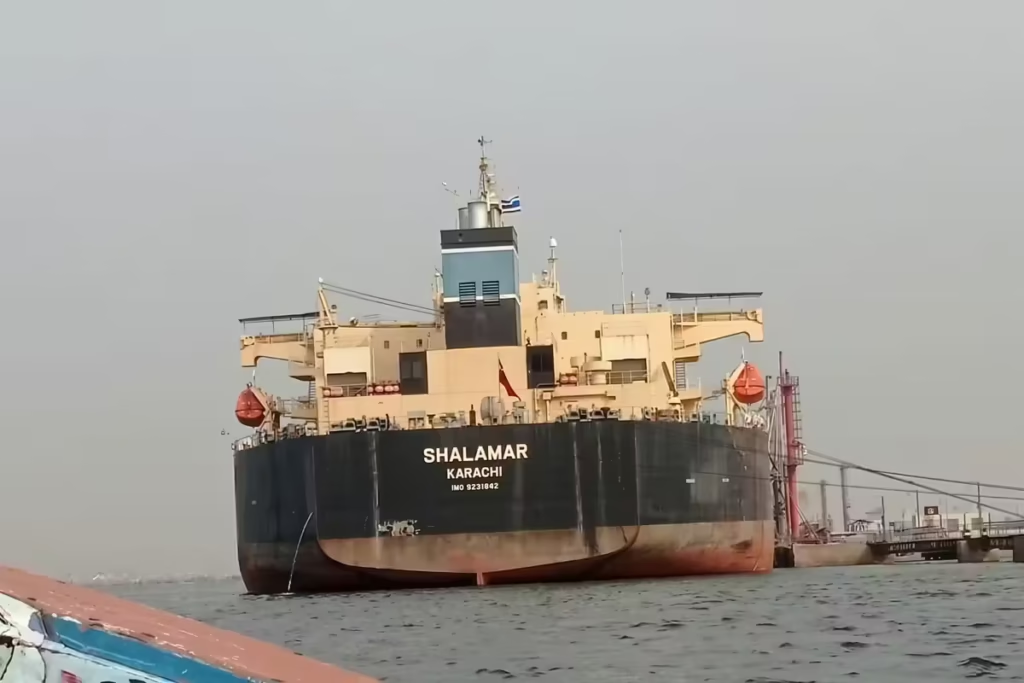
Karachi Port transshipment activity has unexpectedly surged as global shipping lines reroute cargo due to escalating tensions in the Middle East and the disruption of traditional shipping corridors. The evolving geopolitical situation, particularly the closure of the strategic Strait of Hormuz, is forcing maritime operators to rethink long-standing logistics routes that have shaped regional trade for decades. In a significant development, Karachi Port has begun receiving large volumes of containers originally destined for the United Arab Emirates, marking a shift in regional shipping patterns and potentially positioning Pakistan as a new logistics hub for international trade. This sudden redirection of cargo has sparked curiosity across the maritime industry: Could Karachi emerge as an alternative transshipment center for the region? Why the Karachi Port Transshipments Shift Is Happening For decades, major shipping lines relied heavily on UAE ports particularly Jebel Ali as the primary transshipment hub in the region. Massive container vessels would dock there, unload cargo destined for neighboring markets, and then distribute those goods via smaller feeder ships to Pakistan, Central Asia, Afghanistan, and parts of East Africa. However, the ongoing conflict involving Iran, the United States, and Israel has disrupted this established model. Iran’s closure of the Strait of Hormuz one of the world’s most critical oil and shipping chokepoints has created uncertainty for vessels heading toward Gulf ports. As a result, several shipping lines have begun offloading UAE-bound cargo at Karachi instead, allowing the containers to be redistributed from Pakistan through alternative maritime routes. This logistical adjustment has effectively triggered a new wave of Karachi Port transshipment operations, highlighting the port’s growing strategic importance. Cargo Ships Arrive with Transshipment Containers The shift became visible this week when two container vessels arrived at Karachi carrying large volumes of redirected cargo. The ships, MV TS Tacoma and MV TS Sydney, docked at Karachi Port and discharged numerous containers belonging to regional shipping companies and non-vessel operating common carriers (NVOCCs). These containers are currently being stored at port terminals before being forwarded onward to the Middle East. The cargo originated from multiple shipping operators including: • TS Line• Heung-A Shipping• Sinokor Merchant Marine• Various international NVOCC operators Once processed at Karachi, the containers will be shipped onward to the UAE, particularly the major regional logistics hub of Jebel Ali. Karachi Port Authority Signals Readiness Karachi Port Trust (KPT) officials say the port is fully prepared to handle the unexpected increase in cargo traffic. KPT Chairman, retired Rear Admiral Shahid Ahmed, reaffirmed the port authority’s commitment to maintaining uninterrupted trade flows despite geopolitical instability in the region. According to port officials, the incoming containers have been temporarily stored within terminal areas inside the port limits while authorities coordinate further logistics arrangements. The surge in Karachi Port transshipment volumes may also require expanded storage capacity and operational coordination to avoid congestion. Shipping Industry Calls for Expanded Storage Facilities Recognizing the growing cargo inflow, the Pakistan Ships Agent Association (PSAA) has urged the government to allow transshipment containers to be temporarily stored at off-dock terminals. These facilities are located in nearby logistics zones such as: • Hawkesbay• Mauripur• Port Qasim Moving cargo to these off-dock terminals could significantly reduce congestion at Karachi Port while improving the speed of container handling and onward transportation. PSAA Chairman Muhammad Rajpar warned that the current disruption may persist for some time. Industry observers believe the Strait of Hormuz may remain closed or unstable in the near term, meaning that the volume of redirected cargo could continue to grow. A Strategic Opportunity for Pakistan’s Logistics Sector While the geopolitical crisis presents clear risks to global trade, it also creates an unexpected opportunity for Pakistan’s maritime sector. If shipping lines continue using Karachi as a temporary redistribution hub, Karachi Port transshipment operations could expand significantly. Increased cargo traffic could boost port revenues, enhance Pakistan’s role in regional supply chains, and encourage further investment in logistics infrastructure. Experts note that ports often gain long-term strategic importance during periods of disruption, when shipping companies discover new and efficient alternatives to traditional routes. If managed effectively, the current crisis could become a turning point for Pakistan’s maritime economy. Could Karachi Become a Regional Shipping Hub? The question now circulating in shipping circles is whether Karachi’s role in transshipment will remain temporary or evolve into a permanent shift. With modernized port terminals, proximity to key regional markets, and access to alternative maritime routes, Karachi has the potential to attract more global shipping traffic. For now, the surge in Karachi Port transshipment activity reflects how quickly global trade patterns can change when geopolitical tensions reshape critical sea routes. And as the Middle East crisis continues to unfold, Karachi may find itself unexpectedly at the center of a new maritime trade corridor.

Scroll to Top