SBP Research Agenda 2026-2029: State Bank Unveils Bold Plan to Reshape Pakistan’s Economic Future
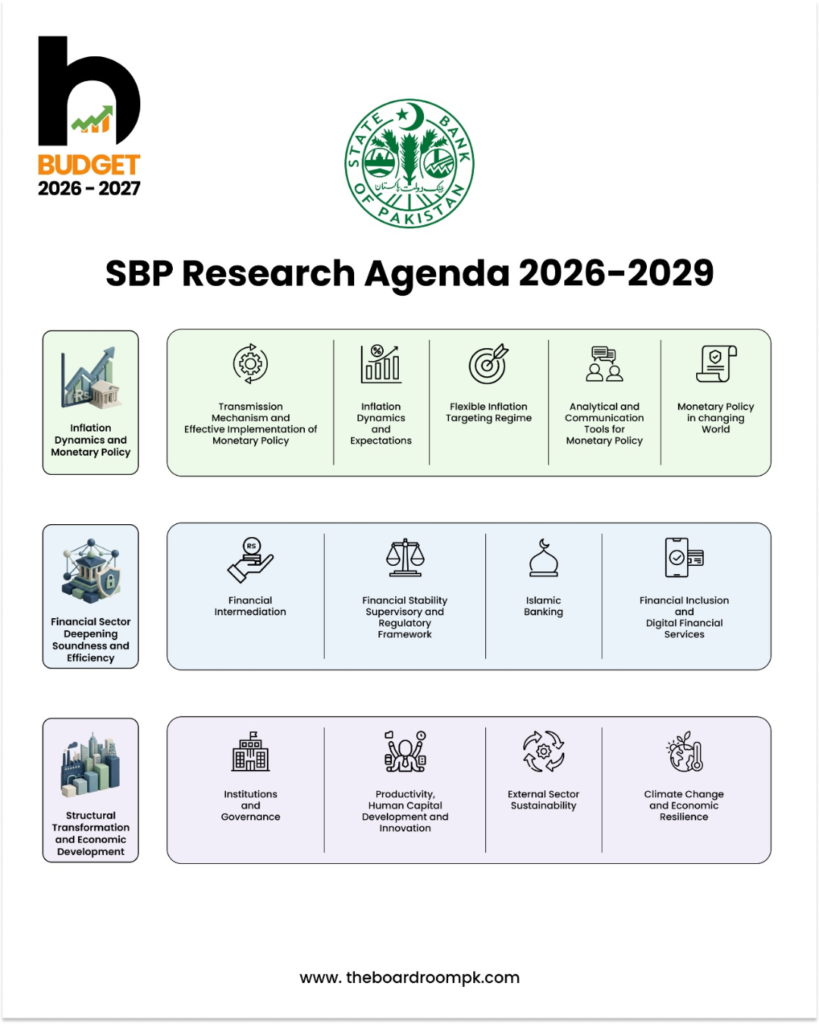
The SBP Research Agenda 2026-2029 is far more than a routine policy document. It is a revealing blueprint that exposes the deep-rooted weaknesses of Pakistan’s economy and lays out how the country’s central bank intends to confront them. At a time when Pakistan continues to grapple with inflation shocks, recurring balance of payments crises, weak productivity, and a narrow financial base, the State Bank of Pakistan has acknowledged that traditional solutions are no longer enough. The newly released three-year roadmap seeks answers to some of the country’s most difficult economic questions while inviting academics, researchers, policymakers, and institutions to help shape future policy decisions. SBP Wants Answers to Why Monetary Policy Often Fails In the foreword to the document, SBP Governor Jameel Ahmad said the objective is to identify factors that weaken the effectiveness of regulations and policy tools so authorities can deliver more timely and informed responses. One of the most striking admissions in the agenda is that monetary policy transmission in Pakistan often works imperfectly. The central bank believes structural problems such as informality, limited financial access, institutional weaknesses, and fragmented markets dilute the impact of policy rate changes. The agenda seeks to understand why some interest rate decisions fail to influence spending, borrowing, and investment as intended. Can Inflation Ever Be Controlled Effectively? A major focus of the SBP Research Agenda 2026-2029 revolves around inflation. Researchers have been tasked with studying whether Pakistan should formally move toward flexible inflation targeting and, if so, how such a framework should be designed. Critical questions include: • What inflation target is realistic for Pakistan?• How wide should the tolerance band be?• How long should policymakers take to achieve targets?• How do supply shocks affect public confidence in the central bank? The document also acknowledges that climate change is emerging as a powerful driver of inflation volatility and can no longer be ignored in economic planning. Digital Currency and Virtual Assets Enter the Conversation In one of the agenda’s most forward-looking sections, SBP raises questions about technologies that until recently remained outside mainstream policy discussions. The central bank plans to examine whether a central bank digital currency could improve monetary policy transmission and what risks expanding digital financial services and virtual asset investments may pose to financial stability. The move suggests Pakistan’s financial authorities are preparing for a future increasingly shaped by technological disruption. Pakistan’s Financial Sector Under the Spotlight The second pillar of the SBP Research Agenda 2026-2029 focuses on financial sector deepening. Despite decades of banking growth, Pakistan continues to face low credit penetration and limited financial inclusion. Banks dominate the financial landscape while capital markets and non-bank institutions remain relatively weak. SBP wants researchers to determine whether these shortcomings stem from temporary economic conditions or deeper structural problems. The agenda seeks evidence on issues such as: • Whether banks are allocating enough credit to the private sector.• How funding structures influence lending decisions.• Whether liquidity management policies discourage deposit growth.• How minimum deposit rates affect economic stability.• How macroprudential tools should complement monetary policy. Islamic Versus Conventional Banks Another notable aspect of the roadmap is its call for a comparative analysis of Islamic and conventional banking models. Researchers will assess their efficiency, pricing mechanisms, credit allocation practices, operational costs, and resilience during financial shocks. The findings could shape future regulatory priorities within Pakistan’s dual banking system. Breaking Pakistan’s Boom and Bust Cycle Perhaps the most consequential section of the document addresses Pakistan’s chronic economic instability. The central bank openly recognizes that the country’s large undocumented economy undermines reliable data collection and weakens policy effectiveness. Research priorities include identifying ways to encourage formalization through: • Tax simplification.• Greater digitalization.• Easier regulatory procedures.• Reduced compliance burdens. The objective is clear. Pakistan cannot sustainably grow while significant portions of economic activity remain outside the formal system. The Big Questions About Remittances and Foreign Investment The SBP Research Agenda 2026-2029 also explores external vulnerabilities that repeatedly trigger economic crises. Researchers have been asked to examine how foreign direct investment, portfolio inflows, and external borrowing affect resilience. One particularly intriguing question stands out: Are workers’ remittances an economic blessing that supports stability, or do they create hidden vulnerabilities over time? The answer could influence future strategies for managing Pakistan’s external accounts. AI, Migration and Climate Transition Shape the Future The agenda extends beyond conventional economics. SBP wants deeper research into export diversification, global value chains, demographic shifts, migration patterns, technological transformation, and artificial intelligence adoption. It also prioritizes understanding the short- and medium-term economic consequences of Pakistan’s transition toward a low-carbon economy. These themes indicate that the central bank is increasingly looking beyond immediate crises and preparing for long-term structural change. A Research Agenda That Reflects Economic Reality The SBP Research Agenda 2026-2029 reveals an institution willing to confront uncomfortable truths about Pakistan’s economic system. By admitting the limitations of existing frameworks and inviting broad collaboration, the State Bank appears determined to replace assumptions with evidence. Whether this ambitious exercise translates into meaningful reforms remains to be seen. However, one message from the agenda is unmistakable: Pakistan’s economic challenges have evolved, and solving them will require fresh thinking, rigorous research, and policies grounded in reality rather than tradition.