
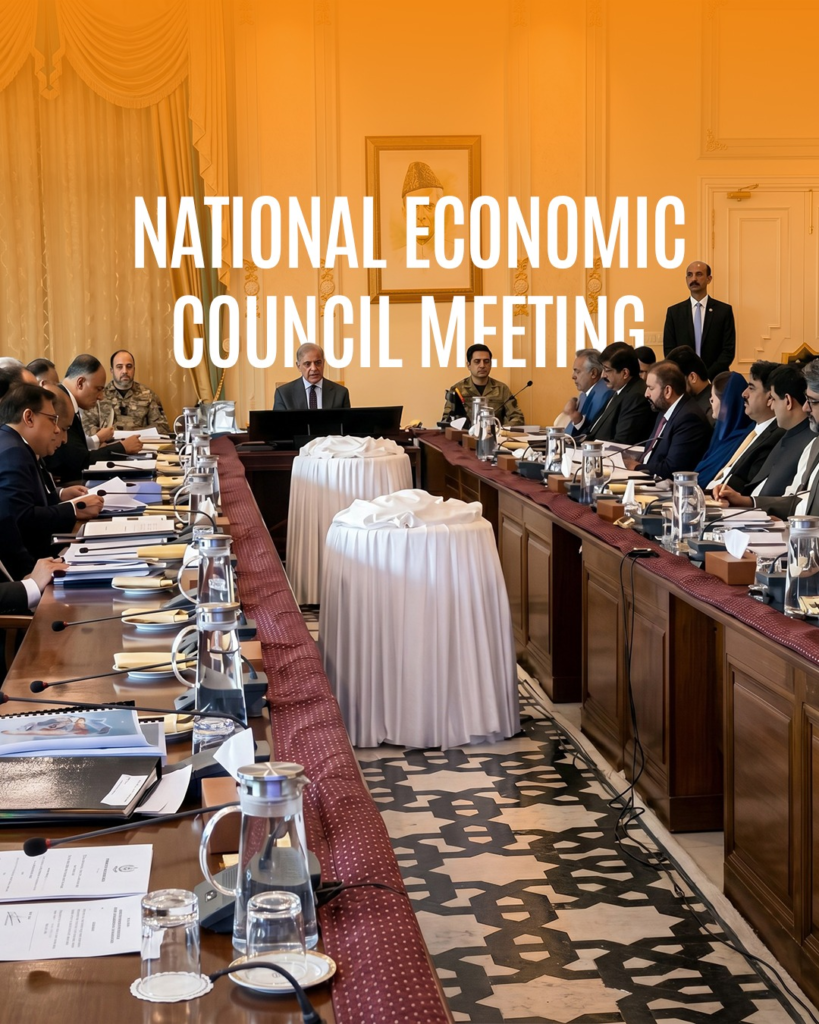
The National Economic Council (NEC) on Wednesday approved a Rs3.2 trillion national development budget for the next fiscal year after three provinces agreed to freeze their development spending and provide Rs920 billion in grants to the federal government.
The decision came amid mounting financial pressures and increased funding requirements for defense and water sector projects.
Prime Minister Shehbaz Sharif chaired the NEC meeting, which also approved key macroeconomic targets for fiscal year 2026-27.
Development Budget Reduced by 25%
The approved development envelope of Rs3.2 trillion is around 25 percent lower than the Rs4.25 trillion initially proposed by the Annual Plan Coordination Committee (APCC) earlier this month.
Planning Minister Ahsan Iqbal told reporters after the meeting that provincial governments had agreed to maintain their Annual Development Programmes (ADPs) at the actual spending levels of the current fiscal year.
As a result, provincial development budgets have been reduced by Rs920 billion compared with the targets approved by the APCC.
The NEC approved provincial development plans worth Rs2.218 trillion and a trimmed Public Sector Development Programme (PSDP) of Rs1 trillion.
The revised PSDP is Rs126 billion lower than the amount initially approved.
Provinces to Provide Rs920 Billion to Centre
According to the new arrangement, provinces will provide a one-time grant of Rs920 billion to help the federal government meet urgent financing needs.
The federal government had sought Rs1.2 trillion from the provinces to fund defense expenditures and strategic water projects.
Ahsan Iqbal said the Finance Ministry was finalising the mechanism for transferring and accounting for the funds.
Prime Minister Shehbaz Sharif thanked the provincial governments for their cooperation and consultations.
He said the assistance reflected a collective effort to address national priorities.
IMF Chief Briefed on New Fiscal Arrangement
Prime Minister Shehbaz Sharif informed the NEC meeting that he had spoken with International Monetary Fund (IMF) Managing Director Kristalina Georgieva regarding the agreement between the Centre and provinces.
According to the prime minister, Georgieva appreciated Pakistan’s efforts to create a coordinated fiscal framework.
Under the arrangement, the federal government will retain most of the additional revenue generated through the National Finance Commission (NFC) award during the next fiscal year.
The arrangement will temporarily reduce the effective share of provinces in the divisible pool, which currently stands at 57.5 percent.
Officials said the agreement is contingent upon the Federal Board of Revenue (FBR) achieving its tax collection target.
FBR Tax Target Set at Rs15.26 Trillion
The FBR has been assigned a tax collection target of Rs15.264 trillion for fiscal year 2026-27.
However, the tax authority has missed its targets by a combined Rs2.2 trillion over the last two fiscal years.
Government officials said provincial contributions would be treated as grants and would not permanently alter the NFC formula.
The provinces have deferred any long-term changes to revenue-sharing arrangements.
Punjab Sees Biggest Reduction in Development Spending
According to Ahsan Iqbal, Punjab’s development budget has been approved at Rs749 billion, which is Rs701 billion lower than the amount proposed by the APCC.
Sindh’s development allocation stands at Rs706 billion, down by Rs110 billion.
Khyber-Pakhtunkhwa’s development outlay has been fixed at Rs455 billion, reflecting a reduction of Rs109 billion.
Balochistan’s development budget remains unchanged at Rs308 billion.
Punjab Chief Minister Maryam Nawaz did not attend the meeting due to recovery from a recent medical procedure.
Chief ministers from the remaining provinces participated in the session.
Government Emphasises Defense and Counterterrorism
Addressing the meeting, Prime Minister Shehbaz Sharif said strengthening national defense remained Pakistan’s top priority.
He highlighted the sacrifices made by the armed forces, law enforcement agencies and the people of Khyber-Pakhtunkhwa and Balochistan in the fight against terrorism.
The prime minister stressed that cooperation between the federation and provinces had played a key role in maintaining stability and would remain essential in the future.
Focus Shifts From Stability to Growth
Prime Minister Shehbaz said Pakistan must move beyond macroeconomic stability and focus on economic expansion.
He called for policies aimed at increasing exports, boosting manufacturing and generating employment opportunities.
Ahsan Iqbal said Pakistan could not continue relying on loans and support from friendly countries.
He stressed that the national discourse should now focus on exports, productivity and sustainable economic growth.
The planning minister also criticized the federal bureaucracy, describing it as one of the biggest obstacles to development.
He said reforms were needed to modernize administrative structures that still operate with a colonial-era mindset.
NEC Approves Key Economic Targets
The NEC approved a 4 percent GDP growth target for fiscal year 2026-27.
Inflation has been targeted at 8.2 percent.
The agriculture sector is expected to grow by 3.8 percent, while large-scale manufacturing has been assigned a growth target of 4.5 percent.
The industrial sector overall is projected to expand by 4 percent, supported by improvements in manufacturing, mining, construction and energy.
Meanwhile, the services sector is expected to grow by 4.2 percent.
The NEC approved a savings target equivalent to 14.3 percent of GDP and an investment target of 15 percent of GDP.
Current Account Deficit Projected at $3.6 Billion
The council approved a current account deficit target of $3.6 billion, or 0.7 percent of GDP, for the next fiscal year.
Exports are projected to rise to $32.8 billion, while imports are expected to exceed $70 billion.
As a result, the trade deficit is estimated at $37 billion.
Remittances are expected to reach $42.3 billion, although officials acknowledged that uncertainties in the Middle East could affect inflows.
Quarterly NEC Meetings Planned
Ahsan Iqbal said the NEC had largely become a ceremonial body in recent years.
He announced that quarterly meetings would now be held to monitor economic targets and development projects more effectively.
The NEC also approved 11 reform initiatives aimed at addressing structural weaknesses, increasing exports, improving productivity and strengthening agriculture and human capital development.