Business

S&P Global Expands $10m StepForward Initiative for AI-era Skills
Business

S&P Global Expands $10m StepForward Initiative for AI-era Skills

Karachi, 20th May, 2026: S&P Global and the S&P Global Foundation announced their support for StepForward, a three-year $10 million initiative aimed at equipping the next generation with the skills needed to succeed in an AI-enabled workforce. Launched in December 2025, StepForward supports organizations delivering innovative workforce readiness and AI education programs globally. StepForward works through global and regional collaborators, complemented by skills-based volunteering that channels S&P Global employees’ expertise. Mujeeb Zahur, Managing Director, S&P Global Pakistan, said, “Urdu AI will help provide accessible AI literacy training and facilitate workshops through mobile-friendly courses in Urdu to reach youth across Pakistan to build practical AI, problem-solving and digital skills — serving a global Urdu-speaking community of over 1 million learners.” S&P Global Foundation also collaborated with MIT Solve through the Essential Innovation Challenge to identify six regional nonprofits that will deliver workforce development programs tailored to local market needs. These organizations are receiving funding from the S&P Global Foundation with the goal of scaling AI learning and human-centric skills including Urdu AI in Pakistan. “Pakistan’s next generation deserves to participate in the AI economy — in their own language, on their own terms. This partnership with S&P Global Foundation allows us to reach underserved communities across the country and ensure that no young person is left behind simply because AI education wasn’t available in Urdu,” said, Qaisar Roonjha, Founder, Urdu AI. Generation and Massachusetts Institute of Technology MIT RAISE (Responsible AI for Social Empowerment and Education) will receive grants from the S&P Global Foundation to deliver AI-focused youth development and young adult employment programs across key markets. The UN Youth Office, a United Nations Entity, will participate as a global collaborator supported through an S&P Global corporate-funded contribution. The organization plays a unique role as a global convener and amplifier with direct digital reach to over one million young people. They will focus on a global campaign to elevate awareness of the future-ready skills young people need to thrive in rapidly changing labor markets. The S&P Global Foundation is a separate 501(c)(3) private foundation that conducts and supports charitable activities in furtherance of its mission, with funding and support from S&P Global. Charitable grants made by the S&P Global Foundation are awarded exclusively to eligible nonprofit organizations in accordance with the Foundation’s independent governance and approval processes. Corporate-funded contributions and collaborations are administered directly by S&P Global and may involve public institutions, multilateral organizations, or other mission-aligned entities. S&P Global has long championed AI adoption and upskilling as part of workforce strategy through its EssentialTECH education, ‘AI for Everyone’ employee training, internal tools including Kensho Spark Assist, and a recent strategic partnership to strengthen workforce development and enable skills-based career mobility across the company.
SLM Tyres Book Building oversubscribed 16.7X, Attracts Rs69.4 Billion of Investors' Interest!
Breaking News, Business

SLM Tyres Book Building oversubscribed 16.7X, Attracts Rs69.4 Billion of Investors’ Interest!

Karachi : Service Long March Tyres Limited’s initial public offering (IPO) book building has witnessed historic investor participation which was oversubscribed 16.7X generating total interest of approximately PKR 69.4 billion (250 million dollars) during the two-day process, marking a remarkable milestone for Pakistan’s capital market. The IPO received the the highest ever bids by any IPO at PSX. Read More: https://theboardroompk.com/islamabad-court-sentences-umar-hayat-to-death-in-sana-yousaf-murder-case/ The level of participation was described by market participants as unlike anything seen before in Pakistan’s IPO market, reflecting strong confidence from institutional investors and high-net-worth individuals in the company’s fundamentals, export potential and long-term growth outlook. The IPO has already achieved its maximum fundraising target of PKR 7.77 billion. The transaction also achieved the maximum cap price, representing a 40% premium over the floor price. The overwhelming response has positioned the transaction among the most strongly participated industrial IPOs in Pakistan’s recent capital market history. It also highlights growing investor appetite for export-oriented manufacturing companies with scale, technology advantage, and regional market access. Speaking on the successful transaction, Shahid Ali Habib, Chief Executive Officer of Arif Habib Limited, the lead manager and book runner for the IPO, said the response marked a historic moment for Pakistan’s capital market. “Service Long March Tyres’ IPO is the largest transaction in the history of the Pakistan Stock Exchange, generating investor interest of approximately PKR 70 billion (250 million dollars) and raising PKR 7.77 billion, which is also the highest amount ever raised by any IPO at PSX,” he said. The response to Service Long March Tyres’ IPO shows that Pakistan’s capital market is ready to support companies with strong fundamentals, export capability, scale, and a clear growth strategy,” he said. The successful book building is being viewed as a landmark transaction for Pakistan China joint venture in the manufacturing sector and a strong signal of renewed investor confidence in export-led industrial listings.

Pakistan Exports to USA Stay Strong Despite Global Slowdown
Business

Pakistan Exports to USA Stay Strong Despite Global Slowdown

Pakistan exports to USA continued to dominate the country’s international trade map in April FY27, even as exports to China recorded explosive growth that surprised many analysts. Fresh data released by the State Bank of Pakistan showed that the United States remained Pakistan’s largest export destination during April. However, growing Chinese demand for Pakistani products is rapidly reshaping the country’s export landscape. The latest figures reveal a fierce global competition for Pakistani goods as exporters battle economic uncertainty, currency fluctuations, and shifting international demand. Pakistan Exports to USA Stay Above $489 Million According to official trade statistics, Pakistan exports to USA stood at $489.75 million in April FY27. Although the figure represented a slight decline of 0.8% compared to $493.83 million recorded during the same month last year, the American market still delivered the highest export receipts for Pakistan. The performance highlights the continued importance of the United States for Pakistan’s textile, apparel, leather, surgical, and agricultural sectors. On a month-on-month basis, exports to the US actually increased by 2.6%, signaling that Pakistani exporters are still finding opportunities in the world’s biggest consumer economy despite global trade pressures. Trade experts believe strong diaspora demand, competitive textile pricing, and stable buyer relationships helped Pakistan maintain its position in the US market. China Becomes Pakistan’s Fastest Growing Export Market While the US remained number one, China emerged as the biggest success story of the month. Pakistan exported goods worth $275.92 million to China during April FY27, compared to $191.95 million in the same period last year. This represented a massive 43.7% year-on-year increase. The sharp rise indicates growing Chinese demand for Pakistani agricultural products, minerals, seafood, and industrial raw materials. On a monthly basis, exports to China also increased by 9.3%, showing sustained momentum rather than a temporary spike. Analysts say the strengthening trade relationship under the framework of China–Pakistan Economic Corridor is helping Pakistani businesses gain greater access to Chinese markets. UK, Spain and Europe Show Mixed Export Trends The United Kingdom remained Pakistan’s third-largest export destination during April FY27. Exports to the UK generated $179.78 million in revenue, down 4.6% from $188.4 million recorded a year earlier. On a monthly basis, shipments to the UK also dipped slightly by 0.3%. Meanwhile, Spain delivered encouraging results for Pakistani exporters. Exports to Spain climbed 3.4% year-on-year to $137.74 million, making it one of the few European destinations showing positive momentum. However, several major European markets witnessed declining imports from Pakistan. Exports to Germany fell 9.2% to $129.52 million, while export receipts from the Netherlands dropped sharply by 16.9% to $124.11 million. The slowdown in European demand reflects weakening consumer spending and economic uncertainty across several EU economies. UAE Trade Sees Sharp Decline Pakistan’s exports to UAE Dubai also faced significant pressure during the month. Export receipts from Dubai stood at $133.05 million, marking a steep 17.6% year-on-year decline. Business analysts believe lower re-export activity and slowing regional demand may have contributed to the drop. Despite the decline, the UAE remains a critical trading hub for Pakistani exporters due to its strategic location and large overseas Pakistani population. 10MFY27 Data Shows America Still Leading Cumulative trade figures for the first ten months of FY27 paint a broader picture of Pakistan’s export performance. Pakistan exports to USA reached $5.12 billion during 10MFY27, slightly higher than the $5.04 billion recorded during the same period last year. China ranked second with exports totaling $2.22 billion, reflecting a healthy 7.2% increase. The UK remained the third-largest export contributor, generating $1.8 billion in export earnings, marginally lower than $1.81 billion recorded in 10MFY26. The data confirms that while traditional Western markets remain essential for Pakistan’s economy, Asian markets particularly China are rapidly gaining strategic importance. Export Sector Faces a Turning Point The latest export numbers arrive at a crucial time for Pakistan’s economy. The country is desperately seeking higher export earnings to stabilize foreign exchange reserves, reduce external financing pressure, and strengthen economic recovery. Economists warn that Pakistan must diversify its export base beyond textiles and explore higher-value industrial and technology exports to remain competitive globally. For now, Pakistan exports to USA continue to provide stability, but China’s accelerating demand may soon redefine the country’s trade future.

China Investment in Pakistan Falls 29 Percent Despite Leading Foreign Direct Investment in FY26
Business

China Investment in Pakistan Falls 29 Percent Despite Leading Foreign Direct Investment in FY26

China investment in Pakistan continued to dominate the country’s foreign direct investment landscape during the first 10 months of FY26, but the latest numbers from the State Bank of Pakistan reveal a troubling slowdown that is raising fresh concerns about investor confidence in the country. Despite remaining Pakistan’s biggest foreign investor, China sharply reduced its investment flow compared to the previous year. The decline comes at a time when Pakistan is struggling to stabilize its economy, attract global capital, and rebuild investor trust. According to the latest SBP data, China injected a net direct investment of $61 million in April 2026 alone, making it the highest investor for the month. Hong Kong followed with $27.6 million, while the United Arab Emirates contributed $25 million. China Investment in Pakistan Crosses $739 Million in FY26 During the first 10 months of FY26, China investment in Pakistan stood at $739.6 million. Although this kept China firmly at the top position among foreign investors, the figure represented a steep 28.95 percent decline compared to the $1.04 billion invested during the same period last year. China alone accounted for more than half of Pakistan’s total direct investment inflows during the period. Its share stood at 52.49 percent of the country’s total FDI. The numbers show that Pakistan still relies heavily on Chinese capital, particularly through infrastructure, energy, and strategic development projects linked to regional economic cooperation. However, the sharp decline signals that even Pakistan’s closest economic partner is becoming more cautious. Pakistan’s Overall FDI Suffers Sharp Decline Pakistan’s total foreign direct investment during 10MFY26 stood at $1.41 billion, reflecting a massive 30.78 percent year-on-year drop compared to $2.04 billion recorded in the same period of FY25. The decline highlights the growing economic pressure facing Pakistan, including currency instability, high financing costs, political uncertainty, and weak investor sentiment. Hong Kong remained the second-largest investor in Pakistan with net FDI of $281.3 million during 10MFY26. However, its investment also fell by 28.15 percent compared to last year’s $391.5 million. In contrast, Switzerland emerged as one of the few bright spots in the investment data. Swiss investment surged 26.41 percent year-on-year to reach $169.9 million, giving the country a 12.06 percent share in Pakistan’s total FDI inflows. Other notable investors included the United Arab Emirates with $168.9 million, followed by other countries contributing $101 million collectively, while the United Kingdom invested $98.7 million during the review period. Foreign Portfolio Investment Triggers Alarm Bells While direct investment remained weak, Pakistan’s foreign portfolio investment situation appeared even more alarming. Foreign portfolio investment, which tracks investment in equity markets and financial instruments, recorded a negative flow of $433.5 million during April 2026 alone. On a cumulative basis, Pakistan witnessed a massive portfolio divestment of $1.38 billion during 10MFY26. This was significantly worse than the $575.3 million divestment recorded in the same period last year. The trend suggests that foreign investors are pulling money out of Pakistan’s stock market and financial sectors amid persistent economic uncertainty. Interestingly, the United Kingdom emerged as the largest portfolio investor during the month, investing $13.9 million in April and $16.1 million during the cumulative period. Pakistan’s Total Foreign Investment Nearly Vanishes Pakistan’s total foreign investment picture painted an even more concerning scenario. The country attracted total foreign investment of just $379 million during April 2026. On a cumulative basis, total foreign investment during 10MFY26 collapsed to only $31.7 million. This marks a dramatic fall compared to $1.46 billion in total foreign investment recorded during the corresponding period last year. The latest figures underline the immense challenge facing Pakistan’s economic managers as the country battles slowing foreign inflows, investor hesitation, and growing dependence on a handful of strategic partners. Economists warn that unless Pakistan introduces stronger economic reforms, political stability, and investor-friendly policies, attracting sustainable foreign investment may become increasingly difficult in the coming years.

Islamic Banking Assets Projected to Reach Rs18–19 Trillion by December 2026!
Business

Islamic Banking Assets Projected to Reach Rs18–19 Trillion by December 2026!

Karachi, May 19: Pakistan’s Islamic banking industry is expected to maintain its strong growth momentum, with total assets projected to reach Rs18–19 trillion by December 2026, compared with Rs14.47 trillion by December 2025, according to industry estimates shared during a media briefing held by Meezan Bank in Karachi. The briefing was addressed by Ahmed Ali Siddiqui, Group Head Consumer Finance, Meezan Bank Farhan Ul Haq Usmani, Head Shariah Audit, Meezan Bank and Muhammad Raza, Group Head General Services & Customer Support Group. The session was aimed at creating greater awareness and understanding of Islamic banking, its market performance, regulatory direction, and future growth outlook in Pakistan. According to the projections shared during the briefing, Islamic banking deposits are expected to increase to Rs13.5–14.5 trillion by December 2026, compared with Rs11.04 trillion by December 2025. The sector’s share in total banking assets is likely to rise to 25–27% by the end of 2026 from 22.9% in December 2025, while its share in total banking deposits is expected to increase to 30–32% from 27.8% during the same period.The Islamic financing portfolio is also projected to grow to Rs7.0–7.8 trillion by December 2026, compared with Rs5.65 trillion in December 2025, reflecting rising demand for Shariah-compliant financing across consumer, SME, agriculture, corporate and government-linked segments. Speakers at the briefing highlighted that Islamic banking continues to expand at a strong pace in Pakistan, supported by rising customer preference, regulatory momentum, branch expansion, wider institutional adoption, growing Sukuk activity, and the country’s broader transition toward a Riba-free banking framework. The sector has shown consistent expansion over the last five years. Islamic banking assets increased from Rs5.27 trillion in December 2021 to Rs 14.47 trillion by December 2025, while deposits rose from Rs3.62 trillion to Rs11.04 trillion during the same period. The Islamic financing portfolio also expanded from Rs2.35 trillion in December 2021 to Rs5.65 trillion by December 2025. The briefing noted that Islamic banking assets grew by 23.1% in CY24 and 30.7% in CY25, reflecting strong underlying demand and increasing customer confidence in Shariah-compliant banking products and services. Branch network expansion remains another key driver of growth. The Islamic banking branch network is projected to reach 7,300–7,800 branches by December 2026, compared with more than 6,700 branches by December 2025, further strengthening financial inclusion across the country. Speakers also noted that digital banking channels are expected to play an increasingly important role in expanding access to Islamic financial services. Industry participants believe Pakistan’s transition target toward Islamic banking by 2027/2028 will continue to accelerate sector-wide transformation, encouraging both full-fledged Islamic banks and conventional banks with Islamic windows to expand their product offerings and customer outreach. The briefing also underlined that large sovereign Islamic financing requirements and Sukuk issuances are deepening Pakistan’s Islamic finance ecosystem, while growing public trust in Shariah-compliant banking is driving deposit mobilisation and retail growth. By the end of 2026, Islamic banking is expected to approach nearly one-third of total banking deposits, cross Rs18–19 trillion in assets, and further expand its footprint across digital banking, SME finance, agriculture finance and consumer finance. If the current growth trajectory continues, Islamic banking assets in Pakistan could exceed Rs25 trillion by 2028, strengthening the country’s position among the fastest-growing Islamic banking markets globally. Speakers said that December 2026 figures are indicative industry projections based on current trends and available data. Actual outcomes may vary depending on regulatory, economic, market and other factors.

KMI-30 Index Recomposition Shakes PSX as Nishat Mills, Honda Atlas and Treet Enter Elite Shariah Club
Business, Editor pick

KMI-30 Index Recomposition Shakes PSX as Nishat Mills, Honda Atlas and Treet Enter Elite Shariah Club

The latest KMI-30 Index Recomposition has triggered fresh excitement among investors and market watchers after the Pakistan Stock Exchange announced major changes to one of the country’s most closely followed Shariah-compliant indices. The Pakistan Stock Exchange Limited completed the re-composition exercise for the KMI-30 Index based on the Shariah status of listed companies as of December 31, 2025. The revised list will officially become effective from Monday, May 25, 2026. The development is being viewed as a major signal for institutional investors, Islamic funds and retail traders who closely track the movement of Shariah-compliant companies on the exchange. KMI-30 Index Recomposition Brings Three New Entrants Under the latest KMI-30 Index Recomposition, three companies successfully secured their place in the prestigious index. The new entrants include: • Nishat Mills Limited• Treet Corporation Limited• Honda Atlas Cars Pakistan Limited These companies replaced: • Cnergyico PK Limited• GlaxoSmithKline Pakistan Limited• Millat Tractors Limited The reshuffle was approved by the Index Committee along with the exchange’s official Shariah Advisor, making the changes fully compliant with the established methodology of the KMI-30 Index. Why the KMI-30 Index Matters for Investors The KMI-30 Index is considered one of the most influential Islamic market benchmarks in Pakistan. It tracks the top 30 Shariah-compliant companies listed on the Pakistan Stock Exchange based on market capitalization, liquidity and sector performance. A company’s inclusion often boosts investor confidence because many Islamic mutual funds and institutional investors prefer or are required to invest only in Shariah-compliant stocks. This means companies entering the index can witness stronger investor attention, higher trading volumes and improved market sentiment. On the other hand, firms exiting the index may experience reduced institutional interest, especially from Islamic investment portfolios. Honda Atlas and Nishat Mills Gain Investor Spotlight One of the biggest talking points in the latest KMI-30 Index Recomposition is the entry of Honda Atlas Cars Pakistan Limited. The automobile sector has recently witnessed renewed investor attention amid improving sales expectations, easing import restrictions and hopes of economic recovery. Honda Atlas joining the KMI-30 Index may further strengthen investor confidence in Pakistan’s auto sector. Nishat Mills Limited also made a strong comeback into the spotlight. As one of Pakistan’s largest textile groups, the company’s inclusion reflects its continued financial strength and relevance within the country’s export-driven economy. Meanwhile, Treet Corporation Limited surprised many market observers with its successful entry into the elite Shariah-compliant group. Complete List of KMI-30 Index Companies After Recomposition Following the KMI-30 Index Recomposition, the index now includes companies from major sectors including cement, energy, banking, pharmaceuticals, automobiles, technology and fertilizers. The final constituent companies include Air Link Communication, Attock Refinery, Citi Pharma, D.G. Khan Cement, Engro Fertilizers, Engro Holdings, Fauji Cement, Fauji Fertilizer, Fauji Foods, Ghandhara Automobiles, Ghandhara Industries, Honda Atlas Cars, Hub Power, Lucky Cement, Mari Energies, Meezan Bank, Maple Leaf Cement, Nishat Mills, National Refinery, Oil and Gas Development Company, Pak Elektron, Pakistan Petroleum, Pakistan Refinery, Pakistan State Oil, Sazgar Engineering Works, The Searle Company, Sui Northern Gas Pipelines, Sui Southern Gas Company, Systems Limited and Treet Corporation. KMI-30 Index Recomposition Signals Changing Market Trends The latest KMI-30 Index Recomposition also highlights changing investor priorities in Pakistan’s stock market. Sectors linked to energy, cement, automobiles and technology continue to dominate investor focus, while traditional sectors are facing tougher competition to maintain their place in benchmark indices. Analysts believe the latest reshuffle may influence short-term trading activity as fund managers adjust their portfolios before the revised index officially takes effect. With investor confidence gradually returning to the Pakistan Stock Exchange, the updated KMI-30 Index could become a key indicator of where smart money is moving in 2026.

Trademark, Copyright, Patent Services to go fully digital under six-month reform drive: DG IPO-Pakistan
Business, Editor pick

Trademark, Copyright, Patent Services to go fully digital under six-month reform drive: DG IPO-Pakistan

KARACHI: Director General of the Intellectual Property Organization of Pakistan, Noman Aslam, announced that IPO Pakistan has launched an aggressive six-month digital transformation strategy aimed at modernizing Pakistan’s intellectual property ecosystem through automation, artificial intelligence, and online complaint management systems. The initiative is intended to make trademark, copyright, and patent services faster, more transparent, and business-friendly. Speaking during his visit to the Karachi Chamber of Commerce & Industry, Noman Aslam said IPO Pakistan is moving away from traditional paperwork-based procedures toward a modern digital framework designed to reduce delays, improve examination quality, and minimize litigation linked to trademark disputes and registration issues. The meeting was attended by KCCI President Muhammad Rehan Hanif, Senior Vice President Muhammad Raza, former President Abdullah Zaki, members of the Executive Committee, and senior IPO officials. The DG explained that IPO Pakistan mainly serves as a facilitating and coordinating body, while complaints regarding infringement, piracy, counterfeiting, and unauthorized use are referred to relevant enforcement agencies depending on the nature of the violation. He said Pakistan Customs handles border-related infringements and piracy, the Federal Investigation Agency deals with copyright-related cases, while police manage trademark and market-level violations. Highlighting ongoing reforms, Noman Aslam informed participants that an Online Complaint Management System (CMS) has been launched and shared with 15 major chambers of commerce across Pakistan. The portal allows businesses to electronically file complaints and monitor cases online without visiting IPO offices. Chambers have also been given representation in IPO’s Enforcement Committees. He urged KCCI to spread awareness of the CMS among its members, particularly SMEs and startups, to help them benefit from the track-and-trace complaint mechanism designed to reduce paperwork and unnecessary visits. He added that IPO Pakistan is working on integrating its CMS with FIA and other law enforcement agencies to establish complete digital tracking of IP complaints, with a target of resolving cases within 30 days. The organization is also implementing a six-month roadmap focused on digitalization, automation, and institutional modernization while conducting webinars, workshops, and training sessions in collaboration with chambers and trade bodies to strengthen Pakistan’s innovation and knowledge economy. Responding to concerns regarding delays and workforce limitations, Noman Aslam said recent recruitments had helped reduce pending cases, but the organization was still dissatisfied with the pace of work. This prompted the adoption of AI-powered systems and automated processes aimed at improving transparency, consistency, and efficiency in trademark and patent examinations. He said IPO Pakistan has introduced job descriptions, performance benchmarks, and KPIs while continuously deploying AI-assisted technologies to improve service delivery. He added that more digital and AI-based services would be introduced over the next six months. Discussing Pakistan’s international obligations, he said trademark rules and procedures are being updated, while the Patent Ordinance 2000 is also being revised in line with global technological and business developments. Following stakeholder consultations, the draft amendments will soon be forwarded to the ministry and Cabinet for approval, while copyright laws are also being modernized. Earlier, KCCI President Muhammad Rehan Hanif highlighted concerns of the business community regarding delayed implementation of intellectual property laws. He said lengthy trademark and copyright registration procedures create major difficulties for genuine entrepreneurs and innovators, often allowing counterfeit or deceptively similar products and brand names to enter the market, causing financial and reputational damage to original businesses. He stressed the need to improve awareness regarding intellectual property laws, trademark protection, and enforcement procedures, particularly for SMEs and startups. He proposed introducing a user-friendly digital trademark search and pre-screening facility that would allow businesses to instantly verify the availability of brand names, logos, and trademarks before filing applications, integrated with online fee submission and application tracking systems. Muhammad Rehan Hanif also pointed out that many businesses suffer losses when misleading or deceptively similar names are approved, forcing companies into lengthy appeals and opposition proceedings. He urged IPO Pakistan to adopt stronger scrutiny mechanisms at the initial examination stage to prevent unnecessary litigation and market confusion. He further called for clearer and more widely publicized enforcement mechanisms for trademark infringement, copyright violations, and counterfeiting cases, noting that many businesses remain unaware whether complaints should be directed to IPO Pakistan, FIA, police, or other agencies. He requested IPO Pakistan to issue comprehensive complaint-handling guidelines and awareness material, assuring that KCCI would actively share such information with its members and the wider business community.

Treet Battery Launched Lithium-Ion Batteries to Capture Pakistan’s Fast-Growing Energy Storage Market
Business

Treet Battery Launched Lithium-Ion Batteries to Capture Pakistan’s Fast-Growing Energy Storage Market

Treet Battery Limited has officially stepped into Pakistan’s booming lithium-ion battery market with the launch of its new product line under the Lithion NeoPower brand. The strategic move signals a major transformation for the company as it shifts beyond conventional battery manufacturing toward advanced energy storage technology. The announcement, shared through a notification to the Pakistan Stock Exchange, has sparked growing interest among investors and energy sector observers who see lithium-ion technology as the future of Pakistan’s rapidly evolving power and solar industry. With electricity prices continuing to rise and power shortages remaining a challenge across the country, the timing of this launch could place Treet Battery in a strong position to benefit from surging demand for reliable backup and renewable energy storage systems. Lithion NeoPower Targets Pakistan’s Solar Boom The newly introduced Lithion NeoPower lineup includes two specialized product categories designed to serve both households and businesses looking for efficient and long-lasting power solutions. The first category is the Residential Energy Storage System Series. This system combines rooftop solar technology, hybrid inverters, lithium battery storage, and an intelligent energy management system into one integrated solution. The launch comes at a time when solar adoption in Pakistan is accelerating rapidly. More households are now investing in solar panels to escape high electricity bills and load-shedding concerns. By introducing an all-in-one smart storage solution, Treet Battery aims to attract consumers searching for uninterrupted and cost-effective energy alternatives. Industry experts believe integrated energy systems could become one of the fastest-growing segments in Pakistan’s renewable energy market over the next few years. Treet Battery Launched Lithium-Ion Batteries as Lead-Acid Replacements The second product category under Lithion NeoPower focuses on replacing traditional lead-acid batteries with advanced lithium-ion alternatives. According to the company, the Lead-Acid Replacement Series has been developed using modern lithium cell technology and enhanced battery management systems. These batteries are designed to deliver better energy efficiency, longer operational life, faster charging capability, and improved reliability compared to conventional lead-acid batteries widely used in Pakistan. For years, lead-acid batteries have dominated the local backup power market despite limitations such as shorter lifespan, heavy maintenance requirements, and reduced efficiency over time. Lithium-ion batteries are increasingly becoming the preferred option because of their durability and superior performance. The transition toward lithium technology is already gaining momentum globally, and Treet Battery’s latest move suggests Pakistan’s local manufacturers are preparing for the same shift. Why This Launch Matters for Investors The launch of Lithion NeoPower is more than just a product introduction. It reflects Treet Battery’s broader strategy to diversify its business and enter high-growth technology segments. As competition intensifies in Pakistan’s battery industry, companies are increasingly focusing on innovation and clean energy solutions to maintain market relevance. Analysts believe the lithium-ion segment could become a key revenue driver for battery manufacturers in the coming years, particularly with the continued expansion of solar energy installations nationwide. Investors are also closely watching how local companies adapt to changing consumer preferences and emerging energy trends. Treet Battery’s move into lithium-ion technology may strengthen its position in the evolving energy storage market while opening new commercial opportunities across residential and industrial sectors. Pakistan’s Energy Crisis Creates Massive Opportunity Pakistan’s persistent electricity challenges have created enormous demand for alternative energy solutions. Businesses and homeowners alike are searching for dependable backup systems that can reduce reliance on the national grid. The introduction of Lithion NeoPower could help Treet Battery tap into this growing market at a critical time. Rising fuel costs, unstable electricity supply, and increasing awareness about renewable energy are accelerating demand for smarter battery technologies across the country. With lithium-ion batteries widely viewed as the future of energy storage, Treet Battery’s latest expansion may prove to be a defining moment for the company’s long-term growth strategy.

Pakistan, Gambia Move Towards Rice Trade Partnership Under New MoU
Business

Pakistan, Gambia Move Towards Rice Trade Partnership Under New MoU

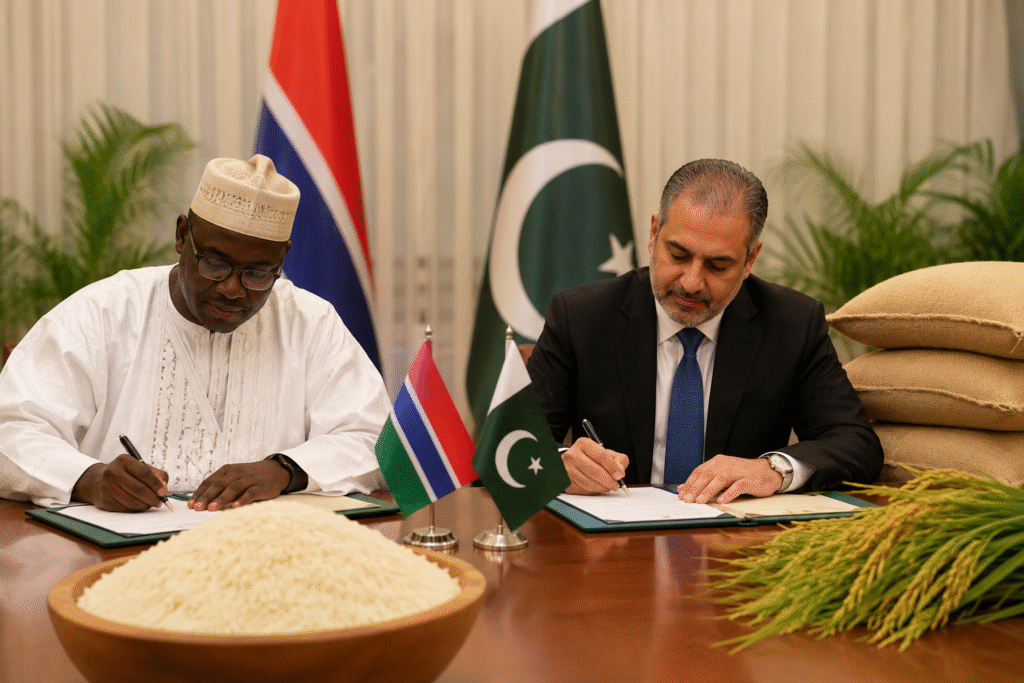
Pakistan is moving closer to expanding its agricultural exports to West Africa as the Ministry of Commerce has sought federal cabinet approval to sign a Memorandum of Understanding (MoU) with The Gambia for stronger bilateral cooperation in agricultural trade, particularly rice exports. The proposed agreement comes after the Gambian government approached the Trading Corporation of Pakistan (TCP) to establish formal government-to-government (G2G) cooperation for the import of agricultural commodities from Pakistan. Officials said the move could open a major new export market for Pakistani rice and strengthen trade ties between the two countries. Gambia Shows Strong Interest in Pakistani Rice According to officials familiar with the development, recent engagements facilitated by the Trade Development Authority of Pakistan played an important role in advancing discussions between the two sides. During these meetings, Gambian officials reportedly expressed strong interest in importing Pakistani rice due to its quality and competitive pricing in international markets. Sources said The Gambia has indicated a demand of around 145,000 metric tons of rice. The expected imports could provide a significant boost to Pakistan’s rice export sector, which remains one of the country’s largest foreign exchange earners. Pakistan is among the world’s leading rice exporters, especially known for its basmati and non-basmati varieties. Exporters believe that expanding into African markets could help diversify export destinations and reduce dependence on traditional buyers. Cabinet Approval Sought for MoU The Ministry of Commerce has now forwarded a summary to the federal cabinet seeking approval to formally sign the MoU with the Gambian side. Officials said the agreement aims to establish a structured framework for agricultural cooperation and streamline trade between the two governments. The proposed arrangement is also expected to improve coordination between relevant institutions and facilitate long-term commodity supply agreements. The Trading Corporation of Pakistan is expected to play a central role in implementing the agreement once approved. Industry stakeholders believe the government-to-government model could strengthen confidence among buyers and ensure stable exports. Pakistan Expanding Presence in African Markets Pakistan has recently intensified efforts to expand trade relations with African countries under its “Look Africa” policy. Authorities are encouraging exporters to explore emerging markets across the continent for food products, textiles, pharmaceuticals, and other goods. Trade experts say Africa’s growing population and rising food demand present significant opportunities for Pakistani exporters. Rice exporters have also welcomed the proposed agreement with The Gambia, saying it could pave the way for similar arrangements with other African nations. They added that Pakistan’s rice sector has the capacity to meet large international orders while maintaining competitive prices. Rice Exports Remain Vital for Economy Rice exports continue to play a crucial role in Pakistan’s economy. The sector contributes billions of dollars annually in export earnings and supports thousands of farmers, millers, and exporters across the country. Officials hope that stronger cooperation with African markets will further increase export volumes and improve foreign exchange inflows at a time when Pakistan is seeking to stabilize its external sector. If approved by the federal cabinet, the MoU is expected to mark another step in Pakistan’s broader strategy to strengthen economic diplomacy and expand agricultural exports globally.

Chinese Apparel Giants Plan $500M Export Facility Creating 20,000 Jobs
Business

Chinese Apparel Giants Plan $500M Export Facility Creating 20,000 Jobs

‎ISLAMABAD: Federal Minister for Commerce Jam Kamal Khan held a meeting with a Chinese business delegation led by Mr. Huwang, Chairman of Challenges Fashion and Ms. Karen Chen, CEO of Challenge Apparel, to discuss investment in export-oriented manufacturing, industrial facilitation, tariff rationalization, and broader Pakistan-China economic cooperation.‎‎During the meeting, both sides exchanged views on the growing potential for Chinese investment in Pakistan, in the textiles, apparel and other sectors. The delegation briefed the Minister on the progress of their ongoing industrial project in Pakistan, sharing plans for significant expansion in manufacturing capacity, employment generation, and export growth.‎‎Mr. Huwang informed the Minister that the company is establishing a major manufacturing facility in Pakistan under international production standards, with the first phase expected to be completed later this year. He shared that the long-term expansion plan envisions one of the largest industrial operations of its kind, with the potential to create up to 20,000 employment opportunities and generate annual exports of approximately USD 400–500 million.‎‎The Chinese delegation highlighted Pakistan’s strategic advantages, including its competitive workforce, and geographic position linking regional and international trade routes. The investors expressed confidence in Pakistan’s industrial potential and expressed growing interest among Chinese businesses in expanding their presence in the country.‎‎Federal Minister Jam Kamal Khan welcomed the delegation and appreciated growing interest of Chinese companies to invest in Pakistan. He noted that the government is actively working to improve the investment climate, simplify regulatory procedures, and facilitate foreign investors through coordinated institutional support.‎‎The Minister highlighted the Prime Minister’s strong emphasis on attracting productive investment and promoting export-led economic growth, noting that investor facilitation remains a key government priority.‎‎During the discussion, the Minister observed that changing global economic dynamics, evolving supply chains, and growing interest in diversification are creating new opportunities for countries like Pakistan. He emphasized that Pakistan’s strategic location, industrial potential, and regional connectivity make it an increasingly attractive destination for export-oriented investment.‎‎The meeting also included discussion on regional connectivity, logistics, energy access, and the importance of secure and diversified trade corridors. The Minister stated that Pakistan’s position offers long-term opportunities for trade facilitation, industrial growth, and stronger economic integration with regional and international partners.‎‎Chinese representatives shared their positive operational experience in Pakistan while noting that international perceptions sometimes influence business decision-making abroad. Jam Kamal Khan acknowledged that perception remains an important factor and emphasized that Pakistan has made substantial progress in improving its business environment and strengthening investor protection.‎‎He stated that the government and relevant institutions remain fully committed to ensuring a stable and secure business environment, expressing confidence that continued improvements would further strengthen investor confidence.‎‎The delegation also raised specific operational requirements relating to specialized industrial construction materials and inputs that are currently not manufactured locally and to be imported to maintain international manufacturing and safety standards.‎‎Federal Minister Jam Kamal Khan assured the investors that the government remains committed to supporting industrial growth and facilitating industrial requirements. He informed the delegation that Pakistan is currently undertaking a phased tariff rationalization process aimed at improving competitiveness and reducing unnecessary costs for manufacturers.‎‎The Minister invited the delegation to formally submit details of specialized products not produced locally, along with relevant tariff classifications, so the Ministry could examine the matter within the ongoing tariff rationalization framework.‎‎He noted that facilitating such industrial requirements could also create opportunities for future local manufacturing once sufficient market demand emerges.‎‎The meeting also reviewed progress on project implementation, including land approvals, infrastructure matters, utility facilitation, and improvements in Special Economic Zone frameworks. The Minister informed the delegation that reforms are underway to reduce procedural hurdles and improve ease of doing business for industrial investors.

Scroll to Top