Author name: Web Desk

Govt Declares 4-Day Eid ul-Fitr Break: March 20-23 Holidays Announced
Pakistan

Govt Declares 4-Day Eid ul-Fitr Break: March 20-23 Holidays Announced

The federal government of Pakistan has announced public holidays for Eid ul-Fitr 2026, declaring March 20 (Friday) and March 21 (Saturday) as official days off. Read More: https://theboardroompk.com/third-drone-hit-on-dubai-hub-spotlights-escalating-gulf-aviation-risks/ This applies to all government offices following five- or six-day work weeks, as per a notification from the Cabinet Division approved by Prime Minister Shehbaz Sharif. Extended Break for Celebrations With March 22 falling on Sunday—a regular weekly holiday—and March 23 observed as Pakistan Day, the public can enjoy four consecutive days off from March 20 to 23. This creates a perfect long weekend for families to celebrate the end of Ramadan with joy and togetherness. Many citizens are planning visits to relatives, shopping for Eid outfits, and enjoying festive meals after a month of fasting. Experts predict Eid on March 21 based on astronomical calculations from Suparco, though the final confirmation depends on the Ruet-e-Hilal Committee’s moon sighting on March 19. The announcement brings relief and excitement nationwide as preparations intensify. Businesses and schools will remain closed during this period, allowing everyone to focus on religious and cultural traditions. Joyful Festive Atmosphere Ahead Eid ul-Fitr marks victory over self-discipline and gratitude for blessings received during Ramadan. Mosques will host special prayers, while markets buzz with shoppers buying sweets, new clothes, and gifts. Families exchange greetings of “Eid Mubarak,” strengthening bonds and community spirit across Pakistan. This four-day holiday break promises relaxation, travel, and memorable moments for millions. The government’s timely notification ensures smooth planning for the festive occasion.

Third Drone Hit on Dubai Hub Spotlights Escalating Gulf Aviation Risks
World

Third Drone Hit on Dubai Hub Spotlights Escalating Gulf Aviation Risks

Dubai International Airport, one of the world’s busiest hubs, faced yet another disruption on March 16, 2026, when a drone attack sparked a fire near a fuel tank, forcing a temporary halt to flights. Read More: https://theboardroompk.com/iran-war-blocks-fertilizer-supplies-hits-us-farmers-hard-ahead-of-spring-planting/ Immediate Aftermath and Response Authorities quickly contained the blaze with no injuries reported. The Dubai Civil Aviation Authority announced a gradual resumption of select flights to limited destinations. Emirates airline began partial operations around 06:00 GMT, though many flights remained cancelled or diverted. Sister carrier flydubai also paused services temporarily before resuming cautiously. Some incoming aircraft were rerouted to Al Maktoum International Airport as a backup. Regional Tensions Fuel Aviation Chaos This marks the third drone incident at Dubai International Airport (DXB) since Iran began assaults on Gulf nations on February 28. The attacks stem from the ongoing US-Israel war against Iran, with Tehran targeting US-linked sites in the region. Gulf states, including the UAE, have endured over 2,000 missile and drone strikes on civilian and oil infrastructure. The UAE, which normalized ties with Israel in 2020, has borne the heaviest impact. Closed airspace across the Middle East has led to widespread cancellations, rerouting, and soaring fuel prices. Experts warn that repeated hits on key hubs like DXB highlight growing risks to global aviation and supply chains. The incident underscores challenges for UAE carriers in restoring full capacity amid persistent threats.

KSE-100 Index Recomposition Sparks Market Buzz as New Corporate Entrants Reshape Benchmark
Business

KSE-100 Index Recomposition Sparks Market Buzz as New Corporate Entrants Reshape Benchmark

The latest KSE-100 Index Recomposition has captured the attention of investors, analysts, and market watchers alike, signaling fresh momentum in Pakistan’s evolving equity landscape. Conducted by the Pakistan Stock Exchange, the periodic review aims to ensure that the benchmark index continues to reflect the country’s most prominent and liquid listed companies. This time, the recalibration has introduced two new corporate players into the spotlight while phasing out two existing constituents. Set to take effect from April 1, 2026, the changes are expected to influence trading patterns, sectoral sentiment, and investor confidence in the months ahead. Why the KSE-100 Index Recomposition Matters for Investors The KSE-100 Index Recomposition is not merely a technical reshuffle it is a critical barometer of economic activity and corporate performance. The index serves as a key benchmark for institutional and retail investors tracking Pakistan’s stock market performance. During the review period from September 2025 to February 2026, companies were assessed primarily on the basis of market capitalization, a fundamental metric used to determine their relative weight and representation within the index. By aligning with this rule-based mechanism, the exchange reinforces transparency and ensures the benchmark remains reflective of real-time market dynamics. Incoming Companies in the KSE-100 Index Recomposition Two companies have secured entry into the benchmark following the latest review. Their inclusion underscores improved market valuation and investor confidence. • Arif Habib Corporation Limited has earned its place through strong capitalization metrics, highlighting its expanding footprint in Pakistan’s financial and investment ecosystem.• Power Cement Limited also joins the index, signaling renewed optimism in the construction and industrial materials sector. These additions are likely to draw increased institutional attention and potentially higher trading volumes, as index-linked funds and portfolios adjust their allocations accordingly. Outgoing Companies in the KSE-100 Index Recomposition While new entrants often create excitement, the KSE-100 Index Recomposition also involves the exit of companies that no longer meet the benchmark’s capitalization thresholds. • Unity Foods Limited will be removed from the index after experiencing relative changes in market valuation.• Pakgen Power Limited also exits the benchmark, reflecting the competitive shifts and evolving performance dynamics within Pakistan’s energy sector. Such transitions highlight the fluid nature of equity markets, where corporate standings can change rapidly based on financial performance, investor sentiment, and macroeconomic trends. How Index Reviews Strengthen Market Credibility Regular reviews like the KSE-100 Index Recomposition play a pivotal role in maintaining the credibility of Pakistan’s primary stock benchmark. By ensuring that only the largest and most liquid companies remain part of the index, the exchange strengthens its relevance for both local and foreign investors. Moreover, the timely release of updated constituent lists allows market participants to make informed investment decisions, fostering transparency and confidence. Analysts believe that such recalibrations also encourage companies to improve governance standards, profitability, and market engagement in order to secure or retain index inclusion. Market Outlook After the KSE-100 Index Recomposition With implementation scheduled for early April 2026, the reshuffle could trigger short-term volatility as portfolio managers rebalance holdings. However, in the long run, the KSE-100 Index Recomposition is expected to support market efficiency and investor trust. As Pakistan’s capital markets continue to mature, periodic adjustments to the benchmark index will remain essential for capturing the economy’s structural shifts from industrial expansion to financial sector innovation. For investors, staying updated on such developments is key to identifying emerging opportunities and managing risk in an increasingly dynamic investment environment.

Iran War Blocks Fertilizer Supplies, Hits US Farmers Hard Ahead of Spring Planting
World

Iran War Blocks Fertilizer Supplies, Hits US Farmers Hard Ahead of Spring Planting

The ongoing war involving Iran has severely disrupted global fertilizer supplies, leaving US farmers facing shortages and sharp price increases just as the spring planting season approaches. Read More: https://theboardroompk.com/psx-down-19-from-peak-brokerage-houses-see-buying-opportunity-ahead-with-caution/ The conflict has effectively closed the Strait of Hormuz, through which over 30% of the world’s nitrogen fertilizer exports and key components like sulfur pass. This has paralyzed shipments from major Gulf producers, hitting the US hard since it relies on imports for a significant portion of its needs, particularly urea. Supply Shortages Hit Critical Timing According to The Fertilizer Institute, the US is about 25% short of usual urea supplies for spring planting, with dealers potentially 25-35% short overall. The just-in-time nature of the US fertilizer distribution system offers little buffer, as most countries lack strategic reserves. Fertilizer shipments from the Gulf take weeks to reach US ports like New Orleans, followed by further transport via barges, trucks, or trains—delays that could render supplies unusable for timely application before crops emerge. Price Spikes Threaten Farmer Viability Prices for available fertilizer have surged more than a third—up to 32% or higher—since the war began. Urea, a key nitrogen fertilizer essential for corn and other crops, has seen dramatic jumps; in some cases, farmers face costs thousands of dollars higher per load compared to pre-war levels. Canadian farmers report similar shocks, with one Saskatchewan producer noting an extra C$44,000 for the same volume purchased earlier. Analysts warn that vessels are being rerouted to higher-paying markets, worsening scarcity for US buyers. Calls for Government Action and Broader Risks US Agriculture Secretary Brooke Rollins indicated the administration is exploring avenues like increased Venezuelan imports to ease pressures, though experts note Venezuela’s production challenges limit quick fixes. Senator Josh Hawley has pushed for investigations into potential price-gouging by major companies. The American Farm Bureau Federation warns that shortages could disrupt the US food supply, leading to reduced yields, lower farmer profits amid already slim margins, and potential rises in grocery prices. Farmers who pre-purchased supplies are somewhat insulated, but late buyers face empty retail centers or unaffordable premiums, raising concerns over planting decisions and crop shifts. This crisis underscores the vulnerability of agriculture to geopolitical events, with spring planting at risk of lower productivity and economic strain for rural communities.

Meta Plans Major Layoffs as AI Costs Skyrocket
World

Meta Plans Major Layoffs as AI Costs Skyrocket

Meta is reportedly planning sweeping layoffs that could impact 20% or more of its workforce, as the company grapples with mounting costs from massive artificial intelligence investments. Read More: https://theboardroompk.com/psx-down-19-from-peak-brokerage-houses-see-buying-opportunity-ahead-with-caution/ According to sources familiar with the matter, this move aims to offset heavy spending on AI infrastructure while positioning the firm to leverage efficiency gains from AI tools that enable smaller teams to handle complex projects. Massive Scale Potential Amid AI Push If the layoffs reach the 20% threshold, they would affect approximately 15,800 employees, based on Meta’s workforce of nearly 79,000 as of late last year. This would mark the company’s most significant workforce reduction since the major restructuring in late 2022 and early 2023, often called the “year of efficiency.” No final decision has been made on the exact percentage or timing, with plans still in early stages. Top executives have signaled the possibility to senior leaders, instructing them to prepare for reductions. Reasons Tied to AI Investments and Efficiency The primary drivers include skyrocketing expenses for AI development, such as a planned $600 billion investment in data centers by 2028. Meta has also pursued aggressive talent acquisition, offering multimillion-dollar packages to top AI researchers for its superintelligence team, alongside acquisitions like a Chinese AI startup for at least $2 billion and recent purchases of AI-focused platforms. CEO Mark Zuckerberg has previously noted that AI advancements allow “projects that used to require big teams now be accomplished by a single very talented person,” highlighting expected productivity boosts. Broader Context and Company Response Meta has faced setbacks in its AI efforts, including delays with models like Llama 4 and the new “Avocado” initiative. The potential cuts follow earlier reductions, such as those in the Reality Labs division earlier in 2026, as the company shifts focus from metaverse ambitions to AI priorities. A Meta spokesperson described reports as “speculative reporting about theoretical approaches.” This trend aligns with actions at other tech firms, where AI-driven efficiencies are prompting workforce adjustments to balance innovation costs. The announcement has sparked discussions about the dual impact of AI—accelerating capabilities while reshaping employment in the tech sector.

Pakistan Govt Holds Fuel Prices Steady Despite Global Oil Surge
Pakistan

Pakistan Govt Holds Fuel Prices Steady Despite Global Oil Surge

Prime Minister Shehbaz Sharif has announced a significant decision to keep petroleum product prices unchanged in Pakistan, despite a notable rise in international oil prices. This move comes amid ongoing global economic pressures, including regional tensions affecting energy markets. Read More: https://theboardroompk.com/pakistan-stock-exchange-closes-lower-after-turbulent-trading-week/ The Prime Minister emphasized his commitment to easing the financial strain on ordinary citizens during these challenging times. The announcement was made on March 13, 2026, honoring a promise to provide relief to the public. Government’s Relief Strategy Amid Economic Challenges The decision not to hike prices aims to reduce the burden on the common man, who has already faced increases in living costs. Earlier this month, the government raised petrol and diesel prices by Rs55 per litre each, pushing petrol to Rs321.17 per litre and diesel to Rs335.86 per litre due to surging global rates. By holding prices steady now, the administration seeks to offer immediate respite. PM Shehbaz highlighted that the government is managing the situation through timely policy-making, financial discipline, and austerity measures. These include starting reductions from the elite and government sectors to protect the poor. Efforts for Supply Stability and Public Support The Prime Minister credited diplomatic and economic teams for securing sufficient crude oil supplies, ensuring no shortages and that no one charges above government-fixed rates. Federal and provincial governments are collaborating to enforce this. He expressed hope that global conditions would improve, leading to stability in international petroleum prices. The step reflects a people-centric approach, prioritizing public welfare over immediate fiscal pressures from volatile oil markets influenced by regional conflicts. This relief measure has been welcomed as a positive signal for consumers, transporters, and industries reliant on fuel, potentially helping control inflation in the short term.

Pakistan Stock Exchange closes lower after turbulent trading week
Pakistan

Pakistan Stock Exchange closes lower after turbulent trading week

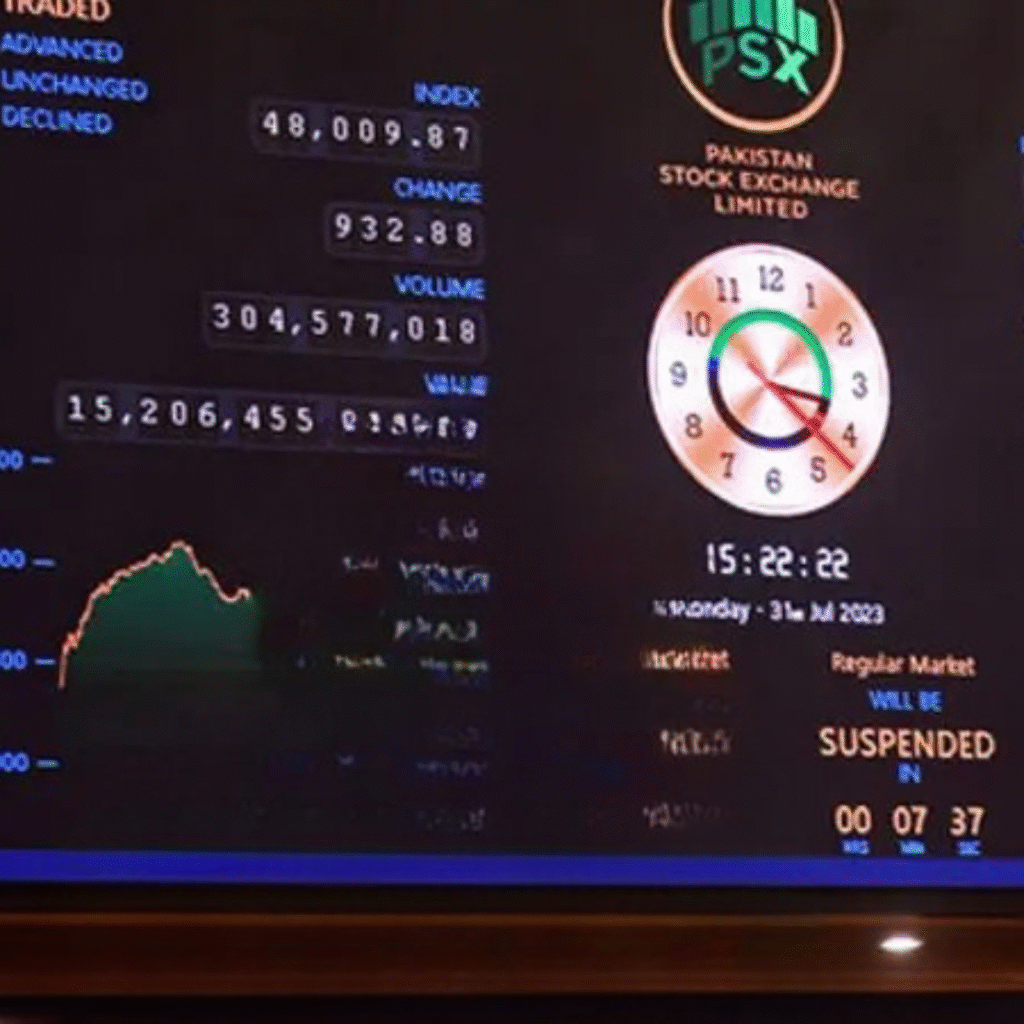
The Pakistan Stock Exchange wrapped up Friday’s trading session on a cautious note, reflecting lingering investor anxiety and global market headwinds. The benchmark KSE-100 Index settled at 153,866.16, slipping by 555.27 points (0.36%), as traders navigated a volatile week filled with uncertainty and shifting sentiment. Read More: https://theboardroompk.com/pakistan-external-financing-january-2026-inflows-raise-economic-eyebrows/ Despite moments of optimism during the session, the market ultimately succumbed to selling pressure, highlighting the fragile confidence that continues to shape trading activity in Pakistan’s equity landscape. Pakistan Stock Exchange volatility signals investor caution Intraday trading on the Pakistan Stock Exchange remained highly dynamic, with the benchmark index swinging across a wide range of more than 2,200 points. The index briefly surged to an intraday high of 155,002.10, before sliding to a low of 152,780.79, underscoring the choppy nature of market participation. Market breadth also painted a mixed picture. While 37 companies posted gains, 58 declined, reflecting selective buying interest rather than broad-based confidence. Trading volumes in the benchmark index stood at 113.04 million shares, indicating moderate activity amid cautious positioning by institutional and retail investors alike. Sector pressures drag Pakistan Stock Exchange lower A closer look at sector-wise performance reveals that declines were concentrated in investment companies, fertilizers, cement, power generation, and pharmaceuticals. Heavyweight stocks such as Engro Holdings, Lucky Cement, and Fauji Fertilizer Company collectively shaved hundreds of points off the benchmark index. In contrast, strength in commercial banks provided a partial cushion. Buying momentum in leading lenders like United Bank Limited and Faysal Bank Limited helped offset losses, signaling that investors continue to favor fundamentally resilient sectors during periods of uncertainty. Meanwhile, select refinery, technology, and textile stocks also recorded modest gains a sign that bargain hunting remains active even as broader sentiment stays subdued. Global and domestic triggers shaping Pakistan Stock Exchange sentiment The recent decline in the Pakistan Stock Exchange did not occur in isolation. Analysts point to ongoing discussions between Pakistan and the International Monetary Fund as a key driver of investor hesitation. Market participants are closely monitoring the progress of the IMF review, as its outcome could significantly influence economic policy direction and liquidity conditions. External factors have added another layer of complexity. Rising crude oil prices fueled by geopolitical tensions in the Middle East and disruptions near the Strait of Hormuz have weighed on energy-dependent sectors and heightened inflationary concerns. Such developments often trigger defensive trading strategies, leading investors to rotate into safer sectors or temporarily reduce exposure to equities. Broader market performance and trading activity Beyond the benchmark index, the broader All-Share Index also ended slightly lower at 92,322.40, reflecting a marginal decline of 0.18%. Overall market participation softened compared with the previous session, as total traded volume fell to 303.02 million shares, while traded value decreased to approximately Rs14.69 billion. Nearly 472 companies were traded during the session, with advancing stocks only narrowly trailing decliners a trend that indicates mixed sentiment rather than outright bearishness. This suggests that while short-term uncertainty persists, underlying market interest remains intact. Pakistan Stock Exchange outlook: volatility likely to continue Despite the latest dip, the Pakistan Stock Exchange has delivered notable gains over the current fiscal year, reflecting strong rallies earlier in the period. However, calendar-year performance has remained under pressure, highlighting the market’s sensitivity to macroeconomic shifts and global developments. Looking ahead, analysts expect continued volatility as investors assess economic indicators, policy signals, and geopolitical risks. Any clarity regarding IMF negotiations, inflation trends, or energy prices could act as a catalyst for renewed direction in the market. For now, cautious optimism appears to define the mood with traders staying alert for opportunities while keeping risk management at the forefront.

Bank Alfalah's 18% of Accounts Now Held by Women, Deposits Hit PKR 237 Billion
Business

Bank Alfalah’s 18% of Accounts Now Held by Women, Deposits Hit PKR 237 Billion

Karachi, Pakistan, March 13, 2026: Bank Alfalah has released updated data highlighting its progress in advancing women’s financial inclusion across Pakistan, with growth in women customers, increased financing for women-led businesses, and broader representation of women across its workforce and leadership structures. Read More: https://theboardroompk.com/pakistan-external-financing-january-2026-inflows-raise-economic-eyebrows/ Women now hold 18% of the bank’s total accounts, representing approximately 650,000 customers. In 2025, the bank recorded a 12% increase in women account holders, while female customers contributed 11% of total deposits, amounting to PKR 237 billion. The bank also reported growth in lending to women across key economic sectors. In the SME segment, the number of women borrowers increased by 20% in 2025, with 117 women-led businesses financed, mainly in manufacturing and trading. Total SME financing for these businesses amounted to PKR 521 million. In agriculture, 857 women-led businesses received PKR 1.32 billion in financing in 2025, supporting dairy, livestock, and crop production. The bank also disbursed PKR 264 million in interest-free financing to 127 small-scale farmers under its Revive and Rise scheme. Bank Alfalah continues to support the Benazir Income Support Programme through digital disbursements across Pakistan. Since 2022, the number of women beneficiaries served through the bank has increased by 150%, reaching approximately 4.5 million women. Within its workforce, women currently represent 21% of employees. As of 31 December 2025, women also represented 16% of members across board committees, management committees, and their subcommittees, reflecting early progress in the bank’s broader efforts to strengthen women’s representation across leadership structures. The bank also continues to support women through community programs focused on entrepreneurship, education, and healthcare. Women now account for 18% of total accounts, with female deposits reaching PKR 237 billionWomen-led borrowing increased across the SME and agriculture segments, while BISP disbursements now reach around 4.5 million women through the bank. Women represent 21% of the workforce, with further progress reported across leadership and community programs.

Affordable Housing Finance Scheme Pakistan: Govt Expands Loan Limit to Rs10 Million
Pakistan

Affordable Housing Finance Scheme Pakistan: Govt Expands Loan Limit to Rs10 Million

The Affordable Housing Finance Scheme Pakistan has entered a transformative phase as the government unveils a sweeping expansion designed to reshape the country’s housing landscape. In a decisive move, the federal authorities in Pakistan have significantly increased the maximum housing loan limit from Rs3.5 million to Rs10 million a policy shift that could redefine the dream of owning a home for thousands of middle-income families. Read More: https://theboardroompk.com/pakistan-external-financing-january-2026-inflows-raise-economic-eyebrows/ Announced through a formal notification by the Ministry of Housing and Works, the revised framework aims not only to expand access to financing but also to ignite fresh momentum across multiple sectors of the national economy. Affordable Housing Finance Scheme Pakistan: Lower Markup, Higher Opportunities One of the most impactful changes under the Affordable Housing Finance Scheme Pakistan is the standardization of the customer markup rate at a flat 5% for all financing tiers. Previously, borrowers in Tier-2 categories were required to pay an 8% markup, creating disparities in affordability. The shift to a uniform and lower rate is expected to significantly ease the financial burden on prospective homeowners. Moreover, loans already disbursed at higher markup rates will now be recalibrated to align with the new 5% structure a move likely to enhance consumer confidence and boost uptake of housing finance products. Inclusive Housing Criteria to Empower Middle-Income Families The expanded Affordable Housing Finance Scheme Pakistan also introduces broader eligibility criteria, reflecting the government’s intent to cater to a wider segment of society. Housing size limits have effectively doubled, allowing financing for houses up to 10 Marlas equivalent to approximately 2,720 square feet. Similarly, the maximum allowable size for apartments and flats has been increased to 1,500 square feet. These changes recognize evolving urban housing needs and provide greater flexibility for families seeking more spacious living arrangements. Financing Structure Designed for Accessibility Under the revised scheme, the Loan-to-Value ratio remains highly favorable at 90:10. In practical terms, this means financial institutions will fund up to 90% of the property’s cost, while buyers are required to contribute only a modest 10% equity portion. This structure reduces the initial financial barrier for first-time homebuyers and aligns with global best practices in affordable housing finance. The policy is expected to make property ownership more attainable for salaried individuals and emerging middle-class households. Affordable Housing Finance Scheme Pakistan: Massive Subsidy Commitment The government’s long-term commitment to the Affordable Housing Finance Scheme Pakistan is reflected in a substantial subsidy allocation. Authorities have pledged to facilitate the construction and purchase of approximately 500,000 housing units over the next four years. In the current fiscal year alone, the target stands at 50,000 units. To support this initial phase, a subsidy package amounting to Rs321.96 billion has been earmarked, covering both markup support and risk-sharing mechanisms. By the fiscal year 2028-29, the annual rollout is expected to scale up to 200,000 housing units. Economic Ripple Effects: Construction and Banking Set to Gain The expansion of the Affordable Housing Finance Scheme Pakistan is widely anticipated to trigger a strong multiplier effect across the national economy. Increased housing construction typically drives demand for cement, steel, and other building materials while stimulating employment in allied industries. At the same time, the banking sector stands to benefit from a surge in mortgage financing activity, potentially unlocking new avenues for financial inclusion and credit growth. Real estate developers are also expected to capitalize on rising demand, fostering broader investment momentum. A Turning Point for Pakistan’s Housing Market As urbanization accelerates and housing shortages persist, the enhanced Affordable Housing Finance Scheme Pakistan represents a strategic policy intervention with far-reaching implications. By lowering financing costs, expanding eligibility, and committing substantial fiscal resources, the government has positioned the housing sector as a key driver of economic resilience and social stability. If effectively implemented, the initiative could mark a pivotal turning point transforming aspirations of homeownership into tangible realities for millions.

Scroll to Top