Uncategorized

The Impact of AI on Business: What You Need to Know About 3 Major Industries
Uncategorized

The Impact of AI on Business: What You Need to Know About 3 Major Industries

The next few years may redefine what work looks like across several major industries and according to a leading OpenAI executive, the transformation has already begun. On a recent episode of the Unsupervised Learning podcast, Olivier Godement, Head of Product for Business at OpenAI, shared why he believes life sciences, customer service, and software engineering are entering an era of accelerated automation. His insights offer a candid look into how fast AI technologies are evolving and how businesses should prepare. 1. Life Sciences & Pharma: AI Is Becoming the New Research Partner: Godement’s first prediction is bold but grounded in real-world progress:the life sciences and pharmaceutical industries are on the brink of a major AI-driven shift. Working closely with companies like Amgen, Godement sees firsthand how drug discovery and development processes can be streamlined. “Once you lock the recipe of a drug, getting it to market takes months, sometimes years,” he explained. “Models are now very good at consolidating huge datasets and tracking document changes. A lot of this admin work can be automated.” In an industry where delays cost billions and impact human lives, AI automation could radically shorten development timelines, reduce operational overhead, and accelerate medical innovation. 2. Software Engineering: The Most Heated Debate in Tech: Few topics have sparked more controversy in 2024 and 2025 than the future of software engineering. According to Godement, while AI isn’t replacing engineers outright “yet” the trajectory is clear. “We’re not at the point of fully automating a software engineer’s job. But we now have a line of sight to get there.” AI-powered coding tools have already become standard across tech companies. Large models can generate boilerplate code, debug issues, review pull requests and even propose architectural solutions. A recent Indeed report reinforces the shift: software engineers, QA engineers, product managers and project managers are the four roles most frequently cut during tech layoffs, largely due to automation and restructuring. The message is unmistakable:coding is becoming more automated, and the nature of engineering roles is evolving fast. 3. Customer Service & Sales: Automation Is Closer Than We Think: Customer-facing roles may feel safe for now, but Godement believes the next two years will bring surprising changes. Working with companies like T-Mobile, OpenAI is already seeing customer support tasks automated at scale with high accuracy. “We’re achieving strong results at meaningful scale. My sense is we’ll be surprised in the next year or two at how many tasks can be reliably automated.” From chat support to sales assistance and ticket resolution, AI systems are becoming more conversational, reliable and available 24/7 making them valuable assets for large enterprises. Are White-Collar Jobs at Risk? Industry Leaders Say Yes: Across Silicon Valley, warnings are growing louder. AI pioneer Geoffrey Hinton, known as the “Godfather of AI,” recently said that while physical jobs like plumbing remain safe for now, intellectual and clerical roles face the greatest risk. “For mundane intellectual labor, AI is going to replace everybody,” Hinton said.He even admitted he’d be terrified to work in a call center today. Paralegals, administrative staff, analysts and customer support agents: these are roles where AI is already outperforming humans in speed, accuracy and cost. The Bottom Line: AI Isn’t Coming, It’s Already Here: Olivier Godement’s insights reflect a bigger trend: The AI revolution is touching every corner of the business world. Industries at the forefront:• Life Sciences → Faster drug discovery, automated documentation• Software Engineering → AI-assistance becoming the norm• Customer Service & Sales → Massive automation potential at enterprise scale As AI systems improve, the businesses that adapt early will lead and those that don’t may struggle to survive.

KSE-100 Suffers Sharp Pullback as Profit-Taking Hits Market, Index Sheds 877 Points Amid Volatile Trading
Uncategorized

KSE-100 Suffers Sharp Pullback as Profit-Taking Hits Market, Index Sheds 877 Points Amid Volatile Trading

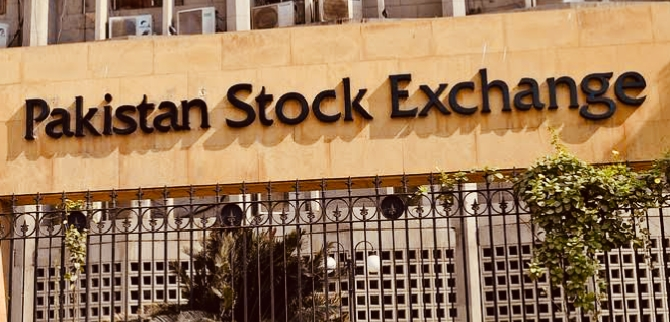
The Pakistan Stock Exchange (PSX) witnessed a turbulent trading session on Thursday as the benchmark KSE-100 Index closed with a notable decline, ending the day at 168,574.69 points, down 877.17 points or 0.52%. After weeks of strong upward momentum, investors opted for profit-taking, triggering a broad-based selloff across major sectors. Volatility Dominates: Index Swings Over 1,700 Points: The market remained highly volatile throughout the session. The KSE-100 surged to an intraday high of 170,301.48 points (+849.62), but heavy selling pressure later dragged it down to an intraday low of 168,548.45 points (-903.41) a massive swing of 1,753 points. The benchmark index recorded a strong activity level, trading 656.55 million shares, reflecting sustained investor participation despite the bearish close. Market Breadth Turns Negative: Out of the 100 companies on the index:• 30 stocks closed higher• 68 declined• 2 remained unchanged The day clearly belonged to the sellers. Top Performers & Major Losers: Top GainersDespite the decline, a few stocks delivered impressive gains:• NML (+10.00%)• KAPCO (+10.00%)• SSGC (+7.50%)• GADT (+7.17%)• PABC (+5.30%) Top LosersSeveral major names came under intense pressure:• ISL (-6.62%)• PKGP (-6.51%)• PSEL (-5.80%)• INIL (-5.75%)• DHPL (-5.33%) Who Moved the Index? Key Contributors: Top Negative Contributors• FFC (-232.66 pts)• LUCK (-150.29 pts)• HBL (-97.52 pts)• PSEL (-85.26 pts)• HUBC (-63.40 pts) Top Positive Contributors• ENGROH (+86.63 pts)• NML (+86.60 pts)• OGDC (+57.57 pts)• KAPCO (+49.60 pts)• AICL (+37.86 pts) These gains helped cushion what could have been a steeper fall. Sector-Wise Performance: Cement & Banking Under Pressure: A deeper breakdown shows that multiple heavyweight sectors dragged the index into the red: Sectors Pulling the Index Down• Cement (-343.52 pts)• Fertilizer (-264.87 pts)• Commercial Banks (-253.96 pts)• Miscellaneous (-70.31 pts)• Engineering (-64.48 pts) Sectors Providing Support• Textile Composite (+108.80 pts)• Oil & Gas Exploration (+57.15 pts)• Investment Banks / Securities (+48.09 pts)• Insurance (+37.86 pts)• Technology & Communication (+26.22 pts) Broader Market Also Slips: The overall market followed a similar trend.The All-Share Index closed at 102,171.27 points, losing 383.53 points or 0.37%. • Total market volume: 1,288.97 million shares (higher than yesterday’s 1,190.53m)• Traded value: Rs 55.23 billion (up Rs 4.74 billion)• Total trades: 429,816 across 485 companies Among these:• 189 stocks advanced• 257 declined• 39 remained unchanged Despite Today’s Drop, KSE-100 Still on a Stellar Run: Even with Thursday’s correction, the market’s bigger story remains overwhelmingly positive. The KSE-100 has gained:• +42,947 points (34.19%) in FY 2025-26• +53,448 points (46.43%) in CY 2025 This makes PSX one of the world’s strongest performing equity markets this year.

Uncategorized

From Newsrooms to Gig Economy: PAFLA Trains Journalists, Photographers with Freelancing Art

KARACHI: The Pakistan Freelancers’ Association (PAFLA) has planned an initiative to empower journalists with freelancing skills in collaboration with press clubs and associations across Pakistan, following its first capacity-building session at the Karachi Press Club (KPC). The nationwide initiative aims to equip Pakistani journalists with in-demand freelancing skills, enabling them to diversify income streams, build global clients, and generate sustainable income in a rapidly changing media economy. In this regard, PAFLA recently organized a “Learn and Earn Session” at the Karachi Press Club as part of its Empowering Journalists series in the digital world, which saw an overwhelming turnout from press club members. PAFLA Chairman Ibrahim Amin said the program is designed to help journalists translate their newsroom strengths, research, storytelling, verification, interviewing, and beat expertise, into paid opportunities across the global digital marketplace. “Journalists already have the most valuable currency in the digital economy: credibility, communication, and clarity,” said Ibrahim Amin, Chairman PAFLA. “Our mission is to empower Pakistani journalists with practical freelancing skills so they can earn with dignity, stay independent, and thrive in the modern world of work.” “Freelancing is not a ‘side hustle’ anymore; it’s a full professional ecosystem,” Amin added. “When journalists understand platforms, pricing, portfolios, and global client expectations, they don’t just survive disruption, they lead it.” The initiative comes at a time when Pakistan’s media industry has been facing repeated waves of job cuts, closures, and salary delays, putting intense financial pressure on reporters, producers, editors, and digital teams. The session was also addressed by experienced freelancing experts, Faraz Hussain and Hasan Bin Liaquat, President KPC Fazil Jamili, and Manzer Turk, Head of Capacity Building Committee-KPC.

Automobile Importers in Crisis: Personal Baggage, TR Schemes Scrapped Overnight
Uncategorized

Automobile Importers in Crisis: Personal Baggage, TR Schemes Scrapped Overnight

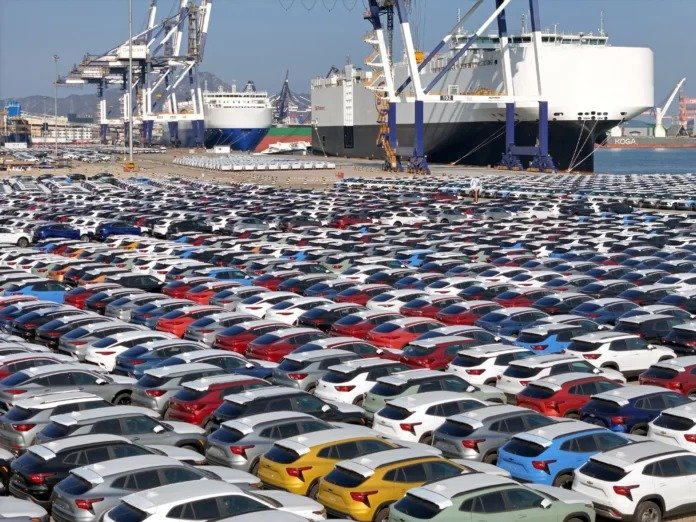
Islamabad, December 11, 2025 – The All Pakistan Motor Dealers Association (APMDA) has urgently appealed to Prime Minister Shehbaz Sharif to intervene and reverse the Economic Coordination Committee’s (ECC) December 9 decision that abolished the popular Personal Baggage Scheme, Gift Scheme, and Transfer of Residence (TR) Scheme for overseas Pakistanis bringing vehicles into the country. In a strongly-worded letter dated December 11, APMDA Chairman H.M. Shahzad warned that the sudden scrapping of these decades-old schemes will deliver a devastating blow to the automobile import sector and the livelihoods of millions of Pakistanis linked to it. Read More: https://theboardroompk.com/imc-proposes-maintaining-40-tariff-difference-in-upcoming-auto-policy/ Overseas Pakistanis remit over USD 40 billion annually and, under the previous schemes, were allowed to import one vehicle every two years on concessional duty. In fiscal year 2024-25 alone, the sector contributed nearly USD 500 million to national exchequer through duties and taxes, the letter highlighted. The association argued that the ECC’s move, ostensibly to curb misuse, has instead punished genuine overseas Pakistanis and pushed thousands of authorised importers, clearing agents, and ancillary workers toward unemployment. Commercial importers, meanwhile, continue to enjoy significantly higher duty concessions, creating an uneven playing field. “On one hand, harsh conditions have been imposed on vehicles arriving under TR, Baggage and Gift schemes; on the other, commercial vehicle imports have been subjected to highly unreasonable terms. This dual pressure is pushing the entire automobile import business toward collapse,” the letter stated. APMDA has requested an immediate high-level meeting with the Prime Minister and relevant ministries to present detailed data and propose safeguards that protect revenue without destroying the overseas Pakistanis’ facility

Uncategorized

Pakistan and Türkiye Forge Deeper Defence and Aviation Partnership Amid Regional Tensions

Islamabad – Pakistan and Türkiye have taken a major step toward deeper defence, aviation, and high-technology cooperation, with a high-level Turkish delegation signalling strong interest in joint ventures, technology transfer, and setting up manufacturing facilities in Pakistan. Read More: https://theboardroompk.com/low-cost-battle-tested-pakistani-defence-firms-win-big-interest-at-egypts-edex/ The delegation, led by Ahmet Khan, Group CEO and Honorary Investment Counsellor of Pakistan in Türkiye, included senior executives from Türkiye’s leading aviation, aircraft manufacturing, drone technology, defence systems, automotive engineering, aerospace, and advanced materials companies. During their meeting on Thursday with Federal Minister for Commerce Jam Kamal Khan, the Turkish side showcased their rapidly advancing defence and aviation industries and expressed eagerness to replicate successful international partnerships with Pakistan.Minister Jam Kamal welcomed the initiative, stressing the historic brotherly ties and highlighting Pakistan’s skilled engineering workforce and abundant critical mineral resources as key enablers for collaboration in aerospace, defence production, and dual-use technologies. He positioned Pakistan as an attractive strategic manufacturing and export base for Turkish companies targeting ASEAN, African, Gulf, and South Asian markets, and called for trilateral and multilateral frameworks to maximise mutual strengths.The Turkish delegation responded positively, pledging long-term cooperation and showing interest in stronger banking channels and trade facilitation to support future projects. Both sides agreed to fast-track sector-specific engagements, promote business-to-business linkages, and pursue investment-driven industrial partnerships.The development comes against a backdrop of persistent regional security challenges, including lingering tensions with India after the May 2025 four-day border clash and strained ties with Afghanistan over cross-border terrorism. Analysts see the deepening Pakistan-Türkiye defence axis as part of broader realignments, providing Islamabad diversified high-tech options and Ankara expanded influence in South and Central Asia.

Pakistan Stock Market Gains Momentum Early, Cools Off by Close, KSE-100 Near 169,451
Pakistan, Uncategorized

Pakistan Stock Market Gains Momentum Early, Cools Off by Close, KSE-100 Near 169,451

The Pakistan Stock Exchange (PSX) delivered another eventful trading day on Wednesday, with the KSE-100 Index showcasing both strength and volatility. Although the benchmark index managed to surge past the 170,000 mark earlier in the session on renewed investor confidence, it ultimately closed slightly lower by 4.52 points, settling at 169,451.86. Despite the marginal dip, sentiment in the broader market remained firm as investors reacted positively to the IMF’s latest loan disbursement approval, signalling improved clarity on Pakistan’s economic outlook. A Day of Wide Swings and High Volumes: Wednesday’s session was defined by a massive intraday range of 1,458.51 points, highlighting intense buying and profit-taking activity: • Intraday High: 170,697.74 (+1,241.36)• Intraday Low: 169,239.23 (-217.15) The KSE-100 also posted an impressive trading volume of 497.18 million shares, reflecting heavy participation across major sectors. Market Breadth: Almost Even Split Between Bulls and Bears: Of the 100 companies within the index: • 51 closed higher• 48 declined• 1 remained unchanged This balanced market performance signals cautious optimism among investors. Top Movers of the Day: Top Gainers Top Gainers • ISL (+10.00%)• MLCF (+10.00%)• DHPL (+7.31%)• FFL (+6.64%)• GHGL (+5.98%) These stocks helped fuel the early rally as momentum shifted in favor of cyclical sectors. Top Losers • SRVI (-8.15%)• HUMNL (-2.78%)• PGLC (-2.56%)• PTC (-2.52%)• PPL (-1.53%) Profit-taking and sector-specific pressures weighed these counters down. Index Point Contribution: Who Pushed the Market Up—and Down? Major Drags • FFC (-188.27pts)• SRVI (-116.63pts)• PPL (-76.06pts)• ENGROH (-75.07pts)• HUBC (-68.59pts) Softness in heavyweights diluted the index’s early gains. Major Boosters • MLCF (+177.89pts)• LUCK (+169.89pts)• ISL (+56.16pts)• FCCL (+52.58pts)• DHPL (+51.70pts) The Cement sector remained the star performer, reflecting strong investor demand. Sector-wise Performance: Cement Leads the Charge Sectors Dragging the Index • Fertilizer (-232.53pts)• Oil & Gas Exploration (-174.60pts)• Leather & Tanneries (-116.63pts)• Technology & Communication (-105.16pts)• Oil & Gas Marketing (-62.44pts) Sectors Supporting the Index• Cement (+538.37pts) the day’s strongest contributor• Textile Composite (+70.33pts)• Engineering (+66.48pts)• Glass & Ceramics (+41.49pts)• Commercial Banks (+28.97pts) The rally in cement stocks played a crucial role in keeping the market stable despite sector-wide volatility. Broader Market Snapshot The All-Share Index closed at 102,554.80, gaining 76.23 points (0.07%). • Total Volume: 1,190.53 million shares (up from 1,031.80m)• Traded Value: Rs 50.49 billion (down by Rs 0.82bn)• Total Companies Traded: 478o 251 advancedo 188 declinedo 39 remained unchangedThe broader market remained firmly positive, signaling continued investor confidence. KSE-100’s Impressive Year: A Strong Bull Run Continues The KSE-100 Index has logged exceptional gains this year: • Up 43,825 points (34.88%) during the fiscal year• Up 54,325 points (47.19%) in the calendar year so far This places the PSX among the best-performing markets in Asia, driven by easing macroeconomic uncertainty and improving liquidity conditions. Final Thoughts: Momentum Still Intact Despite a Minor Dip While the KSE-100 ended slightly negative, the underlying sentiment remains strongly bullish, supported by: • IMF disbursement confidence• Improved macro stability• Heavy interest in cyclical and commodity-linked sectors• Robust volumes across the board If global cues remain steady, the market could attempt another breakout above the 170,000 level in the coming sessions.

Bitcoin Faces First Yearly Loss Since 2022, Fueled by Adoption and Bubble Worries
Uncategorized

Bitcoin Faces First Yearly Loss Since 2022, Fueled by Adoption and Bubble Worries

With a series of record highs and crushing sell-offs, 2025 has been a rollercoaster ride for bitcoin, the world’s largest cryptocurrency, which is at risk of ending the year with its first annual decline since 2022. The world’s main stock benchmarks have also had a turbulent year, repeatedly hitting record peaks and then pulling back as worries over tariffs, interest rates and a possible AI bubble whipsawed markets. While equities are mostly up year-to-date, bitcoin’s overall correlation with share prices has strengthened markedly this year, driven by surging retail and institutional adoption. Retail investors, empowered by user-friendly apps and ETFs, poured billions into bitcoin, mirroring their enthusiasm for high-growth tech stocks. Institutional heavyweights like BlackRock and Fidelity expanded crypto offerings, blending digital assets into traditional portfolios. This convergence has made bitcoin less of a “digital gold” hedge and more a high-beta play on equity rallies, analysts say. “Adoption is blurring lines between crypto and Wall Street,” noted Galaxy Digital’s Alex Thorn. Yet, after October’s brutal crash—triggered by regulatory jitters and leveraged liquidations—bitcoin has struggled to regain footing. Trading around $58,000 as of Monday, it’s down over 15% year-to-date, flirting with a negative close for the first time in three years. The post-crash malaise persists, with low trading volumes and fading hype around blockchain upgrades. Compounding woes, AI stock volatility—epitomized by Nvidia’s 20% swings—has rippled into crypto, amplifying bubble concerns. “If AI’s froth bursts, bitcoin could follow,” warned JPMorgan’s Nikolaos Panigirtzoglou, citing shared speculative fervor. Market sentiment now hinges on Federal Reserve rate cut expectations. Traders price in a 75% chance of a December easing, which could buoy risk assets like bitcoin by cheapening liquidity. But persistent inflation data might dash hopes, extending the crypto winter. As 2025 closes, bitcoin’s fate underscores a maturing yet volatile asset class, increasingly tethered to broader economic tides.

3 Lakh Tons Kinnow Export Target Set for Current Season as Climate-Smart Agriculture Becomes Essential
Uncategorized

3 Lakh Tons Kinnow Export Target Set for Current Season as Climate-Smart Agriculture Becomes Essential

Karachi 09 December 2025: Exports of kinnow from Pakistan have begun for the current season, with 6,000 tons shipped so far—since December 1—to the Middle East, Sri Lanka, and the Philippines. The All Pakistan Fruit and Vegetable Exporters, Importers and Merchants Association has set an export target of 300,000 tons for this season, which is expected to generate 110 million dollars in foreign exchange. Last season, Pakistan exported 250,000 tons of kinnow, earning 95 million dollars. According to the Association’s Patron-in-Chief, Waheed Ahmed, this season has seen a bumper crop, with total production expected to reach 2.7 million tons compared to 1.7 million tons last season. Despite the increase in production, Pakistan’s kinnow exports are still 50 percent lower than the 550,000 tons exported five years ago. He said the main reason for this decline is the lack of research and development in kinnow cultivation and reliance on old varieties that cannot withstand environmental challenges, rather than introducing new ones. Waheed Ahmed said the PFVA has presented short-, medium-, and long-term plans to the government to boost kinnow exports. If implemented, Pakistan can introduce new varieties and increase kinnow exports to 400 million dollars within the next five years. He added that Pakistan will need to acquire new varieties from Egypt, the United States, Morocco, and China for local cultivation. At the same time, preference must be given to low-water-consuming varieties such as lemon, grapefruit, orange, and mandarin, which have strong demand in international markets. According to him, the suspension of trade with Afghanistan has created difficulties in exporting kinnow via land routes to Central Asian states and Russia. The alternative route through Iran is long and costly; freight rates through Iran have already increased by up to 100 percent at the start of the season, alongside additional logistics challenges. Waheed Ahmed also emphasized the need for a national-level strategy to enhance kinnow exports, strengthen research and development, and promote modern irrigation methods in view of the growing water shortage.

Pakistan Receives $3.19 Billion in Workers’ Remittances in November 2025, 9.4% YoY Growth Despite Monthly Dip
Uncategorized

Pakistan Receives $3.19 Billion in Workers’ Remittances in November 2025, 9.4% YoY Growth Despite Monthly Dip

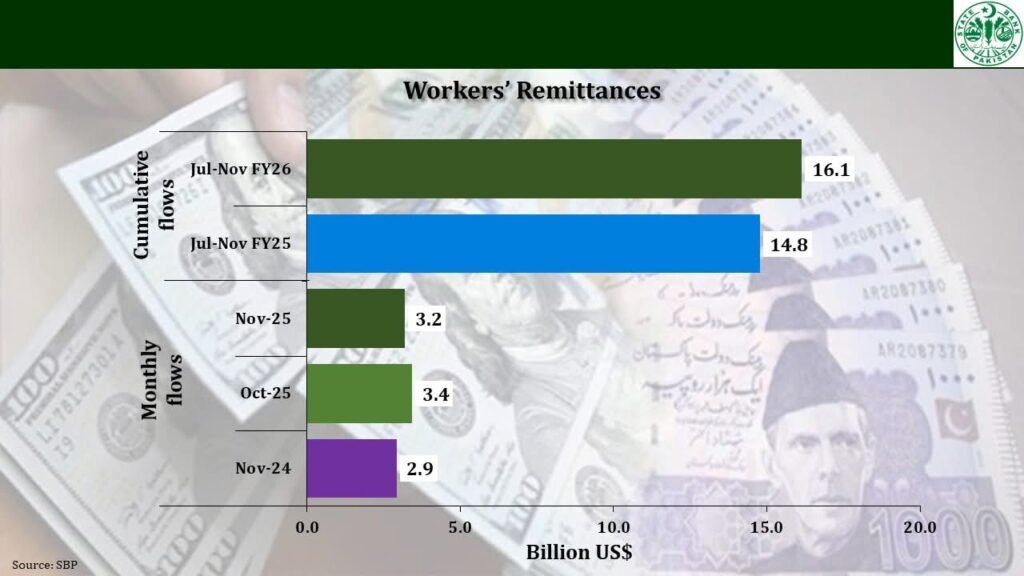
Pakistan recorded $3.19 billion in workers’ remittances during November 2025, according to the latest data released by the State Bank of Pakistan (SBP). While the figure reflects a 6.75% month-on-month decline from October’s inflow of $3.42 billion, the trend remains positive on a yearly basis. Compared to November 2024, when remittances stood at $2.92 billion, Pakistan witnessed a strong 9.4% year-on-year (YoY) growth, signaling sustained support from overseas Pakistanis despite global economic uncertainties. Remittances Hit $16.15 Billion in First Five Months of FY26: During July–November FY26, workers’ remittances reached $16.15 billion, up from $14.77 billion in the same period last year, marking a 9.33% YoY increase. This continued rise highlights the crucial role of expatriate Pakistanis in supporting the country’s external sector and stabilizing foreign exchange reserves. Saudi Arabia and UAE Lead Remittance Inflows in November 2025: Saudi Arabia Remains Top Contributor: Saudi Arabia maintained its position as the largest remittance source, sending $753.0 million in November 2025. MoM change: ▼ 10.11%YoY change: ▲ 3.26% Despite the monthly decline, remittances from the KSA showed healthy annual growth, reaffirming the significant Pakistani workforce presence across the Gulf region. UAE Ranks Second With $675 Million: The United Arab Emirates emerged as the second-largest corridor, contributing $675.0 million: MoM change: ▼ 4.01%YoY change: ▲ 8.98% Within the UAE, Dubai alone accounted for $567.0 million, reflecting its role as a major financial and employment hub for overseas Pakistanis. UK Inflows Surge, While US Remittances Decline: United Kingdom Shows Strong Growth: Workers’ remittances from the UK reached $481.1 million, delivering a significant 17.38% YoY increase. MoM change: ▼ 3.54% The UK remains one of Pakistan’s most stable and high-growth remittance partners, supported by a large, well-established diaspora. United States Records a Decline: Inflows from the United States dropped to $277.1 million: MoM change: ▼ 8.07%YoY change: ▼ 3.86% The decline reflects broader global economic pressures and evolving employment trends impacting overseas workers. EU Remittances Lead With Highest YoY Growth: Remittances from the European Union showed the strongest performance among major corridors, rising 28.81% YoY to $416.6 million. Key contributors included: Italy: $122.9 millionSpain: $72.4 million The growth highlights increasing labor mobility and strengthening economic ties between Pakistan and the EU region. Other GCC Countries See a Decline: Other GCC nations (excluding Saudi Arabia and UAE) sent $298.8 million in November 2025: MoM change: ▼ 13.61%YoY change: ▼ 1.38% The decline reflects softer employment demand and shifting workforce trends in several Gulf markets. Outlook: Remittances Continue to Support Pakistan’s External Accounts: Despite monthly fluctuations, Pakistan’s remittance inflows show strong annual growth, providing a vital buffer for the country’s economy amid ongoing fiscal and external challenges. With over $16.15 billion received in just five months, FY26 is shaping up to be a promising year for foreign inflows driven by overseas Pakistanis.

Karachi Mayor Announces Rs100,000 Monthly Fund Per UC for Manhole Covers After Toddler’s Death
Uncategorized

Karachi Mayor Announces Rs100,000 Monthly Fund Per UC for Manhole Covers After Toddler’s Death

KARACHI: A week after three-year-old Ibrahim tragically died after falling into an uncovered manhole in Gulshan-e-Iqbal’s Nipa area, Mayor Barrister Murtaza Wahab announced on Monday that every Union Committee across the city will receive a dedicated Rs100,000 per month exclusively for installing manhole covers and repairing streetlights. The decision comes amid widespread public outrage and demands for immediate action to prevent further child deaths. Speaking to reporters, the mayor revealed that although UCs previously received Rs500,000 monthly for neighbourhood issues — later increased to Rs1.2 million by the Sindh government — much of the funds were diverted to salaries or deemed insufficient. “After the Nipa tragedy, we have ring-fenced Rs100,000 per UC purely for manhole covers and streetlights starting December,” Wahab said, stressing that the special allocation aims to ensure accountability and swift resolution of these life-threatening hazards.

Scroll to Top