Business

PSCTF delegation visit Federation of Pakistan Chambers of Commerce and Industry in Karachi.
Business

PSCTF delegation visit Federation of Pakistan Chambers of Commerce and Industry in Karachi.

A delegation of the Pakistan SADC Chamber Trade Federation (PSCTF), led by President Sindh Chapter Mr. Muhammad Shoaib Qadri, visited the head office of the Federation of Pakistan Chambers of Commerce and Industry (FPCCI) in Karachi and met with Senior Vice President Mr. Fayyaz Magoon and his team. Read More: https://theboardroompk.com/fitsair-launches-direct-colombo-lahore-route-strengthening-pakistan-sri-lanka-connectivity/ The delegation included Senior Vice President Central PSCTF Mr. Syed Moizuddin and President Balochistan Chapter & Women Wing Ms. Noor Afshan Baloch. The meeting was highly productive, resulting in several key decisions: FPCCI will collaborate with PSCTF in establishing warehouse and trade center facilities in South Africa and will partner in their inauguration during the upcoming 3rd Pak-Africa Trade Summit. Both organizations agreed to jointly advocate for Free Trade Agreement (FTA) and Preferential Trade Agreement (PTA) frameworks between Pakistan and Southern African countries. An MoU for bilateral cooperation between FPCCI and PSCTF will be signed soon. FPCCI will also collaborate with PSCTF in organizing the Pak-Africa Trade and Investment Conference scheduled for 13 May 2026 in Karachi. Relevant committees from both sides, particularly in information technology, will coordinate to develop strategies for increasing IT exports to African markets. Both organizations will nominate focal persons shortly to ensure effective coordination. Key documentation regarding the warehouse, trade center, and trade agreements will also be shared in due cours

UBL Hit Hardest as Bond Yields Trigger Massive Book Value Losses
Breaking News, Business

UBL Hit Hardest as Bond Yields Trigger Massive Book Value Losses

Karachi: Pakistan’s banking sector faces heightened risks from sharply rising government bond yields, which analysts warn could largely wipe out revaluation surpluses on banks’ balance sheets in the March 2026 quarter. Read More: https://theboardroompk.com/bingx-futures-grid-expands-to-gold-silver-and-oil-bringing-automated-precision-to-macro-trading/ According to a report by Optimus Capital Management, the sector-wide revaluation losses could exceed PKR 600 billion in a single quarter, driven by increased reliance on Open Market Operations (OMO) for government financing, concentrated exposures on select bank sheets, and a higher share of floating-rate bonds. The report estimates that OMO now finances around 24% of domestic debt, with floating-rate bonds (PIBs) making up over 50% of total debt — up from 36% in December 2021. This shift has introduced meaningful spread duration risk. An assumed 150 basis points rise in secondary market bond yields and a 45 bps widening in PIB floater spreads (from 55 bps to 100 bps) between December 2025 and March 2026 underpin the projections. Key Impacts Highlighted: Surplus largely wiped out: Revaluation surpluses accumulated during lower-yield periods are expected to be exhausted, potentially eroding CET-1 capital ratios for some banks if yields rise further. While the State Bank of Pakistan (SBP) has historically provided regulatory relief, banks with heavier exposures may face pressure on dividend payouts. Profitability largely insulated: No material hit to core earnings is anticipated beyond normal lagged repricing effects. Banks typically benefit from higher rates with a lag through improved net interest margins. Uneven exposure: United Bank Limited (UBL) stands out as the most vulnerable, with an estimated post-tax book value hit of PKR 117 billion. It is followed by Habib Bank Limited (HBL) at PKR 54 billion and National Bank of Pakistan (NBP) at PKR 45 billion. In contrast, banks like MCB, BAHL, BAFL, MEBL, and FABL appear relatively resilient due to lower fixed-income exposure and shorter duration profiles. The report breaks down losses into floating-rate and fixed-rate components. Fixed bonds held by HBL, UBL, and NBP could see 4-5% price drops, while floating bonds show price declines of 1.0-2.25% depending on maturities. UBL exhibits the highest spread duration risk. On the positive side, banks with stronger current account franchises relative to fixed-bond holdings (such as BAHL, AKBL, MEBL, MCB, FABL, and BAFL) are better positioned for earlier recovery as rates stabilize or rise further. Sector Outlook Remains Cautious but Manageable The situation is fluid, but potential SBP support could limit the damage to balance sheet adjustments and regulatory ratios rather than core profitability. The Optimus report maintains a Neutral stance on the commercial banking sector overall. This development comes amid ongoing government borrowing pressures and recent PIB auctions where yields have continued to climb. Market participants note that while revaluation hits are unrealized for now, sustained yield elevation could test capital buffers more broadly. Analysts emphasize that the banking sector’s strong underlying earnings momentum from prior rate environments should help absorb the shock, but vigilance on duration management and liquidity remains key.

PSX Top 10 Brokers March 2026: AKD Securities Leads as Investor Participation Grows
Business

PSX Top 10 Brokers March 2026: AKD Securities Leads as Investor Participation Grows

PSX Top 10 Brokers March 2026 highlights renewed momentum at the Pakistan Stock Exchange as investor participation continues to strengthen. The latest data released by the exchange ranks brokerage houses based on the highest number of active trading accounts, offering a clear snapshot of market engagement and growing confidence among retail and institutional investors. The ranking indicates that digital accessibility, improved trading tools, and increasing financial awareness are encouraging more Pakistanis to enter the stock market. Analysts believe this trend could further deepen liquidity and strengthen Pakistan’s capital markets. AKD Securities Tops PSX Top 10 Brokers March 2026 Ranking AKD Securities Limited secured the first position in the PSX Top 10 Brokers March 2026 list, maintaining its leadership in active client accounts. The brokerage house has consistently attracted investors through strong research offerings, efficient trading services, and a wide customer base. JS Global Capital Limited followed closely in second place, reflecting its continued growth in investor onboarding. Meanwhile, Mohammad Munir Mohammad Ahmed Khanani Securities Limited claimed the third position, demonstrating strong engagement with both retail and institutional clients. These top three firms collectively represent a significant share of trading activity, highlighting their influence in shaping market participation. Mid-Tier Brokers Show Strong Presence KTrade Securities Limited ranked fourth, continuing its upward trajectory with increased digital adoption among traders. Arif Habib Limited secured fifth place, reinforcing its reputation as one of Pakistan’s most established brokerage firms. The middle segment of the PSX Top 10 Brokers March 2026 also showcased competitive activity. BMA Capital Management Limited stood at sixth place, while Next Capital Limited secured seventh position, both reflecting steady investor growth and market engagement. Emerging Brokerage Firms Gain Momentum Foundation Securities (Private) Limited claimed eighth position, showing consistent participation. Standard Capital Securities (Private) Limited ranked ninth, and Syed Faraz Equities (Private) Limited completed the list at tenth place. The presence of both established and emerging firms in the PSX Top 10 Brokers March 2026 ranking highlights a dynamic and competitive brokerage industry. Smaller firms are gaining traction by offering digital platforms, personalized services, and simplified account opening processes. What the PSX Top 10 Brokers March 2026 Data Means for Investors The ranking based on active accounts serves as a key indicator of investor confidence. An increase in active accounts suggests more frequent trading and deeper market participation. This is particularly important for Pakistan’s equity market, which benefits from higher liquidity and improved price discovery. Analysts explain that growth in active accounts is being supported by: • Improved online trading platforms making investing easier• Increased financial literacy among young investors• Mobile-based trading applications expanding accessibility• Competitive brokerage fee structures• Greater interest in equities as an inflation hedge These factors collectively contribute to the positive momentum seen in the PSX Top 10 Brokers March 2026. Digital Trading Driving Market Expansion Digital transformation is playing a major role in boosting investor participation. Many brokerage houses now offer real-time trading apps, research dashboards, and simplified onboarding procedures. This shift has allowed investors from smaller cities to access the stock market without visiting physical offices. Market experts believe that continued investment in technology by brokerage firms will further expand the investor base. As competition increases, brokerage houses are also focusing on customer support, educational content, and user-friendly platforms to attract new traders. Outlook for Pakistan Stock Exchange The PSX Top 10 Brokers March 2026 ranking signals strengthening investor engagement despite ongoing economic challenges. Analysts expect trading volumes to remain healthy in the coming months as more investors explore equity investments. If brokerage firms continue enhancing digital services and investor outreach, the Pakistan Stock Exchange could witness broader participation and improved market depth. This would support capital formation, encourage corporate listings, and strengthen Pakistan’s financial ecosystem.

AirSial Technology and Innovation Summit 2026: Strategic Partnership for Industrial Innovation in Pakistan
Business

AirSial Technology and Innovation Summit 2026: Strategic Partnership for Industrial Innovation in Pakistan

The AirSial Technology and Innovation Summit 2026 partnership marks a notable development in Pakistan’s business and industrial landscape. AirSial’s decision to join the summit as an official sponsor reflects the airline’s strategic focus on supporting innovation-led initiatives and strengthening industrial growth, particularly in export-oriented sectors. The Technology and Innovation Summit, now entering its fourth edition, is scheduled for April 22, 2026, in Sialkot. The event is expected to bring together industry leaders, entrepreneurs, policymakers, and technology experts. With participation from key stakeholders, the summit aims to explore emerging technological trends and their impact on Pakistan’s evolving industrial ecosystem. Why the AirSial Technology and Innovation Summit 2026 Matters The AirSial Technology and Innovation Summit 2026 comes at a time when Pakistan’s industries are increasingly looking toward technology to remain competitive in global markets. By sponsoring the event, AirSial is aligning itself with innovation-driven platforms that promote collaboration and knowledge-sharing. The summit is expected to focus on how digital transformation, automation, and smart manufacturing can strengthen Pakistan’s industrial base. These discussions are particularly relevant for cities like Sialkot, which is widely known for its export-oriented manufacturing sectors, including surgical instruments, sports goods, and leather products. Strengthening Export-Oriented Industries One of the key objectives highlighted in the AirSial Technology and Innovation Summit 2026 is enhancing technological capabilities in export-driven industries. Sialkot’s surgical manufacturing sector, for example, has long been a cornerstone of Pakistan’s exports. However, maintaining global competitiveness requires continuous innovation, quality improvements, and adoption of modern production techniques. AirSial’s involvement underscores the importance of private-sector collaboration in supporting these goals. By participating in innovation-focused events, companies can contribute to discussions on productivity, supply chain efficiency, and global market expansion. Such collaboration can also encourage small and medium enterprises to adopt new technologies and improve their operational standards. Collaboration Between Business and Policymakers The AirSial Technology and Innovation Summit 2026 is also expected to strengthen dialogue between the private sector and policymakers. This collaboration is crucial for creating policies that support innovation, reduce regulatory hurdles, and encourage investment in technology infrastructure. Industry experts believe that platforms like this summit help bridge the gap between government initiatives and business needs. Discussions are likely to cover topics such as digital transformation, research and development incentives, and workforce upskilling. These elements are essential for building long-term economic resilience. AirSial’s Strategic Positioning By supporting the AirSial Technology and Innovation Summit 2026, the airline is positioning itself as more than just an aviation service provider. The move signals AirSial’s interest in contributing to broader economic development and innovation ecosystems. It also highlights the company’s commitment to strengthening Pakistan’s industrial competitiveness. This partnership aligns with the growing trend of corporate involvement in innovation-driven initiatives. Companies across sectors are increasingly recognizing that technological advancement is key to sustainable growth. AirSial’s sponsorship reflects this understanding and reinforces its role in supporting national development goals. Looking Ahead: Innovation and Economic Resilience The AirSial Technology and Innovation Summit 2026 is expected to encourage knowledge-sharing, promote technological adoption, and foster collaboration among stakeholders. These outcomes can help Pakistan’s industries become more competitive and resilient in an increasingly technology-driven global economy. As businesses, policymakers, and innovators gather in Sialkot, the summit is likely to generate valuable insights into the future of industrial development. AirSial’s involvement highlights the importance of private-sector participation in driving innovation and supporting long-term economic progress.

Pakistan May Face Urea Shortage of 500,000 Tonnes
Business

Pakistan May Face Urea Shortage of 500,000 Tonnes

Pakistan could face a severe fertilizer crisis as official projections warn of a urea shortage of up to 500,000 tonnes during the Rabi 2026–27 season. The alarming estimate, presented by the Ministry of National Food Security and Research, highlights growing risks to agricultural productivity if key fertilizer plants remain partially shut and demand continues to rise. The report underscores a fragile supply-demand balance. It warns that even minor disruptions in production could push the country toward a significant shortfall. Supply Risks Intensify Ahead of Kharif 2026 According to the ministry’s projections, urea availability during Kharif 2026 remains highly sensitive to the operational status of major fertilizer plants. These include Fatima Fertilizer, Fauji Fertilizer Company’s Port Qasim plant, and Agritech Limited. Multiple scenarios assessed by officials show that supply constraints are likely if these plants do not operate at full capacity. In the worst-case scenario, where two major plants remain shut and one operates partially, domestic production could fall sharply. This scenario could lead to a mismatch between supply and demand. As a result, farmers may struggle to secure adequate fertilizer during critical crop cycles. Even in relatively improved scenarios, the supply outlook remains tight. Analysts say this reflects deeper structural weaknesses in Pakistan’s fertilizer production system. Worst-Case Scenario Signals Sharp Shortfall Under Scenario I for Kharif 2026, total urea availability is projected at 3.478 million tonnes. This includes 0.8 million tonnes of opening inventory and 2.678 million tonnes of domestic production. However, estimated offtake stands at 3.364 million tonnes. This would leave a closing inventory of just 114,000 tonnes. More critically, buffer stock could turn negative by 186,000 tonnes. Such a situation would significantly reduce the country’s ability to absorb shocks. Any unexpected surge in demand or disruption in production could worsen the crisis. Officials warn that maintaining a healthy buffer stock is essential. Without it, price volatility and supply shortages could intensify. Rabi 2026–27 Outlook Raises Alarm The situation appears even more concerning for the Rabi 2026–27 season. Projections suggest that shortages could persist despite the assumption that all plants resume operations from October. Under Scenario I for Rabi 2026–27, total urea availability is expected to reach 3.332 million tonnes. This includes 181,000 tonnes of opening inventory and 3.151 million tonnes of production. Against an estimated offtake of 3.486 million tonnes, the country could face a deficit. Closing inventory may fall to negative 154,000 tonnes, while buffer stock could decline further to negative 454,000 tonnes. Even under Scenario II, where only one plant remains offline during Kharif, the outlook remains challenging. Total availability is projected at 3.631 million tonnes, with closing inventory at 145,000 tonnes. However, buffer stock would still remain negative at 155,000 tonnes. These projections clearly indicate that supply-demand imbalances may continue into the next crop cycle. Rising Demand and Smuggling Risks The ministry has also highlighted rising demand as a key concern. Urea offtake is expected to increase during Kharif 2026 due to improved farm economics compared to last year. At the same time, a significant price gap between domestic and international markets could create additional pressure. Currently, urea prices in Pakistan stand at around Rs4,500 per 50 kg bag, compared to nearly Rs14,000 in global markets. This disparity may encourage cross-border smuggling. Such activities could further reduce local availability and deepen the supply crisis. Officials stress that controlling smuggling will be critical. Without effective enforcement, even adequate production may fail to meet domestic demand. No Imports Planned Amid Growing Concerns In a surprising move, the ministry’s projections assume zero urea imports in the coming months. This decision has raised concerns among industry experts. Imports often serve as a buffer during periods of shortage. Without them, Pakistan’s reliance on domestic production becomes absolute. Analysts warn that any disruption in local manufacturing could have immediate and severe consequences. They urge policymakers to keep import options open as a contingency measure. DAP Supply Stable but Risks Remain While urea faces potential shortages, the outlook for DAP fertilizer appears relatively stable. Officials say supply-demand conditions remain balanced based on five-year average trends. However, international price volatility continues to pose a risk. Domestic fertilizer prices remain closely tied to global market movements and exchange rate fluctuations. Any sudden increase in international prices could impact affordability for local farmers. Urgent Need for Policy Intervention The ministry has called for immediate and proactive policy measures. It emphasises the importance of ensuring uninterrupted operations of all ten urea manufacturing plants. Officials believe that stabilising production is the most effective way to prevent shortages. They also recommend stricter controls to curb smuggling and maintain price stability. Without timely intervention, the consequences could be far-reaching. Reduced fertilizer availability may impact crop yields, increase food prices, and strain the overall economy.

Pakistan Oil & Gas Sector Reports Three Discoveries in March 2026 amid Isreal-US war on Iran
Business

Pakistan Oil & Gas Sector Reports Three Discoveries in March 2026 amid Isreal-US war on Iran

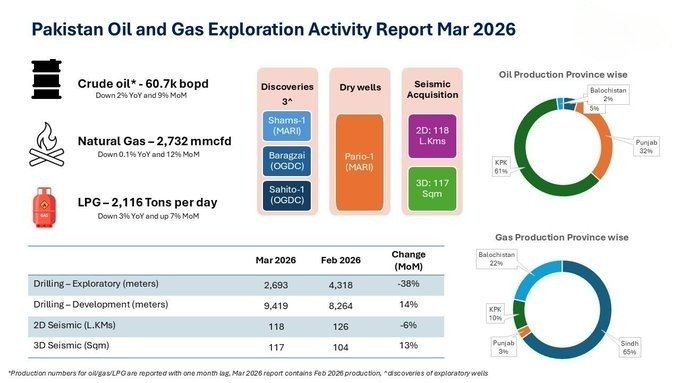
KARACHI: Pakistan has discovered three new fresh sources of oil and gas amid US-Israel war on Iran which has jolted whole world from energy perspective. Read More: https://theboardroompk.com/global-oil-prices-rise-as-iran-tensions-shake-markets-after-ceasefire-dispute/ Topline Securities has issued its latest Oil and Gas Exploration Alert, summarising activity across Pakistan for March 2026. The report points to three new hydrocarbon discoveries while noting a decline in overall production. Industry players are watching closely as the sector balances fresh finds with operational challenges. Three Successful Discoveries Spark Optimism The month saw three notable hydrocarbon discoveries. Mari Petroleum Company (MARI) struck success at Shams-1, while Oil & Gas Development Company (OGDC) announced finds at Baragzai X-1 and Sahito-1. These additions are expected to support future reserves and strengthen local energy supply. In contrast, one dry well was reported — Pario-1 in the Sujawal block, fully operated by MARI. Despite the setback, the discovery count remains positive for the sector.Production Declines but Recovery Signals Emerge Crude oil production stood at 60.7k barrels per day, down 9% month-on-month and 2% year-on-year. Natural gas output fell to 2,732 million cubic feet per day, registering a 12% MoM decline and a marginal 0.1% YoY drop. LPG production was recorded at 2,116 tons per day, up 7% MoM but down 3% YoY. Weekly trends, however, suggest flows may rebound soon due to recent disruptions in RLNG supply. Province-wise, Khyber Pakhtunkhwa led oil output at 61%, followed by Punjab at 32%. For gas, Sindh dominated with 65%, while Balochistan contributed 22%.Analysts believe the discoveries and expected production recovery could ease pressure on imports and support the country’s energy needs in the coming months.

PIA fleet to expand to 60 aircraft, says Arif Habib
Business

PIA fleet to expand to 60 aircraft, says Arif Habib

Karachi: Chairman of the Arif Habib Consortium, Arif Habib, announced plans to expand Pakistan International Airlines’ fleet to 60 aircraft, while confirming that only 18 planes are currently operational. Read More: https://theboardroompk.com/pakistan-steals-global-spotlight-with-us-iran-ceasefire-push-leaving-indians-stunned/ He shared these remarks during an address at the Korangi Association of Trade and Industry (KATI), where prominent industrialists and business leaders attended the session. Fleet recovery and expansion planArif Habib stated that PIA currently owns 30 aircraft, of which 5 to 6 require maintenance and repairs. He added that efforts are underway to restore these planes, which will increase the operational fleet to 26 aircraft in the near term. He emphasized that expanding the fleet to 60 aircraft remains a key long-term target to strengthen the airline’s global standing. Habib also highlighted that representing the business community at the government level is an honor, and he continues to advocate for resolving their issues. Energy costs and economic outlookHe noted that Pakistan’s economy has shown signs of stability, with improved revenues and the government managing to meet expenditures and debt servicing. However, he stressed that reducing the cost of production is essential for sustainable economic growth. Habib pointed out that electricity prices remain high due to capacity charges, despite underutilization of the transmission system. He suggested that fully utilizing over 22,000 megawatts of available capacity could reduce electricity costs by Rs10 to Rs12 per unit. He urged the business community to remain united beyond political affiliations and present a collective voice to the government. Habib also identified IT, agriculture, and mining as key sectors that can drive rapid economic recovery and growth.

BankIslami Takes a Big Step Forward After SBP Green Signal
Business

BankIslami Takes a Big Step Forward After SBP Green Signal

BankIslami Pakistan Limited’s wholly owned subsidiary, BIPL Exchange Company (Private) Limited, has received formal authorization from the State Bank of Pakistan for commencement of business. This BankIslami SBP approval marks a significant milestone for the bank, the company confirmed in a filing to the Pakistan Stock Exchange today. Read More: https://theboardroompk.com/pakistan-steals-global-spotlight-with-us-iran-ceasefire-push-leaving-indians-stunned/ The green light from the central bank allows BIPL Exchange Company to officially begin operations. The authorization strengthens BankIslami’s financial services portfolio under the Islamic banking framework. The subsidiary will now operate as a fully recognized exchange company in Pakistan. According to the filing, the company will comply with all regulations and guidelines set by the State Bank of Pakistan. The subsidiary’s launch enables BankIslami to expand its service offerings and continue its growth within Pakistan’s banking sector. BankIslami emphasized that the approval highlights the bank’s commitment to regulatory compliance and Shariah-compliant financial operations. Stakeholders see this as an important step for the bank’s continued development and service diversification. The commencement of BIPL Exchange Company’s operations reflects BankIslami’s ongoing strategy to strengthen its position in the market. The subsidiary is prepared to deliver regulated financial services to clients, enhancing the bank’s overall portfolio. Industry observers say the approval demonstrates BankIslami’s ability to meet central bank standards and its focus on strategic growth. With the authorization, the bank is positioned to offer new services and expand its reach in Pakistan’s financial sector. This milestone marks a clear step forward for BankIslami, providing a foundation for future developments within the bank’s business operations. The launch of BIPL Exchange Company is expected to benefit both customers and the bank itself by supporting regulated and Shariah-compliant financial solutions.

Pakistan Stock Exchange Rally Lifts Market to Historic Single-Day Gain
Business

Pakistan Stock Exchange Rally Lifts Market to Historic Single-Day Gain

The Pakistan Stock Exchange Rally dominated financial headlines as the benchmark KSE-100 Index recorded one of its largest-ever single-day gains. The market surged amid improving global sentiment, falling oil prices, and expectations of regional stability that triggered aggressive buying across sectors. The index closed at 165,811.00, jumping 14,137.55 points or 9.32 percent. Throughout the session, bullish momentum remained strong with an intraday high of 165,924.13 and a low of 162,956.76, reflecting sustained investor confidence. Pakistan Stock Exchange Rally Supported by Strong Trading Activity Trading volumes expanded significantly during the session, showing widespread participation. Total volume in the benchmark index reached 486.66 million shares. Notably, all 100 companies in the index closed in positive territory, a rare unanimous performance that underlined the strength of the Pakistan Stock Exchange Rally. Leading gainers included KEL, YOUW, AHCL, PIBTL, and FFL, each posting double-digit gains. Even stocks typically considered slow movers ended the day with positive returns, confirming broad-based optimism across the market. Heavyweight companies also played a decisive role in pushing the index higher. Fertilizer, banking, energy, and industrial giants contributed the majority of index points, strengthening the overall rally. Sector-Wise Strength in Pakistan Stock Exchange Rally The Pakistan Stock Exchange Rally was not limited to a few sectors. Commercial banks led the advance, followed by fertilizer companies, oil and gas exploration firms, cement stocks, and investment companies. This broad-based participation highlighted that investor confidence was widespread rather than concentrated. Commercial banks benefited from expectations of economic stability, while fertilizer and energy stocks gained from declining global oil prices and improved outlook for input costs. Cement companies also advanced as investors anticipated increased infrastructure activity. Global Developments Behind the Pakistan Stock Exchange Rally The rally was largely driven by improving geopolitical sentiment. Oil prices fell sharply after Donald Trump postponed a planned military strike on Iran, signaling a possible diplomatic breakthrough. Negotiations between the United States and Iran raised hopes of reopening the Strait of Hormuz, a key global energy route. Lower oil prices are particularly positive for Pakistan, which is an energy-importing economy. Declining fuel costs help reduce inflationary pressure, improve trade balances, and support economic growth expectations. Adding to optimism, Shehbaz Sharif confirmed that Pakistan offered to facilitate dialogue between the two countries by inviting delegations to Islamabad. Investors viewed this diplomatic engagement as a sign of regional stability. Broader Market Performance Strengthens Pakistan Stock Exchange Rally The broader market also reflected strong momentum. The All-Share Index climbed to 98,689.99, gaining 7,903.14 points. Overall market volume surged to more than 1.24 billion shares, while traded value crossed Rs54.40 billion, indicating heightened investor activity. Out of 491 traded companies, 448 advanced, 16 declined, and 27 remained unchanged. Such overwhelming positive breadth reinforced the strength of the Pakistan Stock Exchange Rally. The most actively traded stocks included FNEL, KEL, WTL, CNERGY, TSBL, BOP, PIBTL, PRL, UNITY, and TELE. These companies witnessed heavy volumes as investors sought opportunities across various sectors. Fiscal Year Performance and Market Outlook Despite volatility earlier in the calendar year, the KSE-100 has gained more than 40,000 points or nearly 32 percent during the fiscal year. However, it remains slightly down for the calendar year, indicating room for recovery if positive sentiment continues. Analysts believe sustained geopolitical stability, lower oil prices, and improving macroeconomic indicators could support further upside. Continued foreign inflows and institutional participation may also strengthen the market trend. What the Pakistan Stock Exchange Rally Means for Investors The Pakistan Stock Exchange Rally signals renewed investor confidence driven by global and domestic factors. Falling oil prices, diplomatic progress, and strong sectoral performance have created favorable conditions for equities. If stability persists, market momentum could continue in the coming sessions. Investors are now closely watching developments in global diplomacy, energy markets, and domestic economic indicators to assess whether the rally will sustain.

Gold Rate Jumps Rs15,700 in Pakistan After US-Iran Tensions Ease
Business

Gold Rate Jumps Rs15,700 in Pakistan After US-Iran Tensions Ease

Gold prices jumped sharply on Wednesday, reaching a nearly three-week high after geopolitical tensions eased between the United States and Iran. Markets reacted positively after US President Donald Trump announced a temporary pause in military action, reducing fears of energy-driven inflation. Read More: https://theboardroompk.com/pm-shahbazs-fuel-package-2026-easypaisa-disburses-rs1-2-billion-to-over-32000-transport-operators/ Global Gold Prices Rally Strongly In international markets, spot gold surged by 2.5 percent to $4,819.52 per ounce as of early trading. During the session, bullion climbed more than 3 percent, hitting its highest level since March 19. US gold futures for June delivery also recorded strong gains. Prices rose by 3.4 percent to reach $4,845.30 per ounce. Market analysts linked the rally to improved sentiment following the announcement of a two-week truce. Investors had previously expected further escalation in tensions, which had kept markets volatile. However, the sudden shift toward diplomacy boosted demand for safe-haven assets like gold. Pakistan Gold Prices See Massive Increase Following global trends, gold prices in Pakistan also surged significantly. The price per tola jumped by Rs15,700, reaching Rs504,162. Meanwhile, the price for 10 grams increased by Rs13,460 to Rs432,237. Silver prices also moved higher in the domestic market. The per tola rate rose by Rs440 to Rs8,184. Similarly, the price for 10 grams increased by Rs377 to Rs7,016. Traders said the sharp rise reflects both international price movements and currency factors. Trump’s Decision Eases Market Fears The rally in gold came after Donald Trump confirmed a two-week pause in attacks against Iran. He described the move as part of ongoing diplomatic efforts and said Washington had received a “workable” proposal from Tehran. Earlier, tensions had escalated due to concerns over the Strait of Hormuz. The US had warned Iran to reopen the strategic waterway or face possible retaliation targeting infrastructure. However, the pause in hostilities reduced fears of supply disruptions in global energy markets. As a result, investors reassessed risks and shifted their strategies. Market experts said the unexpected truce triggered a strong reaction. “Investors entered the session expecting escalation, but the truce changed sentiment quickly. That was positive for gold,” said a global market analyst. Islamabad Talks Add to Optimism Diplomatic efforts have gained further momentum, with negotiations expected to begin on April 10 in Islamabad. Iran’s Supreme Security Council confirmed that talks with the United States would take place after a proposal was submitted through Pakistan. The development highlights Pakistan’s growing role in facilitating dialogue between the two countries. However, Iranian officials cautioned that negotiations do not signal an immediate end to the conflict. Inflation Concerns Continue to Influence Markets Despite easing tensions, concerns over inflation remain a key factor driving gold prices. Rising energy costs could still push inflation higher, complicating decisions for central banks worldwide. Gold traditionally serves as a hedge against inflation and economic uncertainty. However, analysts note that higher interest rates can limit gold’s appeal. Since gold does not offer yield, investors may shift toward interest-bearing assets when rates rise. Market Outlook Remains Uncertain Markets are now closely watching upcoming economic data, including minutes from the Federal Reserve’s March meeting. Gold prices have shown strong volatility this year. Despite the current rally, the metal has declined by more than 8 percent since tensions escalated in late February. Experts describe the current surge as a short-term relief rally. They caution that future price movements will depend on whether Iran complies with diplomatic commitments and whether tensions remain contained. Silver and Other Metals Also Gain The rally extended beyond gold to other precious metals. Spot silver jumped by 5.8 percent to $77.16 per ounce. Platinum rose by 4 percent to $2,036.30, while palladium gained 4.6 percent to reach $1,537.75. Analysts say the broader metals market is benefiting from improved investor sentiment and reduced geopolitical risk.

Scroll to Top