Author name: Web Desk

Ericsson Highlights 5G, AI-Led Growth Potential at EU–Pakistan Business Forum 2026!
Tech

Ericsson Highlights 5G, AI-Led Growth Potential at EU–Pakistan Business Forum 2026!

Islamabad, May 01: Ericsson has underscored the transformative role of advanced connectivity, artificial intelligence (AI), and 5G in accelerating Pakistan’s digital economy at the inaugural EU–Pakistan Business Forum 2026. Read More: The two-day forum, held in Islamabad, brought together senior government officials, global technology leaders, investors, and industry stakeholders to explore avenues for investment, innovation, and deeper economic cooperation between Pakistan and the European Union. Participating in high-level roundtable discussions and keynote sessions, Ericsson highlighted how next-generation networks and AI-driven infrastructure can unlock productivity gains across key sectors, including logistics, energy, mobility, and financial services—areas critical to Pakistan’s long-term economic growth. The discussions reinforced that connectivity is no longer a supporting utility but a core economic enabler, directly impacting competitiveness, private sector expansion, and digital inclusion. Ericsson Pakistan’s Country President, Aamir Ahsan, speaking alongside the Federal Minister for IT and Telecom, emphasized the importance of strong public–private partnerships in driving digital transformation at scale. He noted that enabling policies, spectrum readiness, and investment-friendly frameworks will be essential to fully realize the potential of 5G and AI in Pakistan. At its exhibition booth, Ericsson showcased its latest innovations and technology capabilities, demonstrating how differentiated, high-performance networks are enabling new business models, enhancing operational efficiency, and supporting emerging use cases across industries. The company’s engagement at the forum comes at a time when Pakistan is increasingly prioritizing digital infrastructure as a key pillar of economic development. Industry experts note that accelerated adoption of advanced connectivity solutions could significantly enhance productivity, improve service delivery, and attract foreign investment into the country’s growing digital ecosystem. With a long-standing presence in Pakistan, Ericsson continues to collaborate with local telecom operators, enterprises, and public sector stakeholders to develop secure, scalable, and future-ready networks—positioning connectivity as a catalyst for innovation, economic resilience, and inclusive growth.

Petrol Prices in Pakistan Raised Again, Adding Pressure on Consumers
Breaking News, Pakistan

Petrol Prices in Pakistan Raised Again, Adding Pressure on Consumers

Pakistan has once again increased petrol prices, with the latest adjustment pushing rates higher by Rs7 per litre, adding further strain on already burdened consumers. The revision comes as part of the government’s routine fuel price review, influenced by fluctuations in global oil markets. According to official notification, the new prices have been implemented immediately and will remain in effect for the next fortnight. Authorities cited rising international oil prices and import costs as key reasons behind the increase. The hike is expected to have a ripple effect across the economy, particularly on transportation and logistics costs. As fuel prices rise, the cost of goods and services typically follows, contributing to inflationary pressures. Petrol, widely used in private transport and small vehicles, directly impacts household budgets, while increases in diesel—commonly used in heavy transport and agriculture—can drive up food and commodity prices nationwide. With Pakistan heavily reliant on imported fuel, global market volatility continues to play a decisive role in domestic pricing. Analysts warn that if international oil prices remain elevated, consumers may face further increases in the coming months.

India’s Aviation Sector Near Crisis as Iran War Fuels Record Jet Fuel Costs
World

India’s Aviation Sector Near Crisis as Iran War Fuels Record Jet Fuel Costs

India’s aviation industry is facing severe financial strain, with major airlines warning they may be forced to suspend operations as soaring jet fuel prices—driven by the ongoing Iran conflict—push costs to unsustainable levels. Leading carriers including IndiGo, Air India, and SpiceJet, represented by the Federation of Indian Airlines, have urged the government to intervene by capping aviation fuel prices and temporarily removing excise duties. Airlines argue that current pricing conditions are making operations financially unviable. Fuel expenses—already one of the largest cost components for airlines—have surged dramatically. Previously accounting for around 30–40% of operational costs, jet fuel now makes up as much as 55–60%, creating what industry leaders describe as “non-operatable” conditions. The crisis is largely tied to disruptions in global oil supply following conflict in the Middle East. The closure of the Strait of Hormuz—a critical route for global energy shipments—has significantly driven up fuel prices. As one of the world’s largest oil importers, India has been particularly exposed to these shocks. In addition to rising fuel costs, airlines are also dealing with losses linked to flight disruptions and reduced passenger demand. Industry estimates suggest inbound tourism has dropped by up to 20%, while the sector has incurred losses nearing $2 billion due to the cascading impact of the conflict. Despite managing operational challenges such as airspace closures in the region, airlines say the unprecedented surge in fuel prices now poses the biggest threat to their survival. Without immediate policy support, the sector risks deeper financial distress, potentially disrupting air travel across one of the world’s fastest-growing aviation markets.

PNS Hangor Submarine Commissioned as Pakistan Navy Boosts Maritime Defence
Pakistan

PNS Hangor Submarine Commissioned as Pakistan Navy Boosts Maritime Defence

The PNS Hangor submarine has officially joined the Pakistan Navy fleet, marking a major milestone in the country’s naval modernization efforts. The commissioning ceremony took place in Sanya, where top Pakistani and Chinese officials gathered to witness the induction of the first Hangor-class submarine. Historic Milestone for Pakistan Navy According to Inter-Services Public Relations (ISPR), Asif Ali Zardari attended the ceremony as the chief guest. Chief of Naval Staff Naveed Ashraf was also present alongside senior officials from both Pakistan and China. President Zardari described the commissioning of the PNS Hangor submarine as a historic step toward strengthening Pakistan’s defence capabilities. He reaffirmed that Pakistan remains fully capable of safeguarding its sovereignty, protecting maritime interests, and securing vital economic routes. Advanced Capabilities Naval leadership emphasized that the Hangor-class submarines represent a new generation of advanced maritime technology. The PNS Hangor submarine is equipped with state-of-the-art weapons, modern sensors, and Air Independent Propulsion (AIP) systems. These capabilities allow submarines to remain submerged for longer durations, enhancing stealth and operational effectiveness. As a result, the vessel significantly boosts Pakistan Navy’s ability to respond to emerging regional and global threats. Global Maritime Security Speaking at the event, Admiral Naveed Ashraf highlighted growing challenges in global maritime security. He pointed out that disruptions at critical choke points increasingly threaten international trade and energy supply chains. In this context, the PNS Hangor submarine will play a vital role in maintaining stability across key maritime routes. These include the Arabian Sea and the broader Indian Ocean, both of which are crucial for global commerce. Strengthening Deterrence and Regional Stability The Pakistan Navy believes that the addition of the PNS Hangor submarine will enhance deterrence capabilities. The vessel is expected to secure Sea Lines of Communication (SLOCs), which are essential for trade and energy transportation. Officials stressed that maintaining a stable, rule-based maritime order now requires technologically advanced naval forces. The new submarine fleet is designed to meet these demands while ensuring peace and stability in the region. Legacy of Hangor Lives On The name “Hangor” carries deep historical significance in Pakistan’s naval history. According to ISPR, the original Hangor submarine gained prominence during the Indo-Pakistani War of 1971 when it became the first submarine since World War II to sink a warship. The PNS Hangor submarine is expected to carry forward this legacy, symbolizing strength, resilience, and technological progress. Pakistan-China Defence Partnership The commissioning ceremony also reflects the growing strategic partnership between Pakistan and China. Senior officials from the People’s Liberation Army Navy attended the event, highlighting close defence cooperation between the two countries. This development marks another chapter in the long-standing relationship, particularly in the defence and maritime sectors. National Leadership Applauds Achievement Shehbaz Sharif and Asim Munir congratulated the nation and the Pakistan Navy on this achievement. They described the induction of the PNS Hangor submarine as a proud moment that strengthens Pakistan’s defence posture. Modern Naval Strategy With the addition of the PNS Hangor submarine, Pakistan Navy moves closer to building a modern and technologically advanced fleet. As regional dynamics evolve, such developments will play a crucial role in ensuring maritime security and protecting national interests.

Murad Ali Shah Reviews University Road Work as Karachi BRT Red Line Faces Delay Concerns
Pakistan

Murad Ali Shah Reviews University Road Work as Karachi BRT Red Line Faces Delay Concerns

Sindh Chief Minister Murad Ali Shah conducted an early morning visit to University Road in Karachi on Thursday to inspect ongoing development work, including progress on the much-delayed Karachi Bus Rapid Transit (BRT) project. The visit, which also included the Mayor of Karachi, aimed to assess construction quality and ensure timely completion of key infrastructure schemes across the city. Inspection of Development Work on University Road During the visit, officials from the Frontier Works Organisation (FWO) briefed the chief minister on the pace of construction and current progress. Murad Ali Shah expressed satisfaction with the overall development but stressed the importance of maintaining high-quality standards. He reiterated that improving Karachi’s major road networks remains a top priority for the provincial government. According to him, ongoing efforts are focused on upgrading the city’s infrastructure to meet modern urban requirements. Timely Completion and Quality Assurance The chief minister directed relevant departments to accelerate work on all ongoing development projects and avoid unnecessary delays. He emphasized that public convenience must remain central to all infrastructure planning and execution. Senior officials, including Karachi Commissioner Syed Hassan Naqvi and the Managing Director of the Water Board, also accompanied him during the inspection. BRT Red Line Project Under Scrutiny The Karachi BRT Red Line project, a major public transport initiative, continues to face delays and operational challenges. Earlier, Provincial Minister Sharjeel Memon acknowledged that the project could take a year or more to complete. He noted that while efforts are underway to clear and restore sections of University Road, several technical and logistical issues have slowed progress. Authorities have been directed to complete side roads before Eid to ease traffic pressure in the area. Government Commits to Completing Project Despite Delays Despite setbacks, Sindh government officials have reaffirmed their commitment to completing the Karachi BRT Red Line project. Sharjeel Memon stated that although discussions had previously considered halting the project, the government decided to move forward due to its long-term importance for Karachi’s public transport system. He added that large-scale development work is currently underway across the city, with a focus on addressing long-standing infrastructure challenges. Karachi’s Infrastructure Karachi continues to face significant urban infrastructure issues, including traffic congestion, road damage, and delays in public transport projects. The Karachi BRT Red Line project is seen as a key solution aimed at improving mobility for millions of daily commuters. However, repeated delays have raised public concern about execution timelines and project management efficiency. Push for Urban Improvement Continues The latest inspection reflects ongoing efforts by the provincial government to accelerate development and improve urban infrastructure. Officials say the focus remains on completing critical projects that can ease transportation challenges and support Karachi’s growing population.

SSGC Profit Drop 2026 Shocks Market as Earnings Crash Nearly 80 Percent
Pakistan

SSGC Profit Drop 2026 Shocks Market as Earnings Crash Nearly 80 Percent

The SSGC profit drop 2026 has stunned investors and raised serious questions about the financial stability of Pakistan’s gas distribution sector. Sui Southern Gas Company Limited, listed on the Pakistan Stock Exchange, has reported a dramatic 79.63 percent plunge in profits for the nine months ending March 31, 2026. The company’s profit shrank to just Rs1.53 billion, compared to Rs7.49 billion in the same period last year. This steep decline reflects a combination of falling revenue, rising financial costs, and mounting operational pressures that are reshaping the outlook for the energy giant. Earnings Collapse Highlights Depth of SSGC Profit Drop 2026 The scale of the SSGC profit drop 2026 becomes even clearer when looking at earnings per share. EPS fell sharply to Rs1.73 from Rs8.50, wiping out a significant portion of shareholder value. This is not just a routine dip. It signals a deeper structural issue in profitability, where core operations are no longer generating sustainable returns. Revenue Decline and Weak Gas Sales Add Pressure At the heart of the SSGC profit drop 2026 lies a sharp contraction in revenue. Net revenue fell by over 18 percent to Rs289.66 billion, driven almost entirely by a similar drop in gas sales. In simple terms, the company sold less gas and earned significantly less from its core business. While costs also declined, they did not fall fast enough to protect margins. This imbalance crushed gross profit, which dropped by nearly 72 percent. The company’s earnings foundation has clearly weakened. Rising Costs and Credit Losses Deepen the Crisis While revenue was shrinking, expenses moved in the opposite direction. Administrative and selling costs increased, adding further pressure. More alarming, however, was the surge in expected credit losses. These losses more than doubled, jumping from Rs3.11 billion to Rs7.99 billion. This reflects growing concerns over receivables and payment recoveries. As a result, total operating expenses rose by nearly 49 percent, pushing the company into a massive operating loss before accounting for other income. Other Income Saves the Day but Raises Questions One of the most striking aspects of the SSGC profit drop 2026 is that the company’s profitability was largely rescued by non-core income. Other income surged by over 51 percent to Rs27.36 billion. Without this boost, SSGC would have reported a far deeper loss. This raises a critical concern for investors. Reliance on non-operational income is not sustainable and signals underlying weakness in the core business model. Finance Costs and Taxes Further Erode Profitability The financial burden on SSGC intensified as finance costs jumped by more than 37 percent. Rising borrowing costs are becoming a major drag on profitability. At the same time, taxation nearly tripled, further squeezing already thin margins. Even before taxes, profit had already dropped significantly, highlighting the compounding impact of financial and regulatory pressures. SSGC Profit Drop 2026: What the Numbers Really Say To better understand the situation, here is a simplified breakdown: • Revenue declined by 18 percent due to lower gas sales• Gross profit plunged by 72 percent due to weak margins• Operating expenses surged nearly 49 percent• Credit losses more than doubled, indicating recovery issues• Finance costs rose sharply, increasing debt pressure• Final profit dropped nearly 80 percent These figures collectively paint a picture of a company under severe financial stress. Market Reaction and Broader Implications The SSGC profit drop 2026 comes at a time when Pakistan’s broader stock market is already under pressure. Benchmark indices like the KSE-100 have recently recorded steep declines, reflecting investor uncertainty. For the energy sector, this performance raises serious concerns about sustainability, pricing mechanisms, and operational efficiency. What Lies Ahead for SSGC The road ahead for SSGC will depend on its ability to stabilize revenues, control losses, and reduce reliance on non-core income streams. Key areas to watch include: • Improvement in gas sales volumes• Better recovery of receivables• Reduction in finance costs• Policy support from the government Without structural reforms, the SSGC profit drop 2026 may not be a one-off event but a sign of deeper challenges ahead.

Pakistan Tax System Cyber Breach: Rs. 74.8 Million Fraud Shocks FBR
Pakistan

Pakistan Tax System Cyber Breach: Rs. 74.8 Million Fraud Shocks FBR

The Pakistan Tax System Cyber Breach has sent shockwaves across the country’s financial and regulatory circles, exposing alarming vulnerabilities in the digital backbone of the tax infrastructure. In a startling revelation, the Federal Tax Ombudsman has uncovered a sophisticated cyber intrusion that resulted in fraudulent adjustments of input tax credit worth Rs. 74.8 million. This is not just another financial irregularity. It is a high-stakes digital manipulation that raises serious concerns about the security of Pakistan’s tax ecosystem. How the Pakistan Tax System Cyber Breach Happened According to official findings, unidentified cybercriminals managed to gain unauthorized access to a taxpayer’s IRIS profile by exploiting login credentials. The attackers revised the sales tax return for October 2025, inserting fake supplies worth Rs. 415.6 million. This manipulation effectively erased the taxpayer’s legitimate carry-forward input tax credit, turning a legitimate financial position into a fabricated liability. The IRIS system, managed under the Federal Board of Revenue, is a critical digital platform for tax filings. The breach highlights how even central systems can be exploited if safeguards are weak or compromised. Organized Network Behind the Fraud Pakistan Tax System Cyber Breach Spreads Across Cities Investigations revealed that this was not an isolated incident. Instead, it appears to be part of a well-organized fraud network operating across multiple cities including Karachi, Lahore, Multan, Quetta, and Islamabad. Authorities found that cybercriminals specifically targeted: • Dormant taxpayer accounts• Blacklisted entities• Accounts with large accumulated tax credits These accounts were then used to inject fake transactions, creating a web of fraudulent supply chains that benefited multiple parties. There are also troubling indications that individuals linked to the Pakistan Revenue Automation Limited and possibly internal systems may have facilitated or overlooked suspicious activities. Victim Fights Back: Ombudsman Steps In The affected taxpayer filed a formal complaint with the Federal Tax Ombudsman, demanding: • Removal of fake invoices• Restoration of legitimate tax credit• Legal action against perpetrators The Ombudsman termed the incident as clear maladministration and ordered a full-scale investigation by the Directorate General of Intelligence and Investigation (Inland Revenue). Authorities are now leveraging digital forensic tools such as IP tracking to identify those involved, both within and outside official institutions. What Authorities Are Doing Now Pakistan Tax System Cyber Breach Triggers Nationwide Probe In response to the Pakistan Tax System Cyber Breach, tax authorities across the country have been placed on high alert. Regional offices have been directed to collaborate in tracing the fraudulent supply chains and ensuring coordinated enforcement. The Federal Board of Revenue has also been instructed to submit a compliance report within 60 days. This report will detail: • Progress of the investigation• Identified suspects and legal actions• Preventive measures for future System Overhaul: Can Pakistan Prevent the Next Breach The breach has exposed critical weaknesses in the IRIS system, prompting urgent reforms. The IRS Business Process Reengineering team is now working on major upgrades, including: • Stronger controls on login credential changes• Biometric verification for sensitive actions• Enhanced supervisory monitoring These measures aim to rebuild trust in the digital tax system and prevent similar incidents. Why This Pakistan Tax System Cyber Breach Matters This incident is more than a financial scam. It is a wake-up call for Pakistan’s digital governance. The ability of cybercriminals to manipulate official tax records raises fundamental questions about data security, internal accountability, and institutional oversight. If left unaddressed, such vulnerabilities could undermine investor confidence, disrupt revenue collection, and damage the credibility of the entire tax framework. The Pakistan Tax System Cyber Breach underscores the urgent need for robust cybersecurity measures in government systems. As investigations unfold, the focus must remain not only on punishing the culprits but also on strengthening the system against future attacks. The coming weeks will be critical in determining whether Pakistan can turn this crisis into an opportunity for reform or risk facing even larger digital threats ahead.

Karachi businessmen delegation departs for Bangladesh, Sri Lanka to enhance bilateral trade relations
Uncategorized

Karachi businessmen delegation departs for Bangladesh, Sri Lanka to enhance bilateral trade relations

KARACHI: A high-level trade delegation of the Karachi Chamber of Commerce & Industry (KCCI), led by Senior Vice President KCCI, Muhammad Raza, departed on Thursday for a week-long official visit to Bangladesh and Sri Lanka, aimed at strengthening bilateral trade ties and exploring new avenues of economic cooperation. Read More: https://theboardroompk.com/dubai-islamic-bank-pakistan-limited-dibpl-closes-usd-financing-for-acquisition-of-attock-cement-pakistan-limited/ The delegation comprises a diverse group of prominent exporters, manufacturers, traders, and entrepreneurs representing key sectors including textiles, agro-commodities, food products, building materials, industrial supplies, and value-added goods. During the visit, the KCCI delegation will hold a series of Business-to-Business (B2B) meetings with leading chambers of commerce, trade bodies, and business communities in Bangladesh and Sri Lanka. Meetings with government authorities, policymakers, and relevant stakeholders are also scheduled to discuss trade facilitation, market access, and opportunities for joint ventures and investment. Speaking prior to departure, Senior Vice President KCCI, Muhammad Raza, stated that the visit reflects KCCI’s continued efforts to promote Pakistan’s exports and strengthen economic linkages with regional economies. He emphasized that both Bangladesh and Sri Lanka offer significant potential for expanding trade, particularly in sectors such as textiles, agriculture, food processing, construction materials, and industrial inputs. He further noted that the delegation will actively engage with counterparts to explore mutually beneficial collaborations, identify new markets for Pakistani products, and address issues hindering trade growth.The visit also aims to enhance institutional cooperation between KCCI and counterpart organizations, paving the way for sustained business-to-business engagement and long-term economic partnerships.KCCI remains committed to facilitating the business community by providing international exposure, promoting trade diplomacy, and creating meaningful opportunities for growth in global markets.

Dubai Islamic Bank Pakistan Limited (DIBPL) Closes USD Financing for Acquisition of Attock Cement Pakistan Limited
Business

Dubai Islamic Bank Pakistan Limited (DIBPL) Closes USD Financing for Acquisition of Attock Cement Pakistan Limited

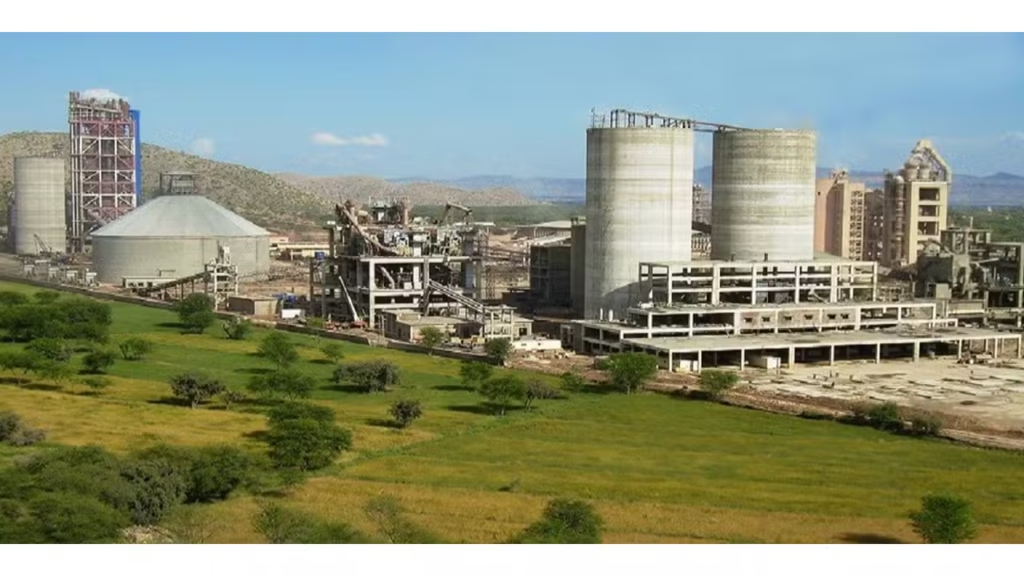
Karachi, Pakistan – Dubai Islamic Bank Pakistan Limited (DIBPL) is pleased to announce the successful closure of USD 76M financing in relation to the acquisition of a majority stake of 84.06% in Attock Cement Pakistan Limited by a consortium comprising Fauji Cement Company Limited and Kot Addu Power Company Limited. Read More: https://theboardroompk.com/wafi-energy-reports-148-surge-in-profit-after-tax-to-pkr-2-16-billion-in-q1-2026/ The transaction represents a significant development in Pakistan’s mergers and acquisitions landscape. DIB acted as Largest Financier, Lead Advisor, and Shariah Advisor, playing a central role in structuring and arranging the financing, as well as delivering an innovative Shariah-compliant solution with Mohsin Tayebaly & Co as transaction legal counsel. “We are pleased to have supported this strategic acquisition through a comprehensive financing and advisory solution,” said Muhammad Ali Gulfaraz, President, DIBPL. “This transaction reflects our continued focus on enabling complex, high-impact transactions and delivering value to our clients.” “This milestone underscores the strength of DIB’s global platform – combining financing, advisory, and Shariah structuring capabilities,” said Khadija Wajahat, Head of Investment Banking, DIBPL. “We remain committed to supporting strategic transactions that contribute to sustainable economic growth.” By leveraging its capabilities as a leading international bank in Pakistan, Dubai Islamic Bank is unlocking unique solutions for the largest conglomerates in Pakistan. We also take this opportunity to celebrate our strong partnership with the management teams of the acquirors and their sponsors that enabled seamless coordination in executing a transaction of this complexity and scale. This landmark transaction marks the transition of a strategic industrial asset from foreign to local ownership, supporting long-term value creation and contributing positively to the domestic economy.

Wafi Energy Reports 148% Surge in Profit After Tax to PKR 2.16 Billion in Q1 2026
Uncategorized

Wafi Energy Reports 148% Surge in Profit After Tax to PKR 2.16 Billion in Q1 2026

Karachi: The Board of Directors of Wafi Energy Pakistan Limited (WEPL) today announced the company’s financial results for the quarter ended March 31, 2026. The company reported a profit after tax of PKR 2,164 million, compared with PKR 873 million in the same period last year, a growth of 148%. The performance reflects steady operations and continued investment through a period of considerable global energy market volatility. The quarter also brought external recognition across two distinct areas of the company’s work. Wafi Energy won the Circular Economy Award at the 15th International CSR Awards for its eco-friendly Shell fuel station in Rawalpindi, which is constructed using recycled plastic. The company received an HR Metrics DEI Survey 2026 award to recognize leading representation of women at the managerial level. Wafi Energy continued to expand its retail footprint, adding 18 new Shell retail sites, 6 new Shell Select convenience stores and upgrading 6 Shell stations. During the quarter, growth in the Lubricants business was broad-based, with expansion in the OEM and mining segment, growth in process oils and continued strength in fleet channels. The company signed a partnership with Indus Motor Company (IMC), marking entry into the Toyota aftermarket lubricants segment in Pakistan. These developments reflect Wafi Energy’s ongoing commitment to strengthening its footprint and delivering improved consumer experience. Commenting on the performance, Zubair Shaikh, Chief Executive Officer, said “This has been a quarter shaped by external volatility and geopolitical challenges. Our focus has been to preserve energy security, keep supply steady, expand the network, and continue investing in areas that matter for Pakistan’s needs. The result this quarter reflects our approach, and we intend to operate with the same discipline – supplying the country reliably, strengthening the business, and delivering long-term value for our shareholders.” Looking ahead, Wafi Energy Pakistan Limited remains focused on operational excellence, strategic growth, and generating shareholder value.

Scroll to Top