
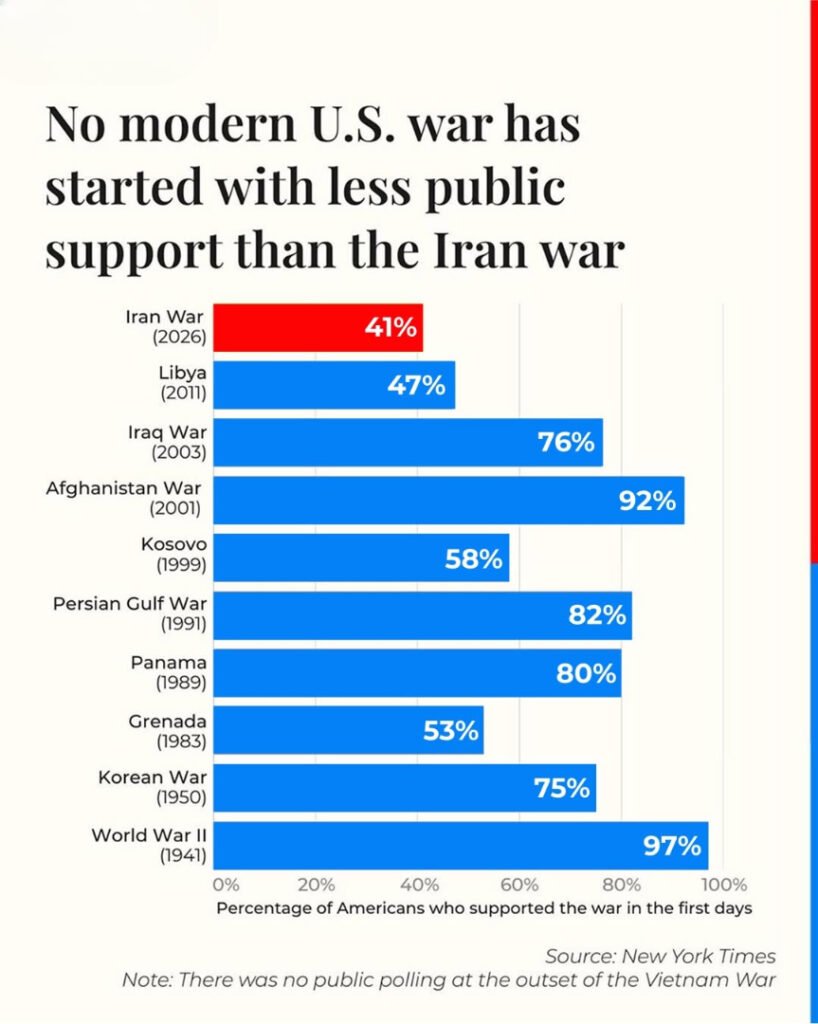
US Iran Attacks Public Opinion has taken an unexpected turn, with early polling showing significantly lower public backing compared to previous American military interventions. In the days following military strikes ordered by Donald Trump, surveys indicate that Americans are far more divided than they were at the start of earlier conflicts.
This trend is unusual in U.S. history, where public opinion traditionally rallies strongly behind presidents during the early phase of military action. The muted response highlights growing political polarization and changing public attitudes toward foreign conflicts.
Polls Reveal Divided US Iran Attacks Public Opinion
Initial surveys show wide variation in public support. Some polls report approval as low as 27 percent, while others suggest support nearing 50 percent. Even at the higher end, backing for the strikes remains considerably lower than the early days of major wars such as World War II, the Korean War, and the Iraq War.
Historical comparisons show dramatic contrasts. After the Attack on Pearl Harbor, nearly 97 percent of Americans supported entering World War II. Similarly, following troop deployment in Afghanistan by George W. Bush, about 92 percent backed the decision. Even the controversial Iraq War initially saw approval levels around 76 percent.
The current US Iran Attacks Public Opinion reflects a far more fragmented public response.
Why Support Is Lower Than Previous Conflicts
Experts argue that one major factor is communication. Previous administrations often spent months building a narrative before engaging in military action. This helped shape public understanding and support.
In contrast, analysts suggest that the Iran strikes were not preceded by a lengthy public persuasion campaign. Without sustained messaging, many citizens remain uncertain about objectives, risks, and long-term consequences.
Another important factor is political polarization. Over the past three decades, American politics has become increasingly divided. This shift has weakened what researchers call the “rally around the flag” effect a phenomenon where citizens typically unite behind the president during international crises.
Political Divisions Shape US Iran Attacks Public Opinion
Political loyalties now play a much stronger role in shaping reactions. Supporters of the sitting president may approve of the action, while opposition voters are less likely to rally behind it. This reduces the chances of a unified national response.
Moreover, some voters who supported Trump did so because they believed he would avoid foreign wars. This perception creates tension between campaign expectations and military actions, further influencing public sentiment.
Historical Pattern: Support Often Drops Over Time
Public support for wars usually declines as conflicts drag on. During the Vietnam War, early backing eroded as casualties increased and costs became more visible. By the late 1960s, a majority of Americans viewed the war as a mistake.
The Iraq War followed a similar trajectory. While initial support was high, approval fell sharply within months. By the end of the conflict, less than half of Americans still backed the decision.
The current US Iran Attacks Public Opinion starts from a lower baseline, meaning any prolonged escalation could reduce support even further.
Global Implications for Pakistan and the Region
For countries like Pakistan, U.S. public opinion matters. Domestic support in America often determines the scale and duration of military involvement abroad. Lower backing could signal limited long-term engagement or cautious policy decisions.
This uncertainty affects global markets, oil prices, and geopolitical stability all issues closely watched in Pakistan’s economic and political circles.
A New Era of Public Response to War
The era of near-unanimous support for military action appears to be fading. Political polarization, rapid news cycles, and skepticism about foreign interventions are reshaping how citizens react.
US Iran Attacks Public Opinion demonstrates that modern conflicts no longer guarantee immediate unity. Instead, public backing now depends heavily on political alignment, communication strategy, and perceived national interest.