Urban Inflation Pakistan

Pakistan Inflation Falls to 9.2% in July 2026 as CPI Returns to Single Digits
Editor pick

Pakistan Inflation Falls to 9.2% in July 2026 as CPI Returns to Single Digits

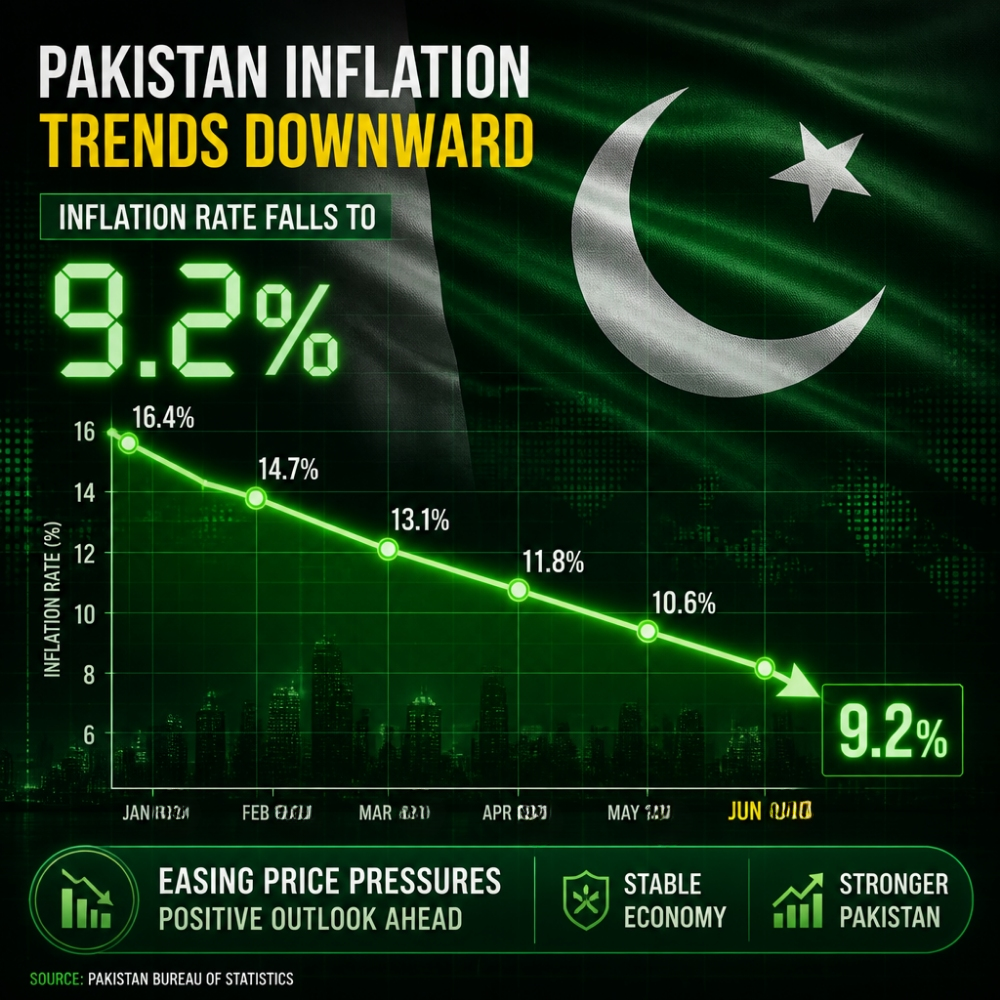
Pakistan’s headline inflation returned to single digits in July 2026, with the Consumer Price Index (CPI) easing to 9.2% year-on-year, according to data released by the Pakistan Bureau of Statistics (PBS). The latest reading marks a significant decline from 11.1% in June, although it remains higher than the 4.1% recorded in July 2025. The slowdown broadly matched market expectations and the Finance Division’s forecast, reflecting favourable base effects despite continued pressure from energy and food prices. Pakistan Inflation Returns to Single Digits The July inflation reading confirms that Pakistan’s CPI has fallen below the double-digit mark after three consecutive months of elevated inflation. On a month-on-month basis, the Consumer Price Index increased 1.2% in July. This followed a 0.3% decline in June and compared with a 2.9% monthly increase in July last year. The Finance Division had earlier projected inflation to remain between 9% and 10% during July, citing rising international oil prices and domestic pricing adjustments. Urban and Rural Inflation Both Decline Inflation moderated across both urban and rural areas during July. Urban CPI inflation stood at 8.7% year-on-year, down from 11.2% in June, though still above the 4.4% recorded in July 2025. On a monthly basis, urban prices rose 1.2%, reversing the 0.5% decline recorded in the previous month. Meanwhile, rural inflation eased to 9.9% year-on-year, compared with 10.9% in June and 3.5% a year earlier. Rural prices also increased 1.2% month-on-month, after remaining unchanged in June. SBP Maintains Policy Rate at 11.5% The latest inflation figures come shortly after the State Bank of Pakistan (SBP) decided to keep its policy rate unchanged at 11.5% during its first Monetary Policy Committee meeting of the new fiscal year. SBP Governor Jameel Ahmad had earlier indicated that inflation was expected to ease during July and projected it would gradually move toward the upper end of the central bank’s 5% to 7% target range by the end of the fiscal year. The central bank continues to balance inflation risks against the need to support economic growth amid global uncertainty. Analysts Say Base Effects Drove the Decline Economists had widely expected inflation to return to single digits. Ismail Iqbal Securities projected 9.3%, while JS Global forecast 9.1% for July inflation. Analysts noted that the decline was driven primarily by favourable base effects rather than a broad-based easing in underlying inflationary pressures. They cautioned that higher energy prices, fuel costs and food inflation continue to pose risks to the inflation outlook over the coming months. Inflation Outlook Remains Uncertain While the return to single-digit inflation offers some relief for households and businesses, underlying price pressures have not disappeared. Persistent increases in energy costs, global commodity prices and food inflation continue to influence Pakistan’s economic outlook. Rising international oil prices could also place renewed pressure on domestic inflation if geopolitical tensions persist. The July data nevertheless represents an important milestone, suggesting inflationary momentum has slowed after several months of elevated readings. Whether this trend continues will largely depend on global energy markets, domestic policy decisions and the pace of economic recovery during the remainder of the fiscal year.

Pakistan Inflation Rises to 11.1% in June 2026 Despite Monthly Decline
Pakistan

Pakistan Inflation Rises to 11.1% in June 2026 Despite Monthly Decline

Pakistan’s headline inflation stood at 11.1% year-on-year (YoY) in June 2026, according to the latest data released by the Pakistan Bureau of Statistics (PBS) on Wednesday. Although inflation remained in double digits, it eased slightly from 11.7% recorded in May 2026, while remaining significantly higher than the 3.2% recorded in June 2025. The latest figures indicate that inflationary pressures persisted during the final month of the fiscal year despite a modest monthly decline in consumer prices. Consumer Prices Fall 0.3% on Monthly Basis According to the PBS, the Consumer Price Index (CPI) declined by 0.3% month-on-month (MoM) in June 2026. This follows a 0.5% increase in May 2026 and a 0.2% rise in June 2025. The monthly decline suggests that while annual inflation remains elevated due to higher prices compared to last year, consumer prices experienced a slight easing during June. Annual Inflation Averages 7.05% in FY2025-26 For the fiscal year 2025-26, average inflation reached 7.05%, compared with 4.49% during the previous fiscal year. The increase reflects sustained price pressures across various sectors throughout the year, despite periods of relative stability in some commodity prices. Urban and Rural Inflation Remain Above 10% Urban inflation continued to outpace rural inflation during June. According to PBS data, urban CPI inflation increased by 11.2% year-on-year, down from 11.8% in May 2026, but considerably higher than 3.0% recorded in June 2025. On a monthly basis, urban inflation declined by 0.5%, compared with a 0.7% increase in May and a 0.1% increase in June last year. Meanwhile, rural CPI inflation stood at 10.9% year-on-year, easing from 11.5% in May 2026 but remaining substantially above the 3.6% recorded in June 2025. On a monthly basis, rural inflation remained unchanged during June after increasing 0.3% in May. In comparison, rural prices had risen 0.5% during June 2025. Government Expects Inflationary Pressures to Ease In its latest monthly economic outlook, the Ministry of Finance said easing geopolitical tensions in the Middle East have improved global market sentiment. The ministry noted that international crude oil prices have retreated from recent highs, reducing imported inflationary pressures and potentially lowering domestic fuel and transportation costs. It projected inflation to remain within the 11% to 12% range for June 2026, broadly in line with the latest PBS figures. The ministry also said lower global oil prices are expected to support Pakistan’s external sector by reducing the country’s oil import bill. SBP Keeps Policy Rate Unchanged Last month, the State Bank of Pakistan (SBP) decided to keep its benchmark policy rate unchanged at 11.5% following a meeting of the Monetary Policy Committee (MPC). The central bank assessed that inflation is likely to remain in double digits over the coming months before gradually easing as domestic and external economic conditions improve. The latest inflation reading will remain a key indicator for policymakers as they assess future monetary policy decisions and monitor the impact of global commodity prices on Pakistan’s economy.

Pakistan Inflation February 2026: CPI Climbs to 7% Is Price Stability Slipping Again?
Pakistan

Pakistan Inflation February 2026: CPI Climbs to 7% Is Price Stability Slipping Again?

Pakistan Inflation February 2026 has taken center stage in economic discussions after the country’s headline Consumer Price Index (CPI) accelerated to 7% year-on-year (YoY), according to data released by the Pakistan Bureau of Statistics. This marks a noticeable jump from 5.8% in January 2026, and a sharp contrast to the 1.5% recorded in February 2025. More significantly, it is the highest annual inflation reading since October 2024, when inflation stood at 7.2%. The fresh data signals that price pressures are once again broadening across the economy raising important questions for policymakers, businesses, and households alike. Pakistan Inflation February 2026: Monthly Trend Shows Gradual Build-Up On a month-on-month (MoM) basis, inflation increased by 0.27% in February 2026. While the monthly rise appears modest, it reflects steady underlying pressure compared to the deflationary trends witnessed in the same period last year. Cumulatively, during the first eight months of fiscal year FY26 (8MFY26), the average CPI inflation stands at 5.46%, slightly lower than 5.96% recorded in the corresponding period last year. This suggests that although February showed acceleration, the broader fiscal-year trend remains relatively controlled for now. Urban vs Rural: Pakistan Inflation February 2026 Broadens Across Regions A closer look reveals that inflation is not confined to a single segment of the economy. Urban Inflation Urban CPI inflation climbed to 6.8% YoY in February, up from 5.8% in January and significantly higher than 1.8% in February 2025. On a monthly basis, urban prices rose 0.3%, building on January’s 0.2% increase. This indicates a gradual but consistent upward trend in city-based consumer prices, affecting salaried households and urban businesses alike. Rural Inflation Rural inflation accelerated even faster, reaching 7.3% YoY, compared to 5.8% in January and just 1.1% a year ago. Monthly rural prices increased by 0.3%, slightly easing from January’s 0.6% rise but reversing the 1.1% decline seen in February 2025. The higher rural reading suggests widening price pressures in agriculture-linked and semi-urban markets, potentially impacting lower-income populations more severely. Sensitive Price Index (SPI): Early Warning Signals The Sensitive Price Index which tracks essential commodities rose 4.8% YoY in February, up from 3.3% in January and a contraction of 0.2% last year. Interestingly, on a monthly basis, SPI edged down by 0.1%, showing some short-term relief compared to the sharper declines seen previously. This mixed trend suggests volatility in essential goods prices rather than a sustained easing. Wholesale Price Index: Supply-Side Pressures Return Wholesale price pressures also strengthened. The Wholesale Price Index (WPI) rose 1.0% YoY in February, up from 0.2% in January and reversing the 0.7% contraction recorded in February 2025. Rising wholesale prices often signal upstream cost pressures that can eventually pass through to consumers. If sustained, this could further fuel Pakistan Inflation February 2026 in the coming months. Core Inflation: Contained but Watchful Core inflation excluding food and energy remained relatively stable: • Urban non-food non-energy inflation eased slightly to 7.1% YoY, down from 7.2% in January and below 7.8% a year ago.• Rural core inflation held steady at 8.3% YoY, significantly lower than 10.4% in February 2025. The 20% weighted trimmed mean often used to measure underlying price trends showed a modest uptick. Urban trimmed mean inflation rose to 5.1% YoY, while rural trimmed mean increased to 5.6% YoY. These readings indicate that while headline inflation has accelerated, deep-rooted inflationary pressures remain moderate though not insignificant. What Pakistan Inflation February 2026 Means for the Economy The February data paints a picture of broadening inflationary pressures: • Headline CPI has reached a 16-month high.• Both urban and rural inflation are accelerating.• Wholesale prices are firming.• Core measures remain contained but ticking upward. For policymakers, this presents a delicate balancing act between maintaining growth momentum and preventing inflation expectations from rising again. For businesses, higher input costs may squeeze margins. For consumers, purchasing power could face renewed strain. If February’s trend continues, Pakistan Inflation February 2026 may mark the beginning of a new upward cycle or it may simply be a temporary spike driven by base effects and seasonal factors. The coming months will determine whether this is a warning sign or just a statistical ripple in Pakistan’s ongoing journey toward economic stabilization.

Scroll to Top