
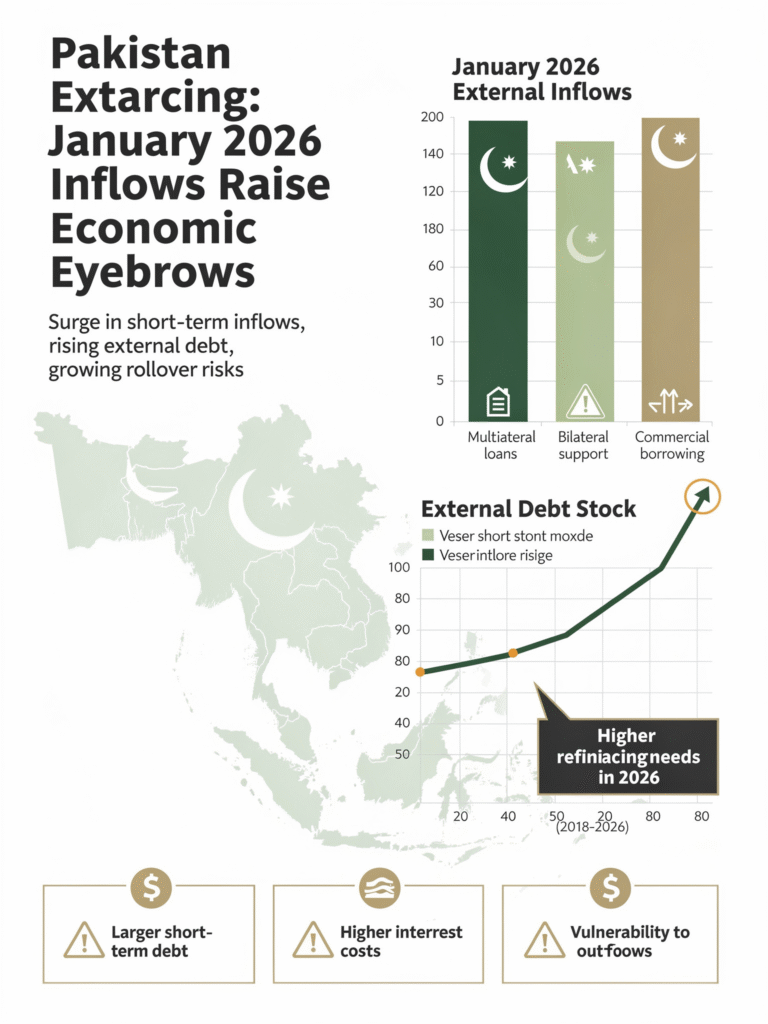
Pakistan External Financing once again took center stage as the country secured $625 million from multiple international sources in January 2026 a sharp 58% decline compared to the previous month. The latest data released by the Economic Affairs Division highlights both progress and persistent challenges in managing external liquidity.
Read More: https://theboardroompk.com/7294-2/
At a time when economic stability remains closely tied to global financing support, the evolving pattern of foreign inflows has sparked debate among policymakers, investors, and analysts alike.
Pakistan External Financing in 7MFY26: A Slow Momentum
During the first seven months of fiscal year 2026, Pakistan External Financing reached $5.17 billion, significantly below the government’s ambitious budgetary projections. While the inflows provided some breathing room by strengthening foreign exchange reserves, the pace has not been enough to fully meet financing needs.
Funding from multilateral and bilateral development partners totaled $237.4 million in January, bringing cumulative disbursements for July–January to $3.06 billion. This highlights the country’s continued reliance on external partners for development and macroeconomic support.
Multilateral Partners Driving Pakistan External Financing
Multilateral institutions remained vital contributors to Pakistan External Financing during the period.
The Asian Development Bank retained its position as the largest multilateral donor, disbursing $56.5 million in January and reaching $624.6 million cumulatively. Its financing has focused on infrastructure development and regional connectivity projects.
Similarly, the International Development Association extended $28.7 million in January, with cumulative support exceeding $608 million, particularly for transformative projects such as hydropower and agricultural reforms.
Meanwhile, the International Bank for Reconstruction and Development contributed $30.6 million during the month, reflecting continued engagement in urban development and power sector reforms.
Another emerging contributor, the Asian Infrastructure Investment Bank, disbursed $13.8 million, signaling growing diversification in Pakistan’s external funding mix.
Bilateral Support Strengthens Pakistan External Financing
Among bilateral partners, Saudi Arabia led January inflows with $100 million, bringing its cumulative support to $708.7 million the highest among bilateral donors.
China continued its role as a strategic financing partner through guaranteed loan facilities totaling $13.8 million in January. Meanwhile, Japan and Germany maintained smaller but steady contributions toward social and infrastructure projects.
These partnerships underline Pakistan’s diplomatic and economic balancing act as it seeks diversified financing channels.
Commercial Borrowing and Market Instruments
Beyond traditional donors, Pakistan External Financing also relied on commercial mechanisms.
The government raised $286.3 million through the Naya Pakistan Certificate scheme, split between conventional and Islamic facilities. Additionally, borrowing from foreign commercial institutions such as Standard Chartered Bank totaled $88.1 million in January.
However, inflows from the International Monetary Fund remained unchanged at $209.5 million cumulatively, as no fresh tranche was released during the month.
Project vs Non-Project Financing: A Growing Dependence
A notable trend in Pakistan External Financing was the dominance of non-project aid, which reached $477.4 million in January, including substantial budgetary support. This reflects the country’s reliance on programme-based loans for macroeconomic stabilisation rather than purely development-focused funding.
Project financing, though smaller at $148.3 million, continues to play a crucial role in supporting provincial initiatives across Punjab, Sindh, and Khyber Pakhtunkhwa spanning water management, education, health, and urban infrastructure.
The Road Ahead for Pakistan External Financing
As Pakistan External Financing trends reveal a mixed outlook, policymakers face the challenge of boosting inflows while reducing reliance on short-term stabilisation support. Strengthening export competitiveness, improving investor confidence, and accelerating development project execution may determine how effectively the country navigates its external financing landscape in the coming months.
With global financial conditions tightening and domestic reforms ongoing, January’s numbers may well be a signal not just of funding gaps, but of the urgent need for a more sustainable financing strategy.