
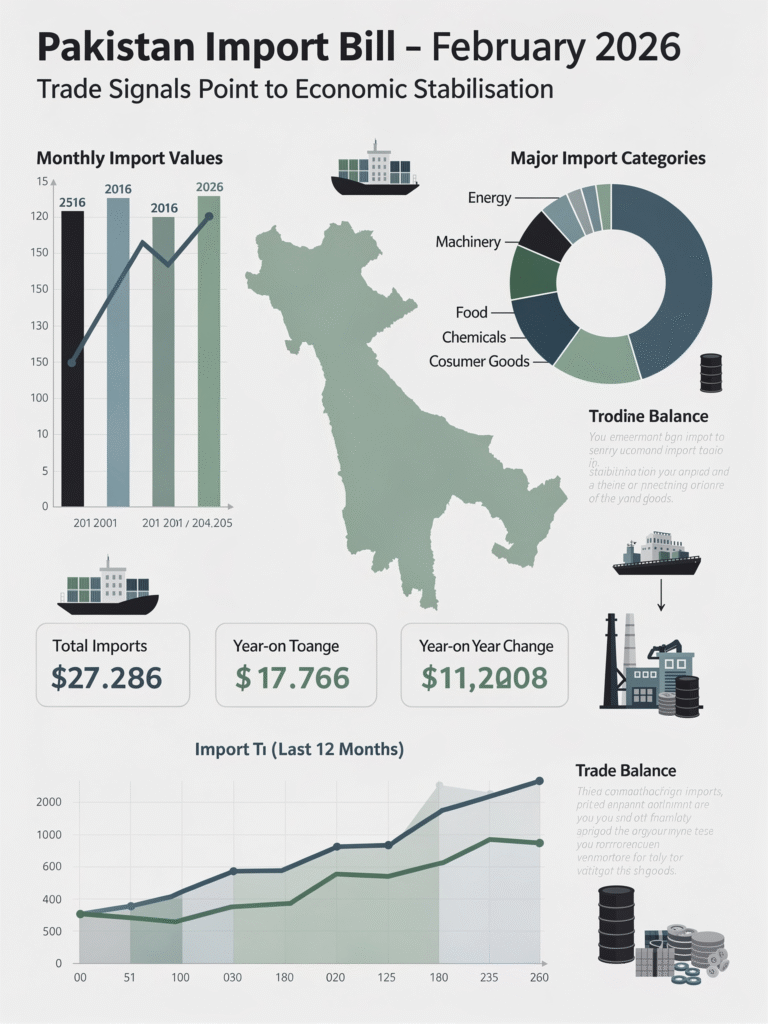
Pakistan Import Bill February 2026 has emerged as a closely watched indicator of the country’s evolving economic trajectory. The latest trade data highlights a period of stabilisation in external accounts, even as sector-specific trends reveal shifting consumption patterns, industrial priorities, and investment sentiment.
With policymakers, businesses, and investors tracking every movement in import volumes, February’s figures offer compelling clues about the direction of Pakistan’s recovery story.
Pakistan Import Bill February 2026 Reflects External Sector Stability
Pakistan’s total import bill for February 2026 stood at $5.32 billion (Rs1.49 trillion), showing only a marginal 0.41% year-on-year decline. More notably, imports fell 8.39% month-on-month from January’s $5.80 billion, pointing towards a cooling trend in overall trade demand.
This moderation suggests improved balance-of-payments management and tighter procurement strategies across key sectors. Analysts interpret this as a sign that the external account is gradually stabilising after periods of volatility.
Petroleum Imports Decline but Refinery Activity Holds Firm
One of the most significant developments in the Pakistan Import Bill February 2026 was the sharp drop in the Petroleum Group, which declined 21.25% year-on-year to $982.9 million.
Refined petroleum imports fell dramatically by nearly 40%, reflecting subdued domestic demand and possible efficiency gains in energy consumption. Liquefied natural gas purchases also contracted by over 25%, indicating more disciplined scheduling and inventory management.
Interestingly, crude oil imports edged up on a monthly basis, signalling that refineries maintained operational throughput despite the broader contraction in energy imports.
Food Imports Surge as Consumer Demand Remains Resilient
In contrast, the Food Group emerged as a standout performer, rising 13.58% year-on-year to $908.1 million.
Tea imports recorded a strong jump of more than 33%, while palm oil Pakistan’s most critical edible oil import grew moderately, underlining steady household consumption patterns. Soyabean oil imports rebounded sharply month-on-month, though they remain significantly below last year’s levels.
Meanwhile, reduced imports of pulses and dairy-related products hint at either shifting dietary preferences or improved domestic supply conditions.
Machinery Imports Signal Mixed Industrial Activity ⚙️
Machinery imports totalled $870.8 million, reflecting modest annual growth but a monthly slowdown. Telecommunications equipment continued to drive demand, with mobile phone imports showing double-digit expansion — a sign of sustained digital adoption across the country.
Agricultural machinery imports surged sharply, suggesting renewed investment in farm mechanisation ahead of upcoming crop cycles. However, lower imports of electrical and power-generating machinery indicate cautious spending in infrastructure and energy projects.
Transport Sector Imports Highlight Growth Optimism
Perhaps the most eye-catching trend in the Pakistan Import Bill February 2026 was the Transport Group’s nearly 49% year-on-year growth.
Completely built vehicle imports rose significantly, while imports of buses, trucks, and heavy vehicles almost tripled. This points to strengthening activity in logistics, construction, and commercial mobility.
Similarly, the sharp rise in CKD/SKD motor car imports suggests that domestic auto assemblers are ramping up production in anticipation of improved consumer demand.
Textile Raw Material Imports Decline Raise Export Concerns
The Textile Group, a backbone of Pakistan’s export economy, recorded a notable contraction. Imports dropped both annually and monthly, with raw cotton purchases plunging by nearly 60% year-on-year.
While partially explained by improved domestic production and softer global prices, industry experts caution that continued declines in raw material imports could eventually constrain export capacity if local supply fails to bridge the gap.
Chemicals, Metals and Healthcare Demand Strengthen Industrial Outlook
Imports in the Agricultural and Chemicals segment grew over 12%, led by a surge in fertiliser imports ahead of the Kharif sowing season. Plastic materials also posted solid growth, aligning with expanding domestic manufacturing activity.
Healthcare demand remained robust, with medicinal product imports rising more than 21%, highlighting ongoing investment in medical supply chains.
Meanwhile, metal imports showed moderate annual growth, supported by continued construction activity and rising aluminium demand.
What Pakistan Import Bill February 2026 Means for the Economy
Overall, the Pakistan Import Bill February 2026 paints a nuanced picture:
• Cooling energy imports signal improved external account management
• Rising food and transport imports reflect steady consumer and commercial demand
• Machinery trends suggest selective industrial investment
• Falling textile raw material imports could pose medium-term export risks
For businesses and investors, these signals underscore a transition phase in Pakistan’s economic cycle one where stability is emerging but structural challenges remain.