Pakistan stock market news

KSE-100 Index Slides 1,303 Points in Volatile Session
Business

KSE-100 Index Slides 1,303 Points in Volatile Session

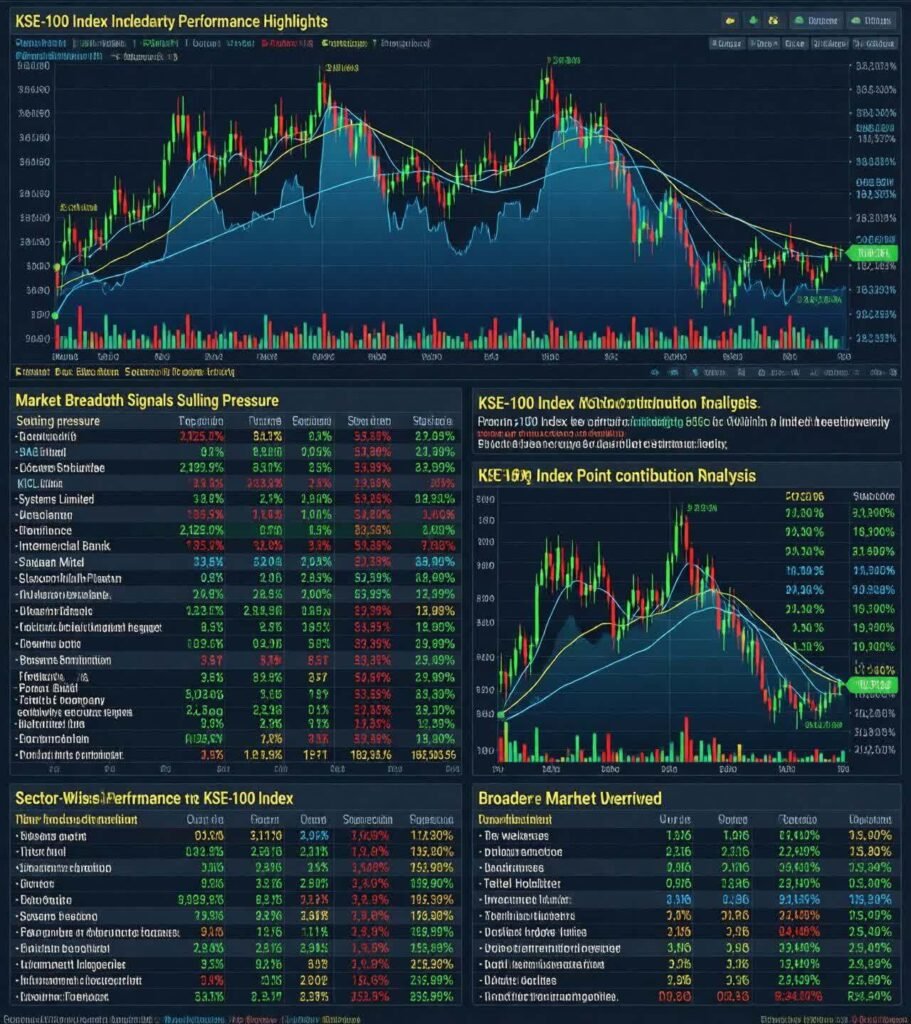
The KSE-100 Index faced sharp selling pressure on Tuesday, closing at 173,150.41 after shedding 1,303.52 points, or 0.75%. The session unfolded like a rollercoaster offering early optimism before giving way to broad-based profit-taking that rattled investor sentiment across the Pakistan Stock Exchange (PSX). But is this just a healthy correction, or the beginning of a deeper pullback? KSE-100 Index Swings Over 4,400 Points The trading day was marked by extraordinary volatility. The KSE-100 Index moved within a massive intraday range of 4,437.96 points. It touched a high of 176,131.35 up 1,677 points at one stage before plunging to a low of 171,693.39, down 2,760 points from the peak. Such wide fluctuations highlight nervous trading behavior as investors balance profit-taking with long-term positioning. Total volume for the index stood at 424.96 million shares, signaling active participation despite the bearish close. Out of 100 index constituents: • 31 stocks closed in the green• 68 stocks ended in the red• 1 stock remained unchanged The market breadth clearly favored the bears. Heavyweights That Dragged the KSE-100 Index Lower The decline was largely driven by major blue-chip stocks. Among the top laggards were: • Pakistan State Oil (PSO), down 6.05%, contributing a hefty 209.89 negative points to the index.• Habib Bank Limited (HBL), which shaved off 174.81 points.• Engro Holdings (ENGROH), reducing the index by 148.90 points.• United Bank Limited (UBL) and• National Bank of Pakistan (NBP) also exerted strong downward pressure. Sector-wise, Commercial Banks emerged as the biggest drag, pulling the index down by over 608 points. Oil & Gas Marketing Companies and Fertilizer stocks further deepened losses. This concentrated selling in heavyweight sectors amplified the market’s downward momentum. Energy Stocks Provide Cushion to the KSE-100 Index Despite the sharp decline, certain sectors provided much-needed support. Oil & Gas Exploration Companies collectively added 286.11 points to the index. Key contributors included: • Oil and Gas Development Company (OGDC), which added 179.09 points.• Pakistan Petroleum Limited (PPL), contributing 87.35 points.• Mari Petroleum Company (MARI) also supported the index. The resilience in exploration stocks suggests investors are selectively accumulating energy plays, possibly anticipating stronger global oil price trends. Broader Market Reflects Cautious Sentiment The broader All-Share Index mirrored the weakness, closing at 104,363.56 down 607.69 points or 0.58%. Market activity showed signs of cooling: • Total volume dropped to 716.04 million shares (from 773.29 million previously).• Traded value declined by Rs5.77 billion to Rs40.47 billion.• A total of 411,431 trades were recorded across 477 companies. Of these: • 128 advanced• 293 declined• 56 remained unchanged The statistics underscore a session dominated by sellers. High-Volume Stocks Signal Retail Activity Among the most actively traded stocks were KEL, BOP, WTL, CNERGY, and PIBTL, indicating strong retail participation despite broader market weakness. Banking and energy stocks continued to attract attention, suggesting investors are positioning strategically rather than exiting entirely. Bigger Picture: Is the KSE-100 Index Rally Still Intact? Zooming out, the KSE-100 Index has gained an impressive 47,523 points, or 37.83%, during the current fiscal year. However, on a calendar-year basis, it remains marginally down by 904 points, or 0.52%. This raises a crucial question: Is Tuesday’s decline a temporary correction within a strong uptrend, or the start of consolidation after a stellar fiscal rally? For now, market fundamentals remain intact, but volatility signals caution. Investors may watch banking and oil sectors closely in upcoming sessions to gauge directional momentum. Conclusion: Correction or Turning Point? The sharp drop in the KSE-100 Index serves as a reminder that markets rarely move in straight lines. While fiscal-year gains remain robust, sector-specific selling pressure particularly in banking and oil marketing suggests investors are recalibrating expectations. With earnings season and macroeconomic signals ahead, the coming sessions could determine whether this dip becomes a buying opportunity or evolves into a broader correction.


Pakistan Stock Exchange Weekly Review: A Calm Surface Hiding Powerful Undercurrents
Business

Pakistan Stock Exchange Weekly Review: A Calm Surface Hiding Powerful Undercurrents

The Pakistan Stock Exchange weekly review for the first week of February 2026 tells a story that goes far beyond a near-unchanged index level. While the KSE-100 Index slipped just 44.91 points to close at 184,129.58, the market was anything but quiet beneath the surface. Investor nerves, macroeconomic signals, and sector-specific moves created a week defined by caution rather than conviction. At first glance, the numbers suggest stability. But a closer look reveals why traders chose patience over aggression. Why the Pakistan Stock Exchange Weekly Review Shows Investor Caution Throughout the week, the PSX remained range-bound as concerns grew over a potential super tax on high-earning corporates. This uncertainty discouraged risk-taking, especially in heavyweight sectors. At the same time, global cues particularly developments surrounding a possible US-India trade deal kept investors on alert. Adding to the cautious mood was a sharp rise in government T-bill yields, which made fixed-income instruments more attractive relative to equities. As a result, trading activity stayed selective, with investors rotating into defensive and high-quality names rather than broad-based buying. Market Capitalization Trends in This Pakistan Stock Exchange Weekly Review In rupee terms, total market capitalization edged down slightly to Rs5.43 trillion, reflecting a marginal weekly erosion of just Rs4.42 billion. This minimal change confirms that the market largely moved sideways rather than undergoing any meaningful correction. In dollar terms, capitalization slipped to $19.43 billion, underscoring how currency stability helped limit valuation swings. With USD-adjusted returns nearly flat, foreign investors saw little incentive to materially increase exposure during the week. Macroeconomic Signals Shaping the Pakistan Stock Exchange Weekly Review Several key economic developments shaped market sentiment. The State Bank of Pakistan (SBP) raised Rs823 billion in its latest Market Treasury Bill auction, with cut-off yields rising across all tenors. Investor preference leaned heavily toward the 12-month paper, highlighting expectations of tighter liquidity conditions. Meanwhile, Pakistan’s trade deficit narrowed sharply by 28.5% month-on-month, supported by record exports exceeding $3 billion and falling imports. While this was an encouraging short-term signal, the cumulative FY26 trade deficit widened year-on-year, reminding investors that structural external pressures remain unresolved. Inflation data added another layer of complexity. CPI inflation ticked up to 5.8%, driven mainly by rural price increases, while wholesale inflation stayed muted. This mixed inflation picture reinforced expectations that monetary policy may remain cautious rather than aggressively accommodative. Sector Performance Highlights in the Pakistan Stock Exchange Weekly Review Sector-wise, the market delivered a classic tug-of-war. Commercial banks emerged as the strongest pillar of support, contributing heavily to index stability amid expectations of sustained profitability in a higher-yield environment. On the flip side, Oil & Gas Exploration, Fertilizer, and Cement sectors dragged the index lower. Weak global energy prices, margin pressures, and tax-related uncertainty weighed heavily on these capital-intensive sectors. Technology, automobiles, and power generation stocks provided selective upside, reflecting investor appetite for growth stories with clearer earnings visibility. Stock Movers That Defined This Pakistan Stock Exchange Weekly Review Among individual stocks, ENGRO Holdings stood out as the single largest positive contributor, signaling continued confidence in diversified conglomerates. Major banks such as UBL and Meezan Bank also attracted strong buying interest, reinforcing the sector’s leadership role. Conversely, Pakistan Petroleum Limited and Fauji Fertilizer Company emerged as major laggards, reflecting broader weakness across energy and fertilizer plays. Heavyweight selling in these names kept the index from breaking higher despite gains elsewhere. Foreign and Local Investor Activity in the Pakistan Stock Exchange Weekly Review Foreign investors turned net sellers, with outflows of $11.44 million, led primarily by foreign corporates. However, this selling pressure was fully absorbed by local institutional investors, particularly mutual funds and companies, which stepped in as net buyers. This balance between foreign caution and local confidence prevented sharper downside moves and kept the PSX in consolidation mode. What This Pakistan Stock Exchange Weekly Review Signals Going Forward The takeaway from this Pakistan Stock Exchange weekly review is clear: the PSX is not lacking direction it is waiting for clarity. With fiscal policy risks, external obligations, and global developments still unfolding, investors appear content to stay selective rather than speculative. For now, stability is the theme. But beneath the calm, powerful macro and policy signals are quietly setting the stage for the market’s next decisive move.

KSE-100 Index Suffers One of Its Sharpest Single-Day Declines
Pakistan

KSE-100 Index Suffers One of Its Sharpest Single-Day Declines

The KSE-100 Index sent shockwaves through Pakistan’s capital markets on Thursday after closing sharply lower at 182,338.12 points, marking a steep decline of 6,042 points or 3.21%. The sudden downturn erased days of gains and reignited debate over whether the market is entering a correction phase or merely pausing after an extended rally. Read More: https://theboardroompk.com/starbucks-attempts-to-use-ai-in-supply-chain-face-persistent-technical-glitches/ Despite beginning the session with mild optimism, selling pressure intensified as the day progressed, dragging the benchmark index to an intraday low that rattled both institutional and retail investors. KSE-100 Index Volatility Signals Rising Investor Anxiety The KSE-100 Index traded within an unusually wide range of nearly 7,000 points, underlining the intensity of market volatility. While the index briefly touched an intraday high of 188,923 points, optimism proved short-lived as aggressive selling pushed it down to 181,961 points by mid-session. Trading volumes remained robust, with over 413 million shares changing hands in the benchmark index alone often a sign that investors are actively repositioning rather than exiting the market entirely. Market Breadth Turns Deeply Negative Out of the 100 companies comprising the KSE-100 Index, only three stocks managed to close in the green, while 96 ended the day in negative territory, highlighting broad-based weakness across sectors. Heavyweight stocks bore the brunt of the sell-off, particularly those with high index weightage, amplifying the downward momentum. KSE-100 Index Dragged Down by Heavyweights A handful of large-cap stocks accounted for a significant portion of the index’s decline. Fertilizer giant FFC alone shaved nearly 1,900 points off the index, while banking and energy stocks followed closely behind. United Bank Limited, Engro Holdings, OGDC, and Hub Power collectively added further pressure, reflecting investor caution toward cyclical and rate-sensitive sectors. On the flip side, gains were marginal and limited to a few low-impact stocks, offering little relief to the broader market. Sector-Wise Breakdown: Where the Damage Was Done The KSE-100 Index downturn was largely sector-driven. Fertilizer stocks emerged as the biggest laggards, followed by commercial banks and oil and gas exploration companies. Cement and investment-related firms also struggled, mirroring concerns over margins, demand sustainability, and near-term earnings visibility. Meanwhile, defensive and low-volume sectors such as paper & packaging and select textile segments offered modest support, though not enough to offset losses elsewhere. Broader Market Mirrors the KSE-100 Index Weakness The sell-off was not limited to the benchmark alone. The All-Share Index closed at 109,608 points, down 2.68%, reflecting widespread selling across the board. Although total market volume dipped slightly compared to the previous session, the traded value surged to Rs66.4 billion, suggesting active institutional participation. Out of nearly 500 traded companies, decliners outnumbered advancers by more than four times an unmistakable signal of bearish sentiment. High-Volume Stocks Reveal Speculative Activity Interestingly, some stocks bucked the broader trend, attracting strong speculative interest. Power, telecom, and select manufacturing stocks dominated volume charts, indicating that short-term traders remain active even amid market uncertainty. However, heavy volumes in declining stocks such as FFC and PTC suggest forced selling and profit-taking at elevated levels. KSE-100 Index Performance: The Bigger Picture Despite the sharp single-day fall, the KSE-100 Index remains one of the strongest-performing markets in the region. The index has gained over 56,700 points during the current fiscal year, translating into a remarkable 45% increase. Even on a calendar-year basis, the market is still up nearly 5%, underscoring the resilience of equities over the longer term. Market analysts believe the current decline may represent a healthy correction rather than a structural reversal provided macroeconomic stability and earnings momentum remain intact. What Comes Next for the KSE-100 Index? With volatility returning to center stage, investors are expected to adopt a cautious stance in the coming sessions. Key triggers to watch include inflation data, monetary policy signals, and corporate earnings guidance. For long-term investors, the pullback may present selective buying opportunities while short-term traders brace for continued swings. One thing is clear: the KSE-100 Index has entered a critical phase where sentiment, not fundamentals alone, will dictate direction.

KSE-100 Index Climbs 3,642 Points as Market Optimism Prevails
Pakistan

KSE-100 Index Climbs 3,642 Points as Market Optimism Prevails

The KSE-100 Index concluded Friday’s trading session at 185,098.83 points, marking a remarkable 2.01% increase (+3,642.50 points). Investors’ confidence remained high throughout the day, with the index hitting an intraday high of 185,208.98 (+3,752.65) and a low of 182,559.69 (+1,103.36) points. Market sentiment was bolstered by the federal government’s decision to maintain current fuel prices for the fortnight starting January 16, 2026. High-Speed Diesel remains at Rs257.08 per litre, while petrol continues at Rs253.17 per litre, providing relief to both businesses and consumers. Global Developments Add to KSE-100 Index Momentum Internationally, fears of a US-Iran confrontation that had previously rattled markets eased as Washington scaled back its military presence in the Middle East. This reduction in geopolitical tension played a significant role in supporting the KSE-100 Index, highlighting the growing sensitivity of local markets to global developments. Trading Overview: Gains, Losers, and Market Volume The total volume traded on the KSE-100 Index reached 381.92 million shares. Out of 100 index companies, 89 closed higher, 11 fell, and none remained unchanged. Top Gainers: • THALL: +10.00%• JVDC: +10.00%• OGDC: +6.75%• PPL: +5.96%• PKGS: +5.57% Top Losers: • MEHT: -3.22%• KAPCO: -1.24%• UPFL: -1.20%• GADT: -1.05%• PIOC: -0.92% Index Contribution Highlights: • OGDC: +457.09 points• PPL: +339.24 points• HUBC: +219.60 points• ENGROH: +187.38 points• FFC: +185.86 points Meanwhile, the companies pulling the index lower included POL (-13.90 pts), PIOC (-13.20 pts), and MEHT (-8.16 pts). Sector-Wise Performance Driving KSE-100 Index Several sectors led the market’s upward momentum: • Oil & Gas Exploration Companies: +886.47 points• Commercial Banks: +800.78 points• Fertilizer: +345.51 points• Power Generation & Distribution: +235.59 points• Investment Banks / Securities Companies: +211.72 points Conversely, the index saw minimal drag from: • Textile Spinning: -1.04 points• Sugar & Allied Industries: -0.61 points This sector-level performance reflects a strong underlying market breadth, indicating broad investor participation rather than concentration in a few high-profile stocks. Broader Market Snapshot The All-Share Index closed at 111,509.34 points, up 2,327.02 points (+2.13%). Market turnover surged to 959.53 million shares, compared to 820.03 million in the previous session. Traded value reached Rs69.46 billion, showing a substantial increase of Rs23.49 billion.There were 451,058 trades across 482 companies, with 334 closing up, 117 closing down, and 31 unchanged. Top Ten Stocks by Volume: KSE-100 Index Shows Strong Year-to-Date Performance The KSE-100 Index has recorded substantial growth over the fiscal year, gaining 59,472 points (+47.34%), while posting a 6.35% increase (+11,045 points) in the current calendar year. This growth highlights resilient market dynamics and investor confidence amid both domestic and global economic factors. Key Takeaways • Fuel price stability continues to boost market sentiment.• Sector-led gains in Oil & Gas, Banks, and Fertilizers drove index performance.• Global geopolitical easing positively impacted investor confidence.• Broader market volumes and traded value surged, reflecting active participation. Investors will likely watch the KSE-100 Index closely in the coming sessions as markets digest domestic policy cues and international developments.

KSE-100 Index Ends Lower Amid Broad-Based Selling Pressure
Pakistan

KSE-100 Index Ends Lower Amid Broad-Based Selling Pressure

The KSE-100 Index extended its corrective phase on Monday, closing sharply lower as heavyweight sectors including commercial banks, oil & gas exploration, cement, and fertilizers came under selling pressure. Investor sentiment remained cautious despite strong year-to-date gains, leading to profit-taking across most index constituents. By the end of the trading session, the KSE-100 Index settled at 182,384.14 points, marking a decline of 2,025.53 points or 1.10% on a day dominated by negative breadth and sector-wide weakness. KSE-100 Index Intraday Performance Highlights The KSE-100 Index experienced heightened volatility throughout the session, moving within a wide intraday range of over 2,100 points. The index briefly touched an intraday high of 184,439.06 points, before selling pressure intensified, dragging it down to a low of 182,303.56 points. Market participation remained active, with 418.83 million shares traded within the benchmark index, indicating sustained investor engagement despite the bearish close. Market Breadth Signals Strong Selling Pressure Out of the 100 companies comprising the KSE-100 Index, market breadth remained decisively negative. Only 18 stocks closed in the green, while 81 stocks ended lower, and one stock remained unchanged, reflecting broad-based selling across sectors. Top Losers and Gainers in the KSE-100 Index Selling pressure was most pronounced in select blue-chip and growth stocks. The worst-performing stocks included insurance, technology, cement, and pharmaceutical names. Meanwhile, selective buying interest emerged in textiles, telecom, and chemicals. Stocks that declined the most were led by AICL, which shed nearly 8%, followed by SAZEW, KOHC, Systems Limited, and GlaxoSmithKline Pakistan. On the positive side, Nishat Mills, Pakistan Telecommunication Company, and Lotte Chemical Pakistan posted strong gains, helping cushion the index from steeper losses. KSE-100 Index Point Contribution Analysis From an index-point perspective, the downward move in the KSE-100 Index was largely driven by heavyweight stocks. Systems Limited, United Bank Limited, Meezan Bank, Engro Holdings, and Fauji Fertilizer Company collectively erased several hundred points from the benchmark. Conversely, support to the index came primarily from PTC, Nishat Mills, Askari Bank, Lotte Chemical, and Millat Tractors, which added modest points but were insufficient to offset broader losses. Sector-Wise Performance of the KSE-100 Index The KSE-100 Index was primarily dragged lower by the commercial banking sector, which contributed the largest negative impact. This was followed by oil & gas exploration, investment companies, cement, and fertilizer sectors, all of which faced notable selling pressure. On the supportive side, textile composite stocks provided limited relief, while marginal gains were recorded in REITs, woollen, sugar & allied industries, and leasing companies, though their overall contribution remained minimal. Broader Market Overview The weakness extended beyond the benchmark, as the All-Share Index closed at 109,499.62 points, down 882.96 points or 0.80%. Total market volume rose to 1.06 billion shares, reflecting increased activity, while traded value declined to Rs48.24 billion, indicating cautious positioning. Across the broader market, 161 stocks advanced, 284 declined, and 36 remained unchanged, reinforcing the bearish undertone. Long-Term Performance Keeps Investor Optimism Alive Despite the short-term correction, the KSE-100 Index has delivered impressive long-term returns. During the current fiscal year, the index has surged by 56,757 points, representing a gain of 45.18%. On a calendar-year basis, it remains up 8,330 points or 4.79%, highlighting the underlying strength of Pakistan’s equity market. Outlook for the KSE-100 Index Market participants are likely to remain selective in the near term, focusing on earnings visibility, interest rate expectations, and macroeconomic signals. While volatility may persist, strong fiscal-year performance suggests that any further dips in the KSE-100 Index could attract value-based buying.

Scroll to Top