KSE-100 index performance

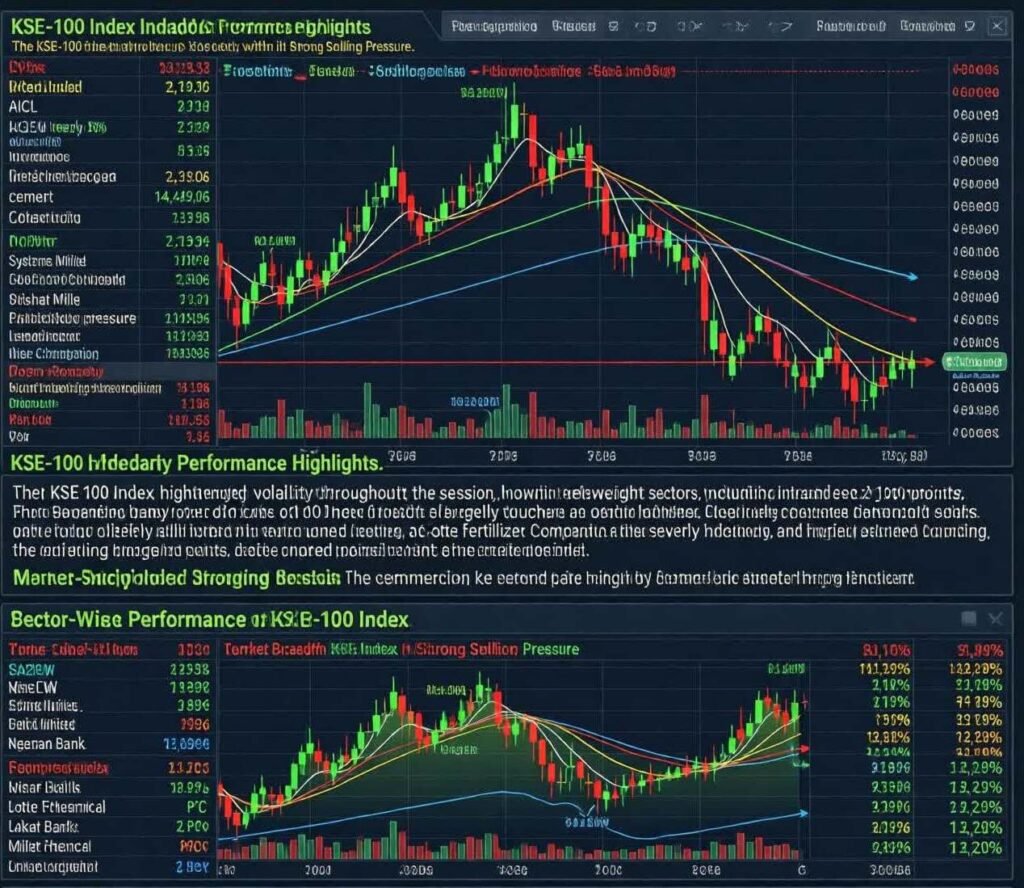
The KSE-100 Index took investors on a rollercoaster ride on Thursday, ultimately closing in the red after an intensely volatile trading session that tested market confidence and nerves alike. Despite touching a fresh intraday high early in the day, selling pressure across heavyweight sectors reversed gains and pulled the benchmark index sharply lower by the close. The KSE-100 Index settled at 181,456.33 points, shedding 1,113.48 points or 0.61%, a move that underscores how fragile sentiment remains even amid strong longer-term gains. KSE-100 Index Volatility Signals Market Unease What made this session particularly eye-catching was the sheer intraday volatility. The KSE-100 Index moved within a massive range of nearly 2,934 points, climbing to a high of 183,717.53 points before tumbling to a low of 180,783.62 points. Such wide swings suggest aggressive profit-taking and uncertainty over short-term direction. Trading volumes within the KSE-100 Index stood at 280.78 million shares, reflecting active participation as investors repositioned portfolios amid mixed cues. Out of the 100 index-listed companies, only 28 managed to close higher, while 71 stocks declined, highlighting the broad-based nature of the sell-off. Top Losers and Gainers in the KSE-100 Index Market weakness was led by sharp declines in select stocks that struggled under selling pressure. IBFL, SAZEW, PGLC, NML, and PSEL emerged as the day’s worst performers, each recording notable percentage losses. On the flip side, pockets of strength still existed. ATLH stole the spotlight with a strong rally, while JVDC, PKGS, PSX, and LOTCHEM also posted respectable gains, offering some relief in an otherwise bearish session. Heavyweights Drag the KSE-100 Index Lower From an index-point perspective, the pressure was unmistakable. Major banking and industrial names bore the brunt of selling. UBL alone erased nearly 172 points, while ENGROH, SYS, MCB, and EFERT collectively shaved hundreds of points off the KSE-100 Index. However, energy stocks played the role of market stabilizers. OGDC and PPL added over 200 points combined, cushioning the fall and preventing an even steeper decline. Select cement and investment-related stocks also provided marginal support. Sector-Wise Performance: Banks Hit Hard The KSE-100 Index was primarily dragged down by the Commercial Banks sector, which accounted for more than 550 negative points. Weakness also spilled over into Technology & Communication, Investment Companies, Cement, and Fertilizer sectors. In contrast, Oil & Gas Exploration Companies stood tall, contributing positively to the index. Additional support came from Property, Paper & Packaging, Auto Parts, and Leather & Tanneries, indicating selective buying interest in defensive and value-driven sectors. Broader Market Mirrors KSE-100 Index Weakness The broader market echoed the benchmark’s tone. The All-Share Index closed at 109,182.32 points, down 492.15 points or 0.45%. Total market volume declined to 820 million shares, while traded value slipped to Rs45.98 billion, reflecting cautious investor behavior. Out of 482 traded companies, only 150 closed higher, while 289 ended lower, reinforcing the dominance of selling pressure. Interestingly, activity remained concentrated in select stocks by volume, with HASCOLNC, MDTL, NCPL, and BOP attracting heavy investor attention suggesting speculative interest remains alive beneath the surface. KSE-100 Index Performance Still Strong Long Term Despite the day’s setback, the bigger picture remains compelling. The KSE-100 Index has surged by 55,829 points, or 44.44%, during the current fiscal year. Even in calendar-year terms, the index is up over 4%, a reminder that long-term momentum remains intact despite short-term turbulence. What This Means for Investors The latest session reinforces one key takeaway: the KSE-100 Index is entering a phase where volatility may persist. While fundamentals remain supportive, short-term corrections and sector rotations are becoming more frequent. For investors, this may be less about panic and more about opportunity especially for those with a long-term horizon.
Pakistan

KSE-100 Index Ends Lower After Wild Swings: What Really Shook the Market?

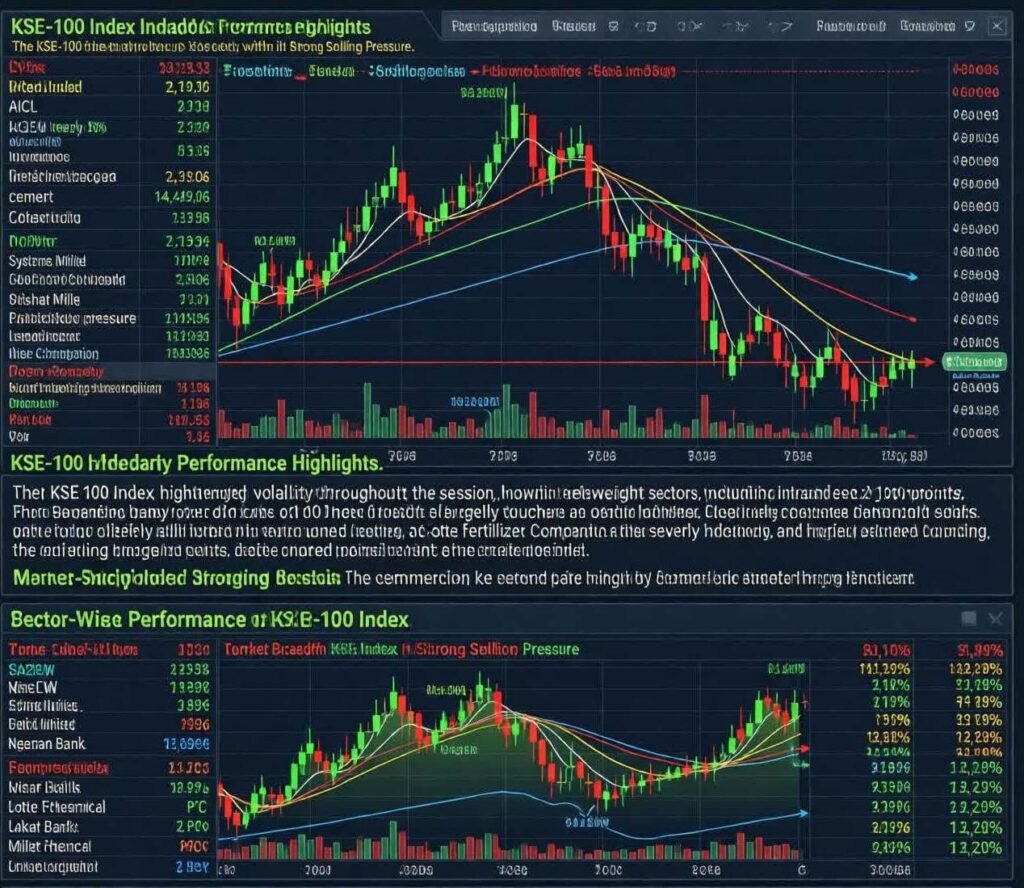
The KSE-100 Index took investors on a rollercoaster ride on Thursday, ultimately closing in the red after an intensely volatile trading session that tested market confidence and nerves alike. Despite touching a fresh intraday high early in the day, selling pressure across heavyweight sectors reversed gains and pulled the benchmark index sharply lower by the close. Read More: https://theboardroompk.com/kse-100-index-performance-declines-amid-broad-based-selling-pressure/ The KSE-100 Index settled at 181,456.33 points, shedding 1,113.48 points or 0.61%, a move that underscores how fragile sentiment remains even amid strong longer-term gains. KSE-100 Index Volatility Signals Market Unease What made this session particularly eye-catching was the sheer intraday volatility. The KSE-100 Index moved within a massive range of nearly 2,934 points, climbing to a high of 183,717.53 points before tumbling to a low of 180,783.62 points. Such wide swings suggest aggressive profit-taking and uncertainty over short-term direction. Trading volumes within the KSE-100 Index stood at 280.78 million shares, reflecting active participation as investors repositioned portfolios amid mixed cues. Out of the 100 index-listed companies, only 28 managed to close higher, while 71 stocks declined, highlighting the broad-based nature of the sell-off. Top Losers and Gainers in the KSE-100 Index Market weakness was led by sharp declines in select stocks that struggled under selling pressure. IBFL, SAZEW, PGLC, NML, and PSEL emerged as the day’s worst performers, each recording notable percentage losses. On the flip side, pockets of strength still existed. ATLH stole the spotlight with a strong rally, while JVDC, PKGS, PSX, and LOTCHEM also posted respectable gains, offering some relief in an otherwise bearish session. Heavyweights Drag the KSE-100 Index Lower From an index-point perspective, the pressure was unmistakable. Major banking and industrial names bore the brunt of selling. UBL alone erased nearly 172 points, while ENGROH, SYS, MCB, and EFERT collectively shaved hundreds of points off the KSE-100 Index. However, energy stocks played the role of market stabilizers. OGDC and PPL added over 200 points combined, cushioning the fall and preventing an even steeper decline. Select cement and investment-related stocks also provided marginal support. Sector-Wise Performance: Banks Hit Hard The KSE-100 Index was primarily dragged down by the Commercial Banks sector, which accounted for more than 550 negative points. Weakness also spilled over into Technology & Communication, Investment Companies, Cement, and Fertilizer sectors. In contrast, Oil & Gas Exploration Companies stood tall, contributing positively to the index. Additional support came from Property, Paper & Packaging, Auto Parts, and Leather & Tanneries, indicating selective buying interest in defensive and value-driven sectors. Broader Market Mirrors KSE-100 Index Weakness The broader market echoed the benchmark’s tone. The All-Share Index closed at 109,182.32 points, down 492.15 points or 0.45%. Total market volume declined to 820 million shares, while traded value slipped to Rs45.98 billion, reflecting cautious investor behavior. Out of 482 traded companies, only 150 closed higher, while 289 ended lower, reinforcing the dominance of selling pressure. Interestingly, activity remained concentrated in select stocks by volume, with HASCOLNC, MDTL, NCPL, and BOP attracting heavy investor attention suggesting speculative interest remains alive beneath the surface. KSE-100 Index Performance Still Strong Long Term Despite the day’s setback, the bigger picture remains compelling. The KSE-100 Index has surged by 55,829 points, or 44.44%, during the current fiscal year. Even in calendar-year terms, the index is up over 4%, a reminder that long-term momentum remains intact despite short-term turbulence. What This Means for Investors The latest session reinforces one key takeaway: the KSE-100 Index is entering a phase where volatility may persist. While fundamentals remain supportive, short-term corrections and sector rotations are becoming more frequent. For investors, this may be less about panic and more about opportunity especially for those with a long-term horizon.

KSE-100 Index Performance Declines Amid Broad-Based Selling Pressure
Pakistan

KSE-100 Index Performance Declines Amid Broad-Based Selling Pressure

KSE-100 Index Performance weakened during Wednesday’s trading session as sustained selling pressure across key sectors pushed the benchmark index lower, despite selective gains in oil and gas exploration stocks. The Pakistan Stock Exchange (PSX) witnessed heightened volatility, reflecting cautious investor sentiment and sector-specific headwinds. Read More: https://theboardroompk.com/pakistan-renewable-energy-transition-gains-momentum-with-solar-and-climate-leadership/ The benchmark KSE-100 Index closed at 182,569.81 points, marking a decline of 1,381.69 points or 0.75% compared to the previous session. The market traded in a wide intraday range, highlighting uncertainty among investors. KSE-100 Index Performance: Intraday Movement and Market Breadth During the session, the index fluctuated within a 2,356-point range, touching an intraday high of 184,726.60 points and a low of 182,369.86 points. This volatility underscores profit-taking after recent rallies and cautious positioning ahead of upcoming economic triggers. In terms of market breadth, selling pressure dominated the session. Out of the 100 index constituents, 81 stocks closed in the red, while 19 managed to end higher, indicating a broadly negative tone across the benchmark. KSE-100 Index Performance Impacted by Heavyweight Stocks The decline in KSE-100 Index Performance was largely driven by losses in major index-heavy stocks. United Bank Limited (UBL), MCB Bank, Fauji Fertilizer Company (FFC), Lucky Cement, and Hub Power Company (HUBC) collectively shaved significant points off the index. In explanatory terms, banking stocks alone pulled the index down by over 576 points, while cement and fertilizer sectors further amplified downside pressure. These heavyweight sectors often dictate short-term market direction due to their large index weightings. Top Gainers and Losers in KSE-100 Index Performance Despite the overall downturn, select stocks posted notable gains. LOTCHEM led gainers, supported by strong buying interest, followed by Atlas Honda-related entities and key oil and gas stocks such as OGDC and PPL. These gains, however, were insufficient to offset losses elsewhere. On the losing side, Pakistan Telecommunication Company Limited (PTC), Ibrahim Fibres, and several mid-cap stocks faced aggressive selling, reflecting sectoral weakness and profit-taking. Sector-Wise Breakdown of KSE-100 Index Performance Sector-wise analysis shows that Commercial Banks, Cement, Fertilizer, Technology & Communication, and Power Generation were the main drags on the index. Investors appeared to rotate out of interest-rate-sensitive sectors amid valuation concerns. Conversely, Oil & Gas Exploration Companies provided meaningful support, contributing nearly 291 points to the index. Chemical, refinery, transport, and cable & electrical goods sectors also closed marginally positive, signaling selective buying interest. Broader Market Snapshot and Trading Activity The broader market mirrored the benchmark’s weakness. The All-Share Index closed at 109,674.47 points, down 729.71 points or 0.66%. Market participation remained healthy, with over one billion shares traded, while total traded value rose to Rs65.96 billion, indicating active positioning despite declining prices. Out of 483 traded companies, only 90 closed higher, while 352 declined, reinforcing the bearish undertone across the broader market. High-volume stocks such as K-Electric, WorldCall Telecom, PIBTL, and PACE dominated turnover, suggesting continued speculative interest in low-priced and momentum-driven stocks. KSE-100 Index Performance: Fiscal and Calendar Year Perspective From a longer-term perspective, KSE-100 Index Performance remains strong. The index has gained 56,942 points or 45.33% during the ongoing fiscal year, reflecting robust investor confidence and improving macroeconomic indicators. On a calendar-year basis, the benchmark is up 8,515 points or 4.89%, indicating that despite short-term volatility, the broader trend remains constructive. Market Outlook Looking ahead, market participants are likely to remain selective, focusing on fundamentally strong sectors such as energy and export-oriented industries. Short-term volatility may persist, but sustained earnings growth and macroeconomic stability could support KSE-100 Index Performance in the medium term.

KSE-100 Index Performance Strengthens as Market Ends Higher
Pakistan

KSE-100 Index Performance Strengthens as Market Ends Higher

KSE-100 Index performance remained firmly positive on Wednesday as Pakistan’s benchmark stock index closed with strong gains, reflecting growing investor confidence, sector-led buying, and sustained trading volumes at the Pakistan Stock Exchange (PSX). The KSE-100 Index ended the trading session at 186,518.71 points, registering a net increase of 1,456.61 points or 0.79 percent. The upbeat close highlights continued bullish sentiment driven by key sectors including power generation, oil and gas exploration, cement, and banking stocks. KSE-100 Index Performance: Intraday Movement and Market Breadth During the session, the KSE-100 Index performance showed notable volatility, trading within a wide range of 2,118 points. The index touched an intraday high of 187,015.11 points, gaining nearly 1,953 points, while the day’s low stood at 184,896.70 points, reflecting temporary profit-taking early in the session. Market breadth remained positive, with 72 out of 100 index companies closing higher, while 28 stocks ended in the red, reinforcing the overall bullish tone. Total trading volume for the KSE-100 stocks reached 569.86 million shares, indicating active participation from both institutional and retail investors. Top Gainers and Losers Driving KSE-100 Index Performance Several stocks posted strong percentage gains, providing momentum to the index. The top gainers included: • YOUW, which surged over 8 percent• AICL, gaining nearly 8 percent• PTC, advancing more than 6 percent• SAZEW and HALEON, both delivering solid upside moves On the downside, selective pressure was observed in stocks such as PSEL, FABL, HMB, JVDC, and UBL, though losses remained contained and did not derail the broader market trend. Index Contributors: Stocks Powering the KSE-100 Index Performance From a points contribution perspective, HUBC emerged as the single largest contributor, adding nearly 296 points to the index. Other heavyweight stocks supporting the rally included PPL, ENGROH, MCB, and MEBL, reflecting renewed interest in energy, industrial, and banking sectors. Conversely, index drag was led by UBL and FFC, which collectively erased over 400 points, followed by losses in PSEL, FABL, and HMB. Sector-Wise Impact on KSE-100 Index Performance Sectoral performance played a decisive role in shaping the day’s gains. The Power Generation & Distribution sector provided the largest boost, contributing nearly 300 points. This was followed by strong support from Oil & Gas Exploration, Cement, Investment Companies, and Technology & Communication sectors. However, some sectors faced selling pressure. Fertilizer stocks weighed on the index, while modest declines were also recorded in miscellaneous, property, chemical, and transport sectors. Broader Market Performance Mirrors KSE-100 Index Strength The positive momentum extended to the broader market, where the All-Share Index closed at 111,118.65 points, up 877 points or 0.80 percent. Overall market activity improved, with total traded volume rising to 1.33 billion shares, while traded value increased to Rs86.59 billion, reflecting enhanced liquidity. More than 606,000 trades were executed across 485 companies, with 298 stocks closing higher, confirming widespread participation. High-volume stocks included KEL, HASCOLNC, BOP, TELE, PTC, and TRG, signaling continued interest in energy, telecom, and financial counters. KSE-100 Index Performance: Year-to-Date and Fiscal Outlook From a longer-term perspective, the KSE-100 Index performance remains exceptionally strong. During the ongoing fiscal year, the index has gained over 60,800 points, marking an impressive 48 percent increase. On a calendar-year basis, the index is up more than 7 percent, underlining sustained momentum despite global and domestic economic challenges. Conclusion: KSE-100 Index Performance Reflects Market Resilience The latest trading session reinforces the resilience of Pakistan’s equity market. With improving volumes, sectoral leadership, and strong fiscal-year gains, KSE-100 Index performance continues to attract investor attention. If macroeconomic stability and corporate earnings momentum persist, the market may maintain its upward trajectory in the near term.

KSE-100 Index Performance Jumps as Banking and Cement Stocks Lead Strong Market Rally
Pakistan

KSE-100 Index Performance Jumps as Banking and Cement Stocks Lead Strong Market Rally

KSE-100 Index performance delivered an impressive showing during Tuesday’s trading session as bullish momentum returned to the Pakistan Stock Exchange (PSX). The benchmark index closed at 185,062.10 points, registering a robust gain of 2,653.87 points or 1.45%, reflecting renewed investor confidence and strong institutional participation. The index experienced heightened volatility throughout the session, trading within a wide intraday range of 4,299 points. It touched an intraday high of 185,481.45 points, while the low stood at 181,182.07 points, indicating aggressive buying on dips. Market Breadth and Trading Activity Highlight KSE-100 Index Performance Market participation remained healthy as 596.93 million shares were traded within the KSE-100 constituents. Out of 100 index companies, 56 closed in positive territory, 42 declined, while 2 remained unchanged, underscoring a broadly positive market sentiment. The broader market mirrored this strength, with the All-Share Index closing at 110,241.43, up 1,270.50 points or 1.17%. Overall market volume stood at 1.306 billion shares, while traded value rose to Rs85.32 billion, marking an increase of Rs7.23 billion compared to the previous session. Top Gainers and Losers Shaping KSE-100 Index Performance Investor interest was particularly strong in select blue-chip and growth stocks. Key Advancers Stocks that recorded notable percentage gains included:• ATRL leading with an 8.25% rise• MCB Bank climbing 7.90%• AIRLINK advancing 6.62%• NATF up 6.35%• AICL gaining 5.95% Key Decliners Meanwhile, selling pressure was observed in:• PSEL, down 5.52%• SSOM, falling 2.89%• MEHT, losing 2.59%• UNITY, declining 2.55%• BOP, down 2.00% Index Movers: Stocks Driving KSE-100 Index Performance In terms of point-wise contribution, commercial banks dominated the rally. MCB alone added over 450 points to the index, followed closely by UBL, MEBL, HBL, and LUCK, collectively contributing more than 1,800 index points. On the downside, PSEL, PPL, EFERT, OGDC, and MARI weighed on the index, though their combined drag remained limited relative to gains from heavyweight banking and cement stocks. Sector-Wise Breakdown of KSE-100 Index Performance Sectors Supporting the Rally The market’s upward trajectory was largely fueled by:• Commercial Banks, contributing nearly 1,908 points• Cement sector, adding 348 points• Investment banks and securities companies• Refinery sector• Technology and communication stocks Sectors Under Pressure Conversely, the index faced resistance from:• Oil & Gas Exploration Companies• Fertilizer sector• Miscellaneous sector• Oil Marketing Companies• Property-related stocks High-Volume Stocks Reflect Active Market Participation Trading activity remained concentrated in select stocks, with KEL, BOP, PIBTL, TELE, and CSIL leading volumes. Notably, MDTLNC stood out with a double-digit price jump of over 17%, highlighting speculative interest in mid-cap counters. Year-to-Date and Fiscal Performance Outlook From a longer-term perspective, KSE-100 Index performance remains exceptionally strong. The benchmark has gained 59,435 points, or 47.31%, during the ongoing fiscal year, while calendar year gains stand at 11,008 points or 6.32% so far. This sustained uptrend reflects improving macroeconomic expectations, easing inflationary pressures, and optimism surrounding monetary and structural reforms. Positive Momentum Keeps Investors Engaged The latest surge in KSE-100 Index performance reinforces the bullish narrative at the PSX, with banking and cement stocks once again acting as market leaders. While sector rotation and selective profit-taking persist, strong volumes and improving breadth suggest that investor appetite remains intact, keeping the outlook cautiously optimistic for the sessions ahead.

Scroll to Top